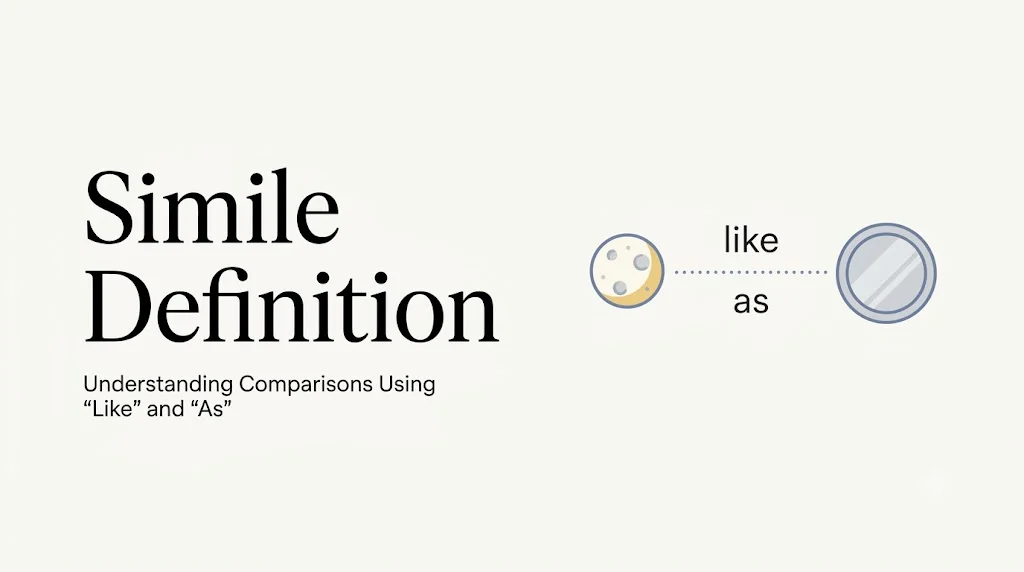
Quick Answer
A simile is a figure of speech that compares two unlike things using the connecting words “like” or “as.” Similes help writers create vivid mental pictures, make abstract ideas concrete, and bring emotion and personality to language.Example: “She was as brave as a lion.”
Language is one of humanity’s most powerful tools, and within language, figures of speech are what separate flat, forgettable writing from vivid, resonant prose. Among all the literary devices available to writers, the simile is one of the most accessible, most used, and most misunderstood.
You have used similes your entire life, often without knowing it. When you told a friend “this coffee is as strong as rocket fuel” or described a nervous person as “shaking like a leaf,” you were using similes naturally. These comparisons work because they instantly connect a new idea to something the listener already knows, making meaning land faster and feel more real.
This guide explores the complete simile definition, its structure, its many types, practical examples across different writing styles, and everything you need to start using similes with confidence and precision.
What Is a Simile? Full Definition
A simile (pronounced SIM-ih-lee) is a figure of speech that makes a direct comparison between two different things by using the words “like” or “as.” The purpose of this comparison is to highlight a shared quality between the two subjects, making one easier to understand through the lens of the other.
Formal Definition
A simile is a rhetorical figure of speech in which one subject is explicitly compared to another subject of a different kind, using “like,” “as,” “as…as,” or “as if” to draw attention to a quality they share. Unlike a metaphor, a simile signals that the comparison is figurative rather than literal.
The word “different” is crucial. You are not comparing two similar things you are illuminating one thing by comparing it to something from a completely different category. Comparing a person’s kindness to sunlight, or someone’s voice to thunder, or a city to a beehive these are all similes because they bring together unlike things to sharpen understanding.
The Simplest Way to Understand a Simile
If you can replace the comparison word with “literally is” and the sentence still makes sense, it is not a simile it is just a factual statement. A simile always makes a figurative comparison, one that is understood not to be literally true, but rather to convey a feeling, quality, or impression.
“His temper was like a volcano unpredictable and explosive.”
His temper is not literally a volcano. But comparing it to one immediately communicates the dangerous, sudden, and overwhelming nature of his anger. That is exactly what similes do.
Origin and Etymology of the Word “Simile”
The word simile comes from the Latin word similis, meaning “like” or “similar.” This root is also the source of English words such as similar, simulate, and simultaneous all of which carry the sense of resemblance or closeness.
The use of simile as a literary device dates back thousands of years. Ancient poets and philosophers used elaborate comparisons to describe nature, gods, battle, and human emotion. The device was so common in classical epic poetry that the “Homeric simile” a long, extended comparison spanning several lines became a recognized form in its own right, named after the ancient Greek poet Homer.
Similes in Classical Literature
In Homer’s Iliad, warriors are frequently compared to natural forces storms, fire, and wild animals to convey their power and ferocity to an audience that may never have witnessed large-scale battle. This tradition of using nature-based comparisons to describe human experience has continued unbroken for nearly three millennia.
The Structure of a Simile
Every simile has three essential components working together to create meaning.
| Component | Role | Example |
|---|---|---|
| Tenor | The subject being described | Her voice |
| Vehicle | The thing it is compared to | honey |
| Connective word | The linking word that signals comparison | like / as |
Putting those together: “Her voice was like honey” the tenor (voice) is compared to the vehicle (honey) using the connective word (like).
Common Connective Words in Similes
While “like” and “as” are the most common, similes can also use the following connecting expressions:
- as…as “as cold as ice”
- as if “she walked as if she owned the world”
- as though “he stared as though he had seen a ghost”
- similar to used in more formal or academic writing
- resembles “the pattern resembles a spider’s web”
The connective word is the signal that keeps a simile honest it tells the reader: ‘this is a comparison, not a fact.’ That small word carries enormous weight.
Types of Similes
Not all similes are alike. They vary in length, complexity, formality, and the type of quality they highlight. Understanding these types allows writers to choose the right simile for the right moment.
1. Simple Similes
The most common form. A short, direct comparison using “like” or “as.” These are easy to understand, highly memorable, and work in almost any writing context.
Examples
“As quiet as a mouse.” | “Like two peas in a pod.” | “As sharp as a tack.”
2. Extended Similes (Homeric or Epic Similes)
A longer, more elaborate comparison that develops the comparison over several lines or sentences. Originally common in epic poetry, these similes draw readers deep into an image before returning to the main subject. They are best used for moments of great significance or emotional weight.
Example
Like a river that begins as a trickle high in the mountains, collecting streams and rainfall as it descends, growing wider and more powerful until it reaches the sea so too did her ambition grow from quiet childhood dreams into a force that changed everything around it.
3. Negative Similes
These comparisons define something by what it is not like, often creating irony, humor, or a deliberately understated effect.
Example
“Life is not like a box of chocolates it is more like a jar of jalapeños: what you do today might burn you tomorrow.”
4. Implied Similes
The connecting word is absent, but the comparison is still clearly figurative and comparative in nature. These blur the line between simile and metaphor and are popular in modern poetry and literary fiction.
Example
“She moved through the party, a ghost among the living.”
5. Mixed or Compound Similes
Two or more comparisons combined in a single sentence, usually to build a richer or more surprising picture.
Example
“His laugh was like gravel and like music at the same time rough on the surface but pleasant underneath.”
Simple
Short, direct, easy to grasp.
“As bold as brass.”
Epic / Extended
Long, developed, poetic in scope.
Multi-line nature comparison.
Negative
Defines by contrast and exclusion.
“Not like the rest…”
Implied
No “like” or “as” but clearly comparative.
“A wolf in the boardroom.”
Simile Examples in Writing
The best way to understand what a simile is and how it works is to see it across different writing contexts.
Similes for Emotions and Feelings
Kindness
“Her kindness was as warm as morning sunlight on a cold January day.”
Grief
“Sadness settled over him like fog over a harbor slowly, until nothing was visible.”
Joy
“The news hit her like sunshine breaking through storm clouds.”
Similes for People and Characters
Bravery
“He stood as firm as an ancient oak against the pressure of the crowd.”
Gentleness
“She handled the situation as gently as falling snow.”
Unpredictability
“His moods shifted like weather in spring calm one moment, stormy the next.”
Similes for Nature and Setting
Setting the scene
“The desert stretched out like a tattered blanket thrown across the earth.”
Night sky
“Stars scattered across the sky like salt spilled on dark velvet.”
Similes in Everyday Speech
Many similes have become so familiar that people use them automatically in daily conversation:
- “As busy as a bee”
- “Like a fish out of water”
- “As cool as a cucumber”
- “Like a broken record”
- “As clear as day”
Simile vs. Metaphor: Key Differences
Similes and metaphors are closely related both compare unlike things to illuminate meaning but they work differently and create different effects.
| Feature | Simile | Metaphor |
|---|---|---|
| Connecting word | Uses “like” or “as” | No connecting word |
| Comparison type | Explicit (clearly signals figurative) | Implicit (states it directly) |
| Tone | Gentle, descriptive, gentle pace | Direct, bold, immediate impact |
| Example | “Life is like a journey.” | “Life is a journey.” |
| Best used for | Descriptive detail, imagery, characterization | Strong assertions, emotional punch |
Which One Should You Use?
There is no universal rule. Similes tend to feel gentler and more illustrative they invite the reader to picture the comparison without fully committing to it. Metaphors are more direct and often hit harder. A grief counselor might say “grief is like a wave” to gently normalize an experience; a poet might say “grief is the wave that capsized everything” for stark emotional power.
Quick Rule of Thumb
If your sentence uses “like” or “as” to make a comparison, it is a simile. If the comparison is stated directly as a fact (“X is Y”), it is a metaphor. Both are figures of speech. Neither is better they serve different rhetorical purposes.
Similes in Literature and Famous Writing
Great writers across centuries have relied on similes to make their work memorable. Studying how they use comparisons can sharpen your own instincts.
Similes in Poetry
Poetry depends heavily on compressed, vivid language. Similes give poets a way to layer meaning into just a few words. A poem comparing love to a red rose, or loneliness to an echo in an empty room, uses simile to make abstract emotional states physically tangible.
Similes in Novels and Fiction
Character descriptions become more vivid and memorable through simile. Describing a character’s eyes as “like two chips of grey ice” tells us far more about their coldness, distance, and danger than simply saying they had grey eyes. The comparison creates an emotional reaction in the reader, not just a visual image.
Similes in Speeches and Rhetoric
Speakers and politicians use similes to make complex ideas accessible and to create emotional resonance. Comparing a nation’s spirit to a flame that can be dimmed but never extinguished, or describing the search for justice as “like planting seeds that will only bloom for those who come after us,” makes abstract political concepts feel human and urgent.
Similes in Song Lyrics
Popular music is filled with similes because they make lines easier to remember and more emotionally immediate. Comparing heartbreak to a physical wound, or freedom to a wide-open sky, transforms personal feeling into universal experience that listeners can immediately recognize and share.
Similes in Everyday Language
One of the most remarkable things about similes is how naturally they appear in ordinary conversation. You do not have to be a literary scholar or a professional writer to use them in fact, most people use several similes every day without realizing it.
Idioms That Are Similes
Many common English idioms are actually similes that have become so familiar they feel like fixed expressions:
| Simile / Idiom | Meaning |
|---|---|
| “As pleased as punch” | Very happy and satisfied |
| “Like pulling teeth” | Extremely difficult or tedious |
| “As old as the hills” | Very old |
| “Like a bull in a china shop” | Clumsy and disruptive |
| “As right as rain” | Perfectly fine |
| “Like talking to a wall” | Getting no response or engagement |
Why We Naturally Reach for Similes
Cognitive scientists note that the human brain understands new concepts most efficiently by relating them to existing knowledge. When you say “this problem is like a puzzle” to someone who has never seen the problem, you instantly give them a mental model. Similes are essentially a linguistic shortcut for building shared understanding which is why they evolved naturally in human speech long before anyone thought to study them as a literary device.
How to Write a Strong Simile
Anyone can write a simile, but writing a good one takes practice and awareness. The difference between a forgettable simile and an unforgettable one often comes down to a few key principles.
1: Identify the Quality You Want to Highlight
Before you write the comparison, be specific about what you are trying to convey. Don’t start by thinking “what can I compare this to?” start by asking “what exactly do I want the reader to feel or understand?” If you want to convey warmth, gentleness, or reliability, those lead to very different comparisons than if you want to convey power, speed, or danger.
2: Think From Your Subject’s World
The most authentic similes come from the real world of the person or thing being described. A farmer’s kindness might be “like rain on thirsty soil.” A musician’s grief might be “like a song with no ending.” A sailor’s loyalty might be “like a compass that always points home.” Ground your comparisons in the lived experience of your subject.
3: Choose Comparisons That Are Visual and Sensory
The best similes activate the reader’s senses. Comparisons involving sight, sound, touch, taste, or smell are far more immediate than abstract comparisons. “As soft as a whisper” engages the ear. “Like honey dissolving in warm tea” engages taste and warmth simultaneously.
4: Test for Clarity and Surprise
A strong simile should feel simultaneously surprising and inevitable the reader should think “I never would have thought of that, but now that you say it, it’s exactly right.” If your simile is too predictable (using the first comparison that comes to mind), it will feel clichéd. If it is too obscure, readers will be confused rather than illuminated.
5: Don’t Overuse Them
Even the most beautiful simile loses its power when surrounded by too many others. Use similes strategically, at moments of emotional importance or when you need to make something particularly vivid. A single well-chosen simile in a paragraph does more work than five weak ones.
Writing Exercise
Take this plain sentence: “She was kind.”
Now rewrite it four ways using different sensory domains:
- Nature: “Her kindness was like rain on cracked earth.”
- Light: “She was as warm as sunlight through a winter window.”
- Touch: “Her words felt like a blanket wrapped around cold shoulders.”
- Taste: “Her generosity flowed like honey through everything it touched.”
Practicing this exercise regularly builds the instinct for finding the right comparison quickly.
Common Mistakes to Avoid When Using Similes
1. Over-Relying on Clichés
Phrases like “as cool as a cucumber,” “as brave as a lion,” or “like two peas in a pod” have been used so many times that they no longer create any vivid image. They slide past the reader’s attention without registering. Whenever you feel yourself reaching for the first, most obvious comparison, push one step further and ask if there is a fresher way to say the same thing.
2. Mixing Incompatible Comparisons
A mixed simile is one where the comparison breaks down logically or creates an absurd image the writer did not intend. “She burned with excitement like a cold stone” combines fire and coldness in a way that confuses rather than illuminates. Make sure your chosen vehicle actually shares the quality you are trying to highlight with your tenor.
3. Using Too Many in Quick Succession
Three similes in a single paragraph will almost always weaken each other. The reader’s imagination cannot keep up with a rapid sequence of comparisons, and the prose begins to feel cluttered and overwrought. Space your similes out and allow each one room to breathe.
4. Mismatching Tone
A playful or humorous simile planted in the middle of a solemn, emotional scene can accidentally puncture the mood. And a heavy, dramatic simile in light-hearted writing can feel pompous. Always match the emotional register of your simile to the emotional register of the surrounding text.
5. Confusing Similes with Metaphors
In academic writing especially, it matters whether you correctly identify a device. Remember: if the comparison uses “like,” “as,” “as if,” or “as though,” it is a simile. If it states the comparison directly without a connecting word, it is a metaphor.
Why Similes Matter in Writing
At their core, similes are a tool for bridging distance between the familiar and the unfamiliar, between the concrete and the abstract, between the writer’s inner world and the reader’s imagination.
They Make Abstract Ideas Concrete
“Loneliness” is abstract. “Loneliness like standing in a crowded room where no one can hear you” is immediately physical and felt. Similes anchor abstract emotional or intellectual concepts in specific, sensory reality.
They Reveal Character
The comparisons a character uses or the comparisons an author uses to describe a character reveal how that person sees the world. A soldier might describe peace as “like putting down a weight you didn’t know you were carrying.” A child might describe it as “like the feeling after a thunderstorm.” The same concept, seen through different eyes, produces different similes that tell us everything about the person speaking.
They Build Emotional Connection
When a simile works, it creates a moment of shared recognition between writer and reader. The reader thinks, “yes, that is exactly what it feels like,” and in that moment, a real connection is formed. That is the deepest purpose of all figurative language: not decoration, but communion.
They Make Writing More Memorable
The human memory is built around images and associations, not abstract labels. We forget that someone was “very kind,” but we remember that their kindness was “like a warm hearth in winter.” Similes give readers something to hold onto a mental image that anchors meaning long after the words have been read.
FAQs
What is the simplest definition of a simile?
A simile is a figure of speech that compares two unlike things using “like” or “as.” Example: “She runs like the wind.
How is a simile different from a metaphor?
A simile uses “like” or “as” to signal a figurative comparison (“He is like a lion”). A metaphor makes the same comparison directly without those words (“He is a lion”). Both compare unlike things; the difference is how explicit the comparison is.
Can a simile use words other than “like” and “as”?
Yes. Similes can also use “as if,” “as though,” “similar to,” and “resembles.” The key is that the comparison is explicitly signalled as figurative rather than stated as literal fact.
Are all similes clichés?
No. Many common similes have become clichés through overuse, but a freshly crafted simile one that makes a specific, surprising, and accurate comparison is the opposite of a cliché. Original similes are a hallmark of skilled, memorable writing.
Can similes appear in formal writing?
Yes, similes appear in academic essays, legal writing, journalism, and speeches. In formal contexts, they are used sparingly and precisely to clarify complex ideas or to create a specific emotional effect at key moments.
What is a Homeric simile?
A Homeric (or epic) simile is an extended comparison that develops over several lines, often found in classical epic poetry. Named after the Greek poet Homer, these elaborate similes compare heroic actions or natural phenomena to everyday experiences to make the extraordinary feel vivid and tangible.
How do I avoid writing bad similes?
Avoid clichés by pushing past your first instinct. Make sure the comparison shares the exact quality you intend to highlight. Keep the image clear and sensory. Match the tone to your surrounding text. And use similes sparingly so each one retains its impact.
Conclusion
A simile is one of the oldest, most natural, and most powerful tools in the writer’s repertoire. At its heart, it is simply a comparison “this is like that” but in the hands of a thoughtful writer, it becomes a bridge between language and lived experience.
Understanding the full simile definition means more than memorizing a rule. It means recognizing how and why comparisons work: they anchor abstract ideas in sensory reality, reveal how characters and speakers see the world, build emotional connections between writer and reader, and make writing more vivid and more memorable than plain description ever could.
Whether you are describing kindness as warm as morning sunlight, fear that creeps like rising water, or hope that arrives like spring after a long winter, the simile gives you a way to make readers not just understand what you mean but feel it.
Use similes with intention, refresh them with originality, and let them do what they were born to do: turn the invisible into the visible, and the unfelt into the felt.







3 thoughts on “Simile Definition | Learn the Figure of Speech with Easy Examples In 2026”