Quick Answer
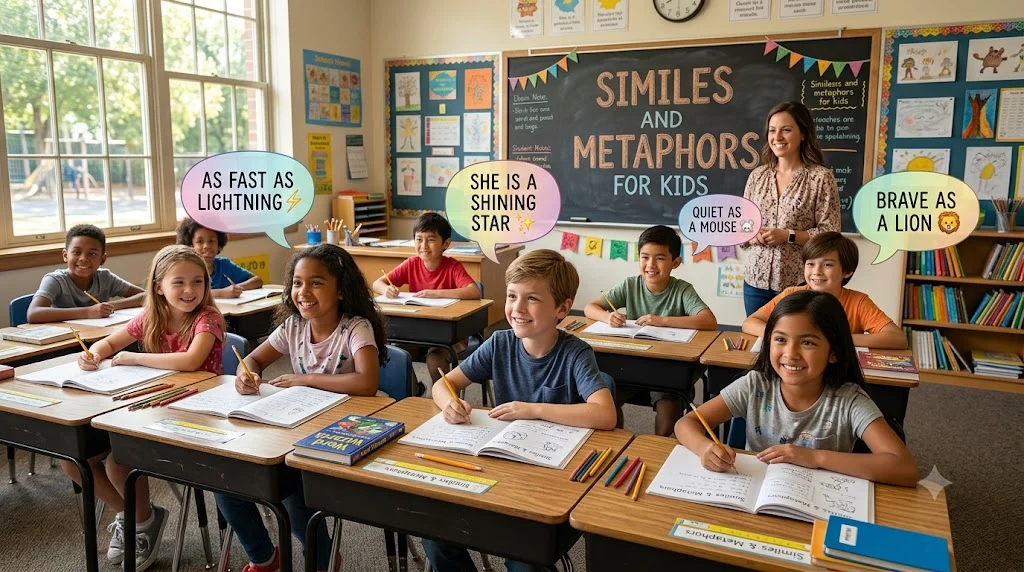
Similes and metaphors for kids are simple comparisons that make language more vivid and fun. Similes use “like” or “as” to compare two things, while metaphors say one thing is another.Both tools help children express ideas more creatively, understand stories more deeply, and become stronger writers and readers.
Learning to write and speak with color and creativity is one of the most exciting parts of growing up with language. Yet when children first encounter figurative language, it can feel confusing. What does it mean when a teacher says “the classroom was a zoo? Or when a storybook says a character ran “as fast as lightning”?
These are similes and metaphors two of the most powerful and playful tools in the English language. They help writers paint pictures with words, turning flat sentences into vivid experiences that readers can see, feel, and remember.
For kids, learning similes and metaphors is not just a grammar lesson. It is an invitation to think creatively, express feelings more accurately, and discover how language can do so much more than simply report facts.
Whether you are a student working on a writing assignment, a teacher planning a lesson, or a parent helping your child with homework, this complete guide to similes and metaphors for kids has everything you need. It includes clear definitions, dozens of examples, relatable meanings, writing exercises, and practical tips for using figurative language confidently.
What Is a Simile?
A simile is a comparison between two different things using the words “like” or “as.”
Similes point out how two things share a quality, even though those things are very different from each other.
Simple Formula
[Person or thing] + is/was + as [adjective] as [comparison] [Person or thing] + [verb] + like + [comparison]
Easy Examples of Similes
- “She is as brave as a lion.”
- “He ran like the wind.”
- “The baby’s skin is as soft as a cloud.”
- “My backpack is as heavy as a rock.”
- “She smiled like the sun coming out.”
Similes are everywhere in books, songs, poems, and everyday conversations. Once kids learn to spot them, they begin noticing similes all around them.
What Is a Metaphor?
A metaphor is a comparison that says one thing is something else without using “like” or “as.
Metaphors do not say something is similar to something else. They say it is that thing directly, creating a stronger and bolder image.
Simple Formula
[Person or thing] + is/was + [comparison]
Easy Examples of Metaphors
- “She is a shining star.”
- “The classroom was a jungle.”
- “His heart is a block of ice.”
- “Life is a roller coaster.”
- “The children were little tornadoes during recess.”
Metaphors make writing feel powerful and direct. They tell readers exactly what something feels like in a bold, unforgettable way.
Simile vs. Metaphor: What Is the Difference?
Many kids find it tricky to tell similes and metaphors apart. Here is the easiest way to remember:
| Feature | Simile | Metaphor |
|---|---|---|
| Uses “like” or “as” | ✅ Yes | ❌ No |
| Makes a direct comparison | ❌ No | ✅ Yes |
| Feels gentler | ✅ Often | ❌ Less so |
| Feels bolder | ❌ Less so | ✅ Often |
Side-by-Side Examples
Simile: “She was as quiet as a mouse.” Metaphor: “She was a mouse, tiptoeing through the hall.”
Simile: “He was like a walking encyclopedia.” Metaphor: “He was a walking encyclopedia.”
Both are powerful. Similes feel like gentle suggestions. Metaphors feel like confident statements.
Quick List of Similes for Kids
| Simile | Meaning |
|---|---|
| As brave as a lion | Very courageous |
| As fast as lightning | Extremely quick |
| As quiet as a mouse | Very silent |
| Like a fish out of water | Feeling uncomfortable |
| As sweet as candy | Very kind or pleasant |
| Like two peas in a pod | Very similar or close |
| As tall as a tree | Very tall |
| Like a broken record | Repeating something over and over |
| As cold as ice | Very cold or unfriendly |
| Like a bull in a china shop | Clumsy or rough |
| As busy as a bee | Very active and hardworking |
| Like a sponge | Absorbing information quickly |
| As bright as the sun | Very cheerful or intelligent |
| Like a fish in water | Completely comfortable |
| As stubborn as a mule | Very determined or inflexible |
Quick List of Metaphors for Kids
| Metaphor | Meaning |
|---|---|
| Life is a roller coaster | Life has many ups and downs |
| The classroom was a zoo | Very chaotic and noisy |
| She is a shining star | She is talented and admired |
| He has a heart of gold | He is very kind and generous |
| The world is a stage | Everyone plays a role in life |
| Time is money | Time is valuable and should not be wasted |
| She is a night owl | She stays up late |
| He is an early bird | He wakes up or arrives early |
| The mind is a computer | The brain processes information |
| She has butterflies in her stomach | She feels nervous |
| He is a walking dictionary | He knows many words |
| The news was a punch to the stomach | The news was shocking and painful |
| Her voice is music | Her voice is very pleasant |
| The children were angels | The children behaved perfectly |
| His room is a tornado | His room is very messy |
Similes for Kids: Detailed Examples with Meanings
1. As Brave as a Lion
Meaning: Describes someone who is very courageous.
Why It Works: Lions are symbols of strength and fearlessness, making this comparison immediately clear to children.
Alternative: “As fearless as a warrior”
Examples in Writing:
Formal: She was as brave as a lion when she stood up to the bully.
Casual: Wow, you’re as brave as a lion for doing that!
Creative: Her heart beat as brave as a lion’s roar when she walked onto the stage.
2. As Fast as Lightning
Meaning: Describes incredible speed.
Why It Works: Lightning is one of the fastest things most children can picture, making this comparison vivid and exciting.
Alternative: “As quick as a flash”
Examples in Writing:
Formal: The runner moved as fast as lightning across the finish line.
Casual: He finished his homework as fast as lightning!
Creative: Her feet flew across the field as fast as lightning splitting the sky.
3. As Quiet as a Mouse
Meaning: Describes someone who makes very little noise.
Why It Works: Mice are famously silent creatures that children know well.
Alternative: “As silent as a sleeping cat”
Examples in Writing:
Formal: The students were as quiet as a mouse during the exam.
Casual: Be as quiet as a mouse while the baby sleeps!
Creative: She moved through the house as quiet as a mouse, not waking a single soul.
4. Like a Fish Out of Water
Meaning: Describes someone who feels uncomfortable or out of place.
Why It Works: The image of a fish struggling without water is a relatable picture of discomfort.
Alternative: “Like a penguin in the desert”
Examples in Writing:
Formal: He felt like a fish out of water at the new school.
Casual: I always feel like a fish out of water at big parties.
Creative: She stood in the crowded room like a fish out of water, gasping for familiar faces.
5. As Busy as a Bee
Meaning: Describes someone who is always working or moving.
Why It Works: Bees are universally recognized for constant activity, making this comparison natural for children.
Alternative: “As active as an ant”
Examples in Writing:
Formal: The teacher was as busy as a bee preparing the classroom.
Casual: Mom is always as busy as a bee in the kitchen.
Creative: Tiny hands buzzed around the art table, as busy as bees on a summer morning.
6. Like a Sponge
Meaning: Describes someone who absorbs information very quickly.
Why It Works: Children understand how sponges soak up water, making this analogy very accessible.
Alternative: “Like an empty jar waiting to be filled”
Examples in Writing:
Formal: Young children learn languages like a sponge.
Casual: She picks up everything so fast she’s like a sponge!
Creative: His curious mind soaked in every lesson like a sponge drinking in summer rain.
7. As Sweet as Candy
Meaning: Describes someone who is very kind, pleasant, or loveable.
Why It Works: Candy is a universally positive image for children.
Alternative: “As sweet as honey”
Examples in Writing:
Formal: The little girl’s personality was as sweet as candy.
Casual: Your little brother is as sweet as candy!
Creative: She greeted every classmate as sweet as candy melting on a warm afternoon.
8. Like Two Peas in a Pod
Meaning: Describes two people who are very similar or always together.
Why It Works: Two peas sharing the same pod is a charming image of closeness.
Alternative: “Like twins from different families”
Examples in Writing:
Formal: The best friends were like two peas in a pod.
Casual: Those two are always together like two peas in a pod!
Creative: They laughed and finished each other’s sentences, like two peas curled inside the same green pod.
Metaphors for Kids: Detailed Examples with Meanings
1. The Classroom Was a Zoo
Meaning: The classroom was very noisy and chaotic.
Why It Works: Zoos are full of noise, movement, and unpredictability just like a rowdy classroom.
Alternative: “The classroom was a circus”
Examples in Writing:
Formal: By lunchtime, the classroom was a zoo.
Casual: It was a zoo in there when the substitute arrived!
Creative: The moment the bell rang, the classroom became a zoo every desk an animal cage set free.
2. She Is a Shining Star
Meaning: She is talented, admired, and stands out.
Why It Works: Stars are bright and visible to everyone perfect for describing someone who shines in a crowd.
Alternative: “She is the light in the room”
Examples in Writing:
Formal: In every performance, she was a shining star.
Casual: You’re a shining star today great job!
Creative: On that tiny stage, she was a shining star burning bright enough to fill the whole auditorium.
3. He Has a Heart of Gold
Meaning: He is extremely kind and generous.
Why It Works: Gold is precious and valuable comparing a heart to gold shows how rare and beautiful true kindness is.
Alternative: “He has a gentle soul”
Examples in Writing:
Formal: Everyone agreed that Mr. Thomas had a heart of gold.
Casual: That boy has a heart of gold he always shares his lunch.
Creative: Kindness poured from him naturally, for his heart was made of gold.
4. Life Is a Roller Coaster
Meaning: Life has exciting highs and frightening lows.
Why It Works: Children who have ridden roller coasters immediately understand the feeling of sudden ups, downs, and unexpected twists.
Alternative: “Life is a winding road”
Examples in Writing:
Formal: Life is a roller coaster, full of unexpected turns.
Casual: Some weeks life is just a roller coaster!
Creative: She learned early that life is a roller coaster sometimes you scream, sometimes you laugh, and sometimes you do both at once.
5. His Room Is a Tornado
Meaning: His room is extremely messy.
Why It Works: Tornadoes leave everything scattered and disordered a perfect image for a child’s messy bedroom.
Alternative: “His room is a disaster zone”
Examples in Writing:
Formal: After the weekend, his room was a tornado.
Casual: Clean up your room is a tornado right now!
Creative: Socks, books, and toy cars lay scattered in every direction. His room was a tornado that had chosen this corner of the house to rest.
6. She Has Butterflies in Her Stomach
Meaning: She feels very nervous or excited.
Why It Works: The fluttery sensation of nervousness really does feel like something moving inside and butterflies are a gentle, non-scary image for kids.
Alternative: “Her stomach was doing somersaults”
Examples in Writing:
Formal: Before the recital, she had butterflies in her stomach.
Casual: I always get butterflies in my stomach before tests.
Creative: The moment her name was called, butterflies filled her stomach and took flight.
7. He Is a Walking Dictionary
Meaning: He knows a lot of words and definitions.
Why It Works: Dictionaries contain thousands of words, so comparing a person to one immediately suggests impressive vocabulary.
Alternative: “He is a human encyclopedia”
Examples in Writing:
Formal: His classmates called him a walking dictionary.
Casual: Ask him anything he’s a walking dictionary!
Creative: Every sentence he spoke was precise and polished. He was a walking dictionary with legs.
Why Similes and Metaphors Matter for Kids
Figurative language is not just decoration. It plays a vital role in how children understand and express the world around them.
They make writing more interesting. Plain sentences tell readers facts. Similes and metaphors help readers feel those facts. “She was sad” becomes “she was a wilting flower.”
They improve reading comprehension. Books and poems are full of figurative language. Children who understand similes and metaphors understand stories more deeply.
They build vocabulary. Learning comparisons introduces new words in context, which is one of the most effective ways children acquire language.
They encourage creative thinking. Finding the right comparison requires imagination and careful observation of the world valuable skills beyond writing class.
They develop emotional expression. Children often struggle to describe feelings. Similes and metaphors give them a richer vocabulary for emotions.
How to Teach Similes and Metaphors to Kids
Start with Familiar Things
Use objects, animals, and experiences children already know. A child who has never seen the ocean will not connect with “as vast as the sea,” but every child knows what candy tastes like.
Use Picture Books and Poems
Classic picture books and children’s poetry are full of figurative language. Reading aloud and pausing to discuss comparisons is one of the most natural ways to teach these concepts.
Play Comparison Games
Call out an adjective “happy,” “slow,” “loud” and ask children to complete the simile. “As happy as a ___.” This builds the habit of thinking comparatively.
Create a Classroom Simile Wall
Let children add their own similes on sticky notes to a classroom wall. Seeing their own words displayed builds pride and reinforces the concept.
Encourage Journaling
Ask children to write three similes or metaphors about their day in a journal. Over time, this practice becomes natural and creative.
Common Mistakes Kids Make with Similes and Metaphors
Mixing similes and metaphors: Writing “She was like a shining star” is a simile. Writing “She was a shining star” is a metaphor. Mixing both in one sentence creates confusion.
Using too many at once: Piling comparisons into one paragraph weakens each one. Teach children that one strong simile is better than five weak ones.
Choosing comparisons that do not fit: “He was as cold as a pizza” might be funny, but it does not clearly communicate a meaning. The comparison needs to connect logically.
Relying on clichés: “As cool as a cucumber” or “as old as the hills” are overused. Encourage children to invent fresh comparisons from their own experiences.
Writing Exercise: Build Better Comparisons
Exercise 1: Complete the Simile
Fill in the blank with your own idea:
- “She was as brave as ___.”
- “He laughed like ___.”
- “The music sounded as sweet as ___.”
- “The storm was as loud as ___.”
Exercise 2: Turn a Simile into a Metaphor
Practice changing similes into metaphors by removing “like” or “as.
- Simile: “She was like a ray of sunshine.” → Metaphor: “She was a ray of sunshine.”
- Simile: “He was as stubborn as a mule.” → Metaphor: “He was a mule, digging in his heels.”
Exercise 3: Describe Your Day with Metaphors
Write three metaphors describing your day:
- “This morning was ___.”
- “School today was ___.”
- “By evening, my brain was ___.”
Exercise 4: Spot the Figurative Language
Read a page from your favorite book and circle every simile and metaphor you find. Can you explain what each one means?
Famous Similes and Metaphors in Children’s Literature
Children’s books are treasure chests of figurative language. Here are some well-known examples (paraphrased for copyright):
Many beloved children’s stories compare characters to animals to show personality traits a slow character might be described like a tortoise, while a clever one is compared to a fox.
Classic fairy tales often use metaphors to describe beauty a princess described as the sun itself, or a voice compared to birdsong at dawn.
Adventure stories frequently describe a brave hero’s heart as a burning flame, or describe an enemy as a dark storm cloud spreading across the land.
Reading with children and pausing to ask “What is the author comparing here?” is one of the simplest and most effective teaching strategies available.
Similes and Metaphors Across School Subjects
Figurative language does not belong only in English class. It appears across many subjects and helps children make sense of complex ideas.
Science: “The cell membrane is like a security guard, choosing what enters and exits.”
History: “The revolution was a wildfire, spreading from town to town.”
Math: “Fractions are like slices of a pizza the more pieces you cut, the smaller each one gets.”
Music: “The melody was a river, winding gently toward the sea.”
Physical Education: “The team moved like a well-oiled machine.”
Showing children that figurative language appears everywhere not just in storybooks helps them understand why it is worth learning.
FAQs
1. What is the easiest way for kids to remember the difference between a simile and a metaphor?
Remind them: similes say something is like something else. Metaphors say something is something else. The word “simile” even sounds a little like “similar,” which can help.
2. What age should kids start learning similes and metaphors?
Most children begin encountering these concepts around age 7–8 in early elementary school, though simple comparisons appear naturally even in picture books for younger children.
3. Are similes and metaphors the same as figurative language?
They are two important types of figurative language. Other types include personification, hyperbole, onomatopoeia, and alliteration.
4. How can parents help children practice similes and metaphors at home?
Play comparison games during car rides, read picture books together and discuss comparisons, and encourage children to describe their feelings using “like” or “as.
5. Do similes always use “like” or “as”?
Yes. If a comparison uses “like” or “as,” it is a simile. If it makes a direct comparison without those words, it is a metaphor.
6. Can similes and metaphors be funny?
Absolutely! Children often love creating silly comparisons “my brother is as loud as a fire truck full of monkeys” and humor is a perfectly valid way to practice figurative language.
7. Why do authors use metaphors instead of just saying what they mean?
Metaphors create pictures in the reader’s mind that direct statements cannot. “The boy was sad” is a fact. “The boy was a storm cloud drifting through the house” is an experience.
Conclusion
Similes and metaphors are among the most exciting tools children can discover in the world of language. They turn ordinary sentences into extraordinary images, help readers feel emotions rather than just understand them, and give young writers a way to express ideas that would otherwise be impossible to describe.
A brave child is not just brave she is as brave as a lion. A noisy classroom is not just noisy it is a zoo. These small shifts in language create big differences in how writing feels to read.
For children, learning similes and metaphors is really about learning to see the world more creatively. It is about noticing that a rainstorm feels like drumming on the rooftop, that a kind smile is like a warm blanket, and that a long car ride feels like crossing an endless ocean.
The best similes and metaphors come from paying close attention to real life and asking one simple question: What does this remind me of?
Encourage the children in your life to ask that question often. With practice, their answers will grow richer, more original, and more beautifully expressive with every passing year. And in doing so, they will not just become better writers they will become more imaginative, empathetic, and curious human beings.