Quick Answer:
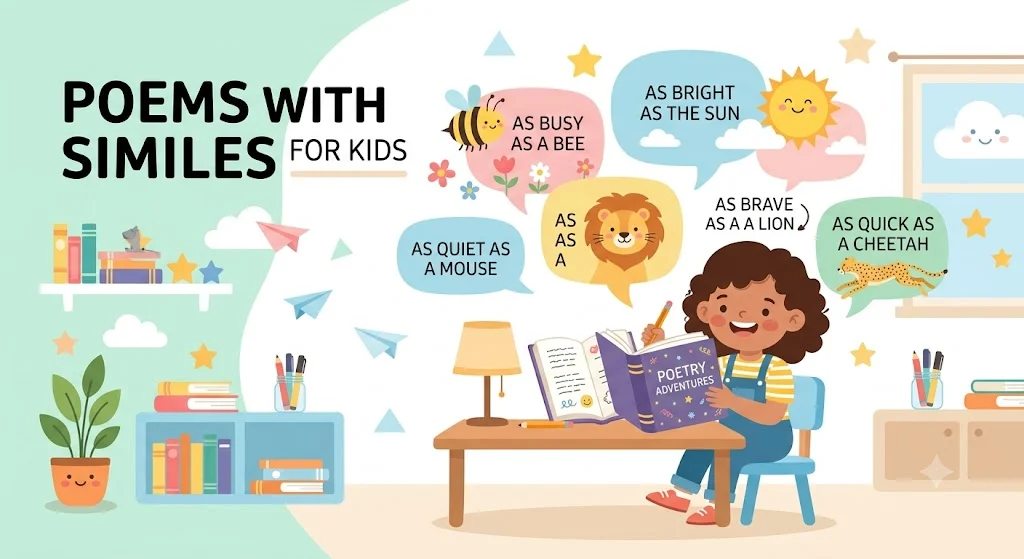
Poems with similes for kids use comparisons with “like” or “as” to describe feelings, animals, and everyday things in vivid, playful ways. They help children understand figurative language, build vocabulary, and develop a love for creative writing through fun, relatable imagery.
Poetry and childhood go hand in hand. From nursery rhymes to silly limericks, children have always found joy in the rhythm and music of words. But when a poem also contains a simile a comparison using “like” or “as” something magical happens. Ordinary things become extraordinary. A sunny day becomes “as bright as a golden coin.” A best friend becomes “like a cozy blanket on a cold winter night.
Simile poems are among the most powerful tools teachers, parents, and young writers can use to make language come alive. They train children to think imaginatively, observe the world around them, and express emotions in ways that are both clear and creative.
Whether you are a teacher looking for classroom-ready examples, a parent helping with homework, or a young writer wanting to craft your very first poem, this guide is for you. We have gathered more than 20 original poems with similes for kids, explained how similes work, and included writing tips, exercises, and answers to the most common questions.
Let’s dive into the wonderful world of simile poetry for children.
What Is a Simile? A Simple Explanation for Kids
Before exploring poems, it helps to understand what a simile actually is. A simile is a figure of speech that compares two different things using the words “like” or “as.”
Simple Definition: A simile says that one thing is like something else, or as something as something else. It helps the reader picture an idea more clearly and feel it more deeply.
Examples of Similes for Kids
| Simile | What It Describes |
|---|---|
| As fast as a cheetah | Speed |
| Like a fish out of water | Feeling uncomfortable |
| As bright as the sun | Happiness or light |
| Like a fluffy cloud | Softness or gentleness |
| As loud as thunder | Noise |
| Like a dancing butterfly | Lightness and joy |
| As cold as ice | Temperature or unfriendliness |
| Like a knight in shining armor | Bravery and protection |
Simile vs. Metaphor What’s the Difference?
Children sometimes confuse similes with metaphors. Here is an easy way to remember the difference:
- Simile: “My dog is like a fluffy cloud.” (uses “like” or “as”)
- Metaphor: “My dog is a fluffy cloud.” (makes a direct comparison, no “like” or “as”)
Similes are often easier for younger children to learn first because the comparison is made clear by the signal words “like” and “as.
Why Simile Poems Are Important for Children
Simile poems are not just fun to read. They serve real educational and emotional purposes that help children grow as thinkers, communicators, and creative writers.
They Build Vocabulary
When children encounter the phrase “as curious as a cat,” they begin to associate the word “curious” with a lively, relatable image. This creates stronger word memory than simply reading a dictionary definition ever could.
They Develop Imagination
Simile poems invite children to see the world differently. A raindrop is no longer just water it becomes “like a tiny dancer on a windowpane.” This imaginative leap is exactly what nurtures creative thinking.
They Teach Figurative Language
Most English curricula from Grade 2 onward introduce figurative language. Simile poems provide memorable, enjoyable examples that children can analyze, recite, and imitate in their own writing.
They Encourage Emotional Expression
Feeling “as happy as a puppy in the park” or “like a storm cloud ready to burst” gives children language for emotions that are otherwise hard to describe. This emotional vocabulary is essential for well-rounded communication.
They Make Reading Fun
Poems with vivid similes are simply more entertaining. The surprising comparisons make children laugh, wonder, and want to keep reading. That joy is the greatest motivation for literacy.
Simile Poems About Animals for Kids
Animals are a natural starting point for simile poetry. Children relate to animals instinctively, and animal behavior offers a rich source of vivid comparisons.
1. My Speedy Dog
My Speedy Dog · Ages 5–8
My dog runs like the wind through the trees, His paws hit the ground with the greatest of ease. His tail wags around like a flag in a storm, And his cuddles at night keep me as cozy as warm. He barks at the postman as loud as a drum, Then licks at my face till my sad feelings go numb. My dog is my friend, like a light in the dark, The very best thing my sweet, speedy spark.
Similes Used in This Poem
- “like the wind through the trees” shows speed and freedom
- “like a flag in a storm” shows the happy, energetic tail wag
- “as cozy as warm” shows the comfort of a pet’s cuddle
- “as loud as a drum” shows how loud the barking is
- “like a light in the dark” shows loyalty and friendship
2. The Busy Bee
The Busy Bee · Ages 6–9
The little bee works like a tiny machine, The hardest small worker that I’ve ever seen. Her wings beat so fast, like a fan on a day, And she gathers up pollen as she goes on her way. She’s as round as a button with stripes of bright gold, A keeper of secrets and stories untold. Her honey is sweet, like a kind word in spring, Oh, what a wonderful thing is a bee on the wing!
3. The Sleepy Cat
The Sleepy Cat · Ages 5–7
My cat curls up like a warm cinnamon bun, She naps through the morning and naps through the sun. Her fur is as soft as a whisper of snow, Her purring fills up the whole room with a glow. She stretches and yawns like a slow, lazy wave, Then blinks her green eyes, as deep as a cave. She pads to her bowl and she looks up at me The most peaceful creature I ever did see.
Simile Poems About Feelings and Emotions for Kids
Helping children name and understand their emotions is one of the most important gifts we can give them. Simile poems make this process natural and enjoyable.
4. When I Feel Happy
When I Feel Happy · Ages 6–10
When I feel happy, I’m like a kite in the breeze, Floating up high through the tall, swaying trees. My heart is as light as a feather that’s free, And the whole, wide world seems to sparkle for me. I laugh like a brook tumbling over the stones, The joy in my chest is like music and tones. Happy is sunshine, as warm as a hug, Happy is cozy, like tea in a mug.
Classroom Discussion Tip
For Teachers: After reading this poem aloud, ask students: “What does happy feel like to you? Can you make your own simile for happiness?” This encourages personal connection and original thinking.
5. When I Feel Scared
When I Feel Scared · Ages 7–11
When I feel scared, my heart’s like a drum, Beating so fast that my fingers go numb. The dark feels as wide as an ocean at night, And shadows that twist fill my heart with a fright. But then comes a hand, like a lighthouse ahead, A voice that is warm pulls the fear from my head. And slowly the scary turns smaller and thin Like fog burning off when the morning comes in.
6. Feeling Angry
Feeling Angry · Ages 7–11
When I am angry, I’m like a kettle that boils, My thoughts are all tangled in knots and in coils. My face burns as hot as a pan on the stove, And words rush around like cars without road. But anger, I’ve learned, is like fire in the rain, It flares for a moment, then fizzles again. I breathe and I wait, and the kettle cools down And the me that I like slowly comes back around.
Simile Poems About Nature for Kids
Nature is perhaps the richest source of similes. The natural world is full of movement, color, texture, and sound all waiting to be compared to something else.
7. The Rainbow’s Promise
The Rainbow’s Promise · Ages 6–10
The rainbow appears like a smile in the sky, A bridge made of color that stretches up high. Each stripe is as bold as a painter’s best stroke, A masterpiece drawn by the clouds and their cloak. Red is as warm as a hug by the fire, Blue stretches calm like a song from a choir. Green is as fresh as the meadow at dawn, And gold fades away like a beautiful yawn.
8. The Storm
The Storm · Ages 8–12
The thunder roars loud like a giant awakes, The lightning splits dark like a mirror that breaks. The rain falls in sheets, like a curtain of grey, Washing the roads and the rooftops away. But after the storm, the air smells like new earth, As if the whole world is preparing for birth. The sun peeks again like a shy, golden child, And the world becomes quiet, and gentle, and mild.
9. The Ocean’s Song
The Ocean’s Song · Ages 7–11
The ocean is like an enormous blue quilt, Stitched out of stories, of tides, and of silt. Its waves roll in soft as a lullaby’s hum, Then crash on the beach like the beat of a drum. The foam swirls around like a dancer in white, The stars in the water shine like lanterns at night. I stand at the edge and I breathe in the air And the ocean fills me like a silent prayer.
Simile Poems About the Seasons for Kids
The four seasons offer a perfect annual cycle of imagery that children can explore, compare, and write about themselves.
10. Spring Is Like…
Spring Is Like… · Ages 6–9
Spring is like a yawn after a long winter sleep, The earth wakes up slowly from its cold, frozen deep. The flowers push up like small fists through the ground, And birds fill the mornings with bright, cheerful sound. The rain falls as soft as a grandmother’s kiss, And everything smells of a green kind of bliss. Spring is like a new notebook waiting to fill Blank pages of warmth on each window sill.
11. Summer Mornings
Summer Mornings · Ages 6–10
Summer is like a long golden yell, A shout to come out from the holiday bell. The sun climbs up high as a bright burning coin, And all of the children and all their laughs join. Ice cream drips down like a slow, sticky tide, And bare feet on grass feel as cool as a ride. Summer is endless or so children say Like a song with no ending on a hot, sunny day.
12. Autumn Leaves
Autumn Leaves · Ages 7–11
The autumn leaves fall like a slow, colorful rain, Red, gold, and orange across every lane. They crunch underfoot like a crinkled-up note, And the air smells as crisp as a freshly starched coat. The trees stand like dancers who’ve taken their bow, Their branches stretched wide in a cold-weather vow. Autumn is quiet like a book nearly done, The final last pages before winter has won.
13. A Winter’s Day
A Winter’s Day · Ages 7–11
The snow falls down soft as a secret being told, And the world tucks itself up against all of the cold. The trees stand as still as the statues in parks, And the sky turns to indigo like ink in the dark. Inside, the fire glows like a small, tame sun, And we pull our loved ones close, one by one. Winter is like a long breath slowly let go Peaceful and quiet beneath all of the snow.
Simile Poems About Friendship for Kids
Friendship is one of the most important topics in a child’s emotional life. These simile poems help children articulate what their friends mean to them.
14. My Best Friend
My Best Friend · Ages 6–10
My best friend is like a sunny Thursday, Unexpected and bright in the middle of grey. They laugh like a stream tumbling over the rocks, They listen as steady as clocks. When I’m feeling down, they’re like rain after drought, They chase all my worries and sadness away and out. My best friend is like a door that’s always wide, The very best place when I need a safe side.
15. Friends Are Like Stars
Friends Are Like Stars · Ages 8–12
Friends are like stars in a clear midnight sky You may not always see them, but you know they are high. Some shine as bright as the moon on still water, Some twinkle like laughter the whole evening after. And when the dark comes and you look up above, The stars are all there, like a letter of love. Friends, like the stars, never truly depart They stay fixed forever, like light in the heart.
Simile Poems About School Life for Kids
16. My Teacher
My Teacher · Ages 6–10
My teacher is like a lighthouse on land, She points us the way with a steady, sure hand. Her voice is as calm as a wind in the park, She gives us the knowledge to shine in the dark. She reads us the stories like a warm summer rain, And shows us the way to try over again. My teacher is patient as rivers are wide, The very best guide for this wild, curious ride.
17. The Library
The Library · Ages 7–11
The library is like a jungle of words, Full of wild adventures and stories of birds. Each book is as heavy as worlds left inside, A universe packed in a cover to hide. The quiet in here is as thick as still air, As if all the stories are holding their breath right there. I open a page and I step through a door The library gives me a thousand worlds more.
How to Write Simile Poems: A Step-by-Step Guide for Kids
Writing a simile poem is easier than it sounds. Follow these simple steps and young writers will have a poem in no time.
Step 1: Choose Your Topic
Pick something you love, feel, or know well. It could be a pet, a season, a friend, a sport, a feeling anything that you can describe.
Step 2: List Describing Words
Write down five words that describe your topic. For example, if your topic is “rain,” you might write: cold, soft, loud, grey, falling.
Step 3: Add a “Like” or “As” Comparison
Take each describing word and find something to compare it to:
- Cold → as cold as the inside of a freezer
- Soft → like a whisper against the window
- Loud → like a hundred tiny drums on the roof
Step 4: Build Your Lines
Turn each simile into a poetic line. Don’t worry about rhyming at first meaning and imagery come first.
Step 5: Add Rhythm (Optional)
Read your poem aloud. If some lines feel too long or short, adjust the words to make it flow more naturally. Rhyme can be added at the end of lines if you like.
Writing Tip: The best similes come from personal experience. Ask yourself: “What does this really feel or look like to me?” The more personal the comparison, the more original and powerful the poem.
Quick Simile Poems for Kids (Short & Sweet)
Sometimes you need a short, punchy poem that children can memorize, recite in class, or illustrate for a school project. Here are some mini simile poems.
18. My Smile
My Smile · Ages 5–8
My smile spreads out like sunrise on water, Growing and glowing as the morning grows hotter. It stretches across like a hammock of light My smile makes everything feel just right.
19. The Moon
The Moon · Ages 6–9
The moon floats up high like a lantern of gold, Telling the nighttime its stories untold. It glows as gentle as light through a screen, The most beautiful nighttime thing I have seen.
20. My Baby Sibling
My Baby Sibling · Ages 6–10
My baby sibling is like a new loaf of bread, Round and soft and warm when it’s fed. They giggle like bubbles that float through the air, And their tiny hand fits like a sweet, trusting prayer.
Teaching Tips: How to Use Simile Poems in the Classroom
Simile poems are incredibly versatile teaching tools. Here are practical strategies for educators at all grade levels.
Read Aloud First
Always read a poem aloud before analyzing it. Let children hear the rhythm and feel the emotion before they begin identifying the literary devices.
Highlight the Similes
Give children a printed copy and ask them to underline or circle every “like” and “as.” This visual exercise makes the figurative language visible and tangible.
Replace and Create
Cover the simile in a line and ask students to suggest their own replacement. This develops critical thinking and encourages original expression.
Illustrate the Similes
Ask students to draw a picture of a simile from the poem. “As cozy as warm” or “like a kite in the breeze” creates vivid mental images that children love to illustrate.
Group Poem Writing
Have each child contribute one simile line about a shared topic (such as “Our Classroom” or “The Playground”). Compile the lines into a class poem. This builds community and collaborative creativity.
Age-Level Recommendations
| Age Group | Recommended Activity |
|---|---|
| Ages 5–6 | Listen and draw simile images; fill in simple blanks (“as happy as a ___”) |
| Ages 7–8 | Identify similes in poems; write one-stanza simile poems |
| Ages 9–10 | Write multi-stanza simile poems; compare simile vs metaphor |
| Ages 11–12 | Analyze the effect of similes; write extended poems with varied figurative language |
FAQs
1. What is a simile poem for kids?
A simile poem is a poem that uses comparisons with the words “like” or “as” to describe something in a vivid, imaginative way. For example, “My cat is as soft as a cloud” is a simile that helps the reader picture how soft the cat is.
2. What grade level are simile poems taught?
similes are typically introduced in Grade 2 or Grade 3 (ages 7–9), but children as young as 5 can enjoy and understand simple simile poems read aloud. By Grade 5, students are expected to write their own extended simile poems.
3. How do I explain a simile to a young child?
Use simple, relatable examples from daily life. Say: “You know how your blanket feels really warm and cozy? Well, when we say someone is ‘as warm as a blanket,’ we mean they make us feel that same cozy, safe feeling.” Connect the word to a physical feeling or familiar experience.
4. Can a poem have both similes and metaphors?
Absolutely. Most poems use a mixture of figurative language, including similes, metaphors, personification, and alliteration. For beginners, it’s easiest to focus on similes first before introducing other devices.
5. How many similes should a kids’ poem have?
There is no strict rule, but for children learning the concept, two to four similes per poem is ideal. Too many comparisons can feel overwhelming; too few may not illustrate the technique effectively.
6. What are some easy similes kids can use in their own writing?
Great starter similes include: “as fast as a rocket,” “like a sleepy bear,” “as bright as a star,” “like a giggling stream,” and “as brave as a lion.” Encourage children to eventually create their own original comparisons.
7. Are simile poems only for English class?
Not at all. Simile poems can be used in science class (describing animals or weather), social studies (describing places or historical figures), art class (describing colors and shapes), and even physical education (describing movement and sport). They are cross-curricular tools with wide application.
Conclusion
Poems with similes give children more than just literary knowledge they give them a new way of seeing. When a child learns to describe their dog “like the wind through the trees” or a friend “like a lighthouse in darkness,” they are not just learning English. They are learning to observe, feel, compare, and imagine.
Simile poems are joyful, accessible, and deeply educational. They meet children where they are in the world of animals, seasons, feelings, and friendships and invite them to say something surprising and true about that world.
The next time a child stares out a rainy window or watches a sunset or feels a wave of happiness they cannot name, give them a simile. Let them say “the rain is like a hundred tiny drums” or “happiness is as warm as my grandmother’s kitchen.” Because in that small, shining comparison, a poet is born.