Quick Answer
Similes in literature are figures of speech that compare two unlike things using the words “like” or “as” to create vivid imagery and emotional resonance.Famous authors use similes to make abstract ideas concrete, help readers visualize scenes instantly, and deepen the emotional impact of their storytelling.
Literature’s greatest power lies in its ability to make readers feel what characters experience, see what writers envision, and understand what language alone struggles to express.
Similes are one of the most important tools writers use to achieve this. By placing two unlike things side by side through a comparison using “like” or “as,” a simile transforms the unfamiliar into the instantly recognizable.
When Shakespeare writes that Juliet is “like the sun,” readers understand both her beauty and Romeo’s emotional blindness in an instant. When Homer describes warriors “like lions charging across the plain,” the ferocity and momentum of battle becomes vivid without a single technical detail.
Similes appear throughout every era of literature, from ancient epics and classical poetry to modern novels, children’s books, and contemporary fiction. Understanding how skilled authors construct and use similes can dramatically improve any writer’s craft.
This guide explores powerful similes examples in literature, complete with their sources, meanings, literary analysis, and practical writing tips for using them effectively in your own work.
Quick List of Similes in Literature
| Simile | Author / Work | Meaning |
|---|---|---|
| “Juliet is the sun” | Shakespeare, Romeo and Juliet | She is radiant and life-giving |
| “Life is like a box of chocolates” | Gump, Forrest Gump | Life is unpredictable |
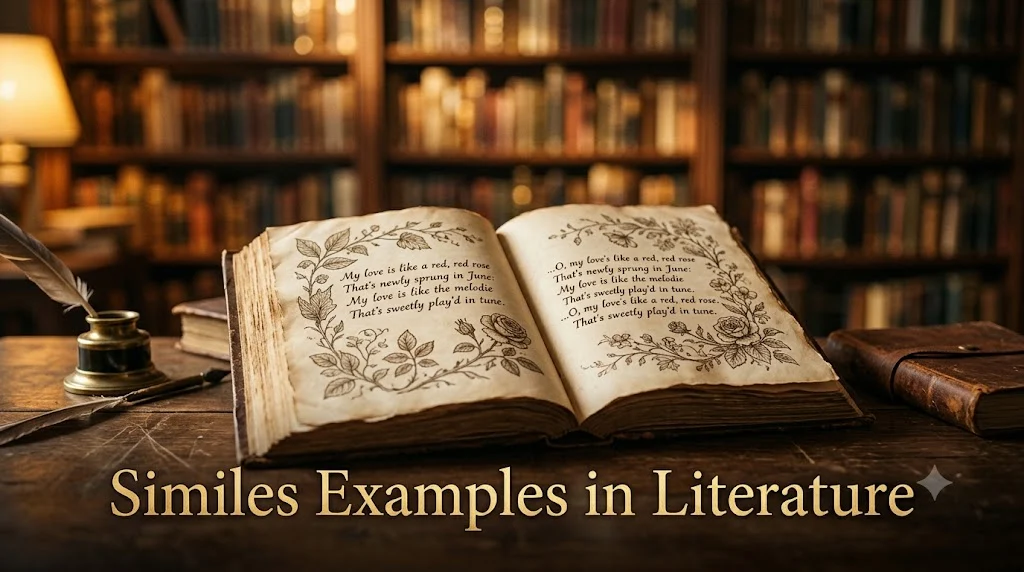
| “Like a red, red rose” | Robert Burns | Deep, passionate love |
| “As cold as ice” | Common literary phrase | Emotionally distant |
| “The fog comes on little cat feet” | Carl Sandburg | Fog moves quietly and softly |
| “Like water for chocolate” | Laura Esquivel | Intense, boiling emotion |
| “As brave as a lion” | Traditional literary usage | Fearless and powerful |
| “My heart is like a singing bird” | Christina Rossetti | Overwhelming joy |
| “Life is like a journey” | Pilgrim’s Progress | Existence as a spiritual path |
| “Like a stone” | Various authors | Unmoved and emotionally hard |
Similes in Classic Poetry
1. “My Love Is Like a Red, Red Rose” Robert Burns
Source Robert Burns, A Red, Red Rose (1794)
The Simile “O my luve is like a red, red rose / That’s newly sprung in June.
Meaning Burns compares his love to a freshly bloomed rose to express beauty, passion, and the freshness of new romantic feeling.
Why It Works The rose is universally understood as a symbol of love, beauty, and fragility. By saying his love is “newly sprung,” Burns implies that this feeling is fresh, alive, and at its peak.
Alternative Expression “My love is like the first morning of spring.”
Examples in Writing
Formal Example Burns uses the rose simile to establish the sincerity and intensity of romantic devotion.
Casual Example He described her the way Burns described his love beautiful and impossible to ignore.
Creative Example His affection bloomed quietly around her, like a red rose newly parted from the morning rain.
2. “My Heart Is Like a Singing Bird” Christina Rossetti
Source Christina Rossetti, A Birthday (1861)
The Simile “My heart is like a singing bird / Whose nest is in a watered shoot.
Meaning Rossetti compares her joyful heart to a bird singing freely in an abundant, well-watered place expressing pure happiness at a lover’s return.
Why It Works Birds singing represent unrestrained joy and vitality. The watered nest suggests a nourishing, safe environment, amplifying the feeling of emotional fullness.
Alternative Expression “My heart leaps like a sparrow toward the sun.”
Examples in Writing
Formal Example Rossetti’s simile captures feminine joy in Victorian poetry through accessible and sensory natural imagery.
Casual Example She felt her heart flutter like a bird the moment she saw him.
Creative Example Joy moved through her chest like a small bird singing inside a garden heavy with rain.
3. “The Fog Comes on Little Cat Feet” Carl Sandburg
Source Carl Sandburg, Fog (1916)
The Simile “The fog comes / on little cat feet.
Meaning Sandburg compares the movement of fog to a cat approaching silently and softly, suggesting how fog arrives without announcement.
Why It Works Cats move with quiet, deliberate grace. The comparison transforms a weather event into something almost sentient and mysterious, which suits the mood of observation and quiet presence.
Alternative Expression “The fog settled like a cat curling into sleep.”
Examples in Writing
Formal Example Sandburg’s simile is celebrated for compressing an entire atmosphere into a single, perfectly chosen image.
Casual Example The mist crept in like a cat that nobody invited but everyone noticed.
Creative Example Evening settled over the harbor as softly as a cat finding its place in an old familiar chair.
4. “Like as the Waves Make Towards the Pebbled Shore” Shakespeare
Source William Shakespeare, Sonnet 60 (1609)
The Simile “Like as the waves make towards the pebbled shore, / So do our minutes hasten to their end.
Meaning Shakespeare compares the relentless movement of ocean waves to the unstoppable passage of time, suggesting both are inevitable and impossible to stop.
Why It Works Ocean waves arriving endlessly at shore create a natural visual clock. The comparison elevates a meditation on mortality into something physically observable and emotionally resonant.
Alternative Expression “Minutes pass like water flowing toward the sea.
Examples in Writing
Formal Example Shakespeare’s simile frames time as a natural force, lending the sonnet both melancholy and grandeur.
Casual Example Time passes like waves each one looks the same until you realize how far the tide has come.
Creative Example Days came and went like waves against the shore, each one washing a little more of him away.
Similes in Classic Novels
5. “It Was as If the Sun Had Come Out” Various Usage
Meaning Describes an emotional or situational shift from darkness or difficulty to sudden warmth and relief.
Why It Works The sun emerging is universally experienced as welcome, warm, and positive. Writers use this simile to signal a turning point in a character’s emotional state.
Examples in Writing
Formal Example The moment the letter arrived, the atmosphere in the room changed as if the sun had come out.
Casual Example When she smiled, it felt like the sun finally showed up after a long rainy week.
Creative Example Something shifted in him the moment she spoke the world rearranging itself as if the sun had broken through a winter of clouds.
6. “Like Water for Chocolate” Laura Esquivel
Source Laura Esquivel, Like Water for Chocolate (1989)
The Simile The title itself functions as an extended simile comparing emotional intensity to water heated just to the point of boiling.
Meaning In Mexican Spanish, the phrase “como agua para chocolate” (like water for chocolate) means to be in a state of extreme emotion furious, passionate, or deeply agitated.
Why It Works Water approaching a boil is just beneath the surface of explosion. The simile captures barely contained passion perfectly.
Alternative Expression “Like a kettle just before it screams.”
Examples in Writing
Formal Example Esquivel’s title simile establishes the novel’s central theme that deep emotion literally flavors the world around us.
Casual Example She was so angry she was practically boiling, like water right before chocolate melts into it.
Creative Example She stood in the kitchen trembling, every emotion in her like water trembling just before it breaks into a boil.
7. “Life Is Like a Box of Chocolates” Forrest Gump
Source Winston Groom, Forrest Gump (1986) / popularized in the 1994 film
The Simile “Life is like a box of chocolates you never know what you’re gonna get.
Meaning Life’s unpredictability is compared to reaching blindly into a box of assorted chocolates, where each choice might bring something delightful or disappointing.
Why It Works The comparison is humble, accessible, and deeply human. It avoids philosophical complexity while delivering a profound truth about uncertainty.
Alternative Expression “Life is like a lottery ticket the result is never what you expect.”
Examples in Writing
Formal Example The simile reflects a worldview shaped by innocence and acceptance of chance.
Casual Example He shrugged and said life is a box of chocolates you take what you get and move on.
Creative Example She picked her future the way she picked chocolates with hope, eyes closed, and no guarantees.
8. “He Fought Like a Lion” Homer’s Iliad
Source Homer, The Iliad (c. 8th century BCE)
The Simile Homer repeatedly uses extended lion similes to describe warriors in battle, such as comparing Achilles to a lion descending upon prey.
Meaning The lion simile communicates raw power, ferocity, and fearlessness in combat.
Why It Works Lions are apex predators universally associated with strength and dominance. Homer’s extended similes often describe the environment, behavior, and emotion of lions before applying the comparison back to the warrior, creating a vivid pause in the narrative.
Alternative Expression “He charged like a wolf descending on a flock at dawn.”
Examples in Writing
Formal Example Homer’s Homeric similes extended comparisons drawn from nature are considered a defining feature of epic poetry.
Casual Example He fought like a lion, which is another way of saying he fought like he had nothing left to lose.
Creative Example He moved through the battle the way a lion moves through tall grass with total certainty that everything ahead of him would fall.
Similes in Children’s Literature
9. “As Brave as a Lion” Traditional Usage
Meaning Describes courage and fearlessness, often used in children’s stories to make bravery relatable.
Why It Works Children recognize lions as powerful animals. The simile gives young readers an immediately understandable frame for what bravery looks like.
Alternative Expression “As fearless as a knight before a dragon.”
Examples in Writing
Formal Example Children’s literature uses animal similes to translate abstract virtues into physical, recognizable forms.
Casual Example She told herself she was as brave as a lion just before she walked into the room.
Creative Example He stood at the edge of the dark forest, heart hammering, telling himself he was as brave as a lion even though his knees said otherwise.
10. “Like a Fish Out of Water” Common Literary Usage
Meaning Describes a person who is clearly uncomfortable or out of place in a particular situation.
Why It Works The image of a fish struggling outside its natural environment is immediately visual and emotionally clear.
Alternative Expression “Like a bird in a sealed room.”
Examples in Writing
Formal Example The protagonist’s displacement is expressed through the simile of being like a fish out of water in city life.
Casual Example At the formal dinner, he felt like a fish completely out of water.
Creative Example She navigated the crowded ballroom like a fish someone had accidentally dropped on a ballroom floor desperate, gasping, looking for water.
Similes in Modern Literature
11. “Her Voice Was Like Music” General Literary Usage
Meaning Describes a pleasant, melodic speaking or singing voice by comparing it to music.
Why It Works Music is a deeply emotional and sensory experience. Comparing a voice to music immediately elevates it from ordinary sound to something meaningful.
Alternative Expression “Her voice moved like a slow river over smooth stones.”
Examples in Writing
Formal Example Modern authors frequently use musical similes to characterize voices without technical description.
Casual Example When she spoke, it sounded like music the kind you didn’t want to stop.
Creative Example Her words came out slow and warm, like a melody played on an instrument nobody had heard before but everyone immediately loved.
12. “Like a Diamond in the Sky” Nursery Rhyme / Literary Culture
Source Jane Taylor, The Star (1806)
The Simile “Twinkle, twinkle, little star, how I wonder what you are / Up above the world so high, like a diamond in the sky.
Meaning Stars are compared to diamonds to express brightness, beauty, and preciousness.
Why It Works Diamonds sparkle with concentrated light, just as stars appear to from earth. The comparison is memorable, visual, and emotionally warm.
Alternative Expression “Like scattered glass on a black velvet sky.”
Examples in Writing
Formal Example Taylor’s diamond simile has become one of the most recognized comparisons in English-language literature.
Casual Example The stars that night were exactly like diamonds sharp, brilliant, and everywhere.
Creative Example Above them, the sky held its diamonds carefully, each one placed where it would be seen by someone who needed it.
13. “As Cold as Ice” General Literary Usage
Meaning Describes someone who is emotionally distant, unfeeling, or deliberately cruel in manner.
Why It Works Ice is physically cold, hard, and impenetrable — qualities that map directly onto emotional inaccessibility.
Alternative Expression “As distant as a mountain in winter.”
Examples in Writing
Formal Example Authors use cold similes to signal a character’s emotional guardedness or moral emptiness.
Casual Example Her response was as cold as ice polite on the surface, completely frozen underneath.
Creative Example She shook his hand as though she were shaking ice perfectly still, perfectly cold, giving nothing away.
14. “Like a Phoenix Rising From the Ashes” Mythological Simile
Meaning Describes someone recovering from failure, trauma, or destruction to emerge stronger and renewed.
Why It Works The phoenix is one of literature’s most powerful symbols of resilience. The simile carries centuries of cultural meaning in a single image.
Alternative Expression “Like a tree that blooms again after the fire.”
Examples in Writing
Formal Example The novel’s protagonist rises like a phoenix, the simile marking her transformation from victim to survivor.
Casual Example After everything she went through, she came back like a phoenix stronger and completely changed.
Creative Example From the ruins of everything she had been, she rose slowly, like a phoenix that had decided the ashes were no longer good enough.
15. “As Quiet as a Mouse” Traditional Simile
Meaning Describes extreme quietness, whether from shyness, fear, or deliberate care.
Why It Works Mice are associated with small, careful, almost invisible movement. The simile captures not just silence but the careful quality of it.
Alternative Expression “As still as a held breath.”
Examples in Writing
Formal Example The simile establishes the child character’s fearful, subdued state in the opening chapter.
Casual Example He sat in the corner being as quiet as a mouse, hoping nobody would notice him.
Creative Example She moved through the sleeping house as quiet as a mouse, each step deliberate, each breath carefully measured.
Similes in Shakespeare’s Works
16. “Juliet Is the Sun” Romeo and Juliet
Source William Shakespeare, Romeo and Juliet (c. 1595)
The Simile “But, soft! What light through yonder window breaks? / It is the east, and Juliet is the sun.”
Meaning Romeo compares Juliet to the sun to express that she is the center of his world, his source of light and life.
Why It Works The sun is the most powerful natural light source. By identifying Juliet with it, Romeo suggests she has replaced everything else in his world, including reason.
Alternative Expression “She was the dawn he had been waiting through the dark to see.”
Examples in Writing
Formal Example Shakespeare’s sun simile establishes Romeo’s total emotional surrender to Juliet in Act II.
Casual Example For him, she was simply the sun everything revolved around her.
Creative Example He stood at the window watching her, completely helpless, the way anyone would be helpless standing at the edge of the sun.
17. “All the World’s a Stage” As You Like It
Source William Shakespeare, As You Like It (c. 1599)
The Extended Simile / Metaphor “All the world’s a stage, / And all people merely players.
Meaning Life is compared to a theatrical performance, with each person playing assigned roles across seven life stages.
Why It Works The stage metaphor makes the predictability and brevity of human life visible through a familiar structure. It transforms mortality into something almost choreographed.
Alternative Expression “Life is like a long rehearsal for a performance nobody gets to watch.”
Examples in Writing
Formal Example Shakespeare’s extended simile functions as one of literature’s most comprehensive philosophical observations about human existence.
Casual Example He loved that Shakespeare quote all the world’s a stage because it made life feel less serious.
Creative Example She had spent years learning her lines without realizing she had also been choosing which character to play.
Similes That Define Their Genre
18. “Like a Warrior Entering Battle” Epic Simile
Meaning Epic or Homeric similes extend a comparison across multiple lines to create a complete picture before linking it back to the main narrative.
Why It Works Extended similes in epics create a cinematic pause that allows readers to experience the full emotional weight of a moment before the narrative continues.
Examples in Writing
Formal Example Homer’s Homeric similes in The Iliad and The Odyssey are the defining examples of extended epic comparison in Western literature.
Casual Example He walked into the boardroom like a warrior entering battle calm, prepared, and completely without mercy.
Creative Example He entered the room the way warriors enter battle in old stories slowly, aware that what happened next would be told for a long time.
19. “As Lonely as a Cloud” William Wordsworth
Source William Wordsworth, I Wandered Lonely as a Cloud (1807)
The Simile “I wandered lonely as a cloud / That floats on high o’er vales and hills.
Meaning The poet compares himself to a single cloud drifting aimlessly through the sky, expressing isolation and aimless wandering.
Why It Works A solitary cloud has no direction, no companion, and no destination. The comparison captures emotional detachment and purposelessness with gentle natural imagery.
Alternative Expression “As adrift as a leaf in an empty river.”
Examples in Writing
Formal Example Wordsworth’s opening simile establishes the poem’s emotional arc from isolation to restoration through the memory of nature.
Casual Example She felt exactly like that lonely as a cloud with nowhere particular to go.
Creative Example He drifted through the city that summer the way clouds drift across empty skies present, observed, and utterly alone.
20. “Like a Stone Thrown Into Still Water” General Usage
Meaning Describes how a single event or person creates ripples that spread far beyond the initial impact.
Why It Works Everyone has watched a stone disturb still water. The simile makes the invisible spread of consequence physically visible.
Alternative Expression “Like a single word dropped into a quiet room.”
Examples in Writing
Formal Example The simile of a stone in still water is used to describe the protagonist’s influence on the community around her.
Casual Example One decision changed everything like a stone thrown into still water, the ripples went on forever.
Creative Example She said three words and they spread through the room like a stone landing in a perfectly still pond first a small disturbance, then something much larger.
How to Use Similes in Your Own Writing
Match the Comparison to the Character’s World
The most effective literary similes feel natural within the character’s experience.
A sailor would compare sadness to a calm sea before a storm. A farmer might compare hope to seeds buried in winter soil. A musician might compare loneliness to a song played in an empty room.
When similes come from a character’s world, they reveal character and create atmosphere simultaneously.
Use Sensory Imagery
The strongest literary similes appeal to the senses sight, sound, touch, smell, or taste. Abstract emotions become concrete and relatable when anchored in physical experience.
Instead of: “She was happy.” Try: “Joy moved through her like the first warm day of spring.”
Vary Your Length
Short similes create sharp, immediate impact. Extended similes create atmosphere and emotional depth.
Mix both in longer writing to control the pace and emotional rhythm of your work.
Common Mistakes Writers Make With Similes
Overusing Familiar Comparisons
Similes like “as brave as a lion” or “cold as ice” have appeared so often they no longer create vivid images. Unless you use them deliberately for effect, original comparisons resonate more deeply.
Mixing Registers
A serious literary scene loses credibility when it includes a casual, humorous simile. Match the tone of your comparison to the emotional register of the scene.
Stretching the Comparison Too Far
If the comparison requires too much explanation to make sense, it will slow the reader down. The best similes create instant recognition.
Forgetting That Both Parts Need to Be Vivid
A simile only works when both the subject and the comparison image are clear. “Her mood was like a complicated algorithm” tells a reader nothing they can visualize.
Similes vs. Metaphors in Literature
| Feature | Simile | Metaphor |
|---|---|---|
| Comparison word | Uses “like” or “as” | No connecting word |
| Directness | Gentler, suggestive | Direct, declarative |
| Example | “Life is like a journey” | “Life is a journey” |
| Emotional tone | Reflective, descriptive | Assertive, transformative |
| Best used for | Vivid description | Bold, emotional statements |
Simile: “She moved like water finding its way through stone.”
Metaphor: “She was water, patient and inevitable.”
Both are powerful. Similes invite comparison. Metaphors declare transformation.
Writing Exercise: Build Your Own Literary Similes
Start with a simple sentence and use different imagery categories to expand it:
Original sentence: “He was sad.”
Nature simile: “He was as quiet as a field after the last bird has gone south.”
Light simile: “He was like a lantern that had run out of oil.”
Water simile: “Sadness moved through him like water filling a broken boat.”
Sound simile: “He sat with the silence of a song whose last note has faded.”
Practice transforming simple emotional states into sensory experiences. This is the heart of literary simile writing.
FAQs
1. What are similes in literature?
Similes in literature are figures of speech that compare two unlike things using “like” or “as” to create vivid, emotionally resonant images.
2. How are similes different from metaphors?
Similes use connecting words like “like” or “as,” while metaphors make direct comparisons without connecting words.
3. Why do authors use similes?
Authors use similes to make abstract ideas concrete, help readers visualize scenes, and create emotional impact through recognizable comparison.
4. What is a Homeric simile?
A Homeric or epic simile is an extended comparison that spans multiple lines, typically found in epic poetry like Homer’s Iliad and Odyssey.
5. Can similes be used in all types of writing?
Yes. Similes appear in poetry, novels, children’s books, speeches, essays, and everyday conversation. They are one of the most versatile literary devices available to writers.
6. What makes a strong literary simile?
A strong literary simile is easy to visualize, emotionally accurate, rooted in the character’s world, and fresh enough to feel original rather than clichéd.
Conclusion
Similes are among the oldest, most powerful, and most enduring tools in a writer’s craft.
From Homer’s epic comparisons of warriors to roaring lions, to Shakespeare’s declaration that Juliet is the sun, to Carl Sandburg’s fog arriving on little cat feet similes have shaped how readers experience emotion, place, character, and time across thousands of years of literature.
- They work because they do something language alone cannot: they transform the unfamiliar into the immediately recognizable.
- They make the invisible visible.
- They turn inner emotional states into sensory experiences that any reader can understand and feel.
A kind person might be “as warm as morning sunlight.” A grieving one might be “as lonely as a cloud.” A brave one might fight “like a lion.” In each case, the simile doesn’t just describe it makes the reader feel the truth of what is being said.
As a writer, building a strong sense of simile is not about memorizing lists of comparisons. It is about training yourself to look at the world and ask: what does this feel like, look like, or sound like? The answer to that question, when chosen carefully, becomes a simile that readers remember long after they’ve forgotten everything else about your work.
The best literary similes are not decorations. They are the moments where writing stops being words on a page and becomes something the reader actually experiences.







2 thoughts on “Similes Examples In Literature | Classic and Modern Comparisons Explained In 2026”