Quick Answer:
Similes for children are simple comparisons that use “like” or “as” to make ideas easier and more fun to understand. Examples include “as happy as a clam,” “as fast as a cheetah,” and “as gentle as a lamb,” helping kids develop creative language and writing skills.
Have you ever tried to describe a child’s boundless energy, unquenchable curiosity, or innocent joy and found yourself at a loss for words? Children live in a world full of imagination, wonder, and big emotions, and sometimes it’s tricky for them to find just the right words to explain how they feel inside. That’s where similes become truly magical.
Similes are like the paintbrushes of language, adding color, depth, and beauty to our words . They compare one thing to another using the words “like” or “as,” helping readers and listeners picture what you’re saying more clearly . For children, learning similes isn’t just about improving vocabulary—it’s about unlocking a whole new way to express themselves, tell stories, and understand the world around them.
Whether you’re a parent helping with homework, a teacher planning a creative writing lesson, or a young writer looking to spice up your stories, this comprehensive guide will walk you through everything you need to know about similes for children. From playful comparisons to thoughtful descriptions, we’ve gathered the most effective and memorable similes to bring children’s writing to life.
What Are Similes and Why Do They Matter for Children?
Understanding Similes
A simile is a figure of speech that compares two different things using the words “like” or “as” . The purpose of a simile is to make descriptions more vivid and easier to understand by connecting an unfamiliar idea to something familiar. For example, instead of saying “She’s very fast,” you might say “She’s as fast as a cheetah.” That simple comparison creates an instant mental picture.
Why Children Benefit from Learning Similes
Learning similes offers numerous benefits for young learners:
Enhanced Writing Skills: When children use similes, their writing becomes more colorful and engaging. Rather than flat descriptions, they can paint vivid pictures with words.
Improved Reading Comprehension: Recognizing similes in stories helps children understand what they’re reading on a deeper level and appreciate the author’s craft.
Creative Thinking: Coming up with original similes encourages children to think creatively and make connections between seemingly unrelated things.
Better Communication: Similes help children express their feelings and experiences more precisely. Instead of just saying they’re happy, they can say they’re “as happy as a clam at high tide.”
Vocabulary Building: Learning similes naturally introduces children to new words and descriptive language.
As one source beautifully puts it, similes “make sentences more fun and help us picture things in our minds” . This is especially powerful for children, who are naturally imaginative and respond to vivid imagery.
Essential Similes for Describing Children’s Energy and Playfulness
Children are bundles of energy, and some of the most common similes capture that vibrant, unstoppable spirit. These comparisons help describe everything from running at recess to bouncing with excitement at a birthday party.
1. As Playful as a Puppy
Meaning: Full of energy and fun, always ready to play
This simile appears repeatedly across resources as a classic way to describe children’s exuberance. A child described this way is constantly moving, laughing, and finding joy in everything around them .
- “The children were as playful as puppies at the park, chasing each other across the grass.”
- “He was as playful as a puppy during gym class, unable to stop bouncing around.”
- “My little brother is as playful as a puppy, always wanting someone to play with him.”
When to Use: Perfect for describing recess time, birthday parties, or any moment of carefree fun.
2. As Bouncy as a Trampoline
Meaning: Always moving and full of joyful energy
This simile paints a picture of someone who simply cannot stay still—they’re literally bouncing with excitement .
Examples in Writing:
- “The kids were as bouncy as trampolines, jumping up and down with excitement.”
- “She bounced into the room as bouncy as a trampoline.”
- “His laughter popped like trampoline jumps, filling the room with joy.”
When to Use: Great for describing anticipation before a field trip, birthday, or exciting announcement.
3. As Quick as a Blink
Meaning: Extremely fast
Children often move at lightning speed, and this simile captures that incredible quickness .
Examples in Writing:
- “He finished his snack as quick as a blink, eager to get back outside.”
- “She solved the puzzle as quick as a blink, amazing her teacher.”
- “The weekend passed as quick as a blink, and suddenly it was Monday morning.”
4. As Fast as a Cheetah
Meaning: Moving with incredible speed
The cheetah is the fastest land animal, making it a perfect comparison for a child running at top speed .
Examples in Writing:
- “Jake ran as fast as a cheetah to catch the bus.”
- He raced across the playground as fast as a cheetah, his sneakers pounding the ground like thunder.
- “She darted between the trees as fast as a cheetah chasing its prey.”
When to Use: Perfect for race scenes, playground descriptions, or any moment of intense physical activity.
5. As Bouncy as a Ball
Meaning: Very energetic and lively
This simile appears in multiple sources as a go-to description for children’s irrepressible energy .
Examples in Writing:
- “He was as bouncy as a ball at recess, never staying in one place for more than a second.”
- “She jumped around as bouncy as a ball, unable to contain her excitement.”
- “The kids were as bouncy as a ball after eating cake.”
6. As Wild as a Roller Coaster
Meaning: Full of ups and downs or excitement
This simile captures the unpredictable, thrilling nature of children’s energy and emotions .
Examples in Writing:
- “Their day was as wild as a roller coaster, with moments of chaos followed by peace.”
- “The game was as wild as a roller coaster ride, keeping everyone on the edge of their seats.”
- “His emotions were as wild as a roller coaster during the school play.”
Similes for Describing Children’s Curiosity and Intelligence
Children are natural explorers, constantly asking questions and trying to understand the world around them. These similes capture that wonderful curiosity and quick thinking.
7. As Curious as a Cat
Meaning: Always wanting to know more and explore
This is one of the most common and well-known similes, appearing in nearly every resource .
Examples in Writing:
- “He was as curious as a cat about the science fair, examining every exhibit closely.”
- “She asked questions as curious as a cat, wanting to understand everything.”
- “The little boy was as curious as a cat, always peeking into drawers and cupboards.”
Fun Fact: This simile works because cats are famously inquisitive animals who explore every corner of their environment.
8. As Bright as a Button
Meaning: Very smart or quick-witted
This simile describes children who think quickly and understand things easily .
Examples in Writing:
- “My little brother is as bright as a button, solving tricky puzzles that stump adults.”
- “She was as bright as a button during the quiz, answering every question correctly.”
- “He noticed the solution immediately—he’s as bright as a button.”
9. As Sharp as a Tack
Meaning: Very intelligent and quick-thinking
This simile emphasizes mental sharpness and alertness .
Examples in Writing:
- “She is as sharp as a tack in math class, solving problems before anyone else.”
- “He solved the puzzle as sharp as a tack, finding the answer in seconds.”
- “Her mind worked as quickly as a tack, absorbing every new fact.”
10. As Bright as a Lightbulb
Meaning: Very smart or quick to think of solutions
This simile captures that moment when a good idea seems to pop into someone’s head .
Examples in Writing:
- “She was as bright as a lightbulb during the quiz, knowing every answer.”
- “He solved the riddle as bright as a lightbulb, figuring it out instantly.”
- “Her idea came to her as bright as a lightbulb flickering on in a dark room.”
11. As Curious as a Raccoon
Meaning: Loves to explore and investigate
This simile adds a slightly mischievous twist to curiosity .
Examples in Writing:
- “He searched the room as curious as a raccoon, looking for hidden treasures.”
- “Her eyes looked around as curious as a raccoon’s, taking in every detail.”
- “The kids were as curious as raccoons at night, exploring the dark garden.”
When to Use: This variation works well when a child’s curiosity leads them into slightly mischievous adventures.
Similes for Describing Emotional Qualities in Children
Children experience big emotions, and similes help them express feelings with clarity and creativity. These comparisons are perfect for writing about kindness, bravery, happiness, and gentleness.
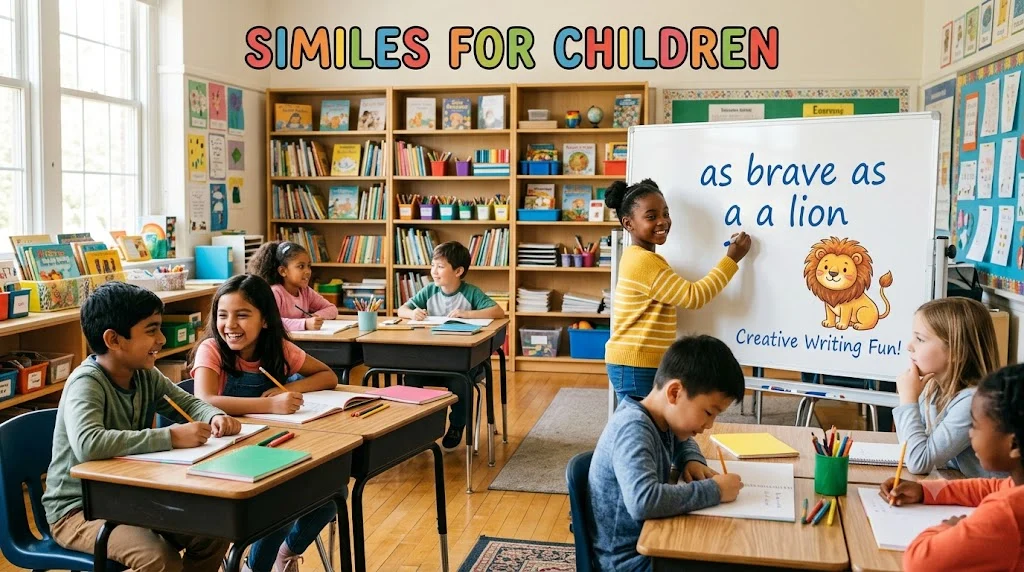
12. As Brave as a Lion
Meaning: Extremely courageous and fearless
This is perhaps the most classic simile for bravery, appearing in virtually every collection .
Examples in Writing:
- “She was as brave as a lion when she stood up for her friend.”
- “The firefighter was as brave as a lion when he saved the puppy.”
- “He stood in front of the whole school assembly as brave as a lion, delivering his speech with confidence.”
When to Use: Perfect for describing a child facing a fear, standing up for someone, or trying something new and challenging.
13. As Gentle as a Lamb
Meaning: Very kind, soft, and considerate
This simile evokes tenderness and gentle care .
Examples in Writing:
- “The baby was as gentle as a lamb, never crying or fussing.”
- “He held the tiny kitten in his arms as gentle as a lamb, careful not to hurt it.”
- “She was as gentle as a lamb with her younger sister, always patient and kind.”
When to Use: Beautiful for describing caring interactions with younger children, pets, or in tender moments.
14. As Sweet as Honey
Meaning: Very kind, loving, and delightful
This simile appears across multiple sources as a classic way to describe a kind heart .
Examples in Writing:
- “Grandma is as sweet as honey whenever she tells us stories.”
- “My little sister is as sweet as honey when she brings me handmade cards.”
- “Her note was as sweet as honey, filled with kind words and hearts.”
15. As Happy as a Clam
Meaning: Very content and joyful
This simile has a charming maritime origin—clams are supposedly happiest at high tide when they’re covered by water .
Examples in Writing:
- “I was as happy as a clam at high tide when I got my new bicycle.”
- “After finishing his homework, he felt as happy as a clam.”
- “She was as happy as a clam on the last day of school.”
16. As Proud as a Peacock
Meaning: Feeling very proud or confident
This simile captures the joy of accomplishment and the natural desire to share success .
Examples in Writing:
- “He was as proud as a peacock after his drawing won first prize.”
- “She walked to the stage as proud as a peacock, holding her trophy high.”
- “He puffed out his chest as proud as a peacock, showing everyone his achievement.”
17. As Quiet as a Mouse
Meaning: Very silent and discreet
This simile helps describe those rare moments when children are actually being quiet .
Examples in Writing:
- “He tiptoed into the room as quiet as a mouse, not wanting to wake his baby sister.”
- “She stayed as quiet as a mouse during the movie, completely captivated.”
- “The library was as quiet as a mouse, with everyone focused on their books.”
18. As Gentle as a Dove
Meaning: Tender and compassionate
This simile evokes peacefulness and kindness .
Examples in Writing:
- “In her care, the younger kids were as gentle as a dove, showing kindness to one another.”
- “She was as gentle as a dove when comforting her crying friend.”
- “His touch was as gentle as a dove’s feather, soft and reassuring.”
Similes for Describing Children’s Creativity and Imagination
Children have remarkable imaginations, and these similes capture that wonderful quality.
19. As Bright as the Morning Sun
Meaning: Radiant and full of potential
This simile celebrates the hope and promise that children represent .
Examples in Writing:
- “Her smile was as bright as the morning sun, lighting up the whole room.”
- “He looked as bright as the morning sun on field day, full of anticipation.”
- She greeted everyone as bright as the morning sun on a happy day.
When to Use: Perfect for describing a child’s presence lighting up a room or a moment of pure joy.
20. As Fresh as a Spring Morning
Meaning: Full of energy and newness
This simile captures that wonderful sense of a new day, a fresh start .
Examples in Writing:
- “She felt as fresh as a spring morning on the first day of school.”
- “His jokes were as fresh as a spring breeze, bringing laughter to everyone.”
- “The class felt as fresh as a spring morning after the field trip, full of stories to share.”
21. Like a New Book with Blank Pages
Meaning: Full of possibilities and potential
This beautiful simile compares a child’s future to a blank book waiting to be filled .
Examples in Writing:
- “The first day of school felt like a new book with blank pages, ready to be written.”
- His new journal was like a book waiting for stories, full of endless possibilities.
- “Her mind was like a blank book ready to be filled with knowledge and adventures.”
When to Use: This simile is especially powerful for the start of the school year, a child’s first day at something new, or when describing a child’s unlimited potential.
22. Like a Story Waiting to Be Told
Meaning: Full of adventures and potential
This simile connects to the idea that every child has a unique story to share .
Examples in Writing:
- “His life was like a story waiting to be told, full of adventures and surprises.”
- “Their day felt like a chapter in a book, each moment adding to the narrative.”
- “Her dreams were like books waiting to open, full of excitement and wonder.”
23. As Colorful as a Crayon Box
Meaning: Full of color and joy
This simile captures the vibrant, colorful nature of childhood .
Examples in Writing:
- “Her dress was as colorful as a crayon box, making her stand out in the crowd.”
- “The poster was as colorful as a crayon box, bright and fun.”
- “His imagination was as colorful as a brand-new box of crayons.”
24. As Bright as a Star
Meaning: Very brilliant and shining with potential
This simile captures the unique sparkle of every child .
Examples in Writing:
- “Her idea was as bright as a star, shining with creativity.”
- “His smile was as bright as a star in the night sky.”
- “She shone as bright as a star during the talent show.”
Similes for Describing Children’s Actions and Behaviors
25. As Busy as a Bee
Meaning: Very active and hardworking
This simile captures children’s constant activity and industriousness .
Examples in Writing:
- “Emma was as busy as a bee, finishing her school project before the deadline.”
- “She buzzed around the classroom as busy as a bee, gathering crayons and papers.”
- “The kitchen was filled with children as busy as bees preparing for the bake sale.”
26. As Silly as a Clown
Meaning: Very funny and playful
This simile captures the pure joy of being silly and making others laugh .
Examples in Writing:
- “He made faces as silly as a clown, cracking everyone up.”
- “Their dance moves were as silly as a clown’s, all floppy and fun.”
- “She was as silly as a circus clown during lunch, telling jokes and making faces.”
27. As Stubborn as a Mule
Meaning: Very determined and unwilling to change
This simile describes that wonderful (and sometimes frustrating) determination children can show .
Examples in Writing:
- “My little brother can be as stubborn as a mule when he doesn’t want to share his toys.”
- “She was as stubborn as a mule, refusing to give up until she solved the puzzle.”
- “He sat cross-legged and crossed his arms, as stubborn as a mule.”
28. As Slippery as an Eel
Meaning: Hard to hold onto or catch
This simile captures children’s ability to wriggle away when they don’t want to be caught .
Examples in Writing:
- “The soap was as slippery as an eel in his hands.”
- “He wiggled away as slippery as an eel, dodging his mother’s grasp.”
- “She ran through the crowd as slippery as an eel, impossible to catch.”
Similes for Describing Children’s Physical Traits
29. As Tall as a Giraffe
Meaning: Very tall
This simile helps describe children who are growing quickly .
Examples in Writing:
- “My uncle is as tall as a giraffe, reaching the highest shelves.”
- “The basketball player looked as tall as a giraffe on the court.”
- “He’s growing as tall as a tree, shooting up over the summer.”
30. As Light as a Feather
Meaning: Very lightweight
This simile is perfect for describing how light a child feels .
Examples in Writing:
- “The kitten was as light as a feather in my hands.”
- “Her backpack felt as light as a feather today, with no heavy books.”
- “I felt as light as a feather when I jumped onto the trampoline.”
31. As Fast as a Racecar
Meaning: Extremely fast
This simile appeals to children’s love of speed and racing .
Examples in Writing:
- “She ran as fast as a racecar around the track.”
- “His thoughts zoomed as fast as a racecar, processing everything quickly.”
- Their game moved as fast as a speeding racecar, everyone running and laughing.
32. As Quick as a Squirrel
Meaning: Very fast and alert
This simile captures children’s quick movements, especially when they’re focused on something .
Examples in Writing:
- “He ran across the playground as quick as a squirrel.”
- “She grabbed her pencil as quick as a squirrel, ready to write.”
- “The kids were as quick as squirrels during tag, darting in all directions.”
Similes for Describing Children’s Reactions and Feelings
33. As Excited as a Kid on Christmas
Meaning: Extremely thrilled and full of anticipation
This simile taps into the universal excitement children feel on Christmas morning .
Examples in Writing:
- She was as excited as a kid on Christmas before the field trip.
- “He looked as excited as a kid on Christmas opening his gift.”
- “They were as excited as kids on Christmas morning, barely able to sit still.”
34. As Sleepy as a Bear in Winter
Meaning: Very tired and ready to sleep
This simile uses the image of a hibernating bear to describe profound tiredness .
Examples in Writing:
- “After our long camping trip, I was as sleepy as a bear in winter.”
- “He felt as sleepy as a bear after eating a big meal.”
- “She could barely keep her eyes open, as sleepy as a bear ready for hibernation.”
35. As Hungry as a Wolf
Meaning: Extremely hungry
This simile describes that ravenous hunger children often feel after playing hard .
Examples in Writing:
- “After soccer practice, he was as hungry as a wolf.”
- I came home hungry as a wolf, devouring my dinner in minutes.
- “The children were as hungry as wolves after running around all afternoon.”
Teaching Similes to Children: Practical Activities and Exercises
Understanding Similes Through Reading
One of the best ways to teach similes is through exposure. Children’s books are full of wonderful similes that make reading more enjoyable and educational. Look for picture books that use similes creatively, like Norton Juster’s “As: A Surfeit of Similes,” which the author describes as “a rollicking batch of playful similes” . When reading together, pause and ask:
- “What is being compared?”
- “What picture does this create in your mind?”
- “Why do you think the author chose this comparison?”
Creative Writing Activity: The Simile Journal
This simple activity has been recommended across various educational resources . Ask children to keep a “Simile Journal” where they write down similes they hear or create. Here’s how to make it engaging:
- Observation: Describe everyday objects using similes
- “The sun is like a golden coin.”
- “The clouds are as fluffy as cotton candy.”
- “The rain sounds like tiny fingers tapping on the window.”
- Emotions: Describe how they feel
- “I’m as happy as a fish in water.”
- “I’m as nervous as a cat on a hot tin roof.”
- People: Describe family members and friends
- “Dad is as strong as an ox.”
- “Mom is as sweet as honey.”
The Sentence Transformation Game
This is a simple but powerful exercise :
- Start with a basic sentence
- “She was kind.”
- “He ran quickly.”
- “The house was messy.”
- Transform it using similes
- “She was as gentle as a lamb.”
- “He ran as fast as a cheetah.”
- “The house was as messy as a pig’s sty.”
Drawing Similes
Ask children to draw what a simile might look like. For example, what does “as bright as the sun” look like? What about “as quiet as a mouse”? This helps children visualize the comparison and makes it more memorable.
Simile Bingo
Create bingo cards with different similes. Call out the meaning, and children mark the matching simile. This game makes learning fun and reinforces understanding.
Common Mistakes to Avoid When Teaching Similes
Confusing Similes and Metaphors
It’s important to help children understand the difference. A simile uses “like” or “as” to make a comparison. A metaphor makes a direct comparison without using these words.
Simile: “Her smile was as bright as the sun.”
Metaphor: “She was sunshine.”
Using Overly Complex Comparisons
For children, the best similes are simple and use familiar images. “As quick as a blink” works better than something like “As fleet-footed as Hermes in Greek mythology.”
Forgetting the “As” or “Like”
Children sometimes forget to include the connecting word. Remind them that similes always compare things using “like” or “as.
Making Comparisons That Don’t Make Sense
A good simile should create a clear picture. “As quiet as the ocean” doesn’t work because oceans are noisy. Help children think about whether the comparison actually fits.
50 Essential Similes for Children: A Quick Reference List
| Simile | Meaning |
|---|---|
| As playful as a puppy | Full of energy and fun |
| As curious as a cat | Always asking questions, exploring |
| As brave as a lion | Courageous and fearless |
| As happy as a clam | Very content and joyful |
| As quiet as a mouse | Very silent and discreet |
| As busy as a bee | Hardworking and active |
| As sweet as honey | Kind and loving |
| As proud as a peacock | Very proud or confident |
| As gentle as a lamb | Soft and kind |
| As fast as a cheetah | Extremely fast |
| As bright as the sun | Very smart or cheerful |
| As slow as a snail | Moving very slowly |
| As strong as an ox | Very strong |
| As light as a feather | Very lightweight |
| As tall as a giraffe | Very tall |
| As cool as a cucumber | Very calm |
| As sharp as a tack | Very smart |
| As stubborn as a mule | Determined, won’t change |
| As silly as a clown | Very funny and playful |
| As clear as glass | Very easy to understand |
| As fresh as a daisy | Full of energy and life |
| As loud as thunder | Very noisy |
| As sneaky as a fox | Tricky and clever |
| As jumpy as popcorn | Moving around a lot |
| As colorful as a crayon box | Full of colors and brightness |
| As bouncy as a trampoline | Always moving and cheerful |
| As quick as a blink | Very fast |
| As bright as a button | Smart and quick-witted |
| As slippery as an eel | Hard to hold or catch |
| As sleepy as a bear | Very tired |
| As hungry as a wolf | Extremely hungry |
| As gentle as a dove | Tender and compassionate |
| As fresh as a spring morning | Full of energy and newness |
| As bright as a star | Very brilliant and shining |
| As adventurous as a pirate | Brave and seeking excitement |
| As innocent as a new bloom | Pure and unblemished |
| As joyful as a songbird | Exuberant and expressive |
| As restless as the wind | Never still, always moving |
| As mysterious as the stars | Full of wonder and unknown depths |
| As spirited as a wild horse | Free-spirited and unbridled |
| As hopeful as a dawn | Embodies optimism and new beginnings |
| As limitless as the sky | Infinite in potential and possibilities |
| As wild as a roller coaster | Full of ups and downs, exciting |
| As bouncy as a ball | Very energetic and lively |
| As sweet as candy | Very kind and loving |
| As fast as a rocket | Very speedy |
| As loud as a marching band | Very noisy and full of life |
| As brave as a superhero | Very courageous |
| As quick as a hiccup | Very fast, over in a flash |
| As full of life as a buzzing bee | Very busy and active |
| As excited as a kid on Christmas | Extremely thrilled |
FAQs
What are similes for children?
Similes for children are comparisons that use “like” or “as” to describe traits, actions, or feelings in a way that’s easy for young minds to understand. Examples include “as playful as a puppy” or “as curious as a cat” .
Why should children learn similes?
Learning similes helps children improve their writing skills, understand stories better, think creatively, and communicate their feelings more precisely .
How can I help my child understand similes?
Read books together that use similes, point out similes in everyday speech, and practice creating new similes together. The “Simile Journal” activity is a great place to start .
What’s the difference between a simile and a metaphor?
A simile uses “like” or “as” to make a comparison (e.g., “as brave as a lion”), while a metaphor makes a direct comparison without these words (e.g., “She is a lion in battle”) .
What are some simple similes for young children?
Simple similes for young children include:
- “As fast as a rocket”
- “As loud as thunder”
- “As sweet as candy”
- “As small as a pebble”
- “As bright as the sun”
How do you write a simile?
To write a simile, identify what you want to describe and think of something familiar that shares a similar quality. Then connect them using “like” or “as” .
Conclusion
Similes are powerful tools that help children express themselves more vividly, understand language more deeply, and explore their creativity more fully. Whether they’re describing their energy as “as bouncy as a trampoline” or their curiosity as “as curious as a cat,” similes bring their writing to life.
As Norton Juster, author of “As: A Surfeit of Similes,” understood, similes “reveal the essence of whatever we want to describe to enlarge our understanding or perception of human experience and observation” . By teaching children to use similes, we’re giving them the paintbrushes to color their world with words.
The similes we’ve explored in this guide are just the beginning. Encourage children to observe the world around them, notice the qualities of different things, and create their own original similes. With practice, they’ll develop a rich vocabulary of comparisons that will serve them well throughout their writing lives.
Remember, the best similes come from genuine observation. Pay attention to the small acts of kindness, moments of joy, and flashes of curiosity that surround you. Sometimes a single thoughtful comparison can reveal more about a child’s heart than pages of explanation ever could.







1 thought on “Similes For Children | Creative Comparisons For Young Minds In 2026”