Quick Answer
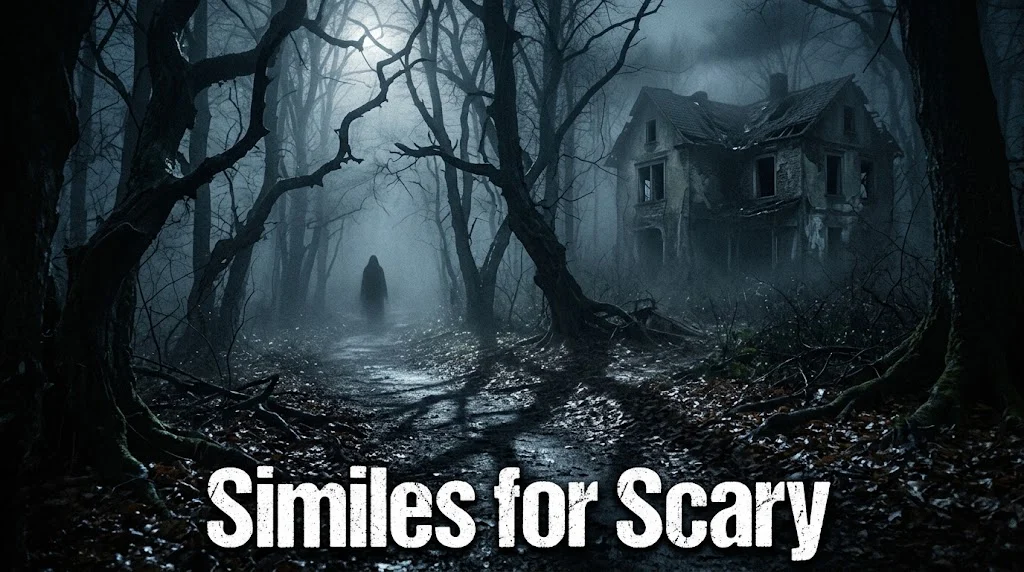
Similes for scary compare frightening situations and experiences using “like” or “as” to create vivid, visceral images that evoke fear. They help writers convey dread, terror, and unease by connecting abstract fear to tangible, recognizable sensations. Common examples include “as dark as a crypt,” “like footsteps in an empty hallway,” and “as cold as a corpse’s touch.”
Fear is one of the most primal human emotions, yet describing it effectively in writing remains a challenge for many authors.
Simply telling readers that a character is “scared” or that a place is “creepy” rarely generates the kind of visceral response that makes horror stories memorable. The reader needs to feel the fear, not just read about it. That’s where similes become essential tools in a writer’s arsenal.
By comparing frightening experiences to familiar sensations, objects, and situations, similes create instant emotional connections. A dark room becomes “as black as a grave,” a sudden noise sounds “like bones cracking in the distance,” and a threatening presence feels “like icy fingers trailing down your spine.”
These comparisons transform abstract terror into tangible imagery that readers can see, hear, and almost feel. Whether you’re crafting horror fiction, thriller novels, suspense scenes, poetry, or even Halloween content, the right simile can elevate your description from merely informative to genuinely chilling.
This comprehensive guide explores powerful similes for scary situations, organized by the specific types of fear they evoke. Each entry includes detailed explanations, why the comparison works, alternative expressions, and practical examples you can adapt for your own writing.
Quick List of Similes for Scary
| Simile | Meaning |
|---|---|
| As dark as a crypt | Extremely dark and foreboding |
| Like a scream in an empty house | Abrupt, jarring, and unsettling |
| As cold as a corpse’s touch | Unnervingly cold and lifeless |
| Like footsteps in a deserted hallway | Signs of presence where none should exist |
| As still as death | Absolute, unnatural stillness |
| Like broken glass underfoot | Sharp, dangerous, and threatening |
| As silent as a graveyard | Oppressive, unnatural silence |
| Like a trap snapping shut | Sudden, inescapable danger |
| As pale as a ghost | Unnaturally white from fear |
| Like shadows that breathe | Alive and menacing darkness |
Similes for Darkness and Atmosphere
1. As Dark as a Crypt
Meaning: Describes an environment so dark it feels oppressive and tomb-like, suggesting confinement and the presence of death.
Why It Works: Crypts are burial chambers places associated with death, decay, and the supernatural. Comparing darkness to a crypt immediately evokes feelings of being trapped underground with no escape.
Alternative Expressions:
- As black as a burial shroud
- Like being sealed in a coffin
- As dark as a moonless night in a forest
Examples in Writing:
Formal Example:
The basement stretched before them, as dark as a crypt, with only the faint outline of stairs visible in the gloom.
Casual Example:
Walking through that abandoned tunnel felt like stepping into a crypt no light, no air, just the sense of something watching.
Creative Example:
Darkness swallowed the corridor whole, as thick and final as the inside of a crypt, pressing against their eyes until they couldn’t tell if their lids were open or closed.
2. Like a Tomb That Has Been Sealed
Meaning: Describes a space that feels closed off, suffocating, and permanently cut off from the outside world.
Why It Works: Tombs are final resting places once sealed, they represent inescapable confinement. This simile triggers claustrophobia and fear of being trapped.
Alternative Expressions:
- Like being buried alive
- As sealed as a pharaoh’s grave
- Like a vault that’s been welded shut
Examples in Writing:
Formal Example:
The room felt like a tomb that had been sealed for centuries airless, timeless, and utterly silent.
Casual Example:
Once that door clicked shut, the whole place felt like a tomb. I couldn’t hear anything from outside.
Creative Example:
Silence pressed in from all sides, heavy as stone, turning the small apartment into a tomb that had swallowed every sound for a hundred years.
3. As Black as Pitch
Meaning: Darkness so complete that it obscures all vision, creating disorientation and vulnerability.
Why It Works: Pitch is thick, sticky, and opaque it doesn’t just block light, it seems to absorb it completely. The comparison suggests a darkness that clings and suffocates.
Alternative Expressions:
- As black as a raven’s wing
- Like being swallowed by ink
- As dark as coal in a mine
Examples in Writing:
Formal Example:
The cave mouth yawned before them, as black as pitch, swallowing every beam of their flashlights.
Casual Example:
I couldn’t see my hand in front of my face the night was as black as pitch out there.
Creative Example:
Darkness flooded through the broken window like liquid pitch, coating every surface, erasing shapes and distances until up and down lost all meaning.
4. Like Shadows That Breathe
Meaning: Describes darkness or shadows that seem alive and animate, suggesting a malevolent presence.
Why It Works: The juxtaposition of “shadows” and “breathe” creates an unsettling image darkness should be passive, but this simile gives it life and intention.
Alternative Expressions:
- Like darkness with a pulse
- As alive as crawling ivy
- Like shadows that watch
Examples in Writing:
Formal Example:
The corners of the room shifted like shadows that breathed, expanding and contracting with an unnatural rhythm.
Casual Example:
Those trees cast shadows that seemed to breathe every time I looked away, they’d moved closer.
Creative Example:
Darkness pooled in the corners like a living thing, shadows expanding with each slow, wet breath she couldn’t hear but somehow felt against her skin.
5. As Still as a Corpse
Meaning: Complete absence of motion, suggesting death or the potential for sudden, violent movement.
Why It Works: Corpses represent the ultimate stillness the absence of life. This simile creates tension because the reader knows anything so still might be waiting to move.
Alternative Expressions:
- As motionless as a statue in a graveyard
- Like a snake before it strikes
- As frozen as a prey animal
Examples in Writing:
Formal Example:
The figure stood as still as a corpse, not even the rise and fall of breath disturbing its outline.
Casual Example:
He didn’t move a muscle. It was like looking at a corpse no twitch, no blink, nothing.
Creative Example:
She held herself as still as the dead, every muscle locked, lungs refusing to expand, because if she made even the smallest sound, she knew whatever stood in the shadows would hear.
Similes for Sounds That Terrify
6. Like a Scream in an Empty House
Meaning: A sound that is jarring, unexpected, and echoes with loneliness and terror.
Why It Works: Empty houses represent abandonment when a scream occurs there, there’s no one to hear it, no one to help. The simile suggests both the sound itself and the isolation that makes it frightening.
Alternative Expressions:
- Like a cry for help in a vacuum
- As sharp as breaking glass at midnight
- Like a shriek that goes unanswered
Examples in Writing:
Formal Example:
The floorboard’s groan cut through the silence like a scream in an empty house, echoing with no one to hear.
Casual Example:
That sound was like a scream in an empty house just this sudden, horrible noise with nothing behind it.
Creative Example:
Her gasp rang through the hallway like a scream in an abandoned mansion, bouncing off walls that had forgotten the sound of living voices.
7. Like Footsteps in a Deserted Hallway
Meaning: Sounds that suggest a presence where none should exist, creating anticipation and dread.
Why It Works: The combination of “footsteps” and “deserted” creates a paradox sound implies movement, but an empty place shouldn’t have movement. This contradiction creates unease.
Alternative Expressions:
- Like breathing in an empty room
- Like whispers from a vacant house
- As clear as knocking from a grave
Examples in Writing:
Formal Example:
The creaking above them sounded like footsteps in a deserted hallway measured, deliberate, and impossible.
Casual Example:
I heard it again footsteps like someone pacing a hallway that shouldn’t have anyone in it.
Creative Example:
Slow, deliberate, the sound traveled from the upper floor like footsteps exploring an empty corridor, each one a question about what might be walking there.
8. Like Bones Cracking in the Distance
Meaning: Sharp, disturbing sounds that suggest violence or the threat of physical harm.
Why It Works: Everyone knows the sound of bones breaking it’s universally recognized as a sign of injury or death. Even at a distance, it triggers an instinctual fear response.
Alternative Expressions:
- Like twigs snapping under unseen feet
- As sharp as a neck breaking
- Like joints popping in a corpse
Examples in Writing:
Formal Example:
The branches outside snapped like bones cracking in the distance, each sound a reminder that something was out there.
Casual Example:
I heard this crunching sound, like bones breaking somewhere out in the dark.
Creative Example:
The forest floor surrendered to their steps with sounds like bones grinding together each footfall a reminder that something in these woods had died violently and often.
9. Like a Whisper That Shouldn’t Be There
Meaning: Sounds that are barely audible but feel wrong or out of place.
Why It Works: The phrase “shouldn’t be there” acknowledges the audience’s awareness that something is off. It’s subtle horror rather than overt terror.
Alternative Expressions:
- Like a voice with no speaker
- As faint as a cry from a sealed room
- Like murmurs from an empty bed
Examples in Writing:
Formal Example:
Her name drifted through the darkness like a whisper that shouldn’t be there, soft and wrong and horrifyingly close.
Casual Example:
I thought I heard someone say my name, but it was like a whisper from nowhere no mouth, no breath, just words.
Creative Example:
The sound wrapped around her like a whisper that had no right to exist, curling into her ear with a warmth that could only belong to the living.
10. Like Glass Shattering at Midnight
Meaning: Abrupt, shocking sounds that interrupt silence and signal danger or intrusion.
Why It Works: Glass breaking is universally recognized as a sound of violence or intrusion. Adding “midnight” emphasizes the vulnerability of the hour.
Alternative Expressions:
- Like a window giving way
- As sharp as a mirror cracking
- Like the world breaking apart
Examples in Writing:
Formal Example:
The silence broke like glass shattering at midnight sudden, violent, and leaving behind only jagged edges.
Casual Example:
That crash was like glass breaking in the middle of the night. My heart just stopped.
Creative Example:
The wine glass hit the floor with a sound like midnight shattering, each shard a piece of the peace that had existed just a heartbeat before.
Similes for Icy and Unsettling Sensations
11. As Cold as a Corpse’s Touch
Meaning: A chill that goes beyond temperature one that suggests death and finality.
Why It Works: Corpses are the ultimate symbol of death’s coldness. This comparison connects physical sensation to mortality, making the cold feel like a prophecy.
Alternative Expressions:
- As cold as a grave’s kiss
- Like frost on a coffin lid
- As chill as an undertaker’s hands
Examples in Writing:
Formal Example:
His hand wrapped around her wrist, as cold as a corpse’s touch, and she knew before she looked that something was wrong.
Casual Example:
When he grabbed my arm, it was like touching a corpse just this dead, cold weight.
Creative Example:
Cold seeped through her dress where his fingers pressed, as lifeless and chilling as a hand that had never known warmth, that would never know warmth again.
12. Like Icy Fingers Trailing Down Your Spine
Meaning: A creeping, unnerving sensation that suggests an unseen presence.
Why It Works: The image of being touched by an invisible hand is deeply unsettling. The spine is vulnerable touching it suggests intimate threat.
Alternative Expressions:
- As cold as a ghost’s breath on your neck
- Like frost spreading through your veins
- As chilling as a dead man’s stare
Examples in Writing:
Formal Example:
The warning crawled across her skin like icy fingers trailing down her spine.
Casual Example:
I got this feeling like someone was tracing my spine with cold fingers. I couldn’t shake it.
Creative Example:
Fear dripped down her back like frozen water, each drop a finger tracing the bones of her spine, counting them, learning them, claiming them.
13. As Pale as a Ghost
Meaning: An unnatural pallor that betrays extreme fear, shock, or horror.
Why It Works: Ghosts are dead, pale, and associated with the supernatural. Comparing someone’s complexion to a ghost suggests they’re on the threshold between life and death or at least that they’ve seen something that might put them there.
Alternative Expressions:
- As white as a shroud
- Like milk that’s curdled
- As bloodless as a corpse’s face
Examples in Writing:
Formal Example:
His face drained of every color, as pale as a ghost, when he recognized the voice on the phone.
Casual Example:
She went as pale as a ghost when she saw what was in the closet.
Creative Example:
The blood fled from his cheeks like a tide retreating, leaving him as pale as the ghost he suddenly believed in, as pale as the things he’d sworn couldn’t exist.
14. Like a Current of Ice Through Your Veins
Meaning: Fear that physically manifests as a sensation of cold flowing through the body.
Why It Works: Veins are the body’s river system suggesting something cold flowing through them implies that the fear has entered the body and is spreading from within.
Alternative Expressions:
- As cold as poison in the blood
- Like winter filling your arteries
- As chilling as a stroke of dread
Examples in Writing:
Formal Example:
The realization shot through her like a current of ice through her veins, freezing every thought, every motion.
Casual Example:
I felt this cold rush through my veins, like someone had filled me with ice water.
Creative Example:
Recognition flowed through him like a glacial river cold, slow, and carrying the bones of everything he’d thought was safe.
15. As Hollow as a Dead Man’s Eyes
Meaning: Empty, soulless, and terrifyingly vacant.
Why It Works: Dead eyes represent the absence of everything that makes a person human consciousness, emotion, life. Comparing anything to them suggests a void that can’t be filled.
Alternative Expressions:
- Like looking into nothing
- As empty as a skull’s sockets
- Like windows into a vacant house
Examples in Writing:
Formal Example:
His gaze fixed on her, as hollow as a dead man’s eyes, seeing nothing but also seeing everything.
Casual Example:
He looked at me with eyes like a dead man’s just empty, just nothing.
Creative Example:
She stared into the darkness until her eyes felt as hollow as a corpse’s, vision going dark at the edges, everything fading into that perfect, empty nothing.
Similes for Threat and Danger
16. Like a Trap Snapping Shut
Meaning: A sudden moment when danger becomes inescapable, often after a false sense of security.
Why It Works: Traps are designed to catch they spring without warning, and once they do, escape is impossible. This comparison suggests that the victim has been lured into a situation they can’t escape.
Alternative Expressions:
- Like a door slamming behind you
- As final as a guillotine’s drop
- Like jaws closing around prey
Examples in Writing:
Formal Example:
The moment he stepped inside, the lock clicked behind him like a trap snapping shut.
Casual Example:
I knew as soon as the door closed that it was like a trap I wasn’t getting out.
Creative Example:
The lights went out with a sound like a trap closing final, absolute, and promising that what was waiting wasn’t going to let go.
17. Like a Blade Pressed Against Skin
Meaning: Constant, immediate threat that is just short of being acted upon.
Why It Works: A blade against skin creates tension it hasn’t cut yet, but the potential is always there. It’s a threat that’s present but not yet realized.
Alternative Expressions:
- Like a knife held to the throat
- As sharp as a razor’s edge on flesh
- Like a needle hovering above the eye
Examples in Writing:
Formal Example:
The silence pressed against them like a blade against skin waiting, patient, and capable of cutting at any moment.
Casual Example:
Every second felt like a knife on my throat I couldn’t breathe, couldn’t move, couldn’t do anything.
Creative Example:
Tension held her like a knife pressed to her throat just enough pressure to feel, just enough threat to keep her exactly where they wanted her.
18. Like a Predator’s Eyes in the Dark
Meaning: The sense of being watched with predatory intent.
Why It Works: Predators are patient hunters they watch, they wait, and they strike when least expected. This simile creates anticipation of an attack that hasn’t happened yet.
Alternative Expressions:
- Like being stalked in tall grass
- As watching as a wolf’s gaze
- Like hungry eyes in shadows
Examples in Writing:
Formal Example:
Something watched them from the treeline, its gaze like a predator’s eyes in the dark patient, calculating, and completely certain of its hunger.
Casual Example:
I felt it watching me, like a predator in the dark. I couldn’t see it, but I knew it was there.
Creative Example:
The weight of the hunter’s gaze settled on her like a blanket made of hunger warm in the worst way, patient in the worst way, watching with the worst kind of promise.
19. Like a Spider’s Web Across the Face
Meaning: A creeping, clinging sensation that suggests being caught in something unseen and inescapable.
Why It Works: Spider webs are nearly invisible, sticky, and often touched before they’re seen. The metaphor suggests being caught in something you didn’t realize was there until it was too late.
Alternative Expressions:
- Like cobwebs on exposed skin
- As clinging as a spider’s silk
- Like threads of a trap
Examples in Writing:
Formal Example:
The realization settled over him like a spider’s web across his face soft, clinging, and far too intimate.
Casual Example:
I walked into something, and it felt like spider webs all over me. That’s when I knew I was in its territory.
Creative Example:
The truth of what he’d done settled on her like silk across her face something that could be brushed away, except it wasn’t silk, and she wasn’t a fly, and the spider was still hungry.
20. Like a Guillotine’s Shadow
Meaning: The anticipation of something terrible and inevitable approaching.
Why It Works: Guillotines deliver death with certainty and finality. Their shadow represents the doom that’s coming, whether the victim sees it or not.
Alternative Expressions:
- Like the shadow of the noose
- As final as death’s own shadow
- Like a death sentence waiting to be read
Examples in Writing:
Formal Example:
The knowledge hung over them like a guillotine’s shadow, dark and patient and utterly certain.
Casual Example:
That feeling never went away like the shadow of something waiting to drop.
Creative Example:
The future stretched before him, as dark and inevitable as the shadow of a blade, and he knew that blade would fall eventually. It was just a matter of when.
Similes for Unnatural and Supernatural Fear
21. Like Something That Shouldn’t Exist
Meaning: Fear that comes from encountering things that violate the natural order.
Why It Works: The phrase “shouldn’t exist” captures the specific horror of the unnatural the sense that what you’re seeing is impossible, yet undeniably present.
Alternative Expressions:
- Like a nightmare given flesh
- As wrong as a corpse that still breathes
- Like a story that shouldn’t be real
Examples in Writing:
Formal Example:
It moved like something that shouldn’t exist, joints bending in ways joints weren’t meant to bend.
Casual Example:
The thing in the corner looked like something that shouldn’t exist. I couldn’t even describe it because it didn’t make sense.
Creative Example:
She watched it step into the light like a creature that had no business being alive wrong angles, wrong shadows, everything about it screaming that it came from someplace never meant to be visited.
22. Like a Door Opening to Nowhere
Meaning: A situation or choice that leads only to uncertainty, emptiness, and potential danger.
Why It Works: Doors represent choices, passages, and new beginnings. A door that opens to nowhere subverts that expectation instead of leading somewhere, it leads into nothing.
Alternative Expressions:
- Like stepping off a cliff you can’t see
- As empty as a promise from the dead
- Like a path that goes nowhere
Examples in Writing:
Formal Example:
The invitation felt like a door opening to nowhere tempting, yes, but with nothing on the other side except darkness.
Casual Example:
Every answer just led to more questions, like doors to empty rooms. Nothing was solid.
Creative Example:
She opened the door like it was a mouth that had always been waiting to swallow her, and on the other side was the same nothing that had been there before, only darker, only hungrier.
23. Like Eyes Watching from Every Shadow
Meaning: The sense of being observed from all directions, creating paranoia and helplessness.
Why It Works: This comparison suggests that there is no place of safety the observation is total, inescapable, and comes from everywhere at once.
Alternative Expressions:
- Like being visible in a dark room
- As surrounding as a circle of witnesses
- Like being the center of every gaze
Examples in Writing:
Formal Example:
The weight of unseen eyes pressed on her like eyes watching from every shadow, as though the darkness itself had learned to see.
Casual Example:
I couldn’t shake the feeling that every shadow had eyes in it. I was being watched from everywhere.
Creative Example:
He felt their attention like a physical weight not just being watched, but being consumed, each shadow a pupil dilating to swallow him whole.
24. Like a Reflection That Moves Alone
Meaning: Something is wrong with reality itself a reflection that doesn’t match its source suggests a fundamental break in the natural order.
Why It Works: Reflections are supposed to mimic. When they don’t, it’s deeply unsettling because it violates basic physics. The horror comes from the wrongness of it.
Alternative Expressions:
- Like a shadow that has its own mind
- As wrong as a mirror with no reflection
- Like an echo that speaks first
Examples in Writing:
Formal Example:
The mirror showed him something else entirely like a reflection that moved alone, independent of its source.
Casual Example:
I looked in the mirror and the reflection wasn’t mine. It was like watching someone else use my face.
Creative Example:
She watched the thing in the glass move with a life of its own, a reflection that had divorced itself from its creator, doing in the mirror what she would never dare do in the world.
25. Like a Dream That Knows You’re Dreaming
Meaning: A situation that feels unreal but has a disturbing awareness of your presence.
Why It Works: Dreams become terrifying when they gain awareness. This comparison suggests that the horror is self-aware and is making choices about how to torment you.
Alternative Expressions:
- Like a nightmare with intention
- As aware as a predator in a dream
- Like a hallucination that watches you back
Examples in Writing:
Formal Example:
The figure approached with the certainty of a dream that knows you’re dreaming deliberate, purposeful, and utterly in control.
Casual Example:
It was like being in a nightmare that knew it was a nightmare. Every move I made, it was already there.
Creative Example:
The nightmare had found her sleeping, she knew that much, but what she didn’t know was whether it knew she knew whether it had chosen this form specifically because she’d been afraid of it, or whether it was just coincidentally hungry.
How to Use Scary Similes Effectively
Choose Imagery That Matches Your Subgenre
Different types of horror require different types of similes.
Gothic Horror: Focus on decay, death, and the supernatural.
- “as dark as a crypt”
- “like a tomb that has been sealed”
Psychological Thriller: Focus on internal sensations and paranoia.
- “like a whisper that shouldn’t be there”
- “as hollow as a dead man’s eyes”
Monster/Slasher Horror: Focus on physical threat and violence.
- “like a trap snapping shut”
- “as cold as a corpse’s touch”
Cosmic/Supernatural Horror: Focus on the unnatural and incomprehensible.
- “like something that shouldn’t exist”
- “like a reflection that moves alone”
Create a Progression of Fear
Strong writing often builds fear gradually, using similes that escalate in intensity.
Example Progression:
- Initial Unease: “The basement felt as dark as a crypt.”
- Growing Dread: “A sound came from below, like footsteps in a deserted hallway.”
- Imminent Threat: “The breathing seemed to surround her, like a predator’s eyes in the dark.”
- Terror Realized: “The door clicked shut behind her final, absolute, like a trap snapping shut.”
Avoid Common Simile Mistakes
- Overusing Obvious Comparisons: “As scary as a ghost” is effective occasionally, but relying on it too heavily becomes predictable.
- Mixing Tones: A humorous simile in a serious horror scene can undermine the tension.
- Making It Too Complex: The strongest similes create instant understanding. If the reader has to think too long about what you’re comparing, the fear doesn’t land.
- Using Inappropriate Comparisons: A simile should match the context. “As terrifying as a clown at midnight” works for a story about killer clowns, but might feel forced in a Gothic novel.
Writing Exercise: Create Your Own Scary Similes
Step 1: Start With a Simple Statement
“The house was scary.”
Step 2: Identify What’s Scary About It
- The house is old
- It’s isolated
- Strange sounds come from inside
- You can’t see what’s in the shadows
Step 3: Choose Your Domain of Comparison
Death Domain:
“As quiet as a house where everyone has died”
“Like a mausoleum that someone forgot to lock”
Nature Domain:
“As lonely as a mountain in winter”
“Like a cave where things hibernate and eat”
Human Domain:
“Like a face with no expression”
“As blank as a person who isn’t there”
Step 4: Add Sensory Details
“Weak version: The house was scary.”
Stronger version: “The house stood at the road’s end like a face pressed against a window, watching, waiting for us to see it see us.”
Scary Similes vs. Scary Metaphors
Simile
Uses “like” or “as.”
Example: “The room felt as cold as a corpse’s touch.”
Effect: Similes feel more like comparisons they acknowledge that they’re describing something, which can make the description feel more deliberate, almost like a warning.
Metaphor
Makes a direct comparison.
Example: “The room was a corpse’s touch.”
Effect: Metaphors are more immersive they don’t create distance between the reader and the horror. The room doesn’t feel like death; it is death.
When to Use Each:
- Use similes for building anticipation, because they acknowledge the comparison and make it feel like foreshadowing.
- Use metaphors for moments of peak horror, because they pull the reader directly into the experience.
FAQs
1. What are similes for scary situations?
Similes for scary situations are comparisons using “like” or “as” that describe fear-inducing environments, sensations, or experiences. Examples include “as dark as a crypt,” “like a scream in an empty house,” and “as cold as a corpse’s touch.”
2. Why should writers use scary similes?
Scary similes help readers visualize and emotionally connect with frightening scenes. Instead of simply stating something is “scary,” similes create vivid imagery that evokes genuine fear and tension.
3. What makes a strong scary simile?
A strong scary simile is instantly understandable, matches the tone of the scene, creates a visceral response, and connects an abstract fear to a concrete, recognizable experience.
4. Can scary similes be used outside of horror writing?
Yes! Scary similes are effective in thrillers, suspense novels, crime fiction, dystopian fiction, and even some literary fiction. They can also be used to describe real-life frightening experiences in personal essays or memoirs.
5. How can I create original scary similes?
Observe what scares you in real life eerie silence, sudden sounds, unexpected movements. Think about what those experiences feel like and compare them to other frightening things. For example, “The silence was like someone holding their breath, waiting for me to make the first sound.”
6. What are the most common scary similes?
Common scary similes include:
- As dark as a tomb
- Like a shadow that moves alone
- As cold as ice
- Like something in the corner of your eye
- As still as death
Conclusion
Fear is one of the most powerful emotions a writer can evoke, and similes are among the most effective tools for doing so. A well-crafted comparison can transform a simple description into a moment of genuine dread, making readers feel the cold fingers of terror tracing along their own spines.
The best scary similes do more than describe they create an experience. When you compare a dark room to “a crypt,” you’re not just saying it’s dark; you’re suggesting a specific kind of darkness, one that carries the weight of death and confinement. When you describe a sound as “like footsteps in an empty hallway,” you’re tapping into a universal fear the presence where there should be none.
But similes are not just for horror writers. Suspense, thriller, and even romance writers can benefit from understanding how to create and deploy frightening imagery effectively. Tension relies on the reader’s anticipation of danger, and similes can build that anticipation with remarkable efficiency.
As you write, pay attention to the moments in your story where fear is the primary emotion. Ask yourself what that fear looks like, sounds like, feels like. Then find the comparison that captures that sensation most perfectly.
Sometimes a single chilling simile can accomplish more than a paragraph of straightforward description. The right comparison creates an image that sticks with the reader long after they’ve turned the page a shadow in the corner of their mind that shifts when they’re not quite looking.
So experiment. Take risks. Push beyond the expected comparisons into imagery that is unique, visceral, and deeply unsettling. Your readers will thank you for it they may just need to sleep with the lights on first.
Read More Related Articles:
- Similes for Clean | Comparisons That Capture Purity and Freshness In 2026
- Similes for Big | Comparisons That Describe Size, Scale and Magnitude In 2026
- Similes for Rain | Comparisons to Describe Every Type of Rainfall In 2026