Quick Answer
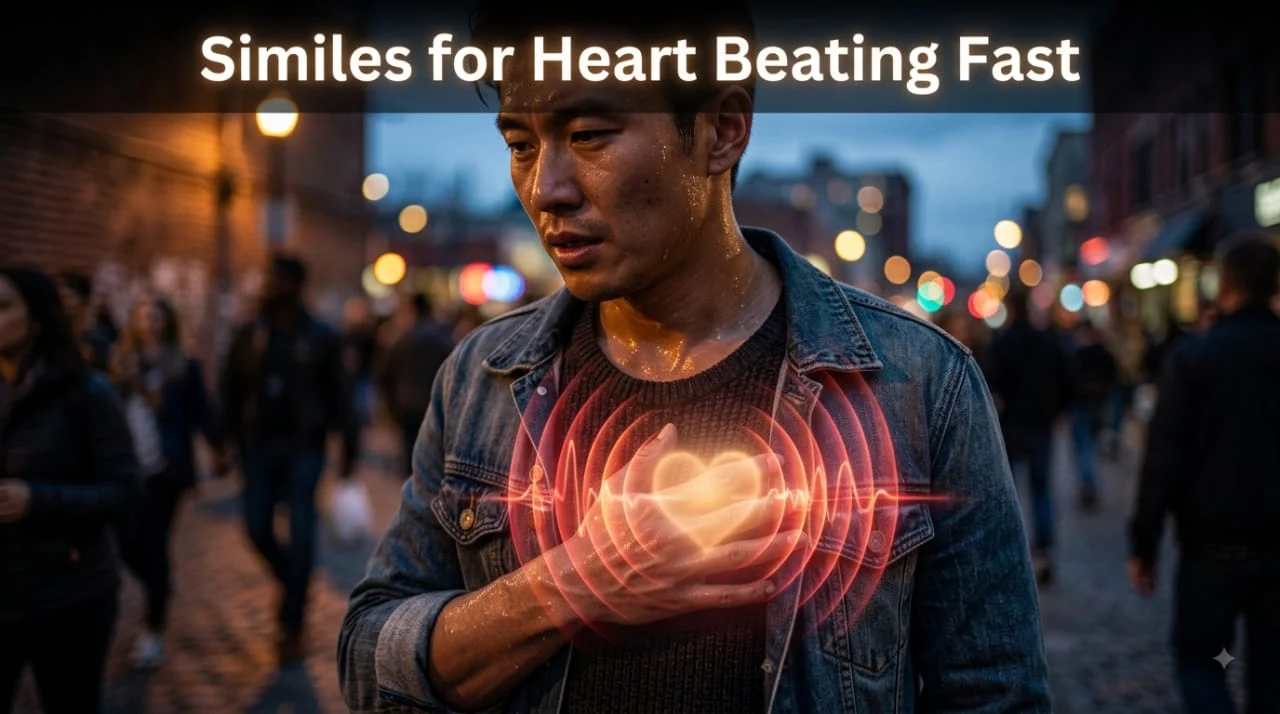
Similes for a beating heart compare a racing pulse to familiar experiences using “like” or “as,” helping writers convey fear, excitement, love, or anxiety through vivid imagery. Whether your character is nervous, thrilled, or terrified, the right comparison transforms simple description into an emotional experience.
Have you ever felt your heart pounding so fiercely that it seemed to drown out every other sound? That moment when time slows down, your breath catches, and all you can hear is the relentless thumping in your chest it’s one of the most universal human experiences.
Yet describing this sensation in writing can be surprisingly tricky. Simply saying “my heart was beating fast” often falls flat, failing to capture the specific flavor of emotion your character is experiencing. Is it the fluttering nervousness of a first date? The adrenaline-fueled pounding of fear? The joyful racing of unexpected good news?
That’s where similes become invaluable.
Similes comparisons using “like” or “as” transform abstract bodily sensations into vivid, relatable imagery that readers can immediately understand and feel. A heart “pounding like thunder” conveys something entirely different from a heart “fluttering like butterfly wings,” and that distinction matters in storytelling.
This comprehensive guide explores over 100 powerful similes for a beating heart, organized by the emotion they convey. Whether you’re writing fiction, poetry, personal essays, or simply want to express yourself more vividly, these comparisons will help you make every heartbeat count.
The Power of Similes for a Beating Heart
Before diving into specific comparisons, it’s worth understanding why similes work so well for describing a racing heart.
A fast heartbeat is an internal sensation something readers can’t directly observe. By comparing it to external, familiar experiences, writers bridge that gap. The reader might not know exactly what your character is feeling, but they know what thunder sounds like, what a hummingbird’s wings look like, or how it feels to stand in a storm.
Key benefits of using heart-beating similes:
- Emotional precision: The type of comparison instantly signals whether the character is afraid, excited, nervous, or in love
- Sensory engagement: These similes engage readers’ senses of sound, sight, and even physical sensation
- Memorable imagery: Vivid comparisons stick in readers’ minds long after they’ve finished reading
- Character depth: The imagery a character uses can reveal their personality, background, and worldview
As one writing expert notes, by using more imaginative and sensory-rich language, “a writer can connect more deeply with the reader, painting a more vivid picture of the character’s internal state”.
Similes for Heart Beating Fast in Fear and Panic
Like a Drum in a Parade
Meaning: Heart beating loudly and rhythmically with intensity.
Explanation: The steady, powerful thumping of a parade drum mirrors the way fear makes the heart pound with predictable force. This comparison works particularly well when the character is anticipating something frightening but not necessarily surprised by it.
Examples:
- “When she saw her favorite band on stage, her heart pounded like a drum in a parade.”
- “His heart beat like a drum in a parade as he awaited the exam results.”
Alternative Expressions:
- Like a bass drum in a marching band
- Like drums of war approaching
Pounding Like Thunder
Meaning: Heart beating hard, loud, and overwhelming.
Explanation: Thunder commands attention it’s impossible to ignore. Comparing a racing heart to thunder suggests the heartbeat has become so powerful it dominates the character’s awareness, much like a thunderclap during a storm.
Examples:
- “During the storm, my heart pounded like thunder in the dark room.”
- “Her heart pounded like thunder as she stepped onto the stage.”
Alternative Expressions:
- Like thunder under my ribs
- Like a thunderstorm in my chest
Like a Jackhammer
Meaning: Extremely fast, powerful, and relentless heartbeat.
Explanation: A jackhammer’s rapid, repetitive pounding mirrors the relentless speed of a heart under intense stress or fear. This simile suggests a heartbeat that’s almost mechanical in its intensity and impossible to control.
Examples:
- “The haunted house made her heart hammer like a jackhammer.”
- “His heart beat like a jackhammer waiting for the interview results.”
Alternative Expressions:
- Like a jackhammer on concrete
- Like a jackhammer in my chest
Like a Trapped Bird
Meaning: Fluttering, panicked heartbeat reflecting anxiety or fear.
Explanation: A bird trapped in a cage beats its wings frantically, desperately trying to escape. This comparison captures the panicked, erratic quality of a heart racing with anxiety or claustrophobic fear.
Examples:
- “Her heart beat like a trapped bird inside her chest.”
- “His heart fluttered like a bird caught in sudden panic.”
Alternative Expressions:
- Like a bird beating against a cage
- Like a trapped sparrow
Like a Startled Rabbit
Meaning: Quick, sudden, nervous heartbeat.
Explanation: A startled rabbit leaps and darts away in an instant. This simile captures the sudden, uncontrollable jolt that fear sends through the body, making the heart race before conscious thought can intervene.
Examples:
- “My heart jumped like a startled rabbit when I heard the floorboard creak.”
- “Her pulse raced like a frightened bunny in the dark alley.”
Alternative Expressions:
- Like a rabbit fleeing from a predator
- Like a wild rabbit in a trap
Like a Hammer on Wood
Meaning: Strong, forceful, percussive heartbeat.
Explanation: Each hammer blow is deliberate, powerful, and resonant. This simile suggests a heartbeat that feels like it’s physically striking against the ribs from the inside, with almost violent force.
Examples:
- “My heart thudded like a hammer on wood as I approached the door.”
- “His chest reverberated as his heart pounded like a hammer on wood.”
Alternative Expressions:
- Like a sledgehammer in my chest
- Like a pounding fist against my ribs
Like a Stormy Sea
Meaning: Turbulent, chaotic, and overwhelming heartbeat.
Explanation: A stormy sea is unpredictable, crashing against rocks, and capable of overwhelming everything in its path. This simile captures the sense of being swept away by fear, unable to control the racing heartbeat.
Examples:
- “Meeting his idol made her heart churn like a stormy sea.”
- “His heart roared like a stormy sea when the car skidded on ice.”
Alternative Expressions:
- Like waves in a tsunami
- Like a raging ocean in my chest
Like Leaves Shaking in the Wind
Meaning: Nervous, trembling, and unsteady heartbeat.
Explanation: Leaves caught in a strong wind tremble and shake uncontrollably. This comparison works well for nervousness that manifests as a trembling, fluttering sensation in the chest rather than aggressive pounding.
Examples:
- “My heart fluttered like leaves in the wind before the speech.”
- “Her pulse shook like autumn foliage in the storm.”
Alternative Expressions:
- Like trembling foliage
- Like leaves in a storm
Like a Fire Alarm
Meaning: Sudden, urgent, alarm-bell heartbeat.
Explanation: A fire alarm signals immediate danger with an insistent, impossible-to-ignore sound. This simile captures the body’s emergency response, where the heart races as if sounding its own internal alarm.
Examples:
- “My heart jumped like a fire alarm when the lights went out.”
- “Her pulse screamed like bells in panic.”
Alternative Expressions:
- Like warning bells in my chest
- Like a panic button pressing inside me
Like a Trapped Mouse
Meaning: Fearful, fluttering, frantic heartbeat.
Explanation: A trapped mouse scurries desperately, darting back and forth in panic. This simile captures the erratic, skittering quality of a heart racing with fear, unable to find calm.
Examples:
- “My heart trembled like a trapped mouse in the dark corridor.”
- “Her pulse skittered like a caged rodent.”
Similes for Heart Beating Fast in Excitement and Joy
Like Fireworks Exploding
Meaning: Heart bursting with excitement, anticipation, or joy.
Explanation: Fireworks are sudden, loud, colorful, and thrilling. This simile captures the explosive, celebratory feeling of a heart racing with pure excitement, where joy seems to burst from the chest.
Examples:
- “Her heart felt like fireworks exploding on New Year’s Eve.”
- “Winning the award made his heart explode like fireworks.”
Alternative Expressions:
- Like rockets bursting in my chest
- Like a celebration in my heart
Like a Galloping Horse
Meaning: Heart racing energetically with excitement or adventure.
Explanation: A horse galloping across an open field is a powerful, joyful image. This simile suggests a heart racing with thrilling momentum, moving forward with energy and purpose.
Examples:
- “Seeing the message from her crush, her heart galloped like a horse across the field.”
- “He felt his heart race like a galloping horse before the competition.”
Alternative Expressions:
- Like a wild horse running free
- Like an untamed stallion galloping
Like a Hummingbird’s Wings
Meaning: Heart fluttering rapidly and lightly with excitement or nervous pleasure.
Explanation: Hummingbirds flap their wings incredibly fast up to 80 times per second. This simile suggests a delicate but rapid heartbeat, perfect for describing the fluttery excitement of a new romance or joyful anticipation.
Examples:
- “His heart raced like a hummingbird’s wings when he stepped onto the stage.”
- “She felt her heart beat like a hummingbird’s wings seeing her crush smile.”
Alternative Expressions:
- Like butterfly wings fluttering
- Like a hummingbird trapped in my ribs
Like a Festival Drumbeat
Meaning: Joyful, rhythmic, celebratory heartbeat.
Explanation: Festival drums are associated with celebration, dancing, and communal joy. This simile captures the happy, rhythmic quality of a heart racing with pure delight.
Examples:
- “My heart danced like a festival drumbeat at the news.”
- “Her pulse moved like celebratory music.”
Alternative Expressions:
- Like celebration drums
- Like a party rhythm in my chest
Like Clapping Hands in Excitement
Meaning: Happy, energetic, spontaneous heartbeat.
Explanation: Clapping is an automatic response to joy or excitement. This simile captures the spontaneous, almost involuntary racing of the heart in moments of happiness.
Examples:
- “My heart clapped like hands in excitement when I saw her.”
- “Her pulse jumped like enthusiastic applause.”
Alternative Expressions:
- Like applause in my chest
- Like happy hands clapping
Like a Rainbow After Rain
Meaning: Heart lifting with sudden, bright happiness.
Explanation: A rainbow after rain signals relief, beauty, and hope. This simile works for moments when excitement follows anxiety or sadness, making the racing heart feel like a welcome relief.
Examples:
- “When she said yes, my heart shone like a rainbow after rain.”
- “The good news made my heart bloom like a rainbow.”
Like Butterflies in Spring
Meaning: Light, happy, fluttering heartbeat.
Explanation: Butterflies emerging in spring are gentle, beautiful, and full of life. This simile captures the light, pleasant fluttering of a heart filled with happiness or gentle excitement.
Examples:
- “Her heart fluttered like butterflies in spring when she received the invitation.”
- “My heart danced like spring butterflies.”
Similes for Heart Beating Fast in Love and Romance
Fluttering Like Butterfly Wings
Meaning: Heart beating quickly and delicately with romantic excitement.
Explanation: The classic “butterflies in your stomach” feeling translates beautifully to the heart. Butterfly wings are gentle, rapid, and beautiful, capturing the pleasant nervousness of romantic attraction.
Examples:
- “Her heart fluttered like butterfly wings during their first kiss.”
- “Every text from him made her heart flutter softly.”
Alternative Expressions:
- Like moth wings in candlelight
- Like a butterfly in a garden
Racing Like a Rollercoaster
Meaning: Heart beating fast with a thrilling mix of excitement and fear.
Explanation: Rollercoasters combine fear and excitement, making them perfect for describing the intense emotions of falling in love or experiencing romantic suspense.
Examples:
- “Her heart raced like a rollercoaster at the peak of joy.”
- “Every word he said sent her heart spiraling.”
Alternative Expressions:
- Like a rollercoaster drop
- Like a thrill ride in my chest
Like a Dancer’s Rhythm
Meaning: Heart beating with a graceful, excited cadence.
Explanation: Dance combines passion, rhythm, and physical expression. This simile captures the feeling of a heart that seems to move to its own romantic music.
Examples:
- “My pulse moved like a dancer’s rhythm when he took my hand.”
- “Her heart skipped beats like a choreographed dance.”
Alternative Expressions:
- Like a tango beat
- Like salsa steps in my chest
Like a Racing Engine
Meaning: Heart pumping with intense, passionate energy.
Explanation: A racing engine suggests power, speed, and barely contained energy. This simile works for passionate love that feels overwhelming and all-consuming.
Examples:
- “Meeting the celebrity made her heart race like a racing engine.”
- “His heart roared like a racing engine at the sight of her.”
Alternative Expressions:
- Like a sports car revving
- Like an engine at full throttle
Like Wildfire Spreading
Meaning: Heart racing uncontrollably with romantic passion.
Explanation: Wildfire spreads rapidly and consumes everything in its path. This simile captures the all-consuming nature of intense romantic feeling, where the heart seems to race beyond control.
Examples:
- “Her heart raced like a wildfire when she received the exciting news.”
- “He felt his heart blaze like a wildfire in her presence.”
Similes for Heart Beating Fast in Anxiety and Nervousness
Like a Ticking Stopwatch
Meaning: Heart beating with nervous anticipation, counting down to something.
Explanation: A stopwatch ticking away precious seconds creates a sense of pressure and urgency. This simile captures the anxious feeling of watching time slip away while waiting for something important.
Examples:
- “My heart ticked like a stopwatch counting seconds as I waited for the results.”
- “Her pulse raced like time slipping away.”
Alternative Expressions:
- Like a countdown timer
- Like seconds ticking in my chest
Like a Racing Clock
Meaning: Heart beating fast with anxiety and pressure.
Explanation: Clocks suggest time pressure, deadlines, and the passing of moments we can’t get back. This simile captures the sense of being overwhelmed by time-related anxiety.
Examples:
- “My heart ticked faster than time as the deadline approached.”
- “His pulse raced like a clock on fast-forward.”
Alternative Expressions:
- Like a clock running too fast
- Like time racing ahead of me
Like a Broken Record
Meaning: Heart beating unevenly, skittishly with shock or anxiety.
Explanation: A broken record skips and repeats itself unexpectedly. This simile captures the jarring, uneven sensation of a heart that feels like it’s skipping beats or stuttering with anxiety.
Examples:
- “My heart skipped like a broken record when I saw him there.”
- “At the surprise, my heart skipped like a broken record.”
Alternative Expressions:
- Like a skipping CD
- Like a stuck needle
Like a Child Knocking on a Door
Meaning: Heart tapping repeatedly, anxiously.
Explanation: A child knocking on a door might be hesitant, persistent, or uncertain. This simile captures the repeated, anxious tapping of a nervous heart seeking entry or attention.
Examples:
- “My heart tapped like a child knocking on a door as I approached the office.”
- “Her pulse repeated like hesitant knocks.”
Alternative Expressions:
- Like timid taps
- Like nervous knocking
Like a Fast Metronome
Meaning: Steady but uncomfortably quick heartbeat.
Explanation: A metronome set to a fast tempo provides an unrelenting, mechanical rhythm. This simile captures the sensation of a heart that simply won’t slow down, ticking away with anxious precision.
Examples:
- “My heart clicked like a fast metronome before the speech.”
- “His pulse kept time like an overeager metronome.”
Similes for Heart Beating Fast from Exertion
Like a Racing Car
Meaning: Heart moving very quickly, like a vehicle at high speed.
Explanation: A racing car is designed for speed, moving fast and smoothly. This simile works well for describing a heart beating fast from physical exertion or sustained excitement.
Examples:
- “As I sprinted for the bus, my heart raced like a racing car.”
- “The excitement made his heart accelerate like a race car.”
Alternative Expressions:
- Like a speeding car down the highway
- Like a turbocharged vehicle
Like a Running Engine
Meaning: Heart pumping continuously and powerfully with exertion.
Explanation: A running engine provides sustained power and momentum. This simile captures the feeling of a heart working steadily but intensely, like after a run or intense activity.
Examples:
- “My heart hummed like a running engine after the marathon.”
- “His pulse buzzed like a motor at full power.”
Alternative Expressions:
- Like a motor running
- Like an engine at work
Like a Race Car Engine
Meaning: Extremely fast, roaring heartbeat after exertion.
Explanation: A race car engine is high-performance and loud. This simile emphasizes the intensity and volume of a heart beating fast after physical exertion.
Examples:
- “My heart roared like a race car engine after the sprint.”
- “Her pulse raced like a turbocharged vehicle.”
Like a Speeding Motorcycle
Meaning: Fast, thrilling, and loud heartbeat.
Explanation: Motorcycles suggest speed, freedom, and a bit of danger. This simile captures the exhilarating quality of a heart racing after something thrilling or physically demanding.
Examples:
- “My pulse raced like a speeding motorcycle.”
- “His heart thumped like a bike revving on the highway.”
Sound-Based Similes for Beating Heart
Pounding Like a Drum
Meaning: Heart beating very fast and loudly.
Explanation: This is perhaps the most classic simile for a fast heartbeat. Drums are percussive, insistent, and impossible to ignore, much like a racing heart.
Examples:
- “Before the race, my heart beat like a drum.”
- “The tension in the air made his heart beat like a drum of war.”
Alternative Expressions:
- Like a drum in my chest
- Like a marching band drum
Like a Bass Speaker
Meaning: Heart beating with deep, powerful, vibration.
Explanation: A bass speaker produces low frequencies that you feel as much as hear. This simile captures the deep, resonant quality of a heart that seems to shake the entire body.
Examples:
- “In the silent hall, my heart thumped like a bass speaker.”
- “My heart pounded like the rhythm of a concert.”
Alternative Expressions:
- Like a subwoofer thumping
- Like deep bass in my chest
Like a Timpani in an Orchestra
Meaning: Deep, resonant, dramatic heartbeat.
Explanation: Timpani drums produce a booming, dramatic sound that adds gravitas to orchestral music. This simile works for dramatic moments where the heart seems to echo with importance.
Examples:
- “Her heart thumped like timpani in an orchestra during the suspenseful movie scene.”
- “His heart beat like timpani as he approached the stage.”
Like Heavy Rain on a Tin Roof
Meaning: Steady, intense, relentless heartbeat.
Explanation: Rain on a tin roof creates a persistent, percussive sound that fills the space. This simile captures the unrelenting nature of a heart that won’t slow down.
Examples:
- “His heart thudded like heavy rain on a tin roof.”
- “The tension made her heartbeat pour like a storm.”
Alternative Expressions:
- Like drumming rain
- Like raindrops on a metal roof
Like a Drumroll at a Contest
Meaning: Anticipatory, suspenseful heartbeat.
Explanation: A drumroll builds tension and expectation. This simile captures the anxious, eager heartbeat before an important announcement or event.
Examples:
- “Waiting for her exam results, her heart rolled like a drumroll at a contest.”
- “His heart raced like a drumroll before the winner was announced.”
Visual and Motion-Based Similes for Beating Heart
Like a Speeding Car
Meaning: Heart racing quickly, like a vehicle at high speed.
Explanation: This simile visualizes the heart’s speed in terms of rapid motion, making the abstract concept of a fast pulse tangible through the familiar image of a speeding car.
Examples:
- “As the lights went off, my heart raced like a speeding car.”
- “My heart raced like a speeding car during the test.”
Like Popcorn in a Pan
Meaning: Heart jumping suddenly and unpredictably.
Explanation: Popcorn pops in sudden, energetic bursts. This simile captures the jumpy, surprising quality of a heart that races suddenly, often with no warning.
Examples:
- “My heart jumped like popcorn in a pan when I heard the noise.”
- “My heart jumped like popcorn when she called me.”
Like a Rollercoaster
Meaning: Heart beating fast with wild, thrilling motion.
Explanation: Rollercoasters move quickly, unpredictably, and excitingly. This simile captures the thrilling but slightly scary feeling of a heart racing during exciting events.
Examples:
- “On stage, my heart raced like a rollercoaster.”
- “My heart raced like a rollercoaster during the match.”
Like the Wind
Meaning: Heart moving very quickly and freely.
Explanation: Wind moves fast, invisibly, and freely. This simile suggests a heart racing with excitement rather than fear, with a sense of freedom and speed.
Examples:
- “As I ran, my heart raced like the wind.”
- “My heart raced like the wind on stage.”
Like a Wild Horse
Meaning: Heart beating fast, uncontrollably, and energetically.
Explanation: A wild horse galloping is untamed, powerful, and free. This simile captures the sense of a heart that seems to have a mind of its own, especially during moments of intense excitement.
Examples:
- “His heart raced like a wild horse when their eyes met.”
- “The thrill made her heart gallop like an untamed stallion.”
Similes for Heart Beating Fast in Surprise and Shock
Like a Jack-in-the-Box
Meaning: Sudden, jumpy, surprising heartbeat.
Explanation: The unexpected popping of a jack-in-the-box mirrors a heart that seems to spring upward with shock or surprise.
Examples:
- “She jumped as her heart sprang like a jack-in-the-box at the loud noise.”
- “The surprise party made his heart pop like a jack-in-the-box.”
Like Thunder in a Storm
Meaning: Heart pounding with sudden, shocking intensity.
Explanation: Thunder can come without warning, much like a shocking event. This simile captures the overwhelming quality of a heart racing with sudden surprise.
Examples:
- “Her heart was like thunder in a storm when she heard the shocking news.”
- “As the rollercoaster climbed, his heart pounded like thunder in a storm.”
Like a Spark in the Dark
Meaning: Sudden, bright, quick heartbeat of surprise.
Explanation: A spark appears suddenly and catches attention instantly. This simile captures the jolt of surprise that makes the heart race momentarily.
Examples:
- “Surprise shot through me like a spark in the dark.”
- “My heart flashed like a spark when I saw the unexpected guest.”
Like a Volcanic Eruption
Meaning: Explosive, intense, unstoppable heartbeat.
Explanation: A volcanic eruption is sudden, powerful, and impossible to stop. This simile captures the sense of being overwhelmed by a sudden shock that makes the heart surge.
Examples:
- “My heart erupted like a volcano when I heard the news.”
- “Her pulse surged like molten lava.”
Long and Descriptive Similes for Beating Heart
Like a Humming Motor
Meaning: Steady, high-speed beating that persists.
Explanation: A motor running rapidly provides consistent, unending power. This simile works for sustained nervousness or excitement that continues over time.
Examples:
- “As the plane took off, his heart hummed like a motor.”
- “She felt her heart humming like a motor before the speech.”
Like Ocean Waves Crashing
Meaning: Rhythmic but powerful surges of emotion.
Explanation: Ocean waves come in relentless, rhythmic surges. This simile captures the cyclical nature of a heart that pounds in waves, rising and falling with emotion.
Examples:
- “Her heart pounded like ocean waves in the storm.”
- “His heart surged like waves against the rocks of fear.”
Like Footsteps in Silence
Meaning: Heart thumping with quiet but noticeable tension.
Explanation: In complete silence, even soft footsteps become noticeable and ominous. This simile captures the way a racing heart seems loud and prominent in moments of tension.
Examples:
- “In the dark room, her heart thumped like footsteps approaching.”
- “His heart echoed like soft steps in an empty hallway.”
Like a Tornado Spinning
Meaning: Heart beating wildly and out of control.
Explanation: Tornadoes are chaotic, destructive, and uncontrollable. This simile captures the sense of being completely overwhelmed by emotion.
Examples:
- “My heart spun like a tornado when my name was called.”
- “Fear swirled in my chest like a tornado’s winds.”
Like a Stomping Giant
Meaning: Heavy, powerful, earth-shaking heartbeat.
Explanation: Giants stomp with tremendous force. This simile captures the almost literal feeling that each heartbeat is shaking the body from the inside.
Examples:
- “Each heartbeat felt like a giant stomping inside me.”
- “My chest shook with the force of a stomping giant.”
How to Choose the Right Simile for Your Writing
Match the Emotion
The most important factor in choosing a heart-beating simile is the underlying emotion. Different feelings require different imagery:
| Emotion | Recommended Similes |
| Fear | Thunder, jackhammer, trapped bird, fire alarm |
| Excitement | Fireworks, galloping horse, festival drumbeat |
| Love | Butterfly wings, rollercoaster, dancer’s rhythm |
| Anxiety | Ticking stopwatch, racing clock, broken record |
| Surprise | Jack-in-the-box, spark, volcanic eruption |
| Physical exertion | Racing car, running engine, race car engine |
Match Your Character
The similes your character uses should reflect who they are. A soldier might compare their heartbeat to “drums of war,” while a musician might think of “a timpani in an orchestra.” A child might think of “popcorn in a pan,” while an adult might compare it to “a jackhammer.”
Match Your Tone
Consider the overall tone of your piece:
- Serious or dramatic moments: Thunder, jackhammer, fire alarm
- Romantic moments: Butterfly wings, hummingbird, dancer’s rhythm
- Light or humorous moments: Popcorn, jack-in-the-box, broken record
- Intense or action moments: Racing car, galloping horse, wildfire
Avoid Overuse
Even the most beautiful simile loses impact if overused. Vary your comparisons throughout your writing, and sometimes let the action or dialogue convey the emotion without any heart-beating simile at all.
Show, Don’t Just Simile
Remember that similes are just one tool. Combine them with physical descriptions for the best effect. Instead of just saying “My heart pounded like thunder,” you might write:
“My heart pounded like thunder against my ribs, my breath coming in ragged gasps as I pressed my back against the cold wall. I could feel my pulse throbbing in my throat, in my temples, in my fingertips.”
This combination creates a much more immersive reading experience.
Common Mistakes to Avoid
1. Clichés
Some similes have been used so often they’ve lost their power. “My heart raced” is one of the most common try to find fresh alternatives.
2. Mixed Metaphors
“Her heart raced like a drum” doesn’t quite work race suggests speed, while drum suggests sound. The simile should be consistent.
3. Overcomplication
The best similes are often the simplest. “My heart pounded like thunder” works better than “My heart pounded like the thunderous rumble of an approaching storm.”
4. Wrong Tone
A humorous simile like “like popcorn in a pan” would be inappropriate in a serious, terrifying scene.
5. Too Many Similes
Using multiple similes for the same heartbeat can feel redundant. Choose the best one and trust it to do the work.
Similes vs. Metaphors for a Beating Heart
It’s worth understanding the difference between similes and metaphors:
Similes use “like” or “as”:
- “My heart pounded like thunder.”
- “My heart raced as fast as a hummingbird’s wings.”
Metaphors make a direct comparison:
- “Thunder pounded in my chest.”
- “A hummingbird fluttered in my ribs.”
While similes feel gentler and more descriptive, metaphors often create stronger emotional impact. Both are valuable tools. One writing guide suggests that metaphors can be even more direct, such as calling the heart “a trapped animal” or “a frantic drum”.
Writing Exercises
Exercise 1: Match the Scenario
Read each scenario and choose the most appropriate simile:
- Scenario: Your character is about to propose to their partner.
- Which simile works best: thunder, butterfly wings, or a fire alarm?
- Scenario: Your character is hiding from a pursuer in a dark alley.
- Which simile works best: a galloping horse, leaves in the wind, or a trapped bird?
- Scenario: Your character just won the lottery.
- Which simile works best: a racing clock, fireworks, or a broken record?
Exercise 2: Simile Swaps
Take a classic heart-beating phrase and rewrite it with three different similes to change the emotion:
Original: “My heart was beating fast.”
1 (Fear): “My heart hammered like a jackhammer against my ribs.”
2 (Excitement): “My heart danced like a festival drumbeat.”
3 (Love): “My heart fluttered like a butterfly caught in sunshine.”
Exercise 3: Create Your Own
Think about the most heart-racing moment you’ve experienced. What does it feel like? Can you create a simile that captures it perfectly? Try to avoid the ones you’ve heard before.
FAQs
What is a simile for a heart beating fast?
A simile for a heart beating fast compares a racing pulse to something else using “like” or “as.” Examples include “pounding like thunder,” “fluttering like butterfly wings,” and “racing like a speeding car.” These comparisons help readers visualize and feel the character’s emotional state.
Why should writers use similes for a beating heart?
Similes make abstract physical sensations vivid and relatable. A reader may not know exactly what your character is feeling, but they understand what thunder sounds like or how it feels to be nervous. Similes engage the senses and create deeper emotional connections.
What’s the difference between a simile and a metaphor for a fast heartbeat?
A simile uses “like” or “as” (“My heart pounded like thunder”), while a metaphor makes a direct comparison (“Thunder pounded in my chest”). Similes tend to feel more descriptive, while metaphors often create stronger emotional impact.
How do I choose the right simile for a racing heart?
Consider the emotion fear, excitement, love, anxiety and choose imagery that matches. Fear might call for thunder or a jackhammer, while excitement might work better with fireworks or a galloping horse. Also consider your character’s personality and the overall tone of your piece.
Can you use too many similes in a description?
Yes. Overusing similes can make writing feel forced or cluttered. Choose the strongest comparison and use it well, rather than trying to pile multiple similes on the same moment. Sometimes a single well-chosen simile is more powerful than many average ones.
What are some fresh alternatives to “my heart raced”?
Instead of “raced,” try:
- My heart hammered
- My heart pounded
- My heart thumped
- My heart fluttered
- My heart lurched
- My heart hammered
- My heart skipped
- My heart thudded
Conclusion
A beating heart is one of the most universal human experiences, yet describing it in writing presents a wonderful challenge. When we fear, the heart pounds with the force of thunder; when we love, it flutters with the delicacy of butterfly wings; when we’re excited, it explodes like fireworks in the night sky.
These similes do more than decorate writing they reveal what’s going on inside a character’s soul. They transform a simple biological function into a window into emotion, bringing readers closer to the experience of the character.
The best similes arise from honest observation. Pay attention to your own racing heart what does it really feel like? What does it sound like? What images does it evoke? The most vivid comparisons often come from genuine experience.
As you write, remember that the heart is more than a muscle. It’s the seat of courage, love, fear, and passion. The similes you choose can honor that complexity, making your writing resonate long after the final page is turned.
Read More Related Articles:
- Similes for Great | Comparisons That Capture Greatness and Excellence In 2026
- Similes for Pretty | Comparisons That Capture Beauty In 2026
- Similes for Kids | Fun and Easy Comparisons to Help Children Learn and Write Better In 2026