Quick Answer
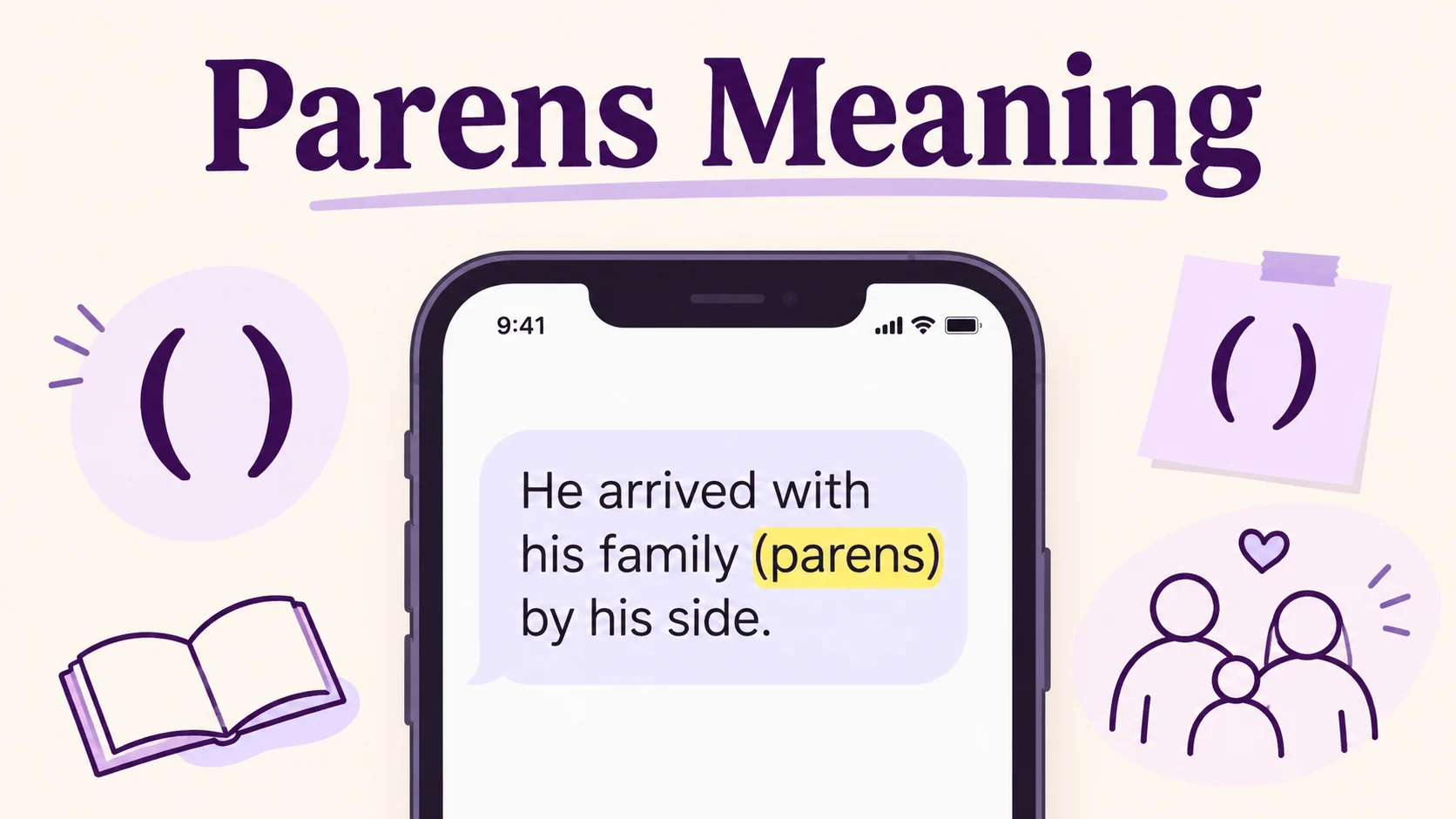
Parens Meaning In Text refers to the short form of “parentheses,” the symbols ( ) used to add extra information, side comments, or clarification within a sentence or message.
Parens Meaning In Text can be confusing if you come across the term in chats, social media, or online discussions.
“Parens” is simply a shortened form of parentheses, referring to the symbols ( ).
People commonly use them to add extra details without interrupting the main message.
Understanding this simple texting term can make online conversations much easier to follow.
In everyday digital communication, Parens Meaning In Text may also depend on how someone uses the symbols.
For example, a person might put a quick thought, explanation, or reaction inside parentheses.
This makes the added information feel like a side note rather than the main point.
Once you recognize “parens,” you can easily understand what the writer means from the context.
Parens Meaning At A Glance
Parens is a shortened, casual way of saying either “parentheses” or “parents.” When someone mentions formatting, writing, or editing, they usually mean the punctuation marks. When someone mentions family, staying somewhere, or plans, they usually mean their mom and dad.
| Detail | Explanation |
|---|---|
| Most Common Meaning | Short for “parentheses” (the punctuation marks) |
| Alternative Meaning | Casual short form of “parents” |
| Tone | Casual, everyday, informal |
| Common Platforms | Text messages, group chats, social media, writing/editing chats |
| Formal or Informal | Informal |
Main Meaning: Parens As Short For Parentheses
The most widely recognized use of parens is as an abbreviation for parentheses, the curved punctuation marks used to add extra information inside a sentence. Writers, students, editors, and coworkers use it as a quick shortcut instead of typing out the full word every time.
People typically use it when giving instructions about writing or formatting, such as asking someone to add a note, a clarification, or a side comment inside brackets. It’s a practical, no-nonsense term with a neutral, slightly technical tone.
Example: “Can you add the date in parens after the title?”
Here, the person is simply asking for the date to be placed inside parentheses, like this: Report (August 2026). It’s a quick, efficient way to give a formatting instruction without sounding overly formal.
Alternative Meaning: Parens As Short For Parents
The second common meaning of parens is a casual nickname for parents. This version shows up mostly in friendly, relaxed conversations, especially among younger texters and on social media, where clipping words short is common.
| Meaning | Context | Tone | Example |
|---|---|---|---|
| Parentheses (punctuation) | Writing, editing, formatting | Neutral, practical | “Put the price in parens.” |
| Parents (mom/dad) | Family plans, living situations | Casual, friendly | “My parens are visiting Sunday.” |
Both meanings are genuine and commonly used; there isn’t one that’s automatically “more correct” than the other. What matters is the topic of the conversation.
How Context Changes The Meaning
Since parens can mean two very different things, context does most of the work in telling them apart. Here’s what to pay attention to:
- Topic of conversation: Writing, documents, or edits usually point to punctuation. Family, home, or weekend plans usually point to parents.
- Surrounding words: Phrases like “add it,” “close the,” or “inside” suggest punctuation. Phrases like “at my,” “my,” or “visiting” suggest parents.
- Platform and setting: Work chats, school assignments, and editing tools lean toward punctuation. Casual texts and social captions lean toward parents.
- Relationship between speakers: Coworkers and classmates discussing a document almost always mean punctuation. Friends chatting about weekend plans almost always mean parents.
- Example 1: “Add parens around that sentence.” → Punctuation, because it’s an editing instruction.
- Example 2: “Can’t hang out, my parens said no.” → Parents, because it’s about permission from family.
- Example 3: “Use parens for the extra info.” → Punctuation, because it’s a writing guideline.
- Example 4: “Home alone, parens are out of town.” → Parents, because it describes a living situation.
Real Conversation Examples
Person A: “Should the abbreviation go in parens or a footnote?” Person B: “Parens is cleaner, just do that.” Meaning: Punctuation they’re discussing formatting for a document.
Person A: “You coming to the party tonight?” Person B: “Depends, my parens want me home early.” Meaning: Parents the reply is about family rules and curfew.
Person A: “Editing your essay now, want me to add page numbers in parens?” Person B: “Yes please, and fix the citation too.” Meaning: Punctuation a school or writing-related request.
Tone And Emotional Meaning
Parens is a neutral, informal word in almost every situation. It doesn’t carry sarcasm, rudeness, or hidden emotion on its own.
Is Parens Rude? No. It’s simply a shortcut word, and using it doesn’t come across as disrespectful in either meaning.
Is Parens Formal? No. It’s a casual shorthand, so it fits everyday texting and chatting far better than formal writing or professional emails.
How To Reply
Friendly Replies
- “Got it, adding the parens now.”
- “Sure, I’ll toss that in parentheses.”
- “Your parens sound cool, say hi for me.”
- “Makes sense, family stuff comes first.”
Polite Replies
- “Understood, I’ll format it with parens.”
- “No worries, I get why your parents said that.”
- “I’ll make that edit right away.”
Replies When You’re Confused
- “Wait, do you mean parentheses or your parents?”
- “Just to check, are we talking punctuation here?”
- “Can you clarify what you mean by parens?”
When To Use The Term
Parens fits comfortably into casual writing conversations, group chats, texts with friends, and quick messages about family plans. It works well between people who already text casually and understand shorthand, like classmates working on a project or friends catching up.
Before using it, think about whether the other person will recognize the shortcut. If they’re used to casual texting, it should land naturally without needing an explanation.
When To Avoid The Term
In professional emails, academic papers, client communication, or formal instructions, it’s safer to spell out “parentheses” or “parents” in full. Slang shortcuts like parens can come across as too casual for these settings, and there’s a small risk the reader won’t immediately know which meaning is intended.
It’s also worth avoiding in first-time conversations with people you don’t text casually, since they may not catch on right away.
Common Mistakes
| Common Mistake | Correct Understanding |
|---|---|
| Assuming parens only means punctuation | It’s also a common casual short form for “parents” |
| Ignoring the conversation topic | The topic almost always reveals which meaning is intended |
| Using it in formal writing | Spell out “parentheses” or “parents” fully in professional contexts |
Similar Slang Terms
| Term | Meaning | Main Difference |
|---|---|---|
| Rents | Casual short form of “parents” | Only means parents, never punctuation |
| Brackets | Square punctuation marks [ ] | A different punctuation symbol entirely |
| ASL | Age, sex, location (older chat slang) | Unrelated meaning, used for identity questions |
| FYI | For your information | Used to share info, not related to punctuation or family |
Parens And Autocorrect: Why It Gets Changed Or Flagged
Most phone keyboards and spellcheck tools don’t recognize “parens” as a real word, since it’s an informal shorthand rather than an official dictionary entry on many devices. This means autocorrect sometimes tries to change it to “parens” with a suggested underline, or occasionally swaps it for something unrelated if you’re typing quickly.
If a text arrives with a strange autocorrect swap near the word, it’s worth rereading the sentence rather than assuming the meaning changed. This is a small but genuinely common source of confusion that rarely gets mentioned when people explain the term.
Nested Parens: What Double Parentheses Can Mean
In some texting and online writing styles, people use double or nested parens, like ((this)), instead of single ones. This isn’t about the word “parens” itself, but it’s closely related since it changes how the punctuation is read in a message.
Double parentheses are sometimes used for emphasis, a quiet aside, or a softer tone, almost like whispering a comment inside a comment. For example, “I’ll be there ((hopefully))” reads as more hesitant or self-aware than a single set of parens would. This layered use is rarely explained even though it shows up often in casual writing, texting, and comment sections.
Using Parens As A Verb
Beyond being a noun for the punctuation marks, “parens” sometimes gets used casually as an action, especially among students, writers, and editors. Saying “just parens it” or “parens that part” means to place something inside parentheses, turning the noun into a quick verb.
Example: “Don’t delete the extra detail, just parens it instead.”
This verb-style use is common in fast-moving editing conversations, group projects, or writing feedback, where speed matters more than grammatical precision. It’s a small shift in usage that most explanations of the term skip entirely.
Parens In Bios And Usernames
On social platforms, some people add a nickname, pronoun, or extra identifier inside parentheses directly in their display name or bio, such as “Jordan (he/him)” or “Sam (the real one).” While this isn’t usually spoken aloud as “parens,” it’s a practical, everyday use of the punctuation that ties directly back to the term’s core meaning.
Understanding this use helps explain why “parens” instructions come up so often in casual editing requests, since adding a short clarifying tag inside parentheses is a habit many people already practice in their own profiles.
Why Some People Avoid Using The Word Parens
Because parens can mean either parentheses or parents, some careful texters deliberately avoid the shorthand altogether, especially in group chats with a mix of people who don’t text the same way. Instead, they’ll spell out the full word to prevent even a moment of confusion.
This habit is more common among people communicating across different age groups or in mixed settings like family group chats, school clubs, or workplace teams that blend casual and formal tones. It’s a small, practical communication choice that rarely gets discussed, even though it explains why usage of the term can vary so much from one chat to another.
Quick Recap
- Parens most commonly means parentheses, the punctuation marks ( ).
- It can also casually mean parents, depending on the conversation.
- The surrounding topic tells you which meaning is intended.
- It’s informal, so it fits casual texts more than professional writing.
- When in doubt, a quick clarifying question clears up any confusion.
Frequently Asked Questions
What does parens mean in text?
Parens usually means parentheses, the punctuation marks, though it can also casually mean parents depending on context.
Is parens rude?
No, parens is a neutral, casual shorthand and isn’t rude in either of its common meanings.
What does parens mean on TikTok?
On TikTok, parens is typically used casually to mean parents, especially in captions about family or home life.
How should you reply to parens?
Reply based on the topic, confirming a formatting edit for punctuation or acknowledging a family-related comment for parents.
Can parens have different meanings?
Yes, parens can mean either parentheses or parents, and the surrounding conversation shows which one is meant.
Conclusion
Parens is a simple, informal shorthand with two genuine meanings: parentheses, the punctuation marks, and a casual nickname for parents. Neither meaning is more “correct” than the other, so context always decides which one fits. Writing, editing, or formatting conversations almost always point to punctuation, while chats about family, home, or weekend plans point to parents.
Once you notice the topic and wording around it, telling the two apart becomes second nature, and you’ll know exactly how to read or use the word the next time it shows up in a text.

Alex Morgan is a creative mind behind SimileVibe.com, focused on building clean digital experiences that feel simple, modern, and real. He works closely with ideas, design, and user experience to create projects that connect naturally with people online.