Quick Answer:
A similes for kids worksheet helps children practice identifying, completing, and creating similes using “like” or “as.” These fun activities improve vocabulary, reading comprehension, and creative writing while making figurative language easy to learn.
Learning to write with vivid, imaginative language is one of the most important skills a child can develop in their early education. Yet for many young learners, abstract grammar concepts can feel dry and difficult to grasp. That is where similes come in and more specifically, where a well-designed similes for kids worksheet can completely transform how children understand and use figurative language.
Similes are one of the most approachable forms of figurative language because they rely on everyday comparisons children already make naturally in conversation. When a child says “my backpack is as heavy as a boulder” or “running to the bus felt like flying,” they are already thinking in similes without even knowing it.
A targeted worksheet gives that natural thinking a structure, turning intuitive comparisons into a conscious, repeatable writing skill. This guide covers everything teachers and parents need to know about similes for kids worksheets what they include, how to use them, examples at every level, activities that make practice fun, and tips for helping children create their own original comparisons.
Whether you are teaching a second-grader encountering similes for the first time or guiding a fifth-grader toward more creative figurative language, this resource will give you the tools to make every lesson effective and enjoyable.
What Is a Simile? A Simple Explanation for Kids
Before exploring worksheet activities, it helps to make sure children have a crystal-clear understanding of what a simile actually is.
The Child-Friendly Definition
A simile is a way of comparing two different things using the words “like” or “as.” Similes help writers paint pictures with words by connecting something familiar to something new.
Simple examples a child can immediately understand:
- “My dog is as fluffy as a cloud.”
- “She ran like the wind.”
- “His laugh was like thunder in a quiet room.”
- “The lemon tasted as sour as a lemon drop candy.”
Each of these sentences helps the reader see, hear, or feel something more vividly than a plain description would allow.
Similes vs. Metaphors: What Is the Difference?
Children often confuse similes and metaphors, so worksheets commonly address both side by side.
| Feature | Simile | Metaphor |
|---|---|---|
| Uses “like” or “as” | Yes | No |
| Makes a direct comparison | No | Yes |
| Example | “She is as brave as a lion.” | “She is a lion.” |
| Tone | Descriptive and gentle | Bold and direct |
A helpful classroom tip: tell students that similes always carry a “road sign” the words “like” or “as” that tells you a comparison is coming. Metaphors make the same comparison but skip the sign and go straight through.
Why Use a Similes for Kids Worksheet?
Worksheets are one of the most reliable tools for building figurative language skills because they give children structured opportunities to practice recognizing, reading, completing, and creating similes.
Benefits of Simile Worksheets for Children
1. They Build Vocabulary Through Context
When children encounter a simile like “as quiet as a mouse,” they are simultaneously learning a new expression and reinforcing their understanding of what the word “quiet” feels like in descriptive writing. Worksheets expose children to dozens of these expressions in a single session.
2. They Encourage Creative Thinking
Fill-in-the-blank and open-ended simile activities invite children to stretch their imagination. There is rarely a single correct answer, which makes these exercises unusually freeing for young writers who often fear making mistakes.
3. They Strengthen Reading Comprehension
Recognizing similes in a passage helps children understand the tone, mood, and meaning an author is trying to convey. A worksheet that asks students to identify similes in short paragraphs builds this critical reading skill.
4. They Support Writing Development
Once children can recognize and complete similes, they begin using them independently in their own stories and essays making their writing more expressive, vivid, and enjoyable to read.
5. They Are Adaptable to Every Grade Level
A kindergartener can match simple picture-based similes, while a sixth-grader can analyze similes in poetry. The same concept scales beautifully across years of learning.
Common Simile Examples for Kids Worksheets
Good worksheets are built around similes that feel immediately relatable to children. Below is a comprehensive collection organized by theme, making it easy for teachers to select examples appropriate for their lesson focus.
Similes About Animals
Animals are among the most natural subjects for children’s similes because kids relate to them emotionally and know their characteristics well.
| Simile | Meaning |
|---|---|
| As fast as a cheetah | Extremely quick |
| As quiet as a mouse | Very silent |
| As strong as an ox | Very powerful |
| As busy as a bee | Always working |
| As slippery as an eel | Hard to catch or hold |
| As gentle as a lamb | Very soft and kind |
| As proud as a peacock | Very confident or showy |
| As stubborn as a mule | Unwilling to change |
| As wise as an owl | Very smart or knowing |
| As playful as a puppy | Full of energy and fun |
Worksheet Activity Idea: Animal Simile Match
Draw two columns. On the left, list the first half of each simile. On the right, list the animal in shuffled order. Ask children to draw lines connecting the correct pairs.
Similes About Nature
Nature-based similes teach children to observe the world around them and use those observations in their writing.
| Simile | Meaning |
|---|---|
| As bright as the sun | Extremely bright or cheerful |
| As cold as ice | Very cold or unfriendly |
| As light as a feather | Very easy to lift |
| As dark as night | Completely dark |
| As fresh as a daisy | Clean, energetic, and happy |
| As hard as a rock | Very strong or firm |
| As smooth as silk | Perfectly soft and even |
| As tall as a tree | Very tall |
| As deep as the ocean | Extremely deep or vast |
| As sharp as a thorn | Painfully pointed |
Worksheet Activity Idea: Nature Drawing and Simile
After completing the sentence “The water was as _______ as _______,” children illustrate their simile in a box beside it. Combining writing and drawing deepens both comprehension and creative engagement.
Similes About Feelings and Emotions
Emotional similes are especially valuable because they help children articulate how they feel an important social-emotional skill alongside the literary one.
| Simile | Meaning |
|---|---|
| As happy as a lark | Extremely joyful |
| As sad as a rainy day | Feeling down and gloomy |
| As nervous as a cat in a dog park | Very anxious |
| As excited as a kid on Christmas morning | Bursting with anticipation |
| As calm as a still lake | Peaceful and relaxed |
| As angry as a stormy sea | Very upset |
| As surprised as someone finding a gift | Completely shocked |
| As lonely as a single cloud in the sky | Feeling isolated |
| As brave as a firefighter | Showing great courage |
| As confused as a lost puppy | Completely uncertain |
Worksheet Activity Idea: Feelings Simile Journal
Give children a prompt such as “Think about the last time you felt really excited. Write a simile to describe that feeling.” This connects figurative language to personal experience.
Similes About People and Appearance
These similes help children write vivid character descriptions in their stories.
| Simile | Meaning |
|---|---|
| As tall as a giant | Very tall person |
| As small as a mouse | Very small or short |
| As loud as a foghorn | Extremely loud voice |
| As sweet as sugar | Very kind and pleasant |
| As sharp as a tack | Very clever and alert |
| As fast as lightning | Moving very quickly |
| As slow as a snail | Moving very slowly |
| As bright as a button | Very alert and smart |
| As tough as nails | Very strong and determined |
| As cool as a cucumber | Very calm under pressure |
Similes About Food and Everyday Objects
Connecting similes to familiar objects from daily life makes the concept immediately accessible for younger children.
| Simile | Meaning |
|---|---|
| As sweet as honey | Very pleasant and kind |
| As hard as a stone | Very firm and unyielding |
| As soft as butter | Very smooth and gentle |
| As warm as toast | Very comfortable and cozy |
| As round as a ball | Perfectly circular |
| As thin as paper | Very flat or slim |
| As clean as a whistle | Completely spotless |
| As flat as a pancake | Completely level |
| As sticky as glue | Very adhesive or clingy |
| As bouncy as a rubber ball | Full of spring and energy |
Types of Simile Worksheet Activities for Kids
Effective simile worksheets use a variety of activity formats to keep children engaged and to test different aspects of their understanding.
H3: Fill in the Blank Worksheets
These are the most common and accessible simile worksheets. Children are given the beginning of a simile and must complete it.
Examples:
- The snow was as white as _____________.
- He ran like a _____________.
- Her hair was as long as _____________.
- The music sounded like _____________.
- My hands were as cold as _____________.
Teaching Tip: For younger children (Grades K–2), provide a word bank at the bottom of the page. For older children (Grades 3–6), leave the blanks completely open to encourage original thinking.
Identify the Simile Worksheets
Children read a short paragraph or set of sentences and underline or circle every simile they find.
Sample passage for a Grade 3 worksheet:
Marco ran onto the field as fast as a rocket. His heart was pounding like a drum. The crowd was as loud as a thunderstorm, and the grass under his feet felt like a soft carpet. When he finally scored the goal, he felt like the happiest person on Earth.
Questions that follow:
- How many similes can you find in the passage?
- Write each simile in your own words.
- Choose your favorite simile and draw a picture of what it makes you imagine.
True or False Simile Worksheets
Children are given a list of sentences and must decide whether each one contains a simile.
Examples:
- “The dog barked at the stranger.” True / False
- “Her smile was like sunshine on a cloudy day.” True / False
- “He kicked the ball hard.” True / False
- “The classroom was as quiet as a library.” True / False
This format tests comprehension rather than production, helping teachers identify children who understand the concept versus those who can only reproduce memorized examples.
Match the Simile Worksheets
Children draw lines to match the first half of a simile to its correct ending.
Column A:
- As cool as…
- As blind as…
- As white as…
- As bold as…
- As light as…
Column B:
- a feather
- a bat
- snow
- a cucumber
- brass
This activity builds familiarity with conventional similes while also being quick and low-pressure ideal as a warm-up or homework activity.
Create Your Own Simile Worksheets
Open-ended worksheets ask children to write completely original similes based on a prompt or topic.
Sample prompts:
- Write a simile that describes your bedroom.
- Write a simile about your best friend.
- Write a simile about how summer feels.
- Write a simile about your favorite food.
- Write a simile about a thunderstorm.
These activities are particularly powerful for developing voice and creativity. Encourage children to avoid the first answer that comes to mind and to think of something surprising or personal instead.
Rewrite the Sentence Worksheets
Children are given a plain sentence and asked to rewrite it using a simile to make it more vivid.
Examples:
| Plain SentenceRewritten with a Simile | |
|---|---|
| The dog was fast. | The dog was as fast as a speeding car. |
| She was scared. | She was shaking like a leaf in the wind. |
| The pizza was hot. | The pizza was as hot as a volcano. |
| He was very tall. | He was as tall as a telephone pole. |
This is one of the best activities for bridging the gap between recognizing similes and actually using them in writing.
Grade-by-Grade Guide to Simile Worksheets
Kindergarten and Grade 1: Picture-Based Simile Activities
At this level, the focus is on recognition and oral language rather than writing. Worksheets typically show pictures and ask children to circle which image matches a given simile.
Example: Show a picture of a snail and a racecar. Ask: “Which picture matches ‘as slow as a snail’?”
Simple sentence completion with picture support and teacher read-aloud is ideal here.
Grades 2 and 3: Simple Completion and Identification
Children at this level can handle written worksheets with a word bank. They should be completing similes, identifying them in sentences, and beginning to write their own with guidance.
Key skills:
- Understanding what “like” and “as” signal
- Completing common conventional similes
- Identifying similes in short passages
Grades 4 and 5: Original Simile Writing and Analysis
Students are ready to write fully original similes and analyze why an author chose a particular comparison. Worksheets at this level include short reading passages with simile analysis questions and open-ended creative writing prompts.
Key skills:
- Creating original similes without a word bank
- Explaining the meaning and effect of a simile
- Distinguishing similes from metaphors
Grade 6 and Above: Similes in Literature and Advanced Writing
Older students explore similes within the context of full literary works poems, short stories, novels. Worksheets ask them to evaluate the effectiveness of a simile and to revise weak similes into stronger ones.
Key skills:
- Analyzing similes in published literature
- Evaluating and revising simile quality
- Using similes purposefully in extended writing pieces
Fun Simile Games and Classroom Activities
Worksheets are most effective when paired with interactive activities that bring the language to life.
Simile Relay Race
Divide the class into teams. Call out a category (an animal, a weather event, a feeling) and each team must shout a simile using that subject. The first team to produce a correct, original simile earns a point.
Simile Charades
Write similes on slips of paper. One child acts out the simile without speaking while teammates guess what it is. “As stiff as a board” and “as bouncy as a ball” are particularly fun to mime.
Simile Story Chain
Start a story with a sentence that includes a simile: “The morning was as bright as a diamond.” Each child adds one sentence which must include a new simile until the class has created a complete short story together.
Simile Scavenger Hunt
Give children a page from a storybook or a short newspaper article. Ask them to find and highlight every simile they can spot. The child who finds the most wins but every simile must be correctly identified to count.
My Simile Booklet
Each child creates a small illustrated booklet with one simile per page, drawn and written by them. These make wonderful classroom displays and give children real ownership of what they’ve learned.
Tips for Teachers: Making Simile Worksheets More Effective
Read Similes Aloud First
Before any written worksheet, share simile-rich picture books or poems aloud. Hearing figurative language in context makes the concept click far faster than a definition alone.
Excellent books for this:
- My Many Colored Days by Dr. Seuss
- Quick as a Cricket by Audrey Wood
- Owl Moon by Jane Yolen
Celebrate Creative Answers
When a child writes “my cat is as mysterious as a locked box,” that is worth celebrating even if it surprises you. Original comparisons are the goal. Reward creative risk-taking generously.
Use Mentor Texts
Pull similes directly from books the class is already reading. Recognizing them in a beloved story is far more motivating than finding them on an abstract worksheet.
Connect to Personal Experience
The strongest similes come from real observation. Ask children to think about their own lives: “What does your neighborhood smell like in autumn? What does Monday morning feel like? What does your grandmother’s house sound like?” Their answers will produce vivid, personal comparisons that no generic worksheet can provide.
Display a Simile Wall
Create a classroom display where new similes are added each week. Children can nominate similes they wrote themselves or encountered in their reading. Seeing language celebrated publicly reinforces its value.
Sample Similes for Kids Worksheet: Ready to Use
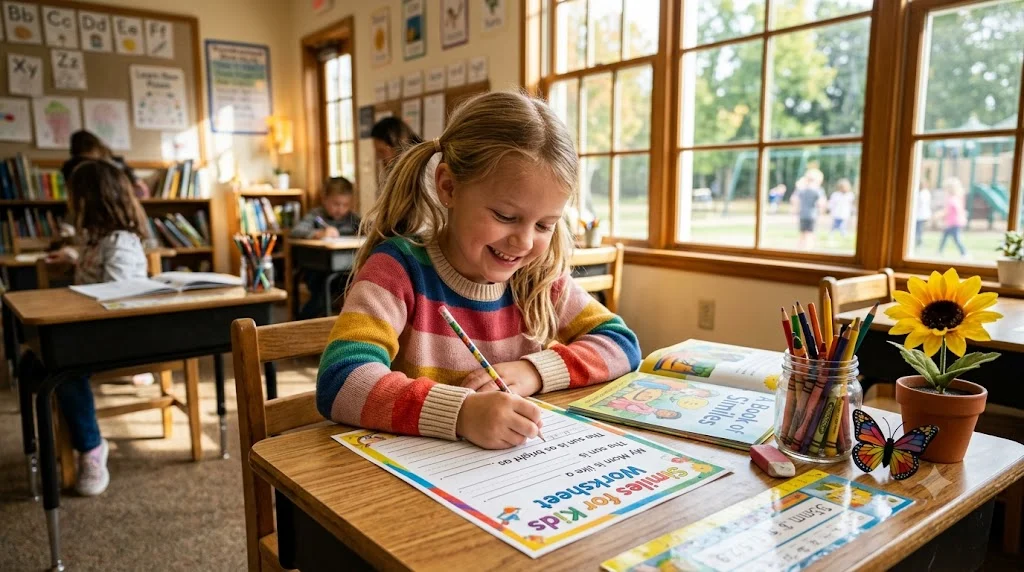
Below is a ready-to-use sample worksheet suitable for Grades 2–4.
Name: _________________________ Date: _____________
Similes for Kids Worksheet
Part 1: Fill in the Blank Complete each simile with a word from the box below.
Word Bank: ice, feather, thunder, rainbow, snail, honey
- His voice was as loud as _____________.
- She moved as slowly as a _____________.
- The blanket was as light as a _____________.
- Her dress was as colorful as a _____________.
- The drink was as sweet as _____________.
- My fingers were as cold as _____________.
Part 2: Circle the Simile Circle the sentence that contains a simile.
- a) The cat sat by the window. b) The cat was as still as a statue.
- a) He laughed like a hyena. b) He laughed very loudly.
- a) She wore a red coat. b) Her coat was as red as a fire truck.
Part 3: Write Your Own Complete these similes in your own words. Be creative!
- My best friend is as _____________ as _____________.
- The playground felt like _____________.
- Summer smells as _____________ as _____________.
Part 4: Draw It Choose one simile you wrote in Part 3 and draw a picture of it in the box below.
(Drawing box)
Common Mistakes Children Make with Similes and How to Fix Them
Mixing Up Similes and Metaphors
The mistake: Writing “She was sunshine” instead of “She was like sunshine.” The fix: Remind children to check for the “road sign words” like or as. If they are missing, the comparison is a metaphor, not a simile.
Using Comparisons That Don’t Make Sense
The mistake: “He ran as fast as a pencil.” The fix: Ask children to check: does the thing I’m comparing actually have that quality? Would anyone agree that a pencil is fast? Encourage them to choose comparisons that immediately make sense to a reader.
Repeating the Same Few Similes
The mistake: Every character in a story is either “as fast as lightning” or “as quiet as a mouse.” The fix: Challenge children to use each simile only once in a piece of writing. Keep a class list of “used” similes to encourage variety.
Making Comparisons Too Long and Complicated
The mistake: “She was as happy as a dog who had just been given a treat by its favorite person after a long walk.” The fix: The most powerful similes are often the shortest. Encourage children to aim for clarity and snap: “She was as happy as a dog with a new toy.”
FAQs
What grade level should start learning similes?
Most curricula introduce similes in Grade 2 or Grade 3, though picture-book exposure and oral activities can begin as early as kindergarten.
How many simile examples should a worksheet include?
A good worksheet for elementary students includes between 8 and 15 examples or prompts enough to build familiarity without causing fatigue.
Are there simile worksheets for ESL learners?
Yes. For English language learners, it helps to include visual supports alongside each simile a picture of a feather next to “as light as a feather,” for example. Starting with common, concrete comparisons before moving to abstract or cultural ones is also important.
How do I know if my child understands similes?
Ask them to explain a simile in their own words. If they can say “it means she was very calm, like how a lake doesn’t move when there’s no wind,” they genuinely understand it. If they can only repeat the phrase without explaining it, more practice with meaning is needed.
Can simile worksheets be used at home?
Absolutely. Simile worksheets are among the most parent-friendly literacy tools available. No special materials are needed, sessions can be short, and the activities naturally spark conversation about language and creativity.
Conclusion
A well-crafted similes for kids worksheet does far more than teach a grammar rule. It opens a door to a whole way of thinking about language one that connects observation, imagination, and expression in a way that children find natural and genuinely enjoyable.
When a child writes “my little brother is as loud as a marching band” for the first time and the whole class laughs in recognition, something important has happened. They have discovered that their own words can create vivid pictures in other people’s minds. That is one of the most exciting revelations a young writer can have.
The simile examples, worksheet formats, classroom activities, and grade-level guidance in this resource give teachers and parents everything they need to make that discovery happen again and again, at every level of learning.
Keep the activities varied, celebrate every creative comparison, and remind children often that the goal is not to find the “right” answer but to find the most imaginative, honest, and surprising one. That is where real writing begins.