Quick Answer
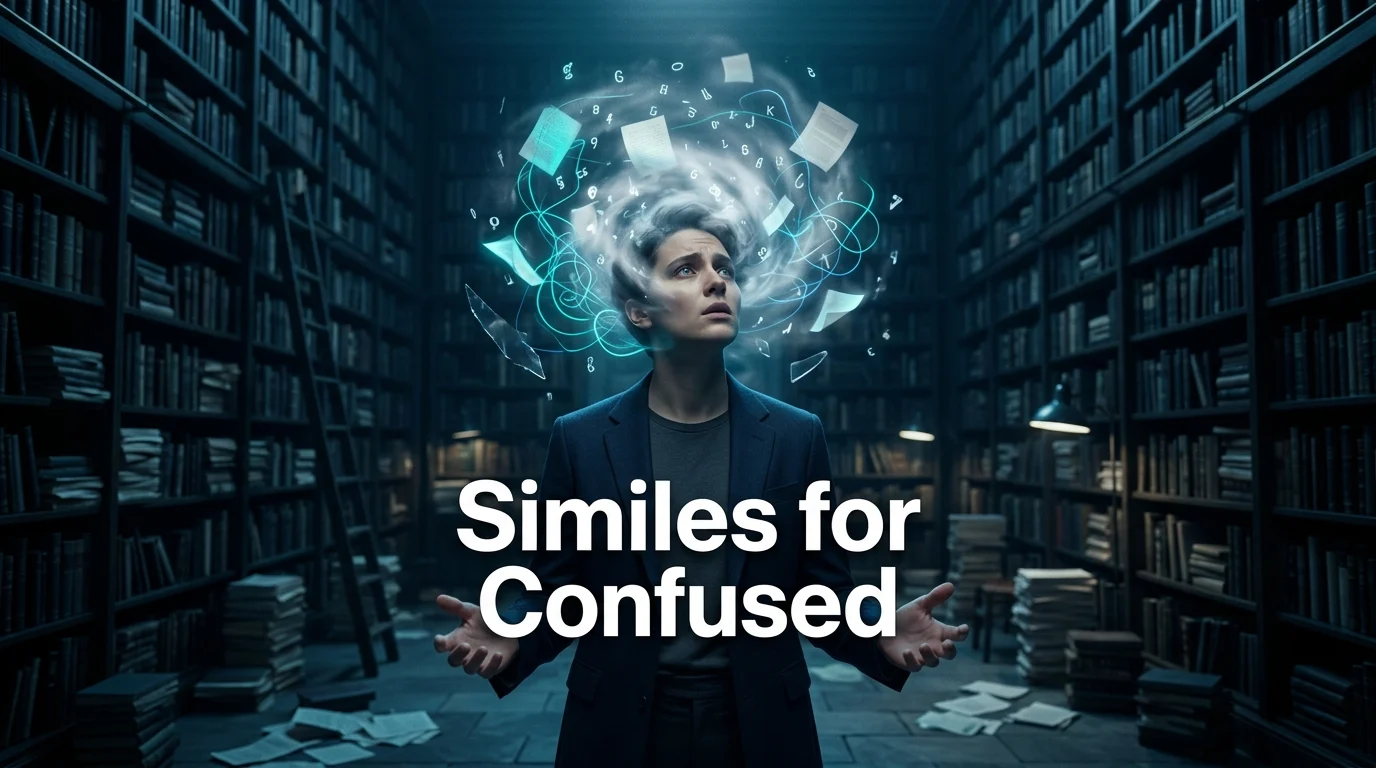
Similes for confused compare a state of mental disorientation or uncertainty to relatable images using “like” or “as.” They help writers show emotional and cognitive chaos, hesitation, and lack of clarity through vivid sensory language rather than simply stating that a character is perplexed.
Confusion is a universal human experience, yet it is notoriously difficult to describe without sounding clinical or repetitive. Simply saying a character is “confused” often fails to capture the swirling thoughts, the mental paralysis, the emotional vertigo, or the frustrating gap between seeing and understanding.
That is where similes become essential tools for writers. By comparing the internal state of confusion to external phenomena weather, physical mazes, radio static, or the natural world writers can create descriptions that resonate instantly with readers. A confused character might feel “as lost as a needle in a haystack” or “like a compass spinning without a North Pole.” These comparisons translate abstract cognitive states into tangible imagery.
Whether you are writing a novel, a short story, a screenplay, a poem, or a personal essay, similes for confusion allow you to externalize the internal. This guide explores a wide variety of similes for confusion, categorized by the specific type of bewilderment, complete with meanings, explanations, examples, and actionable writing advice.
Quick List of Similes for Confused
| Simile | Meaning |
|---|---|
| As lost as a needle in a haystack | Overwhelmed by details or impossible odds |
| Like a compass without a needle | Lacking direction or moral grounding |
| As foggy as a mountain pass | Unclear thoughts and clouded judgment |
| Like a computer with too many tabs open | Mentally overloaded and frozen |
| As tangled as a ball of yarn | Thoughts that are knotted and complex |
| Like a tourist without a map | Lost in unfamiliar territory |
| As muddled as muddy water | Ideas that are stirred up and unclear |
| Like a radio stuck between stations | Receiving conflicting or static-filled information |
| As scattered as autumn leaves | Inability to focus or hold a single thought |
| Like a ship without a rudder | Drifting without control or direction |
Similes for Mental Fog and Fogginess
When confusion is characterized by a lack of clarity, a mental slowness, or an inability to see the solution clearly, similes involving fog, clouds, or haze are highly effective.
As Foggy as a Mountain Pass
Meaning
Describes a state of mind where thoughts are obscured, and the path forward is difficult to see.
Why It Works
Fog distorts distance and visibility. It creates a sense of being trapped in a small bubble while the rest of the world is hidden. This perfectly mirrors the feeling of being unable to grasp a concept or see the consequences of a decision.
Alternative Expression
“As hazy as a summer horizon”
Examples in Writing
- Formal Example: His understanding of the calculus problem was as foggy as a mountain pass at dawn.
- Casual Example: I’m so foggy right now; I can’t remember where I put my keys.
- Creative Example: The truth hid in the recesses of her mind, as foggy as a mountain pass where ghosts whisper secrets.
Like a Clouded Window
Meaning
Represents a perspective that is distorted or an inability to see a situation clearly due to internal or external factors.
Why It Works
A dirty or steamed-up window allows light in but obscures the view. It implies that the confusion is a barrier between the person and reality.
Alternative Expression
“Like looking through frosted glass”
Examples in Writing
- Formal Example: The patient’s memory of the accident was like a clouded window, obscuring the details.
- Casual Example: My brain feels like a clouded window before my morning coffee.
- Creative Example: He tried to recall her face, but his memory was like a window fogged by the breath of time.
As Hazy as a Distant Memory
Meaning
Describes confusion regarding the past, where the lines between reality and imagination blur.
Why It Works
Distant memories are often soft-focus, lacking sharp edges and concrete details. This simile suggests a mind that cannot pin down specific facts.
Alternative Expression
“As indistinct as a whisper in a storm”
Examples in Writing
- Formal Example: The witness’s account of the evening was as hazy as a distant memory, unreliable and shifting.
- Casual Example: Sorry, my recollection of that party is as hazy as a distant memory.
- Creative Example: The logic of the dream was as hazy as a distant memory, slipping away the harder he tried to hold it.
Like a Room Full of Smoke
Meaning
Represents a situation where the air is thick with conflicting information, making it difficult to breathe or think straight.
Why It Works
Smoke is suffocating and irritating. It forces you to focus on survival rather than higher thought. This simile is useful for high-stress confusion where panic is beginning to set in.
Alternative Expression
“As thick as pea soup”
Examples in Writing
- Formal Example: The boardroom felt like a room full of smoke as the executives debated the conflicting financial reports.
- Casual Example: After the argument, my head felt like a room full of smoke.
- Creative Example: The realization hit him, and suddenly his certainty was like a room full of smoke, choking and dark.
Similes for Overload and Chaos
Modern confusion often stems from too much information, sensory overload, or having too many tasks to manage. These similes reflect the anxiety of the digital age.
Like a Computer with Too Many Tabs Open
Meaning
Represents the paralysis that comes from multitasking or processing excessive information. The brain is running slowly because the “RAM” is full.
Why It Works
Everyone is familiar with the frustration of a device lagging or freezing because too much is happening at once. It is a modern, relatable image that instantly conveys the feeling of being mentally frozen.
Alternative Expression
“Like a browser that keeps spinning”
Examples in Writing
- Formal Example: By Friday afternoon, her brain felt like a computer with too many tabs open, unable to process even simple requests.
- Casual Example: Dude, slow down, my brain is like a computer with too many tabs open right now.
- Creative Example: His thoughts were like a computer with too many tabs open, each one playing a different, discordant sound.
As Tangled as a Ball of Yarn
Meaning
Describes thoughts that are so knotted and complex that finding the end of the problem seems impossible.
Why It Works
A tangled ball of yarn is messy, frustrating, and requires patience to solve. It suggests that the confusion is the result of complications rather than a simple lack of knowledge.
Alternative Expression
“As twisted as a pretzel”
Examples in Writing
- Formal Example: The legal loopholes were as tangled as a ball of yarn, baffling even the senior partners.
- Casual Example: My schedule for next week is as tangled as a ball of yarn.
- Creative Example: The lies he told were as tangled as a ball of yarn, and he had lost the thread of the truth long ago.
Like a Radio Stuck Between Stations
Meaning
Represents a mind receiving conflicting signals, full of static, where no clear message comes through.
Why It Works
The screeching static of a radio between frequencies is jarring and unpleasant. This simile captures the anxiety of hearing bits and pieces of information but missing the cohesive whole.
Alternative Expression
“Like a scrambled satellite signal”
Examples in Writing
- Formal Example: His emotions were like a radio stuck between stations, mixing anger, sorrow, and relief into a wall of static.
- Casual Example: I can’t hear you over my own thoughts; I’m like a radio stuck between stations.
- Creative Example: The two conflicting commands left the soldier confused, his instincts like a radio jamming between frequencies.
As Scattered as Autumn Leaves
Meaning
Describes an inability to focus, where thoughts are blown in every direction by the wind of distraction.
Why It Works
Leaves in autumn are colorful but disorganized. They are blown about by external forces, much like a confused mind that is at the mercy of its environment.
Alternative Expression
“Like confetti in a fan”
Examples in Writing
- Formal Example: She tried to study, but her concentration was as scattered as autumn leaves.
- Casual Example: My groceries are on the floor and my thoughts are scattered like leaves, what a day.
- Creative Example: The sudden noise shattered his focus, sending his thoughts scattering like autumn leaves in a gale.
Similes for Being Lost and Directionless
This category of confusion deals not just with a lack of understanding, but a lack of purpose or a clear path forward. It is often used for character arcs or moments of existential crisis.
Like a Ship Without a Rudder
Meaning
Represents a state of drifting without control, unable to steer a course toward a goal.
Why It Works
A ship is a powerful vessel, but a rudder is the small, vital piece that directs that power. Losing it means the ship is at the mercy of the currents. This simile is perfect for portraying ambition or drive that has lost its focus.
Alternative Expression
“Like a kite with a broken string”
Examples in Writing
- Formal Example: After the company collapsed, the CEO felt like a ship without a rudder, his purpose gone.
- Casual Example: I don’t know what I want to do with my life; I’m like a ship without a rudder.
- Creative Example: Grief left him adrift in the world, like a ship without a rudder in a starless sea.
As Lost as a Needle in a Haystack
Meaning
Describes a situation where finding the answer or the person is nearly impossible due to the overwhelming amount of data or clutter.
Why It Works
The imagery is classic: a tiny, metallic object buried in a massive, organic pile. It speaks to the frustration of searching for something specific within a vast sea of noise.
Alternative Expression
“Like a drop in the ocean”
Examples in Writing
- Formal Example: Without a reference number, the file was as lost as a needle in a haystack.
- Casual Example: I dropped my earring on the carpet; it’s lost like a needle in a haystack.
- Creative Example: The truth was buried in the archive, as lost as a needle in a haystack of yellowed paper.
Like a Tourist Without a Map
Meaning
Represents confusion born from unfamiliarity with one’s surroundings or circumstances.
Why It Works
This simile emphasizes the vulnerability and anxiety of being an outsider. A tourist without a map doesn’t just not know where they are going; they don’t even know the language of the signs around them.
Alternative Expression
“Like a cat in a new house”
Examples in Writing
- Formal Example: The new intern looked like a tourist without a map as he navigated the complex office hierarchy.
- Casual Example: I’m hopeless with this new software; I feel like a tourist without a map.
- Creative Example: Stepping into the high-society gala, she felt like a tourist without a map, adrift in a sea of unspoken rules.
Like a Compass Without a Needle
Meaning
Represents a state of confusion regarding one’s core values, beliefs, or direction in life.
Why It Works
A compass needle is guided by the Earth’s magnetic field. Without it, the compass is just a decorative disc. This simile is heavy with emotional weight, suggesting a loss of connection to one’s fundamental truth.
Alternative Expression
“Like a clock without hands”
Examples in Writing
- Formal Example: The politician was like a compass without a needle, swaying to whatever opinion polled highest.
- Casual Example: After the scandal, he felt like a compass without a needle, no longer sure what was right or wrong.
- Creative Example: The trauma left her like a compass without a needle, spinning wildly, searching for a magnetic north that no longer existed.
Similes for Emotional Confusion
Sometimes confusion isn’t about information; it is about feelings. These similes capture the vertigo of not knowing how one feels or being pulled in two directions at once.
Like a Yo-Yo on a String
Meaning
Represents being pulled back and forth between conflicting emotions or decisions without settling.
Why It Works
A yo-yo moves rapidly up and down, controlled by external forces. It implies instability and a lack of agency in one’s own emotional state.
Alternative Expression
“Like a seesaw in motion”
Examples in Writing
- Formal Example: Her feelings for him were like a yo-yo on a string, alternating between deep affection and intense frustration.
- Casual Example: I keep changing my mind about the trip; I’m up and down like a yo-yo.
- Creative Example: Hope and despair tugged at him, making him feel like a yo-yo suspended over a void.
As Muddled as Muddy Water
Meaning
Describes a state where emotions and thoughts are stirred up, and the bottom (the truth) cannot be seen.
Why It Works
When water is muddy, you cannot see the rocks or fish beneath the surface. It is a great simile for situations where underlying motives or deep feelings are obscured by a current of turbulence.
Alternative Expression
“As murky as a swamp”
Examples in Writing
- Formal Example: The witness’s testimony was as muddled as muddy water, mixing speculation with fact.
- Casual Example: My head is all muddy water right now; I need a minute.
- Creative Example: The argument left the couple in a state as muddled as muddy water, unable to distinguish the original point of contention.
Like a Moth in a Chandelier
Meaning
Represents being surrounded by bright, attractive options but having no idea which one to pursue, leading to exhaustion.
Why It Works
A moth is drawn to light, but a chandelier offers multiple competing light sources. The moth flits from one to the other without ever settling. This is the confusion of choice.
Alternative Expression
“Like a kid in a candy store with no money”
Examples in Writing
- Formal Example: Faced with dozens of investment opportunities, the novice was like a moth in a chandelier, dazzled and disoriented.
- Casual Example: Dating apps make me feel like a moth in a chandelier too many lights.
- Creative Example: The possibilities for her future were so vast and bright that she felt like a moth trapped in a chandelier of potential.
Similes for Physical and Spatial Disorientation
These similes describe the feeling of being physically lost or disconnected from one’s body, often used in thriller or horror genres.
Like a Spinning Top
Meaning
Represents the physical sensation of dizziness and mental vertigo where the world feels like it is moving too fast.
Why It Works
A spinning top is unstable, wobbling before it falls. It is an excellent visual for a character who has received shocking news and feels the ground moving beneath them.
Alternative Expression
“Like a hamster in a wheel”
Examples in Writing
- Formal Example: The revelation sent his mind reeling like a spinning top.
- Casual Example: Stop, you’re making my head spin like a top.
- Creative Example: The sheer scale of the universe makes my thoughts spin like a top, teetering on the edge of sanity.
As Disoriented as a Diver in Deep Water
Meaning
Describes a situation where one cannot tell which way is up, surrounded by vast, empty space.
Why It Works
In deep water, without visual reference points, the human inner ear can fail, leading to lethal disorientation. This simile carries a weight of danger and urgency.
Alternative Expression
“As lost as an astronaut without a tether”
Examples in Writing
- Formal Example: Waking from the surgery, he was as disoriented as a diver in deep water, unsure of time or place.
- Casual Example: I woke up from that nap totally disoriented, like a diver in the deep end.
- Creative Example: She was plunged into the world of high finance, as disoriented as a diver in deep water, unable to see the surface.
Like a Reflection in a Broken Mirror
Meaning
Represents a shattered sense of self or a fragmented understanding of reality.
Why It Works
A broken mirror shows the viewer in pieces. It is the ultimate simile for identity confusion or moments when a character no longer recognizes who they are or what they are seeing.
Alternative Expression
“Like an echo in a canyon”
Examples in Writing
- Formal Example: The protagonist’s sense of self was like a reflection in a broken mirror, shattered into irreconcilable parts.
- Casual Example: My self-image is like a broken mirror right now; I don’t know which piece is real.
- Creative Example: The timeline of the narrative was like a reflection in a broken mirror, each shard showing a different version of the truth.
Why Confusion Similes Matter
Confusion is an internal, psychological state. If you write, “John was confused,” the reader understands the fact but does not feel the emotion.
Strong similes help readers understand:
- Cognitive Overload: “Like a computer with too many tabs open.”
- Emotional Turmoil: “Like a yo-yo on a string.”
- Lack of Direction: “Like a ship without a rudder.”
- Sensory Overwhelm: “Like a radio stuck between stations.”
Rather than simply telling readers a character is confused, similes allow them to experience that chaos through imagery, making the narrative more immersive and sympathetic.
How to Use Confusion Similes Naturally
Match the Genre
- Thriller/Horror: Use physical similes like “like a reflection in a broken mirror” or “as disoriented as a diver in deep water.”
- Romance/Drama: Use emotional similes like “like a yo-yo on a string” or “as muddled as muddy water.”
- Sci-Fi/Modern: Use technological similes like “like a computer with too many tabs open.”
Reflect the Character’s World
The best similes are unique to the character’s perspective.
- A carpenter might feel “as tangled as a box of bent nails.”
- A chef might feel “like a sauce that’s about to split.”
- A pilot might feel “like a plane flying blind through clouds.”
Keep Comparisons Simple
Confusion is chaotic. If the simile itself is too complicated, the reader will be confused about the comparison, not just the character. The strongest similes are often the most instantly recognizable images.
Common Mistakes When Writing Confusion Similes
Overusing Similes
If every sentence describes confusion with a new simile, the narrative becomes purple prose and loses impact. Use them sparingly for maximum effect.
Using Clichés Too Often
Phrases like “as confused as a cow on a flat rock” or “like a deer in headlights” are effective but tired. If you use them, ensure the context breathes new life into them.
Ignoring the Tone
A funny simile like “like a dog watching television” is great for a comedy, but it would ruin the tension of a serious thriller.
Making Comparisons Too Complex
Avoid similes that require too much decoding. The reader should instantly “see” the image and understand the feeling without having to stop and think about the mechanics.
Similes vs Metaphors for Confusion
Simile
Uses “like” or “as.”
- Example: “His brain felt like a blender without a lid.”
Metaphor
Makes a direct comparison.
- Example: “His brain was a blender without a lid, spilling everywhere.”
Similes often feel more distant and descriptive, allowing the reader to observe the confusion. Metaphors are more immersive and can feel more chaotic, as if the reader is inside the confusion. Use similes for clarity and metaphors for impact.
Writing Exercise: Create Better Confusion Similes
Start with a simple sentence:
“He was confused.”
Now rewrite it using different types of imagery:
- Technology: “He was like a phone frozen on the home screen.”
- Weather: “He was as lost as a footprint in a snowstorm.”
- Animals: “He felt like a bat in broad daylight.”
- Food: “His thoughts were as scrambled as eggs.”
Practicing this exercise regularly helps create more vivid character descriptions.
FAQs
What are similes for confused?
Similes for confused compare a state of mental disorientation or lack of clarity to familiar, tangible experiences using “like” or “as.”
Why should writers use confusion similes?
They make characters feel more realistic and help readers empathize with the internal struggle of the character, rather than just acknowledging it.
What makes a strong confusion simile?
A strong confusion simile is easy to visualize, matches the tone of the scene, and accurately reflects the specific type of confusion (emotional, physical, logical, etc.).
Can confusion similes improve storytelling?
Yes. They turn an internal state into a visual image, which keeps the reader engaged and deepens the sensory experience of the text.
5. How can I create original confusion similes?
Observe moments when you feel confused in real life. What does it feel like in your chest? In your head? Connect those physical sensations to everyday objects you see around you.
Conclusion
Confusion is a complex state of mind that can range from mild hesitation to complete existential dread. It is a vital emotion to portray in writing because it makes characters vulnerable and human.
Simple labels like “bewildered” or “perplexed” often fail to capture the visceral reality of the experience. Similes bridge that gap by transforming the invisible chaos of the mind into vivid, sensory imagery. A confused character might be as tangled as a ball of yarn, like a ship without a rudder, or as scattered as autumn leaves.
These comparisons do more than just decorate prose; they reveal the character’s internal struggle and invite the reader to step into their shoes. The best similes for confusion help readers feel the fog, the overload, and the vertigo of not knowing.
As you write, remember to observe the specific texture of confusion. Is it a physical dizziness? An emotional pull? A technological overload? By mastering the art of the simile, you can turn the abstract concept of mental uncertainty into one of the most concrete and relatable aspects of your storytelling.
Read More Related Articles:
- Similes for Happiness | Add Joy and Emotion to Your Writing In 2026
- Similes for Ugly | Add Sharp Imagery to Your Writing In 2026
- Similes for Winter | Chilling Comparisons That Bring Winter To Life In 2026