Quick Answer
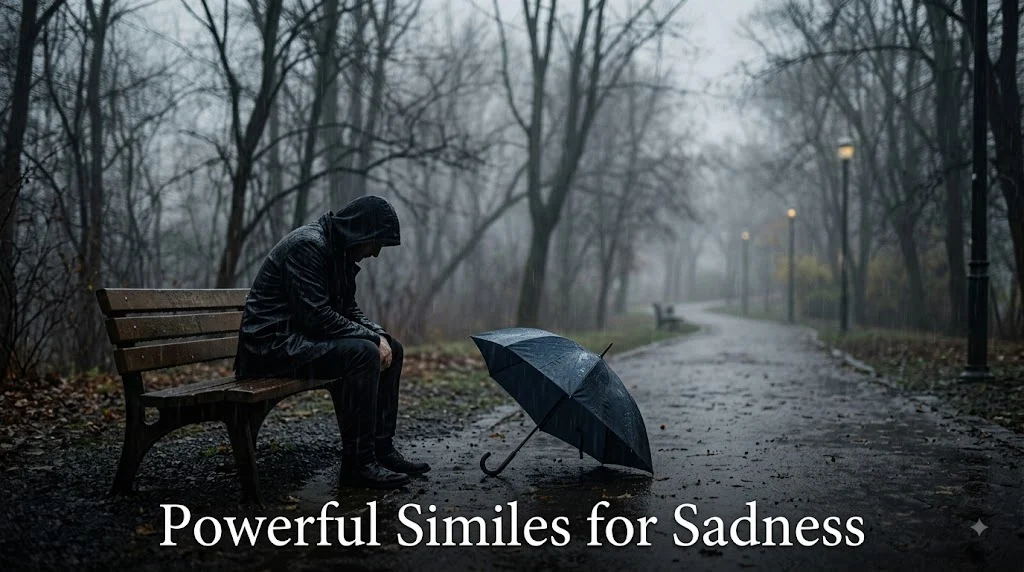
Similes for sadness are figures of speech that compare the feeling of sorrow to vivid, relatable images using “like” or “as.” They transform abstract grief into something readers can see, feel, and understand. A heart might feel “as heavy as a stone” or tears might fall “like rain on a windowpane,” instantly conveying emotional weight and depth.
Sadness is one of the most profound human emotions, yet finding the right words to describe it can feel impossible when you’re in its grip. Writers, poets, and storytellers have long turned to similes comparisons using “like” or “as” to bridge the gap between feeling and expression.
A well-chosen simile does more than describe; it makes readers experience the emotion. When you read that someone felt “as empty as a hollow shell,” you don’t just understand their sadness intellectually you feel its hollowness. The imagery creates an immediate emotional connection.
Whether you’re writing fiction, poetry, personal essays, or simply trying to express your own feelings more clearly, similes for sadness can transform your words from flat statements into powerful emotional experiences.
In this comprehensive guide, you’ll discover over 50 powerful similes for sadness organized by theme, each with clear meanings, example sentences, and tips for natural use. You’ll learn how to choose the right simile for your context, avoid common pitfalls, and create your own original comparisons.
Let’s explore how these vivid comparisons can bring your writing to life.
What Are Similes for Sadness?
A simile is a figure of speech that compares two different things using connecting words like “like,” “as,” or “than.” Similes for sadness specifically compare the feeling of sorrow to familiar experiences, objects, or natural phenomena that readers already understand.
For example:
- “Her heart was as heavy as a stone.”
- “Tears fell like raindrops in a storm.”
- “He felt as lonely as a single cloud in the sky.”
These comparisons help readers visualize and connect with an emotion that might otherwise remain abstract and difficult to grasp.
Similes differ from metaphors, which make direct comparisons without connecting words. A metaphor would say “She was a storm cloud,” while a simile would say “She was like a storm cloud.” Similes often feel gentler and more descriptive, while metaphors create stronger, more direct impact.
Why Writers Use Similes for Sadness
Sadness can feel overwhelming and all-consuming, yet the word “sad” alone rarely captures its complexity. Similes allow writers to:
- Show, not tell: Instead of stating a character is sad, you show the weight, emptiness, or darkness of their feelings.
- Create emotional resonance: Readers connect with familiar images like rain, darkness, or broken objects.
- Add depth and texture: Different similes reveal different flavors of sadness grief, loneliness, disappointment, despair.
- Make writing memorable: Vivid comparisons stick in readers’ minds long after they finish reading.
Every writer, from beginners to professionals, can benefit from a rich vocabulary of similes for sadness.
Quick List of Similes for Sadness
| SimilePrimary Meaning | |
|---|---|
| As heavy as a stone | Deep, weighed-down grief |
| Like a rainy day | Gloomy, downcast mood |
| As empty as a hollow shell | Feeling hollow and devoid of emotion |
| Like a wilted flower | Drained of energy and vitality |
| As cold as ice | Numb, emotionally frozen |
| Like a broken wing | Unable to move forward |
| As dark as a stormy night | Overwhelming hopelessness |
| Like tears in the rain | Sadness that goes unnoticed |
| As lonely as a single cloud | Isolation and solitude |
| Like a fading star | Joy slowly disappearing |
Similes for Deep Sadness and Grief
1. As Heavy as a Stone
Meaning: Describes sadness that feels physically weighty, as though it’s pressing down on the heart or chest.
Why It Works: Stones symbolize immovability, permanence, and burden. The comparison conveys that this sadness isn’t fleeting it’s substantial and difficult to lift.
Examples in Writing:
- Formal: Her heart felt as heavy as a stone when she received the news of his departure.
- Casual: I’ve been carrying this sadness around all week it’s as heavy as a rock.
- Creative: Grief settled in his chest as heavy as a stone dropped into still water, sending ripples through every thought.
2. Like a Rainy Day
Meaning: Evokes the gloom, grayness, and subdued quality of sad emotions.
Why It Works: Rainy days are universally associated with lowered spirits, quietness, and introspection. The imagery is gentle yet unmistakable.
Examples in Writing:
- Formal: His mood remained like a rainy day throughout the entire ordeal.
- Casual: She’s been feeling like a rainy day ever since her cat ran away.
- Creative: The news fell over her spirit like a rainy day seeping through an old roof.
3. As Empty as a Hollow Shell
Meaning: Describes a feeling of profound emptiness, as though all emotion and life have been drained away.
Why It Works: A hollow shell appears intact on the outside but contains nothing within. This powerfully conveys the experience of going through the motions while feeling dead inside.
Examples in Writing:
- Formal: After the loss, he wandered through life as empty as a hollow shell.
- Casual: I felt totally empty, like a shell with nothing inside.
- Creative: Her eyes stared ahead as empty as a hollow shell abandoned on the shore.
4. As Dark as a Stormy Night
Meaning: Represents overwhelming, consuming sadness that feels threatening and inescapable.
Why It Works: Stormy nights combine darkness with turbulence, suggesting both emotional darkness and inner turmoil.
Examples in Writing:
- Formal: His thoughts were as dark as a stormy night after the betrayal.
- Casual: I woke up feeling as dark as a stormy night.
- Creative: Despair gathered around her heart as dark as a stormy night with no moon.
5. Like a Broken Wing
Meaning: Represents the inability to move forward, feel joy, or pursue dreams due to sadness.
Why It Works: A bird with a broken wing is grounded and helpless, an image that resonates with anyone who feels trapped by grief.
Examples in Writing:
- Formal: She moved through the world like a bird with a broken wing, unable to soar as she once had.
- Casual: I feel so stuck, like a bird that can’t fly.
- Creative:* Hope lay in his chest like a broken wing, useless and aching.
Similes for Loneliness and Isolation
6. As Lonely as a Single Cloud
Meaning: Conveys isolation, drifting aimlessly without connection to others.
Why It Works: A single cloud in an empty sky is visible yet separate, suggesting both the experience and visibility of loneliness.
Examples in Writing:
- Formal: At the new school, she felt as lonely as a single cloud in an endless sky.
- Casual: I sat by myself, as lonely as a cloud.
- Creative: His heart drifted through the crowded room as lonely as a single cloud adrift on a summer afternoon.
7. Like a Forgotten Toy
Meaning: Describes feeling unwanted, ignored, or left behind.
Why It Works: This comparison evokes childhood memories of being overlooked or abandoned, making the emotion accessible and poignant.
Examples in Writing:
- Formal: He sat in the corner of the party like a forgotten toy, unseen and unwanted.
- Casual: I felt like a toy nobody wanted to play with.
- Creative:* Her voice went unheard, as quiet as a forgotten toy gathering dust on a shelf.
8. As Quiet as an Empty Classroom
Meaning: Conveys the unnatural silence that accompanies deep sadness or loss.
Why It Works: Classrooms are meant to be full of life and activity. Their emptiness represents absence of people, of laughter, of meaning.
Examples in Writing:
- Formal: After he left, her world was as quiet as an empty classroom.
- Casual: The house felt as quiet as a school on a weekend.
- Creative:* Loneliness echoed through her days as quiet as an empty classroom at midnight.
9. Like a Single Sock in the Dryer
Meaning: Feeling unmatched, incomplete, or separated from a partner.
Why It Works: This relatable domestic image conveys the discomfort of being alone when you should be part of a pair.
Examples in Writing:
- Formal: After the divorce, he wandered through life like a single sock in the dryer.
- Casual: I felt so alone, like a sock without its match.
- Creative:* She spun through her days as lost and incomplete as a single sock tumbling alone in the dryer.
10. As Isolated as a Deserted Island
Meaning: Complete, overwhelming separation from others and support.
Why It Works: Deserted islands represent total isolation no help, no companionship, no escape.
Examples in Writing:
- Formal: Grief left her feeling as isolated as a deserted island in a vast ocean.
- Casual: I felt completely cut off, like I was on an island by myself.
- Creative:* His sorrow surrounded him as isolated as a deserted island, with no rescue in sight.
Similes for Emotional Weight and Burden
11. Like a Backpack Full of Rocks
Meaning: Represents sadness that feels physically heavy, exhausting, and impossible to set down.
Why It Works: The image of carrying rocks suggests deliberate effort required just to keep moving, perfectly capturing depression’s exhaustion.
Examples in Writing:
- Formal: His depression felt like a backpack full of rocks that he could never remove.
- Casual: I’m carrying so much sadness, it’s like a bag of rocks.
- Creative:* Sorrow hung on her shoulders like a backpack full of rocks, each step a small victory.
12. As Slow as Dripping Honey
Meaning: Describes the sensation of time dragging during periods of sadness.
Why It Works: Honey drips slowly, thickly, making the waiting feel endless.
Examples in Writing:
- Formal: The hours passed as slow as dripping honey while she waited for news.
- Casual: This day is going as slow as molasses.
- Creative:* Time moved through his sorrow as slow as dripping honey from a spoon.
13. Like a Dense Fog
Meaning: Describes sadness that obscures everything, making it hard to see clearly or find direction.
Why It Works: Fog confuses, hides, and makes familiar things seem strange just as deep sadness can distort reality.
Examples in Writing:
- Formal: Grief settled over her like a dense fog, making everything unclear.
- Casual: I can’t think straight it’s like walking in a fog.
- Creative:* Despair rolled through his mind like a dense fog, erasing all landmarks.
14. As Burdensome as a Heavy Load
Meaning: Represents the exhaustion and difficulty of carrying emotional pain.
Why It Works: The physical image of a heavy load makes the emotional burden tangible and relatable.
Examples in Writing:
- Formal: Her grief was as burdensome as a heavy load she carried everywhere.
- Casual: I feel like I’m carrying the world on my shoulders.
- Creative:* He trudged through each day with sorrow as burdensome as a heavy load on a steep hill.
15. Like a Knot in the Stomach
Meaning: Describes the physical sensation of anxiety and sadness intertwining.
Why It Works: This visceral image grounds emotional pain in physical experience, making it immediate and real.
Examples in Writing:
- Formal: Fear and sadness twisted in her stomach like a knot that wouldn’t loosen.
- Casual: I’ve had this knot in my stomach all day.
- Creative:* Worry coiled in his gut like a knot, tightening with each sad thought.
Similes for Tears and Crying
16. Like Rain on a Windowpane
Meaning: Describes tears that fall steadily, softly, and somewhat impersonally.
Why It Works: Rain on glass is visible yet distant, suggesting tears that are observed rather than fully expressed.
Examples in Writing:
- Formal: Tears streamed down her face like rain on a windowpane.
- Casual: I just sat there crying, like rain against the glass.
- Creative:* Grief poured from her eyes like rain on a windowpane, each drop tracing a different path.
17. As Unnoticed as Tears in the Rain
Meaning: Describes sadness that goes unacknowledged by others.
Why It Works: The image of invisible tears captures the loneliness of suffering alone, unnoticed.
Examples in Writing:
- Formal: His sadness was as unnoticed as tears in the rain.
- Casual: Nobody even saw me crying it was like tears in the rain.
- Creative:* Her heartbreak fell as unnoticed as tears in the rain, lost in the chaos around her.
18. Like a Dripping Faucet
Meaning: Describes tears that fall slowly, persistently, over time.
Why It Works: A dripping faucet suggests ongoing, perhaps exhausting, grief that won’t stop.
Examples in Writing:
- Formal: Tears fell from her eyes like a dripping faucet, never quite stopping.
- Casual: I couldn’t stop crying it was like a leaky faucet.
- Creative:* His sorrow leaked out like a dripping faucet, a steady stream of loss.
19. As Sorrowful as a Weeping Willow
Meaning: Describes visible, outward grief that’s almost ornamental in its sadness.
Why It Works: Weeping willows are literally drooping trees, their branches hanging like tears nature’s symbol of mourning.
Examples in Writing:
- Formal: She stood by the grave, as sorrowful as a weeping willow.
- Casual: He looked so sad, like a weeping willow tree.
- Creative:* Grief draped over her form as sorrowful as a weeping willow’s trailing branches.
20. Like Thunderous Sobs
Meaning: Describes intense, loud, uncontrollable crying.
Why It Works: Thunder suggests power, volume, and uncontrollable force capturing the overwhelming nature of deep grief.
Examples in Writing:
- Formal: Her sobs echoed through the house like thunder in a storm.
- Casual: I heard him crying it sounded like thunder.
- Creative:* His grief burst forth like thunderous sobs, shaking the quiet room.
Similes for Brokenness and Heartbreak
21. As Broken as Glass
Meaning: Describes the feeling of being shattered, fragmented, and unable to function.
Why It Works: Glass breaks into pieces that can never be perfectly reassembled, just as heartbreak leaves permanent cracks.
Examples in Writing:
- Formal: Her heart was as broken as glass after the betrayal.
- Casual: I feel completely shattered, like broken glass.
- Creative:* Trust lay around him as broken as glass, each piece a sharp reminder.
22. Like a Cracked Phone Screen
Meaning: Describes being damaged but still functioning, with visible signs of hurt.
Why It Works: This modern image makes the comparison relatable and contemporary the phone works, but it’s permanently marked.
Examples in Writing:
- Formal: He went through the motions like a cracked phone screen working, but visibly damaged.
- Casual: I feel like my heart has cracks all over, like my phone screen.
- Creative:* Her smile was as fragile as a cracked phone screen, threatening to shatter at any touch.
23. Like a Dropped Toy
Meaning: Describes the shock and pain of something precious being suddenly broken.
Why It Works: The image captures the helpless feeling of watching something beloved fall and break beyond repair.
Examples in Writing:
- Formal: When the news came, she felt like a dropped toy, broken and discarded.
- Casual: I felt like a toy that got thrown and broke.
- Creative:* His hopes lay scattered around him like a dropped toy, irreparably damaged.
24. As Torn as a Ripped Page
Meaning: Describes internal conflict and pain, feeling divided by sorrow.
Why It Works: A torn page suggests an incomplete story, something important that’s been lost.
Examples in Writing:
- Formal: She was as torn as a ripped page, unable to reconcile her love with her grief.
- Casual: I feel torn in two, like a page torn from a book.
- Creative:* His heart was as torn as a ripped page from his favorite book the story will never be the same.
25. Like a Clock Without Hands
Meaning: Describes feeling stuck in time, unable to move forward.
Why It Works: A clock without hands is useless and frozen it can’t mark progress or change.
Examples in Writing:
- Formal: After the loss, his world felt like a clock without hands.
- Casual: I feel like time has stopped for me.
- Creative:* Grief hung over him like a clock without hands, a permanent moment of loss.
Similes for Disappointment and Letdown
26. Like a Deflated Balloon
Meaning: Describes the loss of excitement, hope, or energy that comes with disappointment.
Why It Works: The image captures the sudden release of air and potential, leaving something limp and useless.
Examples in Writing:
- Formal: His enthusiasm drained away like a deflated balloon.
- Casual: I was so excited, and now I just feel deflated.
- Creative:* Her smile collapsed like a deflated balloon, all the air gone at once.
27. As Faded as an Old Photograph
Meaning: Describes the dulling of joy, memories, or hope over time.
Why It Works: Photographs lose color and clarity over time just as sadness can drain the vividness from life.
Examples in Writing:
- Formal: His memories of happier times were as faded as an old photograph.
- Casual: Everything feels gray and faded, like an old picture.
- Creative:* Joy in her heart had grown as faded as an old photograph, the colors barely visible.
28. Like Melted Ice Cream on a Hot Day
Meaning: Describes the disappointment of something good ruined or lost.
Why It Works: The image is visceral and relatable something wonderful, now just a sad puddle.
Examples in Writing:
- Formal: Her hopes melted away like ice cream on a hot day.
- Casual: My dream just dissolved like ice cream in the sun.
- Creative:* His future plans puddled around him like melted ice cream on a hot day, sweet potential wasted.
29. As Forgotten as a Birthday That Passed
Meaning: Describes the pain of being overlooked or undervalued.
Why It Works: Birthdays are personal and significant; being forgotten on one cuts deeply.
Examples in Writing:
- Formal: She felt as forgotten as a birthday that passed without notice.
- Casual: I felt like nobody remembered I existed.
- Creative:* His presence went as unnoticed as a birthday that passed, celebrated by no one.
30. Like a Missed Train
Meaning: Describes regret and the feeling of losing an opportunity.
Why It Works: A missed train is final you can see it leaving, and you know you can’t catch it.
Examples in Writing:
- Formal: The decision felt like a missed train he could see his chance disappearing.
- Casual: I missed my shot, like a train that left without me.
- Creative:* His chances slipped away like a missed train, the whistle fading into distance.
Similes for Hopelessness and Despair
31. Like a Light That Won’t Turn On
Meaning: Describes feeling stuck, unable to find hope or positive emotion.
Why It Works: The frustration of a dead switch mirrors the inability to feel better no matter how hard you try.
Examples in Writing:
- Formal: His spirits remained like a light that wouldn’t turn on, no matter what he tried.
- Casual: I keep trying to be happy, but it’s like a broken light.
- Creative:* Hope flickered in her heart like a light that wouldn’t turn on there, but unavailable.
32. As Hopeless as a Tunnel With No End
Meaning: Describes the feeling that suffering will continue forever without relief.
Why It Works: A tunnel without an end is terrifying because you can’t see any escape or resolution.
Examples in Writing:
- Formal: His depression stretched before him as hopeless as a tunnel with no end.
- Casual: I can’t see the light at the end of this tunnel.
- Creative:* Despair stretched like a tunnel with no end, each step revealing more darkness.
33. Like a Candle in the Wind
Meaning: Describes fragile hope or spirit threatened by sadness.
Why It Works: A candle flame is delicate and easily extinguished like hope during grief.
Examples in Writing:
- Formal: Her spirits flickered like a candle in the wind.
- Casual: My hope feels so fragile, like a candle ready to go out.
- Creative: Optimism guttered in his heart like a candle in the wind, barely surviving.
34. As Desolate as a Ghost Town
Meaning: Describes overwhelming emptiness and abandonment.
Why It Works: Ghost towns are places that once held life and now contain only echoes and dust.
Examples in Writing:
- Formal: Her heart felt as desolate as a ghost town, empty of all feeling.
- Casual: This place feels totally dead, like a ghost town.
- Creative:* His soul stretched before him as desolate as a ghost town, all warmth long gone.
35. Like Falling into a Deep Abyss
Meaning: Describes the terrifying sensation of sinking into despair without hope of rescue.
Why It Works: An abyss is bottomless falling means there’s no end and no safety.
Examples in Writing:
- Formal: Grief consumed her like falling into a deep abyss.
- Casual: I feel like I’m falling and there’s no bottom.
- Creative:* His hope gave way, and he plunged like falling into a deep abyss, darkness all around.
Similes for Physical Manifestations of Sadness
36. As Pale as a Ghost
Meaning: Describes the physical pallor that often accompanies deep sadness or shock.
Why It Works: Ghosts are transparent and colorless representing both physical and emotional absence.
Examples in Writing:
- Formal: After hearing the news, her face was as pale as a ghost.
- Casual: You look so pale are you okay?
- Creative:* Color drained from his cheeks, leaving him as pale as a ghost haunting his own grief.
37. Like a Wilted Plant
Meaning: Describes the drooping posture and lack of energy that accompanies sadness.
Why It Works: Plants without water droop their leaves lose turgor and they literally slump.
Examples in Writing:
- Formal: She sat like a wilted plant, all energy drained from her frame.
- Casual: I’m totally wilted after that news.
- Creative:* His shoulders drooped like a wilted plant, no strength left to stand tall.
38. As Still as a Frozen Pond
Meaning: Describes emotional numbness and inability to react.
Why It Works: Frozen water is completely still and cold emotionally lifeless.
Examples in Writing:
- Formal: He sat as still as a frozen pond, not responding to anything around him.
- Casual: I feel frozen, like I can’t move.
- Creative:* Her expression was as still as a frozen pond, emotion trapped beneath the surface.
39. Like a Shadow at Noon
Meaning: Describes being present but invisible, diminished by brightness.
Why It Works: Shadows are faintest at noon, barely visible representing a person who’s there but unnoticed.
Examples in Writing:
- Formal: He moved through the party like a shadow at noon, present but unseen.
- Casual:* I felt like I was invisible, just a shadow.
- Creative:* His presence faded like a shadow at noon, barely perceptible in the brightness of others’ joy.
40. As Tired as a Clock Without Batteries
Meaning: Describes the profound exhaustion of sadness.
Why It Works: A clock without batteries is stopped, inert representing total depletion of energy.
Examples in Writing:
- Formal: After weeks of grieving, she was as tired as a clock without batteries.
- Casual:* I’m so tired I can barely function.
- Creative:* His energy gave out like a clock without batteries still there, but completely stopped.
Similes for Regret and Sad Memories
41. Like a Song Stuck on Repeat
Meaning: Describes the feeling of being trapped in painful memories or thoughts.
Why It Works: A song on repeat is inescapable you know what’s coming, and you can’t stop it.
Examples in Writing:
- Formal: The painful memory played in her mind like a song stuck on repeat.
- Casual:* I keep thinking about it over and over.
- Creative:* His regrets circled like a song stuck on repeat, each verse as painful as the last.
42. As Bitter as Cold Coffee
Meaning: Describes disappointment or regret that lingers and tastes unpleasant.
Why It Works: Cold coffee is disappointing, bitter, and unpleasant exactly like unresolved regret.
Examples in Writing:
- Formal: The memory remained as bitter as cold coffee.
- Casual:* That whole situation left a bad taste in my mouth.
- Creative:* His disappointment sat as bitter as cold coffee, impossible to enjoy and impossible to forget.
43. Like a Fading Echo
Meaning: Describes sadness that persists but slowly diminishes.
Why It Works: Echoes fade gradually the sadness is still there, but less intense over time.
Examples in Writing:
- Formal: Grief continued to resonate like a fading echo.
- Casual:* The sadness is still there, but it’s getting quieter.
- Creative:* Her sorrow lingered like a fading echo, each repetition softer than the last.
44. As Sour as Spilled Milk
Meaning: Describes regret for something that can’t be undone.
Why It Works: The phrase “don’t cry over spilled milk” has long been associated with useless regret.
Examples in Writing:
- Formal: His regret was as sour as spilled milk useless and lingering.
- Casual:* I keep thinking about what I should have done differently.
- Creative:* She carried the memory as sour as spilled milk, knowing it could never be cleaned up.
45. Like a Forgotten Song
Meaning: Describes the melancholic feeling of something once loved now lost and half-remembered.
Why It Works: Forgotten songs are fragmented and melancholy you remember you loved them, but you can’t fully recall them.
Examples in Writing:
- Formal:* She drifted through her memories like a forgotten song, incomplete and sad.
- Casual:* It’s like a tune I used to love but can’t remember anymore.
- Creative: Their love existed in her mind like a forgotten song, beautiful but lost.
Tips for Using Sadness Similes Naturally
1. Match the Intensity
Not all sadness is the same. Use heavier, darker similes for deep grief:
- “as heavy as a stone”
- “like falling into a deep abyss”
Use lighter, gentler similes for everyday sadness:
- “like a rainy day”
- “as quiet as an empty classroom”
2. Consider Your Character’s World
A child might compare sadness to a broken toy or a forgotten birthday. A sailor might use:
- “like a sinking ship”
- “like a storm that won’t pass”
A gardener might use:
- “like a wilted flower”
- “as drooping as a thirsty plant”
3. Don’t Overcrowd Your Writing
One powerful simile per paragraph or scene usually makes more impact than several at once. Let the comparison breathe.
4. Mix Similes with Other Descriptions
Don’t rely only on similes. Combine them with action, dialogue, and sensory details for richer writing:
Weak: “She was as sad as a rainy day.”
Stronger: “She sat by the window, as sad as a rainy day, watching the drops slide down the glass that mirrored her own tears.”
5. Avoid Clichés
Some similes have become so common they’ve lost their impact:
- “sad as a funeral” (overused)
- “cried like a baby” (too common)
Create freshness by adding specific details or combining familiar images in new ways.
Similes vs. Metaphors for Sadness
Similes use “like” or “as”:
- “Her sadness was like a dense fog.”
- “He felt as heavy as a stone.”
Metaphors make a direct comparison:
- “Her sadness was a dense fog.”
- “He was a stone of sadness.”
When to Use Similes
Similes work well when you want:
- A gentler, more descriptive tone
- To create distance between the character and the emotion
- To show a comparison rather than declare an identity
When to Use Metaphors
Metaphors work well when you want:
- Stronger, more immediate impact
- A sense that the character is the emotion
- Bold, striking language
Common Mistakes When Writing Sadness Similes
1. Overusing Known Clichés
Phrases like “as sad as a funeral” or “cried like a baby” have lost their power through overuse. Instead, add specific details:
Instead of: “as sad as a funeral”
Try: “as sad as a funeral on a rainy Tuesday when only three people showed up”
2. Inconsistent Tone
A humorous simile in a serious grief scene can break immersion.
Avoid: “His heartbreak was like a dropped ice cream cone” in a scene about a character’s parent dying.
3. Forcing Unfamiliar Images
Don’t use comparisons your readers won’t understand or relate to. A city dweller might not connect with a farming simile.
4. Making Comparisons Too Complex
The best similes are understood instantly. If readers have to stop and think, the comparison has failed.
Writing Exercise: Create Your Own Sadness Similes
Step 1: Think of a specific sad memory or situation.
Step 2: Choose five different categories:
| Category | Example |
|---|---|
| Weather | “like a storm cloud” |
| Light | “like a candle going out” |
| Objects | “like a broken mirror” |
| Nature | “like a fallen leaf” |
| Body | “like a knot in the stomach” |
Step 3: Write a simile for each category, being as specific as possible.
Step 4: Choose the best one and expand it into a full sentence or paragraph.
Practice Example:
Basic: “He was sad.”
Improved with simile: “He walked home with sadness draped around him like a foggy morning, obscuring everything familiar.
FAQs
1. What are similes for sadness?
Similes for sadness compare the emotion of sadness to familiar experiences, objects, or natural phenomena using words like “like” or “as.” Examples include “as heavy as a stone” and “like a rainy day”.
2. Why should writers use similes for sadness?
Similes make abstract emotions concrete and relatable. They help readers experience sadness rather than just being told about it, creating stronger emotional connections.
3. What’s the difference between a simile and a metaphor for sadness?
A simile uses “like” or “as” (e.g., “sadness was like a dark cloud”), while a metaphor makes a direct comparison (e.g., “sadness was a dark cloud”). Similes are often gentler and more descriptive.
4. Can similes for sadness be used in professional writing?
Yes, but use them carefully. In academic writing, similes are acceptable in more creative fields. In business writing, they work best when you need to convey empathy or connect emotionally with readers.
5. What’s the most powerful simile for sadness?
Power depends on context, but “as heavy as a stone” is widely considered effective because it conveys both weight and permanence. “Like falling into a deep abyss” is powerful for despair, while “like a rainy day” works for gentler melancholy.
Conclusion
Sadness is a universal human experience, yet it can feel intensely personal and isolating. Similes for sadness bridge the gap between feeling and expression, allowing writers to capture the complexity of grief in ways that resonate with readers.
A well-chosen simile can transform a simple “she was sad” into something unforgettable. “Her heart felt as heavy as a stone” doesn’t just describe sadness it makes the reader feel the weight. “Tears fell like rain on a windowpane“ creates a visual image that lingers.
As you write, pay attention to the sadness you observe and experience. Notice the physical sensations, the images that come to mind, the sounds and textures of grief. The best similes come from close observation and genuine feeling.
Remember that sadness takes many forms:
- The heavy, immovable weight of deep grief
- The quiet emptiness of loneliness
- The sharp pain of heartbreak
- The slow fade of disappointment
- The darkness of despair
Each flavor of sadness deserves its own comparison, its own image, its own moment to be truly seen and understood. With the rich vocabulary of similes in this guide, you’ll be able to capture every shade of sorrow in your writing.
Read More Related Articles:
- Similes for Water | That Flow Through Beautiful Writing In 2026
- Similes for War | Comparisons That Capture Conflict and Emotion In 2026
- Similes for Writing | Creative Comparisons That Make Words Unforgettable In 2026

Liam Bennett is a creative mind behind SimileVibe.com, focused on building clean digital experiences and real connections through design, content, and modern web culture. He’s passionate about turning simple ideas into engaging online experiences that feel authentic and human.