Quick Answer
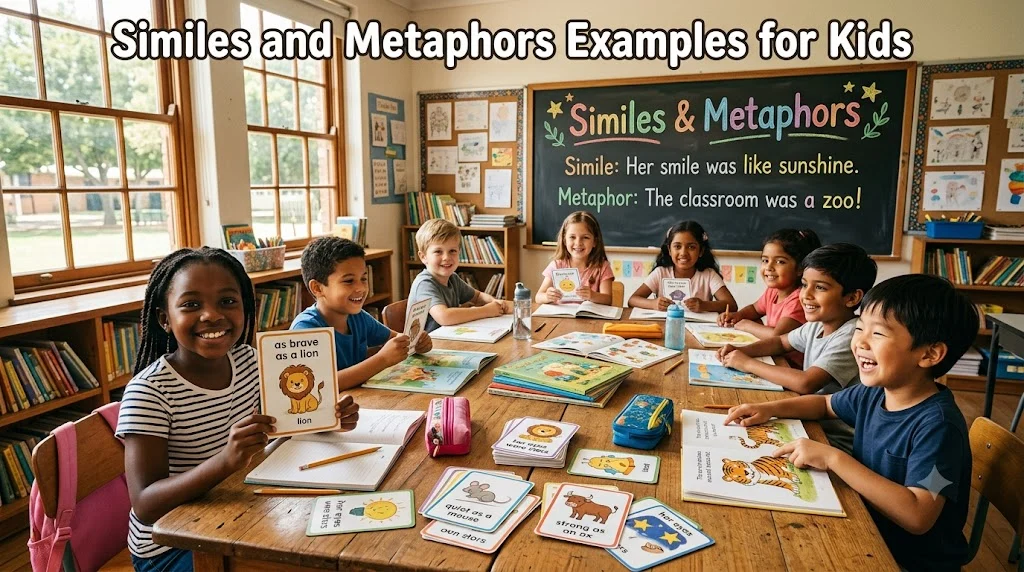
A simile compares two things using the words “like” or “as” (e.g., “She is as brave as a lion“).
A metaphor says one thing is another thing directly (e.g., “She is a lion”).Both are figures of speech that help kids describe feelings, people, places, and ideas in vivid, memorable ways.
Words are the most powerful tools kids will ever pick up. But sometimes plain words just don’t paint a big enough picture. That’s exactly where similes and metaphors come in. These two figures of speech are among the very first literary devices children learn in school and for good reason. They make writing colorful, exciting, and much easier to understand.
Imagine trying to explain how fast someone runs without saying “really fast.” With a simile, a child can write: “She ran like the wind.” Suddenly, readers don’t just know she was fast they feel it. That is the magic of figurative language, and this guide is packed with simple explanations, fun examples, classroom exercises, and everything kids (and parents and teachers) need to master similes and metaphors.
What Are Similes? A Simple Explanation for Kids
A simile (say it: SIM-ih-lee) is a way of comparing two different things to describe something more vividly. The key rule is simple: a simile always uses the words “like” or “as” to make the comparison.
Think of it this way: if you want to describe how cold the ice cream is, you could say “the ice cream is cold.” But with a simile, you could say “the ice cream is as cold as a snowstorm” and now your reader really feels it!
The Golden Rule of Similes
Every simile contains one of these two words:
- “Like” used between the two things being compared: “He eats like a horse.”
- “As” usually used in the pattern “as ___ as ___”: “She is as quiet as a mouse.”
🧠 Memory Tip for Kids: Similes use “like” or “as” think of the letter S in Simile standing for “Says like or as”!
25 Simile Examples for Kids
Similes Using “As…As”
| Simile | Meaning |
|---|---|
| As brave as a lion | Very courageous and fearless |
| As fast as lightning | Extremely quick |
| As quiet as a mouse | Very silent and still |
| As tall as a giraffe | Very tall |
| As cold as ice | Extremely cold |
| As hard as a rock | Very hard or tough |
| As sweet as candy | Very sweet, kind, or pleasant |
| As bright as the sun | Very bright or cheerful |
| As soft as a cloud | Very soft and comfortable |
| As light as a feather | Very light in weight |
| As strong as a bear | Extremely strong |
| As busy as a bee | Always working, never stopping |
| As playful as a puppy | Full of energy and fun |
| As round as a ball | Perfectly circular in shape |
| As clear as crystal | Very easy to see or understand |
Similes Using “Like”
| Simile | Meaning |
|---|---|
| He eats like a horse | He eats a lot |
| She sings like an angel | She has a beautiful voice |
| It spread like wildfire | It moved or grew very quickly |
| He runs like the wind | He runs very fast |
| She cried like a baby | She cried a great deal |
| The children fought like cats and dogs | They argued or fought constantly |
| The stars shone like diamonds | The stars were very bright and sparkly |
| The teacher’s voice was like thunder | The voice was loud and commanding |
| Her laugh was like music | Her laugh was pleasant and joyful |
| The cake disappeared like magic | The cake was eaten very quickly |
Simile Examples in Sentences
Nature
The river moved like a sleeping giant, slow and powerful.
The leaves fell like tiny golden butterflies from the old oak tree.
People and Feelings
After winning the race, I felt as light as a feather.
My grandmother’s hug was as warm as a cozy blanket on a winter night.
Animals
The baby rabbit was as soft as a pillow.
The dog zoomed across the yard like a rocket.
What Are Metaphors? A Simple Explanation for Kids
A metaphor (say it: MET-uh-for) takes comparisons one step further. Instead of saying something is like something else, a metaphor says it is that thing. It skips the words “like” and “as” and makes a direct comparison.
If a simile says “She is as brave as a lion,” the metaphor says “She is a lion.” That single change makes the image feel much stronger and more powerful in the reader’s mind.
The Golden Rule of Metaphors
Metaphors do not use “like” or “as.” They say something is (or was, or becomes) something else:
- The world is a stage.
- Life is a rollercoaster.
- Time is money.
🧠 Memory Tip for Kids: A metaphor makes things MORE think of the letter M in Metaphor standing for “Makes a direct match” no “like” or “as” needed!
25 Metaphor Examples for Kids
Simple Metaphors About People
| Metaphor | Meaning |
|---|---|
| She is a shining star | She is talented, bright, and special |
| He is a walking encyclopedia | He knows a lot about everything |
| She is a ray of sunshine | She is cheerful and makes others happy |
| He is a couch potato | He is lazy and does nothing active |
| She is a night owl | She stays up very late |
| He is an early bird | He wakes up very early |
| She has a heart of gold | She is very kind and generous |
| He is a rock | He is very strong and dependable |
Simple Metaphors About Life and the World
| Metaphor | Meaning |
|---|---|
| The world is a book | Life has many stories and pages to discover |
| Life is a journey | We travel through life with ups and downs |
| School is a treasure chest | School is full of knowledge to discover |
| The mind is an ocean | The mind is deep, vast, and full of things |
| Time is a thief | Time takes away moments before we notice |
| Words are weapons | Words can hurt people deeply |
| Books are windows to new worlds | Books let us explore new places and ideas |
| The moon is a silver coin | The full moon looks round and shiny |
Fun Metaphors for Kids About Nature and Animals
| Metaphor | Meaning |
|---|---|
| The clouds are cotton balls | The clouds look soft, white, and fluffy |
| The wind is a howling wolf | The wind sounds like a wolf howling |
| The snow is a white blanket | The snow covers the ground like a blanket |
| The stars are tiny lanterns | Stars look like small lights in the night sky |
| The flowers are bright jewels | The flowers are beautiful and colorful |
| The sun is a ball of fire | The sun is hot and blazing |
| The ocean is a roaring monster | The rough ocean sounds loud and powerful |
| The tree is a giant | The tree is very tall |
| Her eyes are stars | Her eyes are bright and beautiful |
Simile vs. Metaphor: What Is the Difference?
This is the question every student asks. The answer is actually very simple once you see them side by side.
🔵 Simile
Uses “like” or “as” to compare.
“Her voice was like music.”
“He was as strong as an ox.”
“The rain fell like tiny silver coins.”
🟡 Metaphor
Says one thing IS another no “like” or “as”.
“Her voice was music.”
“He was an ox.”
“The rain was silver coins.”
Same Idea, Two Different Tools
Here are five pairs that show the same idea expressed first as a simile, then as a metaphor:
| Simile | Metaphor |
|---|---|
| She is as brave as a lion. | She is a lion. |
| The classroom was like a zoo. | The classroom was a zoo. |
| He runs like the wind. | He is the wind. |
| The night sky was like a velvet blanket. | The night sky was a velvet blanket. |
| The homework pile was like a mountain. | The homework pile was a mountain. |
✏️ Quick Trick: If you can take the sentence and remove “like” or “as” and it still makes sense as a comparison, you just turned a simile into a metaphor!
Similes and Metaphors in Children’s Books and Stories
Some of the best examples of similes and metaphors come straight from books kids already love. Great authors use figurative language all the time to bring their stories to life.
Similes Found in Everyday Children’s Stories
From Stories and Tales
“The giant’s footsteps were like thunder rolling across the sky.”
“The little girl’s hair was as golden as the morning sun.”
“The witch’s laugh was like broken glass, sharp and cold.”
His hands were as rough as sandpaper from years of hard work.”
Metaphors Found in Everyday Children’s Stories
From Stories and Tales
“The dragon’s eyes were burning coals.”
“The forest was a maze of shadows that twisted in every direction.”
“Every book was a doorway to a world she had never visited.”
“The boy’s imagination was a rocket ship, always launching into new adventures.”
Similes and Metaphors by Grade Level
For Kindergarten and Grade 1 (Ages 5–7)
At this age, keep it simple, sensory, and fun. Focus on things kids can see, touch, hear, smell, and taste.
- The kitten is as soft as a pillow.
- The lemon is as sour as a face.
- The puppy runs like a tornado.
- The stars are tiny nightlights in the sky.
- His smile is sunshine.
For Grades 2 and 3 (Ages 7–9)
Children at this stage can begin connecting feelings and personality to vivid images.
- She was as nervous as a cat in a room full of rocking chairs.
- The homework was like climbing a mountain.
- My backpack felt as heavy as a boulder.
- The library was a treasure island full of adventures.
- Recess was a mini vacation in the middle of the school day.
For Grades 4 and 5 (Ages 9–11)
Students here can layer meaning and use more original, creative comparisons.
- The empty classroom was a sleeping giant, waiting to wake up.
- His words fell like stones into still water, creating ripples that spread through the crowd.
- She swam through the crowded hallway like a fish navigating a reef.
- The test paper stared at him like an unsolved puzzle with no picture on the box.
- Friendship is a garden it needs water, sunlight, and care to grow.
For Grades 6, 7, and 8 (Ages 11–14)
Middle school writers can craft extended metaphors and subtler similes that carry emotional weight.
- Her memories of that summer were faded photographs, beautiful but hard to hold.
- Growing up is like learning to ride a bike terrifying at first, then suddenly something you never forget.
- The city at night was a living creature, breathing neon and exhaling music.
- Silence after the argument settled like snow — soft, heavy, and covering everything.
- His confidence was a sail that caught every passing wind and pulled him forward.
Fun Classroom and Home Writing Exercises
Exercise 1: Complete the Simile
Give students the beginning and ask them to finish it creatively:
- The pizza was as hot as ___.
- She danced like ___.
- The night was as dark as ___.
- My dog runs like ___.
- The math test felt as hard as ___.
Exercise 2: Turn Boring Sentences into Vivid Ones
Ask kids to rewrite plain sentences using a simile or metaphor:
- Plain: “She was happy.” → Simile: “She was as happy as a kid on Christmas morning.”
- Plain: “He was tired.” → Metaphor: “He was a deflated balloon.”
- Plain: “The wind blew hard.” → Simile: “The wind roared like a hungry lion.”
- Plain: “It rained a lot.” → Metaphor: “The sky was a leaking bucket.”
Exercise 3: Simile or Metaphor? Identify the Type
Read each sentence and decide: simile or metaphor?
- “The classroom was a battlefield.” Metaphor
- “She sings like a bird.” Simile
- “His heart was made of stone.” Metaphor
- “The soup was as thick as mud.” Simile
- “Time is a river always flowing forward.” Metaphor
- “The baby slept like an angel.” Simile
Exercise 4: Create Your Own Figurative Language Story
Ask children to write a short 5-sentence story about their favourite animal using at least one simile and one metaphor. Example:
Student Example: The Elephant
“Max the elephant walked slowly through the jungle. His feet were as heavy as tree trunks. Every step shook the ground like a small earthquake. Max was a grey mountain among the smaller animals. But despite his size, his heart was a warm lamp that lit up everyone around him.”
Why Similes and Metaphors Matter for Kids
They Make Writing Come Alive
Plain descriptions tell readers what something is. Figurative language makes them feel it. When a child writes “the storm was loud,” nobody feels anything. When they write “the storm was an angry giant throwing furniture across the sky,” readers duck their heads automatically. That’s the power of figurative language.
They Strengthen Reading Comprehension
Children who understand similes and metaphors find it much easier to read stories, poetry, and even textbooks. Strong readers recognize figurative language automatically and decode meaning faster leading to higher comprehension scores across all subjects.
They Build Vocabulary and Creativity
Creating a good simile or metaphor requires a child to think across categories to connect a feeling to an object in nature, an animal, or a place. This cross-domain thinking is a key marker of creative intelligence and builds vocabulary in a natural, memorable way.
They Are Found Everywhere
Songs, sports commentary, news reports, poems, speeches, advertisements figurative language is all around children every day. Recognizing it early gives them a huge head start in understanding the world through language.
Common Mistakes Kids Make with Similes and Metaphors
Mixing Up Simile and Metaphor
The most common mistake is forgetting the “like/as” rule. A quick fix: if the sentence uses “like” or “as” to compare, it’s a simile. If it says something is something else directly, it’s a metaphor. Practice with examples until this becomes automatic.
Using the Same Similes Over and Over
Phrases like “as brave as a lion” or “cried like a baby” are so common they’ve lost their power. Encourage kids to invent their own comparisons. A dog isn’t just “as fast as lightning” maybe it’s “as fast as a sneeze.” Fresh, original similes are always more interesting.
Making Comparisons That Don’t Make Sense
Figurative language works because the comparison teaches the reader something. “She was as happy as a door” doesn’t work doors don’t have feelings the reader can relate to. Comparisons should connect to something readers already understand.
Overloading One Sentence
Too many figures of speech in one sentence cancel each other out. “She ran like the wind, which was a roaring lion that was as loud as a thunderstorm that was a giant drum” that’s exhausting to read. One strong image per sentence is always better.
Quick-Reference: 20 Best Similes and Metaphors for Kids
| # | Figure of Speech | Type | Meaning |
|---|---|---|---|
| 1 | As brave as a lion | Simile | Very courageous |
| 2 | She is a ray of sunshine | Metaphor | Cheerful and happy |
| 3 | He runs like the wind | Simile | Very fast |
| 4 | Life is a rollercoaster | Metaphor | Full of ups and downs |
| 5 | As quiet as a mouse | Simile | Very silent |
| 6 | The classroom was a zoo | Metaphor | Noisy and chaotic |
| 7 | Swam like a fish | Simile | Swam very well |
| 8 | She has a heart of gold | Metaphor | Very kind |
| 9 | As bright as the sun | Simile | Very bright or cheerful |
| 10 | Books are windows | Metaphor | Books open new worlds |
| 11 | Her laugh was like music | Simile | A beautiful laugh |
| 12 | Time is a thief | Metaphor | Time passes without notice |
| 13 | As busy as a bee | Simile | Always working |
| 14 | He is a walking encyclopedia | Metaphor | Knows everything |
| 15 | Stars shone like diamonds | Simile | Stars were very bright |
| 16 | The snow is a white blanket | Metaphor | Snow covers everything |
| 17 | As cold as ice | Simile | Very cold |
| 18 | Friendship is a garden | Metaphor | Needs care to grow |
| 19 | It spread like wildfire | Simile | Spread very fast |
| 20 | The world is a stage | Metaphor | We all play roles in life |
Tips for Parents and Teachers
Read Aloud Together
Reading aloud with children and pausing whenever you encounter a simile or metaphor is one of the most effective strategies. Say: “Listen to this sentence what two things is the author comparing?” This trains the ear before the pencil ever touches paper.
Play “Simile Spotting” Games
Turn it into a daily game. Ask kids to spot similes and metaphors in songs on the radio, conversations at the dinner table, or sports commentary on TV. Offering a small reward for each one found makes the skill stick much faster.
Create a Figurative Language Journal
Give children a small notebook where they write down any interesting similes or metaphors they discover while reading or listening. Over time, this becomes a personal collection they can draw from when writing their own stories.
Celebrate Original Creativity
When a child invents a fresh, original simile or metaphor even a silly one celebrate it. Figurative language thrives in an environment where creative risk-taking is praised. “The homework was as tall as my dad’s socks” is original, fun, and shows exactly the kind of thinking you want to encourage.
FAQs
1. What is the easiest way for kids to remember the difference between a simile and a metaphor?
The simplest trick: if the sentence uses “like” or “as” to compare two things, it is a simile. If it says something is something else without using those words, it is a metaphor. Practice with at least five examples of each until the rule becomes automatic.
2. At what age should children start learning similes and metaphors?
Most children encounter similes informally as early as age 5–6 in picture books and songs. Formal instruction typically begins in Grade 2 or 3 (ages 7–9), with deeper exploration of metaphors starting around Grade 4 (age 9–10).
3. Are all metaphors and similes figures of speech?
Yes. Both similes and metaphors belong to the family of literary devices known as figures of speech, which also includes personification, hyperbole, alliteration, and onomatopoeia. Similes and metaphors are the two most commonly taught in primary and middle school.
4. Can a sentence be both a simile and a metaphor?
No. A sentence is one or the other. If it uses “like” or “as” to compare, it is a simile. If it makes a direct comparison without those words, it is a metaphor. The distinction is in the structure of the sentence itself.
5. What is an extended metaphor?
An extended metaphor is a metaphor that continues across several sentences or even an entire paragraph or poem. For example, if a writer describes life as a journey and then keeps describing the “roads,” “detours,” and “destinations” of life, that is an extended metaphor. It is usually taught in middle school (Grades 6–8).
6. How do similes and metaphors help with reading comprehension tests?
Many standardized tests and reading comprehension passages include figurative language questions. Students who can quickly identify similes and metaphors and explain what they mean score higher on these questions. Understanding figurative language also helps students grasp the overall tone and meaning of a passage more accurately.
7. What is the difference between a metaphor and personification?
Personification is actually a special type of metaphor where a non-human thing is given human qualities. “The wind whispered secrets through the trees” is personification. All personification is a form of metaphor, but not all metaphors are personification.
Conclusion
Similes and metaphors are among the most important and most joyful tools in any writer’s toolbox. For kids, they unlock a new dimension of language one where feelings have shapes, ideas have colors, and ordinary descriptions suddenly leap off the page.
A child who learns that her backpack feels as heavy as a boulder, or that a school cafeteria is a circus of noise, has discovered that language can be playful, powerful, and deeply personal all at the same time.
The best way to get better at both similes and metaphors is simply to read widely, write often, and pay attention to the vivid comparisons that already surround us every single day. Encourage kids to look for them in songs, stories, conversations, and nature and then challenge them to invent their own. Great writers are not born knowing these tools. They are made, one brave comparison at a time.







1 thought on “Similes and Metaphors Examples For Kids | Easy Guide with Fun Examples In 2026”