Quick Answer
Pars Meaning usually refers to the plural of “par,” meaning equal levels, standards, or expected amounts. Its meaning can vary depending on the context in which it appears.
Pars Meaning can be confusing because the word may appear in different contexts. In English, “pars” is commonly used as the plural form of “par.” Its exact meaning depends on the sentence or subject being discussed. Understanding the context makes the intended meaning much clearer.
When you come across Pars Meaning online or in everyday writing, it may relate to standards, equality, or golf scores. The word can also appear in specialized or historical contexts. This guide breaks down its common meanings in simple language. You’ll also learn how “pars” is used through clear examples.
Pars Meaning
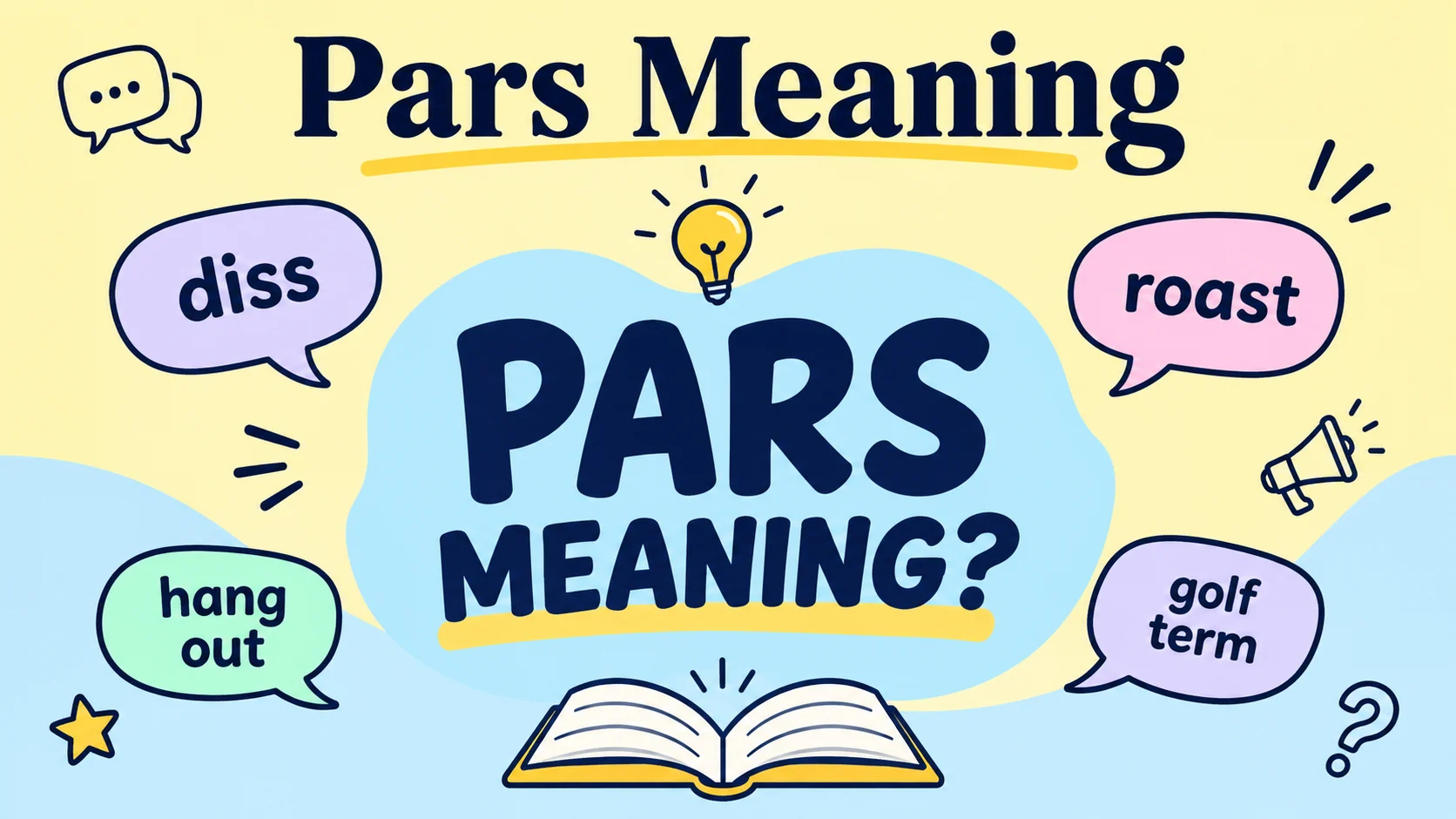
Pars (also spelled par in singular form) is UK street and grime slang that primarily means to insult, mock, disrespect, or embarrass someone, usually in a joking or competitive way. If someone says “you just got parred,” it means you were roasted, called out, or put down often in front of other people.
A second, older usage of pars means to hang out or associate with someone (“I par with my mandem” = “I hang out with my friends”). Outside of slang, pars is also the plural of par in golf (a standard score for a hole) and the Latin word for “a part,” used in medical and legal terms like pars interarticularis or inter partes.
So depending on where you hear it, pars could mean a diss, a friendship, a golf score, or a body part. Context is everything and we’ll walk through all of it below.
Origin of “Pars” Where Does This Word Come From?
The slang version of pars has its roots in UK grime, road, and Caribbean-influenced youth culture, particularly from London in the 2000s and 2010s. It’s closely tied to grime and drill music, where wordplay, disses, and lyrical “bars” often double as social currency.
- “Par” as insult: This usage exploded into mainstream awareness thanks to grime artist Tempa T, whose 2009 track “Next Hype” repeats the line “Everything’s a par, everything’s a par,” cementing the word in UK youth vocabulary. From there, it spread through freestyles, social media, and everyday London slang.
- “Par” as hang out: This meaning is older and comes from Caribbean patois roots, where “par” or “paring” with someone means keeping company with them, similar to “kicking it” or “chilling” in American slang.
- “Pars” the golf term: Comes from the Latin par, meaning “equal.” In golf, it refers to the number of strokes a skilled player is expected to need to complete a hole. This is the oldest and most formally documented usage.
- “Pars” as Latin for “part”: Found in academic, medical, and legal Latin phrases such as pars interarticularis (a part of the spine) and inter partes (a legal term meaning “between the parties”).
Interestingly, all these branches trace back to unrelated linguistic families colliding into the same three letters which is exactly why context matters so much when you hear the word.
How Popular Is “Pars” Today? Real-World Usage
The slang meaning of pars is most commonly used in:
- 🇬🇧 UK youth and street slang, especially in London, Birmingham, and Manchester
- 🎤 Grime, drill, and UK rap lyrics
- 💬 Social media comments, especially TikTok, Snapchat, and Twitter/X, where “you got parred 😭” is a common comedic reaction
- 📱 Group chats and banter among friends, often lighthearted rather than genuinely hostile
It hasn’t fully crossed over into mainstream American slang the way words like “cap” or “rizz” have, so if you’re outside the UK, you might only encounter it through music, memes, or British creators online.
Examples of “Pars” in a Sentence
Tone really shapes how “pars” lands. Here’s how it plays out across friendly, neutral, and more dismissive contexts.
Friendly / Playful Tone 😄
- “Bro just got parred by his own mum in front of everyone 💀”
- “That comeback was a light par, not even that deep.”
- “We were just paring each other the whole bus ride, nothing serious.”
Neutral / Descriptive Tone
- “In grime culture, a ‘par’ usually refers to a witty insult delivered as a punchline.”
- “He said it wasn’t a par, just an observation.”
Negative / Dismissive Tone 😬
- “That wasn’t banter, that was a proper par and everyone went quiet.”
- “Stop paring me in front of people, it’s not funny anymore.”
- “He tried to par her outfit and it did NOT go well for him.”
As you can see, “pars” can range from harmless teasing to something that genuinely stings the delivery and relationship between the people involved makes all the difference.
Pars vs. Similar Slang Terms How Does It Compare?
Since “pars” overlaps with several other slang words for insults or friendship, here’s a quick side-by-side comparison.
| Term | Meaning | Tone | Common Region |
|---|---|---|---|
| Pars / Par | To insult, diss, or roast someone | Playful to harsh | UK (grime/road slang) |
| Diss | To disrespect or criticize openly | Neutral to harsh | US/UK, mainstream |
| Roast | Humorous, exaggerated insult, often among friends | Playful | US/UK, mainstream |
| Cap | A lie or exaggeration | Neutral | US slang |
| Beef | Ongoing conflict or tension between people | Serious | US/UK, mainstream |
| Par (verb, older use) | To hang out or associate with someone | Friendly | UK/Caribbean patois |
| Par (golf) | Standard expected score on a hole | Neutral | Global, formal |
The key distinction: “roast” tends to be affectionate and mutual, while “par” can be more one-sided someone delivering the par usually “wins” the exchange, at least in the moment.
Alternate Meanings of “Pars” You Should Know
Beyond slang, “pars” shows up in a few unrelated but legitimate contexts:
- Golf: The plural of par e.g., “He shot four birdies and fourteen pars in the final round.”
- Latin/Medical: Meaning “a part,” used in anatomical terms like pars interarticularis (a section of the vertebra) or pars orbitalis (part of a facial muscle).
- Legal Latin: Inter partes means “between the parties,” commonly used in legal and patent proceedings.
- Geography: Pars (or Fars) is a historic province in Iran, from which the word “Persia” originates.
- Acronym: In some technical and government contexts, PARS stands for various program names (e.g., a records or reporting system), depending on the industry.
If you’ve searched “pars meaning” expecting one of these definitions instead of the slang one, hopefully this section pointed you in the right direction.
Polite or Professional Alternatives to “Pars”
If you’re writing something formal an email, an article, a school assignment and want to express the same idea without slang, here are cleaner alternatives:
| Instead of saying… | Say this in professional contexts |
|---|---|
| “He parred me in front of everyone.” | “He made a joke at my expense in front of everyone.” |
| “That was a severe par.” | “That was a sharp/witty remark.” |
| “Stop paring people.” | “Please stop mocking/teasing others.” |
| “We just par around.” | “We just hang out casually.” |
Using these alternatives keeps your writing accessible to readers who may not be familiar with UK slang, especially in workplace or academic settings.
FAQs
1. What does “pars” mean in slang?
It typically means to insult, mock, or embarrass someone, often in a witty or public way. It can also mean to hang out with someone, depending on the context.
2. Is “pars” a British word?
Yes, the insult-related meaning of “pars” is primarily British slang, rooted in UK grime and road culture, especially from London.
3. What does “you got parred” mean?
It means you were the target of an insult, roast, or embarrassing comment, often in front of others.
4. Is “par” the same as “diss”?
They’re similar, but “par” often implies a clever or witty put-down, while “diss” can be more general and doesn’t always require humor.
5. What does “pars” mean in golf?
It’s the plural of “par,” referring to the standard number of strokes expected for a skilled golfer to complete a hole.
6. What does “pars” mean in Latin or medical terms?
“Pars” is Latin for “a part,” used in anatomical and legal terms such as pars interarticularis or inter partes.
7. Is calling someone “pars” offensive?
It depends on tone and relationship. Among friends, it’s usually playful banter. Between strangers or in a hostile tone, it can be genuinely disrespectful.
8. Where did the slang word “pars” come from?
It gained popularity through UK grime music, notably Tempa T’s 2009 track “Next Hype,” and has Caribbean patois influence for its “hang out” meaning.
Conclusion
To sum it all up:
- Pars most commonly means to insult, mock, or embarrass someone in UK slang, especially in grime and road culture.
- It can also mean to hang out or associate with someone, depending on regional and generational context.
- Outside slang, pars appears in golf (plural of par), Latin (meaning “a part”), and even geography (an old name tied to Persia/Iran).
- Tone matters a “par” can be playful banter or a genuine put-down depending on delivery and relationship.
- If you’re writing formally, swap “pars” for words like “mock,” “tease,” or “witty remark” to keep things professional.
Next time someone says “don’t pars me,” you’ll know exactly what’s going on and maybe even have a clever comeback ready. 😉
Read More Related Articles:
- Habibi Meaning | Why This Arabic Word Feels So Personal In 2026
- Parens Meaning In Text | From Confusing Shortcut to Clear Meaning In 2026

Alex Morgan is a creative mind behind SimileVibe.com, focused on building clean digital experiences that feel simple, modern, and real. He works closely with ideas, design, and user experience to create projects that connect naturally with people online.