Quick Answer
Wailer Meaning: A wailer is someone who cries, weeps or makes loud, sorrowful sounds. The word can also describe a person or thing that produces a loud, mournful noise.
Understanding the Wailer Meaning helps you recognize how this word describes expressions of sadness, grief and emotional pain. A wailer is usually someone who cries loudly or makes a deep, sorrowful sound. The term can also refer to a person who expresses distress through loud cries. Its exact meaning depends on the situation in which it is used.
The word wailer comes from the verb wail, which means to cry out loudly in sadness, pain or distress. You might hear it used to describe a grieving person, a crying child or someone expressing intense emotions. In some contexts, it can also describe a loud, mournful sound. Learning the Wailer Meaning makes it easier to understand the word in conversations, books and everyday writing.
What Does Wailer Mean?
The word wailer is a noun formed from the verb wail. To wail means to cry, shout, or produce a long, loud sound that often communicates pain, sadness, distress, or intense emotion.
A wailer is therefore someone or something that makes that kind of sound. The term is not limited to human beings. It can describe a crying child, a grieving person, a musical performer, or an object that produces a loud, drawn-out noise.
Consider these examples:
- A grieving person who cries loudly at a funeral may be described as a wailer.
- A baby who cries intensely for a long time might be called a little wailer.
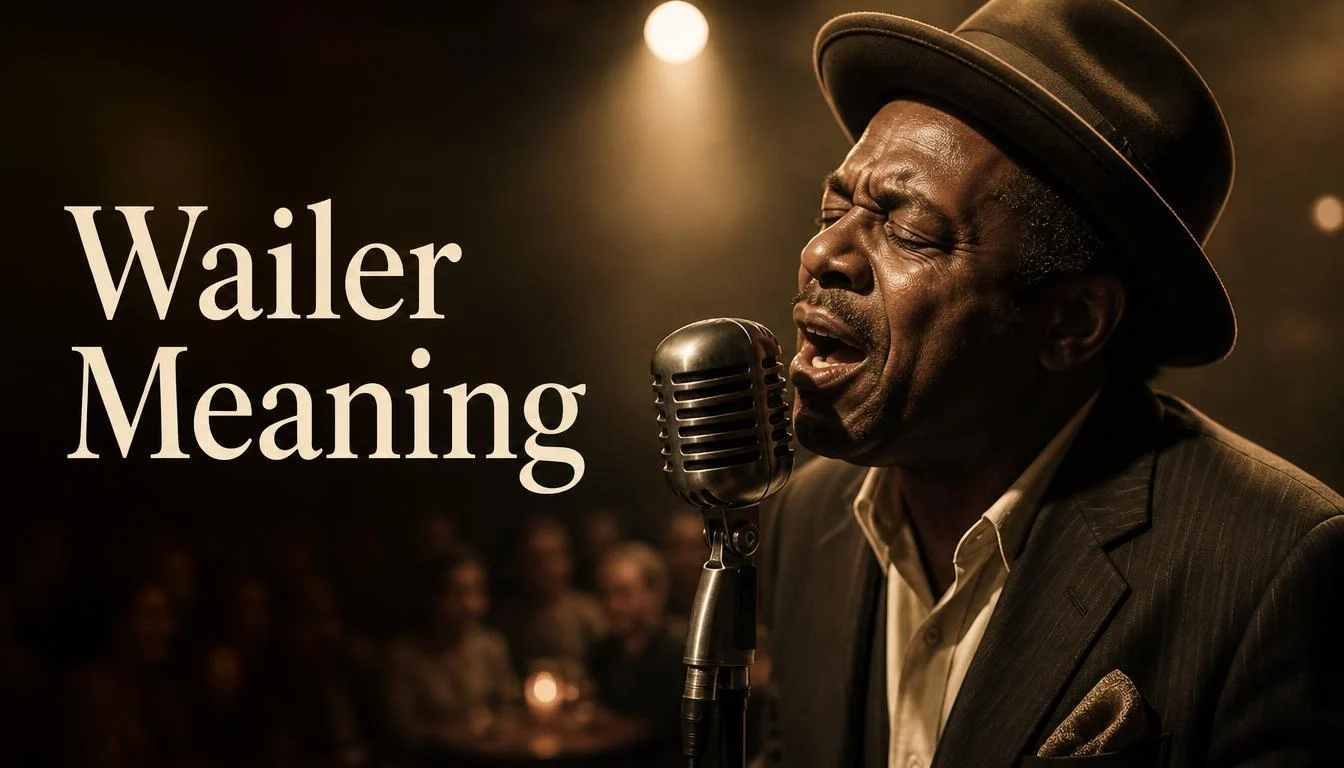
- A musician with a powerful, expressive voice may be described as a wailer in an informal music review.
- A loud siren may be described as a wailer because of the sound it produces.
The word usually suggests more than ordinary speaking or quiet crying. It brings to mind a sound that is noticeable, prolonged, and emotionally charged.
However, it does not always imply sadness. A singer can wail with passion, while a siren can wail without expressing any emotion at all.
Is Wailer Always a Negative Word?
Not necessarily. The word can sound critical when used to describe someone who cries loudly or complains excessively. In that situation, it may suggest that the speaker finds the noise irritating or the behavior difficult to tolerate.
For example, calling someone “a constant wailer” may imply frustration with their repeated crying or complaints. The expression can sound dismissive, particularly if the person is experiencing genuine distress.
In music, the same word can be positive. Describing a vocalist as a wailer may praise the singer’s ability to deliver intense notes with feeling and power.
The distinction lies in the setting and the speaker’s tone. A word associated with distress can also express admiration when it describes artistic performance.
Origin and History of the Word Wailer
The word wailer comes from the verb wail, which has been used in English for centuries to describe loud cries of grief, pain, or distress. The noun follows a common English word-building pattern: adding the suffix -er to a verb creates a word for a person or thing that performs the action.
The same pattern appears in words such as singer, caller, shouter, and whistler. A singer sings, a caller calls, and a wailer wails.
What Does the Word Wail Originally Mean?
The verb wail has a long history in English, with earlier forms recorded in Middle English. Its origins are uncertain, although it is often associated with words imitating or describing cries of sorrow.
The sound of the word itself helps explain its effect. The long vowel and ending can make it feel drawn out, much like the prolonged cry it describes.
Unlike a neutral verb such as speak, wail generally suggests a strong vocal expression. It may communicate grief, physical pain, fear, frustration, or an intense emotional response.
The noun wailer carries that sense into a description of the person or source producing the sound.
How the Suffix -er Changes the Meaning
The suffix -er is useful because it turns an action into a description of its performer. In this case, the difference between wail and wailer is simple but important.
| Word | Part of speech | Meaning | Example |
|---|---|---|---|
| Wail | Verb or noun | To cry loudly or a prolonged cry | She began to wail. |
| Wailer | Noun | A person or thing that wails | The wailer could be heard outside. |
| Wailing | Verb form or noun | The act or sound of wailing | Their wailing filled the room. |
| Wailed | Past-tense verb | Produced a loud, mournful cry | The siren wailed through the night. |
This distinction helps you choose the right word when writing. Use wail for the action, wailing for the ongoing sound or activity, and wailer when identifying the person or thing responsible.
How Wailer Is Used in Everyday English
The term appears in several situations, from descriptions of emotional behavior to informal comments about loud noises. Although the central idea remains the same, its tone changes according to the context.
1. A Person Expressing Grief
One of the clearest uses describes someone who cries loudly because of sadness or loss. This usage is especially relevant in descriptions of funerals, tragic events, and scenes of intense mourning.
For example, a writer might describe a person as a wailer when their grief is expressed through loud, prolonged cries rather than quiet tears.
The word can also appear in descriptions of traditional mourning practices in different cultures. However, it should be used carefully when discussing real people, since it can make an emotional response sound theatrical or excessive.
2. A Baby or Young Child Crying
Parents and caregivers sometimes use wailer informally to describe a baby who cries loudly and persistently. In this context, the word is usually conversational rather than technical.
For instance, someone might say, “Our little wailer finally fell asleep after an exhausting afternoon.”
The expression can sound affectionate, humorous, or frustrated, depending on the speaker’s tone. It is not a medical term, and it does not explain why the baby is crying.
3. A Person Who Complains Loudly
In informal speech, the word may be applied to someone who repeatedly expresses dissatisfaction in a loud or dramatic way. Here, the emphasis shifts from grief to behavior that another person finds irritating.
Imagine a colleague who loudly protests every minor change at work. Someone might privately describe that colleague as a wailer.
This use can be judgmental. It suggests that the person is making a great deal of noise about a problem, but it does not prove that their concerns are unreasonable.
4. Something Producing a Loud Sound
A wailer does not have to be human. The word can also describe a machine or device that produces a long, piercing noise.
A siren is a good example. Emergency sirens can produce sustained rising and falling tones that people commonly describe as wailing.
A writer might say, “The wailer of an approaching ambulance echoed between the buildings.” Although the phrasing is less common than simply saying “the siren wailed,” the meaning remains understandable.
Wailer in Music and Popular Culture
Music provides a different way to understand the term. In informal music writing, a wailer can be a singer or instrumentalist known for producing intense, expressive sounds.
A vocalist might stretch a note, add a rough edge to the voice, or deliver a powerful cry that communicates anguish or excitement. A saxophonist or guitarist might also be described this way when playing with a similarly forceful, vocal quality.
In this setting, the word often expresses admiration rather than criticism.
What Is a Wailer in Singing?
A wailer in singing is generally a performer who delivers strong, emotionally charged vocal sounds. The performance may involve sustained notes, cries, vocal breaks, or a raw tone that gives the music an intense character.
The term is informal, not a formal classification of singers. It does not describe a specific vocal range, training method, or musical technique.
For example, a reviewer might call a blues singer a wailer because the singer communicates sorrow through powerful, rough-edged vocal phrases. A different reviewer might use the word for a rock singer whose live performances feature dramatic high notes.
The key idea is expressive intensity.
The Wailers and Reggae Music
The capitalized name The Wailers is also associated with reggae history. The Wailers were the Jamaican group closely connected with Bob Marley, Peter Tosh, and Bunny Wailer during the band’s early development.
Their work helped bring Jamaican reggae to international audiences. Albums such as Catch a Fire and Burnin’ became important releases in the group’s history.
The name The Wailers is a proper name, so it should not be treated as simply another ordinary use of the noun wailer. Although the spelling is closely related to the English word, the group’s name belongs to its own musical history.
This distinction matters when interpreting a search result or a sentence. Someone asking about “a wailer” may be asking about a singer, while someone searching for “The Wailers” may be looking for the reggae group.
Is Wailer a Slang Word?
Wailer is not primarily internet slang. It is an established English noun that can be used informally in conversation, music reviews, and expressive writing.
Its tone can feel casual when someone calls a crying child a wailer or describes a singer as a great wailer. Still, the word is not restricted to social media, texting, or a particular age group.
If you encounter it in a message, the surrounding words will usually clarify whether it describes crying, complaining, singing, or a loud sound.
Wailer vs. Similar Words
Several English words describe crying, shouting, or loud emotional sounds. They overlap in meaning, but each emphasizes something slightly different.
| Word | Main meaning | Difference from wailer |
|---|---|---|
| Crier | Someone who cries | More general and can describe quiet crying. |
| Weeper | A person who sheds tears | Often emphasizes crying rather than loud vocal sounds. |
| Howler | Someone or something that howls | Usually suggests a howl, a loud cry, or a howl-like sound. |
| Screamer | Someone who screams | Emphasizes a sharp, loud vocal outburst. |
| Moaner | Someone who moans or complains | Often suggests a low sound or repeated complaints. |
| Lamenter | Someone who expresses grief or regret | Emphasizes mourning or sorrow, often in a formal context. |
| Wailer | Someone or something that wails | Emphasizes a prolonged, loud, often mournful sound. |
What Is the Difference Between a Wailer and a Crier?
A crier is a broad term for someone who cries. The crying might be quiet, brief, or loud, and it does not necessarily communicate deep sorrow.
A wailer, by comparison, usually produces a more noticeable, prolonged sound. The word creates a stronger impression of vocal intensity.
For example, a child who quietly sheds tears could be described as a crier. A child crying loudly and continuously might be described as a wailer.
What Is the Difference Between a Wailer and a Howler?
A howler produces a howl, which is often a long, open vocal sound associated with animals, people, or dramatic noise. A wailer produces a sound more strongly associated with grief, distress, or emotional intensity.
The two words can overlap. Someone making a long, mournful cry could reasonably be described as either a howler or a wailer, depending on the sound and the writer’s intention.
However, howler also has other meanings, including a glaring mistake in informal English. Wailer does not normally carry that particular meaning.
Examples of Wailer in Sentences
Seeing the word in context makes its meaning easier to remember. The following examples show how it can describe different people and sounds.
- Grief: The wailer at the memorial expressed her sorrow through loud, prolonged cries.
- A crying child: His little brother was a determined wailer whenever bedtime arrived.
- Music: The blues singer was a remarkable wailer whose voice filled the entire venue.
- A loud siren: The distant wailer grew louder as the ambulance approached.
- Informal criticism: He jokingly called himself a wailer whenever his favorite team lost.
- Creative writing: A lone wailer could be heard across the dark, empty street.
- A live performance: The guitarist became a real wailer during the final solo.
- Everyday conversation: “What a wailer!” she laughed after hearing the baby cry.
- A dramatic scene: The author described the grieving crowd as a group of wailers.
- A noisy device: The old alarm was an irritating wailer that nobody wanted near their bedroom.
These examples also show why context matters. The same noun can describe sadness, artistic expression, humor, or an unpleasant noise.
How to Use Wailer Naturally
When writing with this word, consider whether you need to identify the source of a sound or describe the sound itself. If you are focusing on the action, wail or wailing may be more natural.
For instance, “The siren wailed outside” is more direct than “The wailer sounded outside.” The noun is most useful when the person or source making the noise is the focus of the sentence.
Also, avoid using wailer simply as a substitute for sad person. A person can feel deeply sad without crying loudly. The word describes a particular kind of expression, not someone’s entire emotional state.
Common Mistakes to Avoid
A few small distinctions can prevent confusion when reading or using this word.
- Confusing the action with the person: Wail describes the action, while wailer identifies the person or source producing the sound.
- Assuming it always means sadness: The word often suggests grief, but it can also describe passionate singing or a loud mechanical sound.
- Treating it as exclusively slang: It is an established English word, even though it appears in casual speech.
- Confusing it with The Wailers: The reggae group’s name is a proper noun and has a specific musical history.
- Assuming every use is insulting: Calling someone a wailer can be critical, affectionate, descriptive, or complimentary, depending on the circumstances.
The easiest way to interpret the term is to look at what is producing the sound and why the writer chose that particular word.
FAQs
Is wailer a formal English word?
Yes. Wailer is an established English noun formed from the verb wail. It can appear in literary writing, journalism, music criticism, and everyday conversation, although its suitability depends on the tone of the text.
What is the plural of wailer?
The plural is wailers. For example, “The wailers could be heard outside the building.” When referring to the Jamaican musical group The Wailers, the capitalized form is used because it is the group’s proper name.
Can wailer describe an animal?
Yes, if the animal produces a prolonged, loud cry that can reasonably be described as a wail. The word is not restricted to humans, although more specific terms such as howler or screamer may be more natural for particular animals.
What is the opposite of a wailer?
There is no single exact opposite. Depending on the context, a quiet person, a silent person, or someone who remains composed may express the intended contrast. These descriptions are contextual opposites rather than direct antonyms.
Is wailer the same as a mourner?
No. A mourner is someone who grieves, especially after a death, while a wailer is someone who produces loud, prolonged cries. A mourner may wail, but mourning does not require loud crying.
Conclusion
Wailer is a versatile English word that describes a person or thing producing a loud, prolonged, often emotional sound. Its meaning shifts with context, from grief and everyday crying to passionate singing and the sound of a siren. Understanding the difference between a wailer and related words such as crier, howler, and screamer helps you use it more precisely. When you encounter the term, pay attention to the sound being described and the attitude behind the speaker’s words.









