Quick Answer
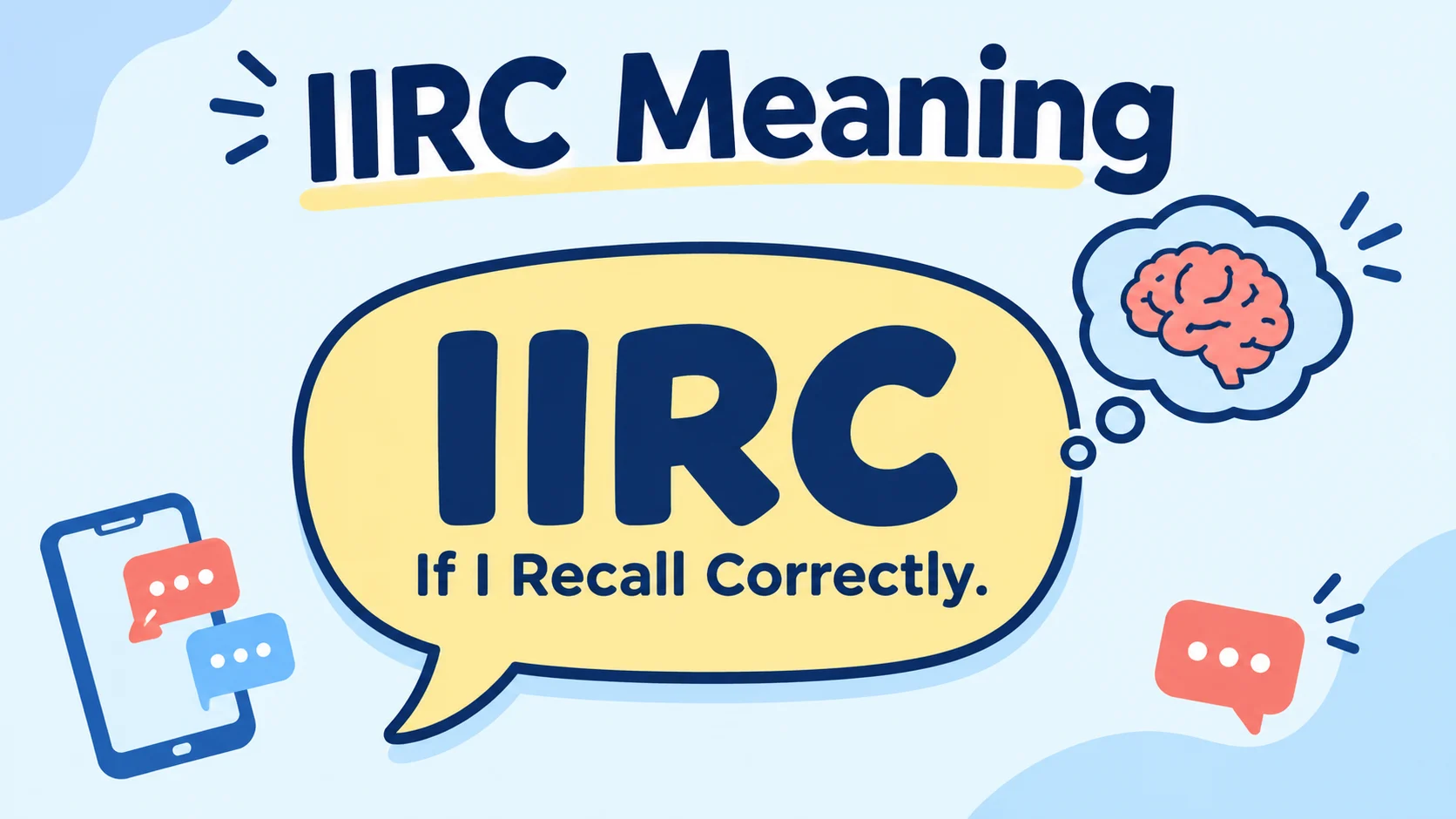
IIRC Meaning is “If I Recall Correctly.” It is used in texts and online chats when someone believes they remember something correctly but isn’t completely certain.
IIRC Meaning is commonly seen in texts, social media posts, and online conversations. It stands for “If I Recall Correctly” and refers to something you remember. People use it when they want to share information without sounding fully certain. It is a quick and casual way to say, “As far as I remember.”
Understanding IIRC Meaning can make online conversations easier to follow. You may see it before a fact, date, event, or detail someone remembers. For example, “IIRC, the meeting starts at 10” means “If I remember correctly.” It is informal and works best in casual digital communication.
Good news: it’s simpler than it looks, and once you know it, you’ll start noticing it everywhere from Discord servers to work Slack channels to your cousin’s texts.
IIRC Meaning
IIRC stands for “If I Recall Correctly” (sometimes written as “If I Remember Correctly”). It’s an internet and texting abbreviation used before sharing information that the speaker believes is accurate, but isn’t 100% certain about. People use it as a small verbal disclaimer a way of saying “here’s what I remember, but don’t quote me on it.”
Example: “IIRC, the store closes at 9 PM on weekdays.”
That one sentence tells you everything: this is a memory-based statement, not a guaranteed fact. It’s honest, low-stakes, and surprisingly useful in everyday conversation.
Where Did IIRC Come From? Origin & History
IIRC belongs to a big family of internet acronyms that were born in the early days of online forums, IRC (Internet Relay Chat) chatrooms, and Usenet groups back in the 1990s. Typing was slow, bandwidth was precious, and abbreviating common phrases became second nature for people who spent hours a day chatting online.
Phrases like “if I recall correctly” got shortened for the same reason we now shorten “to be honest” to “TBH” or “in my opinion” to “IMO” it’s faster to type, and once a community adopts it, everyone just understands it instantly.
IIRC specifically caught on in:
- Tech and programming forums, where people frequently reference documentation, code behavior, or specs from memory
- Gaming communities, where players recall patch notes, game mechanics, or lore details
- Trivia and discussion boards, like early Reddit and forums such as SomethingAwful or 4chan
- Academic and research discussions, where citing something “from memory” needed a quick disclaimer
Over the decades, it moved from niche chatrooms into mainstream texting and social media, especially as younger generations who grew up online carried their internet vocabulary into everyday messaging.
How Popular Is IIRC Today?
IIRC isn’t as universally known as acronyms like LOL or OMG, but it’s extremely common in specific communities particularly among:
- Software developers and engineers
- Gamers (especially in comment sections and forums like Reddit)
- People in their late 20s to 40s who were active online in the 2000s–2010s
- Academic or research-adjacent online spaces
It’s less common in formal business writing (though it does sneak into casual Slack messages) and rarely appears in spoken conversation it’s very much a written internet abbreviation.
How Is IIRC Used in Real Life?
IIRC typically shows up in three tones: friendly/casual, neutral/informational, and occasionally dismissive. Let’s break these down with real examples.
😊 Friendly / Casual Tone
Used between friends or in relaxed group chats, often paired with other casual internet shorthand.
- “IIRC you said you were free Saturday? Wanna grab coffee?”
- “Wasn’t that movie directed by the same guy who did Inception? IIRC anyway lol 😅”
- “IIRC your birthday is next week am I right?”
📋 Neutral / Informational Tone
Common in work chats, forums, or study groups where accuracy matters but the speaker wants to flag uncertainty.
- “IIRC, the deploy window is between 2–4 PM EST.”
- “The function returns null in that edge case, IIRC worth double-checking the docs.”
- “IIRC the treaty was signed in 1919, but I’d verify that before citing it.”
😐 Dismissive / Non-Committal Tone
Sometimes used almost as a shrug a way to answer without fully committing to being right, especially if the topic isn’t that important to the speaker.
- “IIRC it’s somewhere near the mall? Not 100% sure though.”
- “Eh, IIRC that show got cancelled. Don’t quote me.”
- “IIRC he said he’d come, but who knows at this point 🤷”
Notice how the tone shifts depending on punctuation, emojis, and surrounding words IIRC itself stays neutral, but context colors how confident or casual it feels.
IIRC vs. Similar Abbreviations
IIRC has a lot of cousins in the “memory and certainty” family of internet acronyms. Here’s how it stacks up:
| Abbreviation | Full Meaning | Implies Certainty? | Best Used For |
|---|---|---|---|
| IIRC | If I Recall Correctly | Low-medium | Sharing a memory you’re fairly but not fully sure about |
| AFAIK | As Far As I Know | Low-medium | Sharing knowledge with acknowledged limits |
| TBH | To Be Honest | N/A (honesty, not memory) | Giving a candid opinion |
| IMO / IMHO | In My (Humble) Opinion | N/A (opinion, not fact) | Sharing a personal viewpoint |
| FWIW | For What It’s Worth | N/A | Adding info that may or may not be useful |
| CMIIW | Correct Me If I’m Wrong | Low | Inviting correction on a stated fact |
| IIUC | If I Understand Correctly | Low-medium | Checking your understanding of a concept, not a memory |
Key difference: IIRC is specifically about memory recalling something from the past. AFAIK is about the current limits of your knowledge. IIUC is about comprehension of something explained to you. They’re often used interchangeably in casual speech, but technically each one flags a slightly different kind of uncertainty.
Why Do People Use Hedge Words Like IIRC in the First Place?
Before we go further, it’s worth pausing on why abbreviations like IIRC even exist. Linguists call words and phrases like this “hedges” little verbal cushions that soften a statement so it doesn’t sound like an absolute, unshakeable fact.
Think about it: humans misremember things constantly. Names, dates, plot details, prices, appointment times memory is notoriously unreliable, even when we feel confident. Saying “the concert was in 2019” sounds like a hard fact. Saying “IIRC, the concert was in 2019” sounds like a fact you’re offering in good faith, while leaving room to be corrected without losing credibility.
This matters more than it seems, especially online, where:
- Tone is easy to misread a flat statement can come across as arrogant or overly confident, even if that’s not the intent.
- Mistakes are public and permanent a wrong statement in a group chat or forum post can be screenshotted, quoted, or corrected by dozens of people.
- Trust matters in communities people who consistently flag their own uncertainty tend to be seen as more trustworthy than people who state everything as fact and are frequently wrong.
So IIRC isn’t just a lazy shortcut it’s actually a small act of intellectual honesty, dressed up as internet slang.
IIRC Across Different Online Communities
Not every corner of the internet uses IIRC the same way. The tone, frequency, and even the implied confidence level can shift depending on where you see it. Here’s a breakdown:
| Community | How IIRC Is Typically Used | Example |
|---|---|---|
| Gaming forums / Discord | Recalling patch notes, lore, or mechanics from memory | “IIRC that boss was nerfed in the last patch.” |
| Programming/tech forums (Stack Overflow, GitHub) | Flagging technical details that should be double-checked against docs | “IIRC that method was deprecated in v3.” |
| Reddit comment threads | Casual fact-checking or trivia recall | “IIRC he played that role in an earlier film too.” |
| Workplace Slack/Teams chats | Softening a claim about deadlines, decisions, or client requests | “IIRC the client wanted the draft by Friday.” |
| Group texts among friends | Confirming plans, memories, or shared experiences | “IIRC you owe me $20 from last weekend 😅” |
| Academic/research discussion boards | Citing something from memory before verifying a source | “IIRC that study was published around 2018, but I’d confirm the year.” |
Notice the pattern: the more “high-stakes” or fact-checkable the environment (like coding or academic spaces), the more IIRC functions as a genuine disclaimer. In casual texting, it’s often more playful and low-pressure.
Generational and Regional Usage Patterns
IIRC skews heavily toward people who came of age during the rise of internet forums, IRC chatrooms, and early social media roughly Millennials and older Gen Z users. That said, it hasn’t disappeared with newer generations; it’s simply absorbed into the broader pool of internet shorthand that gets passed down through gaming culture, Discord servers, and meme-adjacent spaces.
A few usage patterns worth noting:
- English-speaking online spaces (US, UK, Canada, Australia, India) show the heaviest usage, since IIRC originated in English-language internet culture.
- Non-native English speakers in tech and gaming communities have widely adopted it too, since it’s short, easy to type, and easy to learn from context.
- Older internet users (people who were active on forums, BBS boards, or early IRC channels) tend to use it more naturally and frequently than people who grew up primarily on visual-first platforms like TikTok or Instagram, where slang trends move faster and abbreviations like IIRC are less central.
It’s not regional slang tied to one country it’s internet-culture slang, meaning geography matters far less than “how much time has this person spent in text-based online communities.”
Does IIRC Have Any Alternate Meanings?
Outside of texting and internet slang, “IIRC” occasionally pops up as an acronym in other fields, though these are far less common and usually only understood within niche contexts:
- International Institute for Restorative Coaching (a training organization)
- India Infoline Real Estate Company (finance/business use)
- Individually Identifiable Records/Content (used loosely in some data-privacy contexts)
These are organization- or industry-specific and don’t come close to the popularity of “If I Recall Correctly” in everyday digital communication. If you see “IIRC” in a casual chat, text, forum post, or comment section, it’s almost certainly the memory-related meaning.
Polite & Professional Alternatives to IIRC
If you’re writing something formal an email, a report, a client message IIRC probably isn’t the right fit. Here are some more professional ways to express the same idea:
- “If I remember correctly, …”
- “From what I recall, …”
- “Based on my recollection, …”
- “Unless I’m mistaken, …”
- “To the best of my memory, …”
- “If memory serves, …”
Example rewrite:
- Casual: “IIRC the invoice was due last Friday.”
- Professional: “If I recall correctly, the invoice was due last Friday I’ll confirm and follow up.”
This small swap keeps the same honest, hedge-your-bets tone while sounding polished enough for a workplace setting.
Labeled Example Table: IIRC in Context
| Scenario | Example Sentence | Tone |
|---|---|---|
| Texting a friend | “IIRC we’re meeting at 7, right? 😊” | Friendly |
| Work Slack message | “IIRC the client asked for the blue version, not red.” | Neutral |
| Reddit comment | “IIRC that actor was also in the first movie.” | Neutral |
| Trivia night | “IIRC the capital of Australia isn’t Sydney, it’s Canberra.” | Informational |
| Dismissive reply | “IIRC he said something like that, whatever 🤷” | Dismissive |
| Coding forum | “IIRC that library was deprecated in the last major update.” | Technical/Neutral |
| Group chat debate | “IIRC you’re the one who picked the restaurant last time lol” | Playful/Teasing |
How to Respond When Someone Uses IIRC
Since IIRC is essentially an invitation for correction, it’s helpful to know how to respond gracefully both when the person is right and when they’re not.
If they’re correct:
- “Yep, that’s right!”
- “Good memory 👍”
- “Confirmed, you’re spot on.”
If they’re wrong (or you’re not sure):
- “Actually, I think it was [correct info] but don’t quote me either lol”
- “Close! It was actually [correction].”
- “Hmm, IIRC it was different, let me double check.”
If nobody’s sure:
- “Let’s just Google it lol”
- “IIRC vs IIRC, we need a tiebreaker 😂”
This back-and-forth is actually part of what makes IIRC so useful in group settings it opens the door for collaborative fact-checking without anyone feeling embarrassed for not being 100% sure.
Common Mistakes People Make With IIRC
Even though IIRC is simple, there are a few ways people misuse it:
- Using it for things they’re 100% certain about. If you know something for a fact, IIRC undersells your confidence and can make you sound unnecessarily unsure.
- Overusing it in a single conversation. Repeating “IIRC” multiple times in a row can start to sound like you’re not confident about anything you’re saying.
- Using it in formal writing. IIRC in a cover letter, academic paper, or client proposal will read as too casual and internet-slang-heavy for the setting.
- Confusing it with similar-looking acronyms. IIRC, IIUC, and AFAIK all signal uncertainty but aren’t perfectly interchangeable mixing them up can slightly muddy your meaning (see the comparison table above).
- Assuming everyone knows it. Not everyone is familiar with internet abbreviations, especially outside of forums, gaming, and tech spaces. If you’re talking to someone unfamiliar with internet slang, spelling it out avoids confusion.
Tips for Using IIRC Correctly
- Use it when you’re genuinely unsure it loses its meaning (and honesty) if you use it for things you know for certain.
- Keep it casual save it for texts, DMs, forums, and informal chats rather than resumes, cover letters, or client-facing emails.
- Pair it with punctuation for tone a comma after IIRC (“IIRC, …”) reads more formal-casual, while dropping punctuation (“iirc idk”) feels more relaxed and Gen-Z coded.
- Don’t overuse it sprinkling it into every sentence can make you sound unsure of everything you say.
- Know your audience older relatives or formal colleagues may not recognize it, so spell it out if there’s any doubt.
FAQs:
1. What does IIRC mean in texting?
IIRC means “If I Recall Correctly.” It’s used before a statement to show the person believes it’s accurate but isn’t fully certain.
2. Is IIRC the same as IIUC?
Not exactly. IIRC relates to memory (“if I recall correctly”), while IIUC relates to comprehension (“if I understand correctly”). They’re often confused because both signal mild uncertainty.
3. Can I use IIRC in a professional email?
It’s best avoided in formal writing. Use “If I recall correctly” or “From what I remember” instead for a more polished tone.
4. Is IIRC rude or dismissive?
Not inherently. It’s a neutral hedge word. Tone comes from context, punctuation, and surrounding words rather than the abbreviation itself.
5. What’s the difference between IIRC and AFAIK?
IIRC is about recalling a specific memory or fact from the past. AFAIK (“as far as I know”) is about the current limits of someone’s general knowledge, not necessarily tied to memory.
6. Where did IIRC originate?
It originated in early internet chatrooms and forums (like IRC and Usenet) in the 1990s, where users shortened common phrases to type faster.
7. Is IIRC still commonly used in 2025–2026?
Yes, especially in gaming communities, tech/programming forums, and casual texting among people familiar with internet culture.
8. How do you pronounce IIRC out loud?
It’s rarely spoken aloud since it’s a written abbreviation, but when people do say it, they usually spell it out letter by letter: “I-I-R-C,” or simply say the full phrase, “if I recall correctly.”
Conclusion
IIRC is a small abbreviation that does a big job: it lets you share information honestly while acknowledging you might not have every detail perfectly straight. It’s friendly, low-pressure, and incredibly handy in texts, forums, gaming chats, and casual work conversations.
Quick recap:
- IIRC = “If I Recall Correctly”
- Born in 1990s internet chat culture, still going strong today
- Best used in casual or semi-casual writing, not formal documents
- Similar to AFAIK and IIUC, but specifically tied to memory
- Swap it for “If I recall correctly” or “From what I remember” in professional settings
Next time you see IIRC pop up in your group chat, you’ll know exactly what’s going on someone’s sharing their best memory of the facts, with just enough humility to admit they could be wrong. And honestly? That’s a pretty great habit to borrow, online or off.
Read More Related Articles:
- Parens Meaning In Text | From Confusing Shortcut to Clear Meaning In 2026
- Habibi Meaning | Why This Arabic Word Feels So Personal In 2026

Alex Morgan is a creative mind behind SimileVibe.com, focused on building clean digital experiences that feel simple, modern, and real. He works closely with ideas, design, and user experience to create projects that connect naturally with people online.