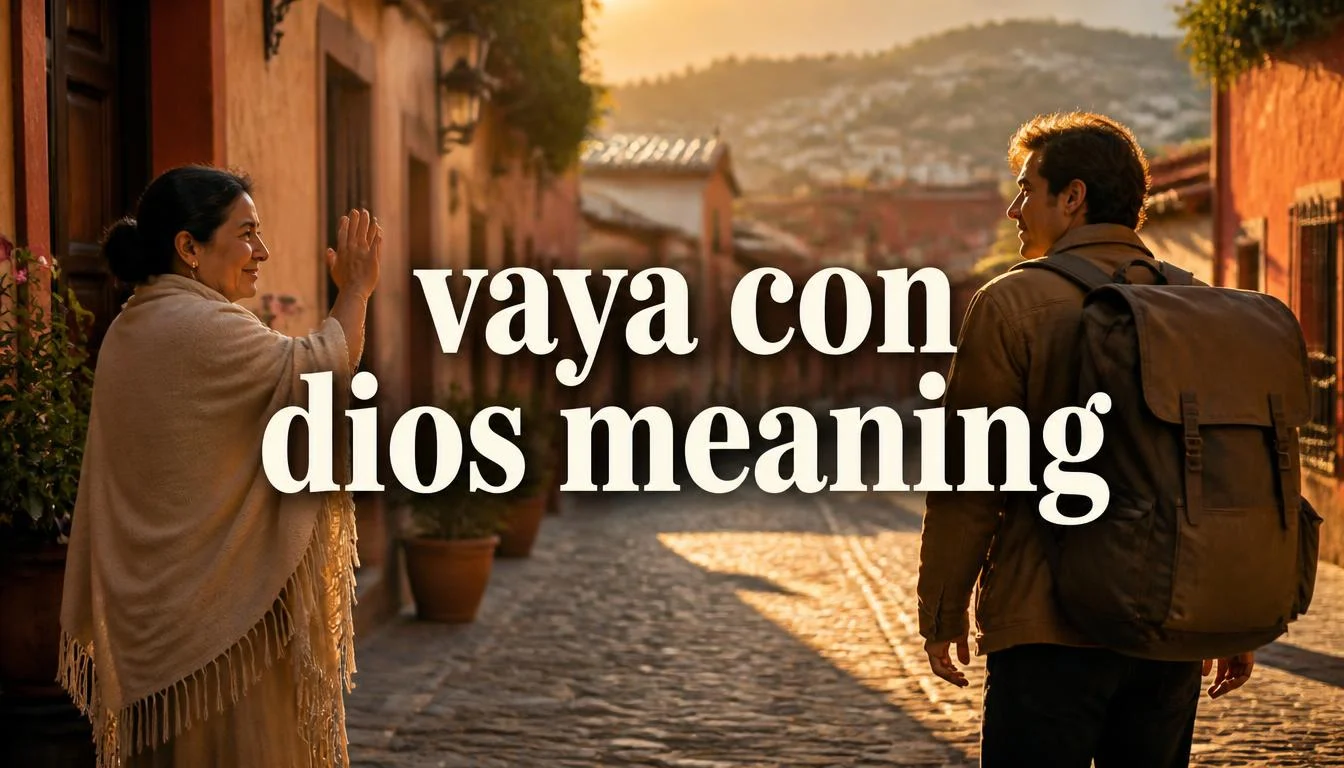
Quick Answer
Vaya con Dios means “Go with God” in Spanish. It’s a farewell that expresses goodwill, protection, or a blessing as someone leaves.
Understanding the vaya con dios meaning helps you appreciate the warmth and cultural significance behind this Spanish expression. People use it to say goodbye while wishing someone safety, peace, and God’s protection on their journey.
The phrase “vaya con Dios” is often used in heartfelt farewells, religious settings, and traditional conversations. Although its literal translation is “go with God,” it can also convey a sentiment similar to “God be with you.” Depending on the context, it may sound sincere, affectionate, spiritual, or old-fashioned.
What Does Vaya Con Dios Mean in English?
The Spanish phrase vaya con Dios translates literally as “go with God.” In everyday use, it functions as a farewell that expresses a wish for someone’s well-being, safety, or spiritual protection.
The expression is often warmer and more meaningful than simply saying “bye.” Depending on the situation, it can communicate affection, respect, concern, or a sincere hope that things go well for the person leaving.
For example:
- “Have a safe trip. ¡Vaya con Dios!”
- “I’ll miss you, my friend. Vaya con Dios.”
- “May your new journey bring you peace. Vaya con Dios.”
The phrase has religious roots because it explicitly mentions God. However, its tone depends on the speaker, their beliefs, and the relationship between the people saying goodbye.
Someone might use it as a sincere religious blessing. Another person might use it as a traditional expression of goodwill without intending to make a formal religious statement.
The Literal Meaning of Each Word
Understanding the individual Spanish words makes the expression easier to remember.
| Spanish word | English meaning | Role in the phrase |
|---|---|---|
| Vaya | Go; may you go | A formal or respectful verb form |
| Con | With | Connects the action to the accompanying person or presence |
| Dios | God | Refers to God in a religious or spiritual sense |
Together, the words form a farewell that wishes the departing person to go with God.
One grammatical detail matters: vaya comes from the Spanish verb ir, meaning “to go.” It is a form of the verb used in the present subjunctive and also in certain formal commands. In this expression, it conveys a traditional wish or blessing rather than a casual instruction to walk away.
The phrase is not simply a word-for-word equivalent of “goodbye.” Its reference to God gives it a particular spiritual and emotional character.
How to Pronounce Vaya Con Dios
The expression is pronounced approximately:
VAH-yah kohn DYOHSS
Here is a simple breakdown:
- Vaya: “VAH-yah,” with two clear syllables.
- Con: “kohn,” with a short, rounded vowel.
- Dios: “DYOHSS,” pronounced as one syllable.
Spanish pronunciation varies somewhat by region. In many Spanish-speaking areas, the final s in Dios is clearly pronounced. In other accents, it may sound softer.
To sound natural, say the three words smoothly rather than separating them too sharply. Keep the emphasis natural and avoid exaggerating the sounds.
You can practice with this sentence:
“Thank you for everything. Vaya con Dios.”
The goal is not to imitate a particular accent perfectly. It is to pronounce the expression clearly and respectfully.
When Do People Say Vaya Con Dios?
The phrase is especially suitable when a goodbye carries some emotional weight. It can express care when someone leaves, encouragement during a difficult transition, or a sincere wish for protection.
1. When Someone Is Starting a Journey
One natural context is saying goodbye to someone who is traveling. The expression can communicate a wish for a safe and peaceful journey.
Example:
“Your flight leaves early tomorrow. Call me when you arrive, and vaya con Dios.”
Here, the phrase expresses concern and goodwill. It adds a personal touch to the usual travel wishes.
It may be particularly fitting when the speaker and listener share religious traditions or when a heartfelt farewell feels more appropriate than a quick goodbye.
2. When Saying Goodbye to a Friend or Family Member
People can use vaya con Dios when a loved one moves away, leaves home, or begins a different stage of life.
Example:
“It’s hard to see you leave, but I hope you find happiness wherever you go. Vaya con Dios.”
The words communicate affection without requiring a long speech. They suggest that the speaker wants good things for the departing person, even when the separation is difficult.
3. When Offering a Religious Blessing
Because the phrase refers directly to God, it can serve as a religious blessing.
Example:
“May God watch over you while you’re away. Vaya con Dios.”
In this context, the expression reflects a sincere hope for divine guidance or protection.
However, it is important not to assume that every Spanish speaker uses it with the same religious intention. Personal beliefs and cultural background influence how the words are understood.
4. When Someone Is Facing a Major Life Change
A farewell does not always involve physical travel. Someone might leave a job, move to another city, retire, or begin an unfamiliar chapter.
Example:
“Congratulations on your new beginning. I hope it brings you peace and opportunity. Vaya con Dios.”
This use gives the expression a reflective, supportive tone. It can acknowledge that the person is moving forward while the speaker wishes them well.
5. In Emotional Goodbyes
The phrase can also appear during a difficult separation, especially when the speaker wants to express care without trying to change the other person’s decision.
Example:
“We’ve shared many good years. I hope life treats you kindly from here. Vaya con Dios.”
In a moment like this, the words may suggest acceptance, affection, or a final expression of goodwill.
The emotional meaning comes from the surrounding conversation. The phrase itself does not automatically signal sadness, reconciliation, or a permanent goodbye.
Is Vaya Con Dios Formal or Informal?
Vaya con Dios can sound respectful, traditional, affectionate, or solemn. It does not fit neatly into a single category of formal or informal speech.
Its suitability depends on the relationship, the situation, and the speaker’s intentions.
| Situation | Is it suitable? | Why |
|---|---|---|
| Saying goodbye to a close relative | Yes | It can express warmth and concern |
| Wishing someone a safe journey | Yes | It communicates goodwill and protection |
| Speaking to a religious acquaintance | Often | Its spiritual meaning may feel appropriate |
| Ending a casual text to a friend | Sometimes | It may sound heartfelt, traditional, or unusually serious |
| Writing a routine business email | Usually unnecessary | A simple professional farewell is generally more natural |
| Speaking to someone who dislikes religious language | Use caution | The explicit reference to God may not suit their preferences |
In a professional setting, the phrase can work if the relationship and cultural context support it. For example, a colleague who is leaving for an important journey might appreciate it. However, it would usually sound out of place as the closing line of a routine customer-service email.
When in doubt, choose a farewell that matches the relationship rather than using the phrase simply because it sounds meaningful.
Vaya Con Dios vs. Adiós: What’s the Difference?
Both expressions are used to say goodbye, but they do not communicate exactly the same thing.
Adiós is the more general Spanish farewell. Depending on context, it can mean “goodbye” or “farewell.” It works in everyday conversations, formal situations, and casual interactions.
Vaya con Dios literally means “go with God.” It carries an additional sense of blessing, care, or spiritual goodwill.
Consider these examples:
- “Adiós, nos vemos mañana.” — “Goodbye, see you tomorrow.”
- “Vaya con Dios. Espero que tengas un viaje seguro.” — “Go with God. I hope you have a safe journey.”
The first example is an ordinary farewell between people expecting to meet again soon. The second expresses a more personal wish for the departing person’s well-being.
Neither phrase is automatically more sincere than the other. A simple adiós can be deeply affectionate, while vaya con Dios can be used as a conventional expression.
The important difference is the extra religious or blessing-like meaning associated with vaya con Dios.
Other Spanish Farewells and Their Meanings
Several Spanish expressions can communicate goodwill without carrying precisely the same meaning.
| Spanish expression | English meaning | Typical tone |
|---|---|---|
| Adiós | Goodbye | General and versatile |
| Hasta luego | See you later | Casual and conversational |
| Hasta pronto | See you soon | Friendly and hopeful |
| Cuídate | Take care | Personal and caring |
| Que te vaya bien | I hope things go well for you | Supportive and encouraging |
| Que Dios te bendiga | May God bless you | Explicitly religious |
| Vaya con Dios | Go with God | Traditional, heartfelt, or spiritual |
These expressions are not interchangeable in every situation. Hasta luego, for instance, suggests a possible future meeting, while vaya con Dios emphasizes goodwill or divine protection.
- If you want a neutral farewell, adiós or hasta luego is usually a safe choice.
- If you want to express care, cuídate or que te vaya bien may feel more natural.
- If you intend to offer a religious blessing, vaya con Dios may be appropriate.
Is Vaya Con Dios Religious?
Yes, the expression has a clear religious meaning because it refers to God. Traditionally, it expresses the hope that God will accompany, guide, or protect someone as they leave.
However, its use is not limited to formal religious settings. The phrase also appears in everyday speech, traditional expressions, literature, music, and dramatic farewells.
Three factors help explain its meaning in a particular conversation.
The speaker’s beliefs: A religious speaker may intend the phrase as a genuine prayer or blessing. Another speaker may use it as a familiar cultural expression.
The relationship: Between close friends or family members, it may sound loving and reassuring. Between people who barely know each other, it might sound more formal or old-fashioned.
The situation: During an important departure, the expression may feel sincere and moving. During an ordinary exchange, it might seem unusually solemn.
It is best to understand the phrase without making assumptions about someone’s personal beliefs. The words have religious roots, but their practical meaning depends on how and why someone uses them.
What Does Vaya Con Dios Mean in Text Messages?
In a text message, vaya con Dios generally carries the same meaning as it does in spoken Spanish: “go with God.”
The written context can make the expression feel particularly thoughtful. A friend might send it before a long trip, a family member might include it in a goodbye message, or someone might use it to close a heartfelt conversation.
Here are several examples of how it can appear in messages.
Before a trip
“Have a safe flight tomorrow! Text me when you land. Vaya con Dios ❤️”
The phrase expresses care and a wish for the person’s protection.
When someone moves away
“I’ll miss having you nearby. I hope your new home brings you happiness. Vaya con Dios.”
Here, it communicates affection and support during a major transition.
After an emotional conversation
“Thank you for the memories. I wish you nothing but peace. Vaya con Dios.”
In this example, the words give the farewell a reflective and potentially final tone. However, the phrase alone does not prove that the sender wants to end a relationship permanently.
In a religious message
“May God guide your steps and protect you wherever you go. Vaya con Dios.”
This use makes the spiritual meaning explicit.
How Should You Respond to Vaya Con Dios?
There is no single required response. You can acknowledge the goodwill, return the farewell, or express appreciation.
| Response in Spanish | English meaning | When to use it |
|---|---|---|
| Gracias, igualmente | Thank you, likewise | A polite, general response |
| Amén | Amen | When you share or welcome the religious sentiment |
| Que Dios te bendiga también | May God bless you too | When you want to return the blessing |
| Cuídate mucho | Take very good care of yourself | A warm, personal goodbye |
| Adiós, hasta pronto | Goodbye, see you soon | A simple farewell when you expect to meet again |
For example:
Person A: “Que tengas un buen viaje. Vaya con Dios.”
Person B: “Muchas gracias. Que Dios te bendiga también.”
English translation:
Person A: “Have a good trip. Go with God.”
Person B: “Thank you very much. May God bless you too.”
You do not need to be religious to acknowledge someone’s kindness. A simple “Thank you, take care” is also a perfectly reasonable response if that better reflects your beliefs.
Common Mistakes When Using Vaya Con Dios
The expression is easy to understand once you know its meaning, but a few mistakes can lead to awkward usage.
Treating It as an Exact Synonym for Goodbye
Although vaya con Dios functions as a farewell, it carries a more specific meaning than a neutral goodbye.
If you’re leaving a casual conversation with a classmate, hasta luego may sound more natural. If you’re sending a loved one off on a long journey, vaya con Dios may better express the emotion you want to convey.
Tip: Choose the phrase based on the message you want to communicate, not just the fact that someone is leaving.
Assuming Everyone Uses It Religiously
The phrase mentions God, but speakers may use it with different degrees of religious intention.
Some people mean it as a sincere blessing. Others use it because it is familiar, traditional, or emotionally fitting.
Tip: Recognize its spiritual meaning without assuming that every speaker has the same beliefs.
Using It in Every Casual Conversation
A heartfelt expression can lose its naturalness when used in situations that call for a simple, everyday farewell.
For example, ending every work chat with vaya con Dios may sound overly solemn or unfamiliar in some workplaces.
Tip: Reserve it for situations where its warmth, tradition, or spiritual meaning suits the relationship.
Misunderstanding the Word Vaya
The word vaya is related to the verb ir, meaning “to go.” It is not a Spanish word for “God,” nor does the complete phrase literally mean “God bless you.”
The translation “go with God” is more accurate. “May God protect you” captures a common implication of the phrase rather than its exact literal wording.
Tip: Keep the literal translation and the emotional meaning separate. This helps you understand both the grammar and the cultural use.
Vaya Con Dios in Music, Film, and Popular Culture
The expression has a long-standing place in popular culture because it combines a clear farewell with emotional and spiritual undertones.
In songs and films, it can signal a departure, a blessing, a painful separation, or a wish for someone to find peace. Writers may choose it when a plain “goodbye” feels too ordinary for the moment.
The phrase also appears in the title of the well-known song “Vaya con Dios,” associated with the song’s mid-20th-century popularity and recordings by several artists. The song’s farewell theme illustrates why the expression can feel nostalgic or emotionally charged to English-speaking audiences as well as Spanish speakers.
When you encounter the phrase in a song, film, or book, context matters. A character might use it affectionately, solemnly, sarcastically, or even as a way to dismiss someone. The surrounding dialogue, tone of voice, and situation help determine which interpretation makes sense.
It is also worth remembering that a familiar phrase can take on additional associations through music and media. Those associations do not replace its Spanish meaning, but they can influence how audiences hear it.
FAQS
What does vaya con Dios mean in English?
Vaya con Dios means “go with God.” It is a Spanish farewell that expresses goodwill and may convey a wish for divine guidance, safety, or protection.
Does vaya con Dios mean God bless you?
Not literally. The direct translation is “go with God.” However, it can function like a blessing because it expresses a wish for God’s presence or protection. “May God bless you” is closer to the Spanish expression que Dios te bendiga.
Is vaya con Dios a polite expression?
Yes, it can be a polite and respectful farewell. It often sounds warm, traditional, or heartfelt. Its suitability depends on the situation, the relationship, and whether religious language feels appropriate.
Can I say vaya con Dios to someone who isn’t religious?
You can, but consider the person’s preferences. Some people appreciate it as a traditional expression of goodwill, while others may prefer a nonreligious farewell such as cuídate (“take care”) or que te vaya bien (“I hope things go well for you”).
Is vaya con Dios used in Mexico and other Spanish-speaking countries?
The expression is understood in many Spanish-speaking communities, including Mexico and other parts of Latin America and Spain. How frequently people use it, and how traditional or solemn it sounds, can vary by region, generation, and personal background.
What is the difference between vaya con Dios and adiós?
Adiós is a general Spanish word for “goodbye.” Vaya con Dios literally means “go with God” and adds a sense of goodwill, blessing, or spiritual protection. Both can be sincere farewells, but they carry different nuances.
Conclusion
The vaya con Dios meaning goes beyond a simple goodbye. Literally, it means “go with God,” but its deeper message is a wish for someone to travel through life with care, guidance, and protection.
You might hear it when a loved one begins a journey, a friend moves away, or someone offers a heartfelt farewell. It can sound religious, affectionate, traditional, or solemn depending on the circumstances.









