Quick Answer
Opel Meaning usually refers to Opel, the German automobile brand known for producing cars and commercial vehicles.
In some contexts, “Opel” may also appear as a name or surname.
Opel Meaning can vary depending on where you encounter the word. Most commonly, Opel refers to the well-known German automotive brand with a long history in the European car industry.
When someone searches for Opel Meaning, they may be looking for the brand’s origin, what the name represents, or its meaning in a particular context. Understanding the background of the term makes its usage much easier to recognize.
Opel Meaning: Quick Definition
Opel (pronounced roughly OH-pel, IPA: /ˈoːpl̩/) is:
- A German surname, most notably belonging to the Opel family of Rüsselsheim, Germany.
- The name of Opel Automobile GmbH, a German car manufacturer founded by Adam Opel in 1862, which today builds passenger cars, SUVs, and electric vehicles under the Stellantis group.
- In everyday conversation, “an Opel” simply means a car made by this brand the same way you’d say “a Toyota” or “a Ford.”
That’s it. No hidden acronym, no secret meaning buried in old German. It’s a name that started with one family and grew into a household word across Europe.
Where Does the Name “Opel” Come From? Origin
To really get the opel meaning, you have to go back to the person, not the product.
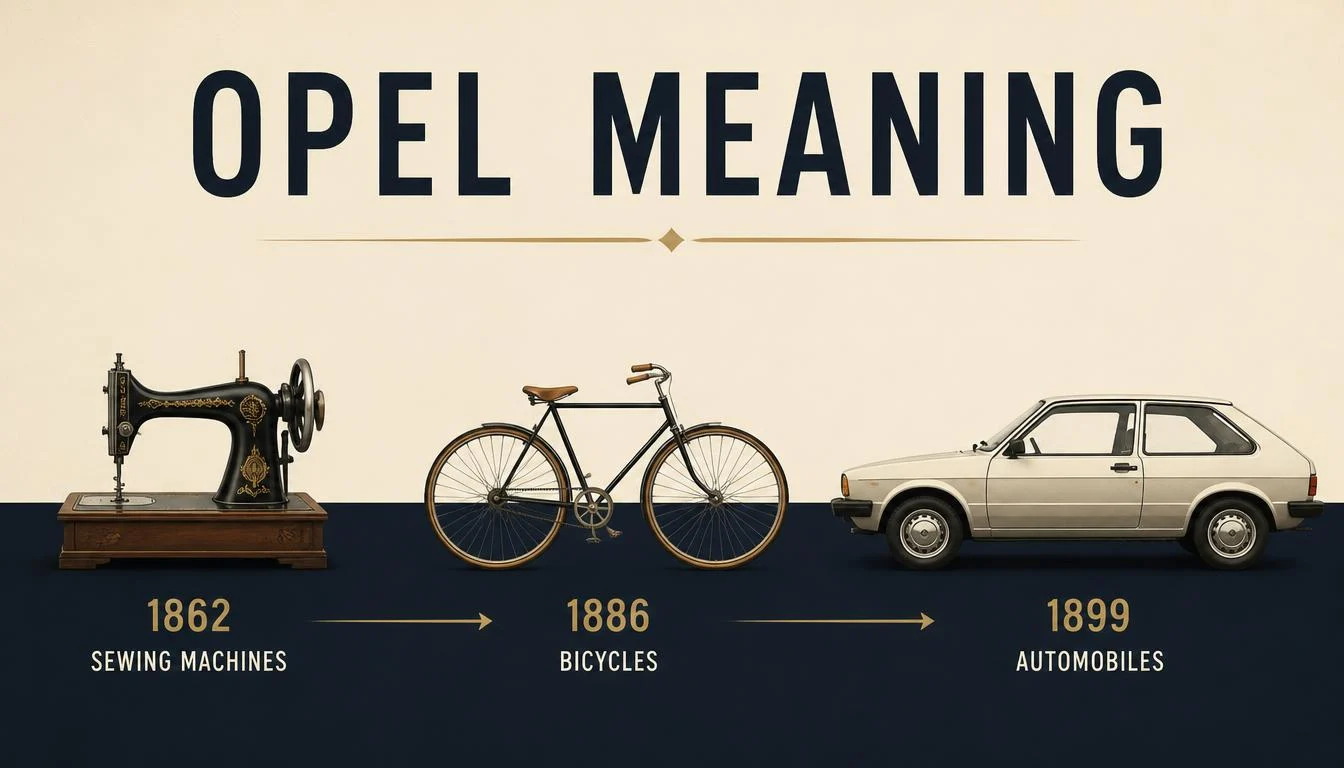
Adam Opel was born in 1837 in Rüsselsheim, a small town in the Hesse region of Germany. He wasn’t dreaming of building cars cars barely existed yet. Instead, he started out manufacturing sewing machines, which were in high demand at the time as home tailoring and small workshops boomed across Europe.
The business did well enough that Opel expanded into bicycles in the 1880s, riding the wave of the cycling craze that swept the continent. By the time bicycles were everywhere, the Opel name was already a trusted household brand in Germany long before a single Opel car existed.
It wasn’t until 1899, a few years after Adam Opel’s death, that his sons steered the company into automobile manufacturing. From there, the surname simply carried over to the new product line, the same way “Ford” or “Honda” are just the founders’ last names stuck onto very different machines than what they started with.
A quick timeline makes this clearer:
| Year | Milestone |
|---|---|
| 1837 | Adam Opel is born in Rüsselsheim, Germany |
| 1862 | Adam Opel founds his company, starting with sewing machines |
| 1886 | Opel begins producing bicycles |
| 1895 | Adam Opel passes away; his sons take over the business |
| 1899 | Opel produces its first automobile |
| 1929 | General Motors (GM) acquires a majority stake in Opel |
| 1931 | GM completes full ownership of Opel |
| 2017 | Opel is sold to the PSA Group (Peugeot’s parent company) |
| 2021 | PSA merges with Fiat Chrysler to form Stellantis; Opel becomes a Stellantis brand |
So when someone asks “what does Opel mean,” the honest, snippet-ready answer is: it’s a person’s last name that turned into one of Germany’s most recognizable industrial and automotive brands.
Is “Opel” an Acronym or Abbreviation?
No and this trips a lot of people up. Unlike names such as BMW (Bayerische Motoren Werke) or FIAT (Fabbrica Italiana Automobili Torino), which really are abbreviations packed with meaning, Opel is not an acronym at all. It doesn’t stand for anything. It’s simply a surname.
This is actually a nice bit of trivia to drop in conversation, because so many people assume every car brand’s name is secretly initials for something grand. Opel breaks that pattern entirely.
How Popular Is the Name and Brand Today?
Opel is a household name across large parts of Europe, especially in Germany, and it’s sold in the UK under the sister brand Vauxhall (same cars, different badge, thanks to a decades-old arrangement). In other regions, Opel-built vehicles have historically appeared under different names too including Buick, Saturn, Cadillac, and even Holden in Australia at various points, depending on ownership era.
As for the surname itself, “Opel” is relatively uncommon as a personal last name outside of Germany, but within Germany it still exists as a family name separate from the car brand. So if you meet someone named Opel, they’re not necessarily related to the automotive dynasty though the family did become one of Germany’s most prominent industrial dynasties in its own right, similar to how “Ford” or “Rockefeller” evokes both a family and an empire in the U.S.
How Is “Opel” Used in Real Conversation?
This is where the opel meaning becomes practical rather than historical. In day-to-day speech, especially in Germany, the Netherlands, the UK (informally), and other parts of Europe, “Opel” is used exactly like any other car brand name.
Neutral, everyday usage 🚗
- “I just bought an Opel Astra, it’s got great fuel economy.”
- “My dad’s had an Opel for twenty years, never had a major issue.”
- “Are you looking at an Opel or a Volkswagen for your next car?”
Friendly / enthusiast tone 😄
- “Opel really nailed the design on the new Mokka, it looks sharp!”
- “Nothing beats road-tripping in an old Opel Kadett, total nostalgia trip.”
Neutral-technical / comparison tone
- “Opel and Vauxhall are basically the same cars with different badges.”
- “Under Stellantis, Opel shares a lot of its platform with Peugeot models.”
Dismissive or negative tone (yes, this exists too)
Like any car brand, Opel has its share of critics, particularly from people who prefer other brands or who’ve had bad experiences with specific older models:
- “Ugh, another Opel breakdown, I swear this car hates me.”
- “I wouldn’t touch an old Opel with a ten-foot pole the electronics were a nightmare in the 2000s.”
None of this reflects an “objective truth” about reliability it just shows how the brand name gets used casually, the same way any car brand becomes shorthand for someone’s personal experience, good or bad.
Opel vs. Similar Terms: A Quick Comparison
People often search “opel meaning” right alongside questions about other car brand names, so here’s how Opel stacks up against a few commonly confused or compared names:
| Term | What It Actually Means | Is It an Acronym? |
|---|---|---|
| Opel | Surname of founder Adam Opel | No |
| BMW | Bayerische Motoren Werke (Bavarian Motor Works) | Yes |
| FIAT | Fabbrica Italiana Automobili Torino | Yes |
| Vauxhall | Named after Fulk le Breant’s manor, “Fulk’s Hall,” in London | No (place-name origin) |
| Audi | Latin translation of founder August Horch’s surname (“Horch” means “listen” in German → “audi” in Latin) | No |
| Volkswagen | Literally “People’s Car” in German | No (descriptive name) |
This table is genuinely useful context, because it shows that car brand names fall into a few categories founder surnames (Opel, Ford, Audi), acronyms (BMW, FIAT), and descriptive names (Volkswagen). Opel firmly belongs in the “founder’s surname” camp, alongside Ford, Honda, Toyota, and Ferrari.
Are There Any Alternate Meanings of “Opel”?
Outside the car brand, the word “Opel” pops up in a few other contexts, though none are as widely known:
- Opel (album) a posthumously released album by Pink Floyd founder Syd Barrett, named as a tribute to the car (or possibly coincidentally similar-sounding).
- Opel (surname) worn by various unrelated individuals throughout history, including musicians, athletes, and businesspeople who have no connection to the automaker.
- OPEL Networks a now-defunct Australian telecommunications company, an unrelated use of similar letters.
- Slang or casual shorthand in some online car forums, “Opel” gets used loosely to refer to any budget-friendly European hatchback, even when the actual car isn’t an Opel. This is informal and not an official definition, but it shows how brand names can drift into generic usage over time (similar to how people say “Kleenex” for any tissue).
None of these alternate meanings are common enough to compete with the primary one when 95%+ of people search “opel meaning,” they’re asking about the car company.
Polite and Professional Ways to Refer to Opel
If you’re writing something formal a report, an article, a business email here’s how to phrase references to the brand professionally:
- ✅ “Opel Automobile GmbH” (full formal name)
- ✅ “The Opel brand” or “the Opel marque”
- ✅ “Opel, a subsidiary of Stellantis”
- ✅ “German automaker Opel”
Avoid casual shorthand like “the Opel thing” or overly dismissive phrasing (“just an Opel”) in professional writing, since it can come across as unnecessarily negative or vague. Stick to neutral, factual language when writing for business or academic purposes.
Quick Reference Table: Opel at a Glance
| Category | Detail |
|---|---|
| Full name | Opel Automobile GmbH |
| Meaning of the word | Surname of founder Adam Opel |
| Founded | 1862 (as a sewing machine company) |
| First car produced | 1899 |
| Headquarters | Rüsselsheim am Main, Germany |
| Current parent company | Stellantis |
| UK sister brand | Vauxhall |
| Pronunciation | OH-pel (/ˈoːpl̩/) |
| Is it an acronym? | No |
| Common products | Corsa, Astra, Mokka, Insignia, Grandland |
Why Does This Matter?
Understanding the opel meaning isn’t just trivia for car nerds it’s genuinely useful if you’re:
- Researching a car brand before buying or writing about it
- Curious about the history behind European automotive names
- Writing content, a school project, or marketing copy that references the brand
- Simply satisfying that nagging “wait, what does this word actually mean” itch
And now you have the full picture: a German family name, an entrepreneurial 19th-century start in sewing machines and bicycles, and a slow, deliberate evolution into one of Europe’s most recognizable car brands.
FAQs
1. What Does the Word “Opel” Actually Mean?
“Opel” is the surname of Adam Opel, the German businessman who founded the company in 1862. It does not have a separate dictionary meaning beyond being a family name.
2. Is Opel an Acronym for Something?
No, Opel is not an acronym. Unlike names such as BMW or FIAT, Opel is simply a family name and was not created as an abbreviation.
3. Is Opel a German or American Car Brand?
Opel is a German car brand, founded in Rüsselsheim, Germany. Although the company was owned by the American automaker General Motors from 1929 to 2017, Opel has its German roots and identity.
4. What’s the Difference Between Opel and Vauxhall?
Vauxhall is Opel’s sister brand in the United Kingdom. Many Vauxhall vehicles are essentially the same models sold under the Opel name in other European markets, with different branding and badges for the UK.
5. Who Owns Opel Now?
Opel is currently owned by Stellantis, a multinational automotive group formed in 2021 through the merger of PSA Group and Fiat Chrysler Automobiles.
6. Did Opel Always Make Cars?
No. Opel did not start as a car manufacturer. The company began by producing sewing machines in 1862 and later manufactured bicycles in the 1880s. It entered automobile production in 1899.
7. How Do You Pronounce “Opel”?
“Opel” is commonly pronounced “OH-pel,” with the emphasis on the first syllable. It is not pronounced with the main stress on the second syllable.
8. Is “Opel” a Common Last Name?
“Opel” does exist as a German surname independently of the car company, but it is not particularly common. Today, most people who hear the name Opel are likely to associate it with the German automaker.
Conclusion
So, next time someone asks what “Opel” means, you can skip the guessing game: it’s not code, it’s not clever marketing wordplay, and it’s not an abbreviation hiding a longer phrase. It’s a real person’s name Adam Opel attached to a company that quietly built its way up from sewing machines to bicycles to some of Europe’s best-selling cars, surviving ownership changes across three different corporate giants along the way.
Whether you’re using “Opel” in a friendly sentence about your neighbor’s hatchback, comparing it to BMW or Volkswagen in a school project, or just settling a bar debate about car brand trivia, you now have the full, accurate story behind the name.
Read More Related Articles:
- FUPA Meaning | Why This Slang Word Keeps Popping Up Online In 2026
- Pars Meaning | Decode This Word in Seconds In 2026
- Eno Meaning | Uncover Its Meaning With Real Examples In 2026

Alex Morgan is a creative mind behind SimileVibe.com, focused on building clean digital experiences that feel simple, modern, and real. He works closely with ideas, design, and user experience to create projects that connect naturally with people online.