Quick Answer:
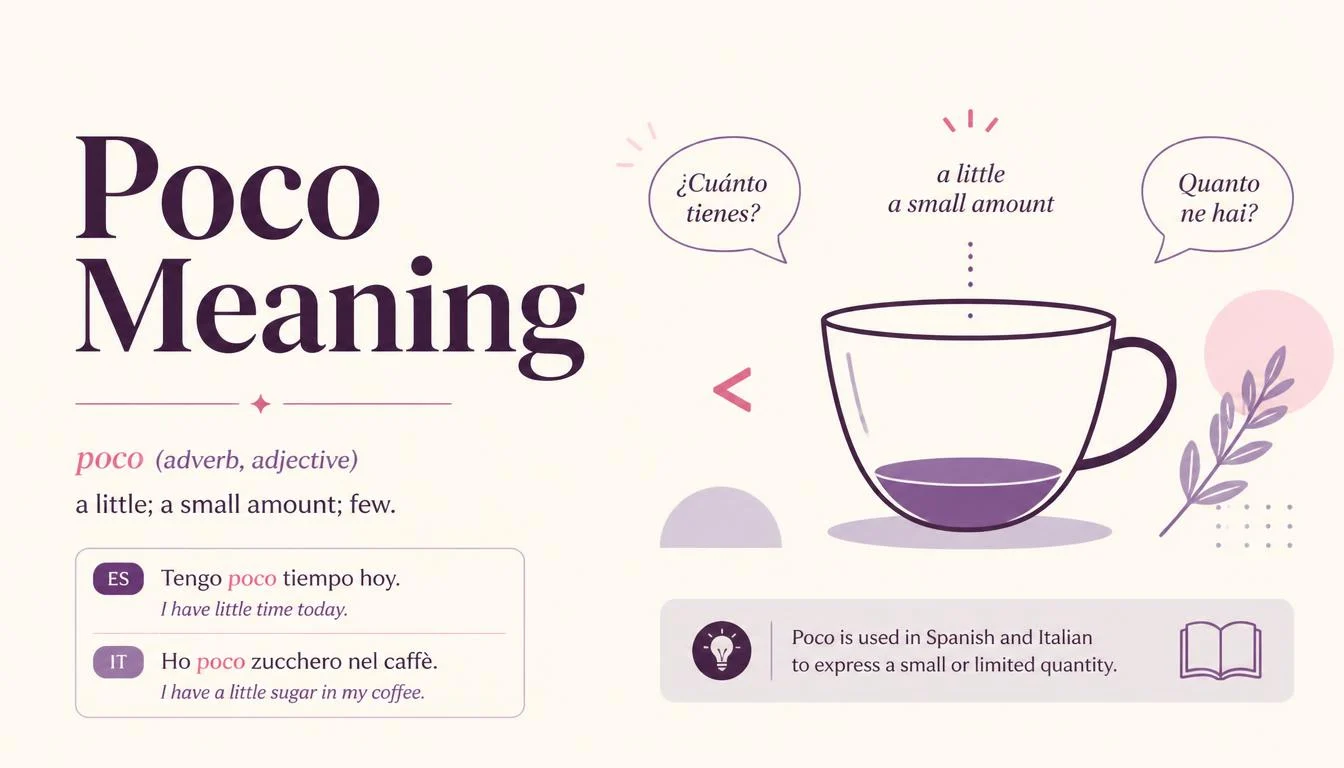
Poco meaning is usually “a little” or “a small amount.” It is a Spanish and Italian word that describes a limited quantity or degree. The exact meaning can change slightly depending on the language and context.
Poco Meaning can change slightly depending on the language and context. In Spanish, poco commonly means “little,” “few,” or “not much.” It is often used when talking about a small amount of something.
In Italian, poco also means “little” or “a little” and is frequently used in everyday conversation. The word can describe quantity, time, or degree, making it useful in many simple phrases.
What Does Poco Mean?
The word poco generally means “a little,” “a bit” or “not much.” It is commonly used when talking about a small quantity or limited amount.
The meaning can depend on the language. In Spanish, poco is widely used to describe a small amount. It can also describe something that happens to a limited degree.
In Italian, poco has a very similar meaning. It can mean “little,” “few” or “not much” depending on how it is used.
So when someone asks what does poco mean, the simplest answer is “a little” or “a small amount.”
Poco Definition in English
The basic poco definition is something that refers to a small amount or a limited degree.
For example, if someone says they speak poco Spanish, they may mean that they speak only a little Spanish. The word does not usually suggest a large quantity.
The English translation can change based on the sentence. It may be translated as “little,” “few,” “slightly” or “a bit.”
This is why looking at the surrounding words is important when understanding the poco word meaning.
Poco Meaning in Spanish
The poco Spanish meaning is usually connected with a small quantity or limited amount.
In Spanish, poco can be used with masculine singular nouns. The feminine form is poca. The plural forms are pocos and pocas.
For example:
Tengo poco tiempo.
I have little time.
Hay poca comida.
There is little food.
Tengo pocos amigos aquí.
I have few friends here.
These examples show why the poco meaning in Spanish can change slightly depending on the noun.
The main idea remains the same. It describes something that exists in a small quantity.
Poco Meaning in English
When people search for poco meaning in English, they are usually looking for a simple translation.
The most common translations include:
- A little
- A bit
- Little
- Few
- Not much
- Not many
- Slightly
The right translation depends on the sentence.
For example, poco tiempo can mean “little time.” But poco a poco means “little by little.”
This shows that translating individual words without considering context can sometimes give an incomplete answer.
What Does Poco Mean in Spanish?
If you are learning Spanish and wondering what does poco mean in Spanish, think of it as a word for a small quantity.
It is often used when something is less than expected or less than a large amount.
For example:
Queda poco dinero.
This means “There is little money left.”
Another example is:
Tengo poco trabajo hoy.
This means “I have little work today.”
The word can also appear in common Spanish expressions. Its exact English translation may change while the general idea stays connected to a small amount.
Poco Translation
The most common poco translation is “little” or “a little.”
However the translation is not always exactly the same. Context determines the most natural English expression.
Consider these examples:
poco tiempo means “little time.”
poco dinero means “little money.”
pocos días means “few days.”
poco a poco means “little by little.”
So poco translated to English can have several forms. The central idea is still a limited amount.
Meaning of Poco in Everyday Conversation
The meaning of poco is easy to understand when you see it in a normal conversation.
Imagine someone asks how much coffee you want. You could use poco to indicate that you want only a small amount.
It can also describe time, money, food, knowledge or ability.
For example:
Sé poco de eso.
This means “I know little about that.”
Another example is:
Es poco difícil.
Depending on the intended context and phrasing this can express a limited degree of difficulty. Natural Spanish often uses other structures for this idea so context matters.
Poco Meaning in Text
The poco meaning in text is generally the same as its normal meaning.
If someone sends poco in a message it can mean “a little,” “not much” or “few.” The exact interpretation depends on what the person is discussing.
For example:
¿Cuánto queda? Poco.
This can be understood as:
“How much is left?”
“Not much.”
In casual messages, people may also use complete expressions containing poco. These expressions can provide more information than the single word itself.
Poco Meaning in Chat
The poco meaning in chat usually depends on the language being used.
If the conversation is in Spanish or Italian, poco is likely being used in its normal linguistic sense.
It can describe a small amount or limited quantity.
For example:
Un poco
means “a little.”
This is one of the most common ways English speakers encounter the word.
If someone says un poco, they are normally referring to a small amount or degree.
Poco Meaning in Conversation
The poco meaning in conversation can be understood by looking at what comes after or before the word.
Someone may use it when talking about time.
Tengo poco tiempo.
They may use it when talking about money.
Tengo poco dinero.
They may also use it when describing knowledge.
Sé poco sobre eso.
In each example the word communicates limitation.
Poco Meaning in Italian
The poco Italian meaning is also connected to a small amount.
In Italian, poco can mean “little,” “few” or “not much.”
For example:
Ho poco tempo.
This means “I have little time.”
Another example is:
Parlo poco italiano.
This means “I speak little Italian.”
The word is common in everyday Italian. Its form can change depending on the noun and grammatical structure.
Is Poco a Spanish Word?
Yes. Poco is a Spanish word and it is commonly used in Spanish.
It can describe a small amount or limited quantity. Spanish learners often encounter it early because it appears in many common expressions.
One familiar expression is:
Poco a poco
It means “little by little.”
Another common phrase is:
Un poco
which means “a little.”
The word is therefore useful for anyone learning basic Spanish vocabulary.
Is Poco Italian?
Yes. Poco is also an Italian word.
Its meaning in Italian is similar to its meaning in Spanish. It can refer to something small in quantity or degree.
For example:
Ho poco tempo.
This means “I have little time.”
The two languages share many words because they developed from Latin. Still, grammar and usage can differ between Spanish and Italian.
So the language of the surrounding conversation matters.
Poco Meaning in Music
The poco meaning in music is slightly different from the everyday meaning.
In musical terminology, poco is often used to mean “a little” or “slightly.”
You may see it in instructions such as:
poco a poco
This means “little by little.” It tells the performer that a change should happen gradually.
Another musical instruction may use poco to indicate a small degree of change.
For example, a composer might indicate that the music should become slightly louder or slightly slower.
The exact instruction depends on the complete musical marking.
Poco Pronunciation
The poco pronunciation is generally straightforward.
In Spanish, it is commonly pronounced approximately as:
POH koh
The first syllable sounds like “poh” and the second sounds like “koh.”
In Italian, the pronunciation is also close to:
POH koh
The pronunciation may sound slightly different from English depending on the speaker’s accent.
If you are learning the word for conversation, listening to native speakers can help you develop a more natural pronunciation.
How to Pronounce Poco
If you want to know how to pronounce poco, break it into two simple parts:
po + co
Say the first part as “poh.”
Then say the second part as “koh.”
Together it sounds like:
POH koh
Try to keep both syllables clear. Avoid turning it into an English sounding word.
Listening practice is useful if you want to use the word naturally in Spanish or Italian.
Poco Example Sentence
A poco example sentence can make the meaning much easier to understand.
Here are some simple examples:
Tengo poco tiempo.
I have little time.
Quiero un poco de agua.
I want a little water.
Hay poco dinero.
There is little money.
Tengo pocos libros.
I have few books.
Vamos poco a poco.
We are going little by little.
These examples show that the word can describe different kinds of limited quantities.
How to Use Poco
Learning how to use poco becomes easier when you focus on the idea of a small amount.
Use it when discussing something that is limited.
For example:
poco tiempo refers to a small amount of time.
poco dinero refers to a small amount of money.
poca comida refers to a small amount of food.
pocos amigos refers to a small number of friends.
Notice that the form can change. Spanish uses poco, poca, pocos and pocas according to grammatical agreement.
Poco vs Poquito
The difference between poco vs poquito is useful for Spanish learners.
Both words can communicate a small amount. However poquito is a diminutive form and can sound softer or more informal.
For example:
un poco means “a little.”
un poquito means “a little bit” or “just a little.”
The second expression can sound more gentle or affectionate depending on the context.
For everyday Spanish, both can be useful. The choice depends on the speaker and the situation.
Poco Synonyms
There are several English words that can work as poco synonyms depending on the context.
Common options include:
- A little
- A bit
- Little
- Few
- Not much
- Not many
- Slightly
- Limited
- Small amount
These are not perfect replacements in every sentence.
For example, “a little” may work naturally in one sentence while “few” is better when talking about countable things.
Understanding the context is therefore more important than memorizing one fixed translation.
Poco Literal Meaning
The poco literal meaning is based on the idea of something being small in amount.
It does not normally describe something abundant or excessive.
If someone uses poco to describe time, they mean there is not much time. If they use it for money, they mean the amount is small.
This simple idea makes many expressions easier to understand.
Poco Meaning and Usage
Understanding poco meaning and usage is especially helpful for people learning Spanish or Italian.
The word appears in everyday conversations, written sentences and common expressions.
It can describe quantities such as money and food. It can also describe time, knowledge or other abstract ideas.
The best way to learn it is through complete phrases rather than memorizing the word alone.
Common Expressions With Poco
Some expressions containing poco are especially common.
Un Poco
Un poco means “a little” or “a bit.”
Example:
Quiero un poco de agua.
This means “I want a little water.”
Poco a Poco
Poco a poco means “little by little.”
It describes something that happens gradually.
Example:
Estoy aprendiendo poco a poco.
This means “I am learning little by little.”
Muy Poco
Muy poco means “very little.”
Example:
Tengo muy poco tiempo.
This means “I have very little time.”
These expressions are useful because they show how poco works in real language.
Does Poco Mean Little or Few?
It can mean either one depending on what it describes.
When it refers to an uncountable quantity it can often translate as “little.”
For example:
poco tiempo means “little time.”
When it refers to countable nouns in plural form it can translate as “few.”
For example:
pocos días means “few days.”
This distinction is important when translating Spanish into natural English.
Why Context Matters With Poco
A single word can sometimes have more than one natural translation.
This is true for poco as well.
If you only translate the word by itself you may miss the intended meaning of the complete phrase.
For example, poco can mean “little,” while pocos can mean “few.” The expression poco a poco has a different natural translation.
Context tells you which English expression sounds right.
FAQs
What does poco mean?
Poco generally means “a little,” “little,” “few” or “not much.” The exact English translation depends on the sentence and language.
What does poco mean in English?
Poco meaning in English is usually “a little” or “little.” It can also mean “few” when referring to a small number of countable things.
What does poco mean in Spanish?
In Spanish, poco refers to a small amount or limited quantity. It is commonly used with words relating to time, money, food and other quantities.
Is poco a Spanish word?
Yes. Poco is a common Spanish word. It is used to describe a small amount or limited degree and appears in many everyday expressions.
Is poco Italian?
Yes. Poco is also an Italian word. Its meaning is similar to Spanish and commonly refers to a small amount or limited quantity.
What does un poco mean?
Un poco means “a little” or “a bit.” It is a very common expression in Spanish and Italian.
What does poco a poco mean?
Poco a poco means “little by little.” It describes something that happens gradually rather than all at once.
What is the difference between poco and poquito?
Poco means “little” or “a little.” Poquito is a diminutive form that can mean “a little bit” or “just a little” and may sound softer or more informal.
How do you pronounce poco?
Poco is generally pronounced close to POH koh in both Spanish and Italian. The two syllables should be pronounced clearly.
What does poco mean in music?
In music, poco means “a little” or “slightly.” It is often used in musical instructions to indicate a small or gradual change.
Conclusion
The poco meaning is mainly connected with a small amount, a limited quantity or a limited degree. In Spanish and Italian, it is a common everyday word.
Depending on the context, it can translate as “a little,” “little,” “few” or “not much.” You may also see it in familiar phrases such as un poco and poco a poco.
If you are learning Spanish or Italian, understanding the word in complete sentences is the easiest way to remember it. The surrounding words will usually tell you exactly how poco should be understood.









