Quick Answer:
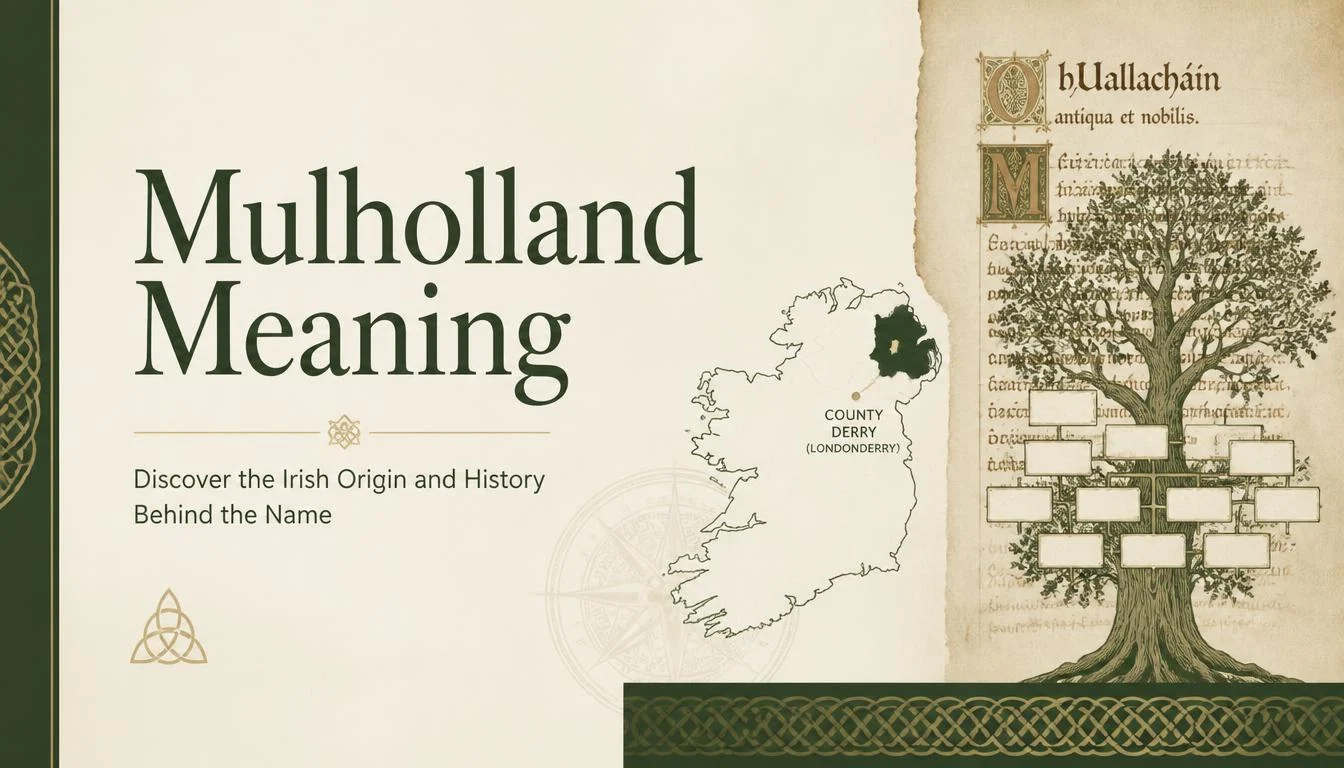
The Mulholland Meaning comes from the Irish Gaelic surname Ó Maolchallann. It is generally understood as “descendant of Maolchallann” with Maolchallann connected with a devotee or follower associated with the kalends. The name has strong historical links to Ulster and particularly County Derry.
The Mulholland Meaning has roots in Irish history and the Gaelic language, making it more than just a modern surname or place name. The name is traditionally associated with an old Irish family name and has developed several variations over time. Today, you may encounter Mulholland as a surname, street name, or geographical reference. Its connection with Los Angeles also makes the name familiar in popular culture.
Understanding the Mulholland Meaning becomes especially interesting when you look at its linguistic roots and historical use. The surname is linked to the Gaelic Ó Maolfholamh, which is generally interpreted in relation to a religious or scholarly figure. Over time, Mulholland became established as an English-language surname. Its history reflects the broader evolution of Irish names as they were adapted into English.
What Does Mulholland Mean?
The Mulholland Meaning has deep roots in Irish history. Mulholland is primarily an Irish surname that comes from the Gaelic form Ó Maolchallann. The name was used by different families in Ireland over many generations.
The Gaelic surname is commonly explained as meaning “descendant of Maolchallann.” Maolchallann was a personal name with a religious connection. Some established sources describe its meaning as “devotee of the kalends.”
This gives the name a meaning that goes beyond a simple family label. It reflects the way many old Irish names were connected to ancestry, religion and community identity.
The name also has several historical spellings. Mulhollan, Mulhallen and other forms appear in historical records. These variations developed as Gaelic names were written in English over time.
Mulholland Name Meaning and Origin
The Mulholland name meaning is closely connected to the Gaelic language of Ireland. The original form was Ó Maolchallann. The prefix Ó traditionally indicated descent from a male ancestor. In simple terms it can be understood as “descendant of Maolchallann.”
The personal name Maolchallann is particularly interesting. The element maol appears in several traditional Irish names. In a religious context it could refer to a devotee or follower. Historical Irish naming traditions often used this element with the name of a saint or religious figure.
The second part of the name has been interpreted in different ways. Some sources connect Maolchallann with the kalends. Other explanations have linked the name with a religious devotee or follower. Because ancient Gaelic names can have more than one interpretation, it is better to treat these explanations as related traditions rather than one absolute translation.
Is Mulholland an Irish Name?
Yes. Mulholland is an Irish name with a particularly strong connection to Ulster. Historical surname sources identify it as an Anglicized form of the Gaelic Ó Maolchallann.
The surname was not limited to one small family group. Historical research identifies several distinct families connected with the name in Ireland. One important branch was associated with Ulster while other families were linked with areas in the Irish midlands.
The name became especially associated with County Derry and nearby parts of Ulster. Historical records also show connections with Antrim and Down. A 1909 report on Irish surnames recorded Mulholland mainly in Antrim, Down and Londonderry.
This regional connection helps explain why Mulholland is often described as an Irish surname with strong Ulster roots.
Mulholland Surname Origin
The Mulholland surname origin can be traced to Gaelic Ireland. Its traditional Gaelic form was Ó Maolchallann. Over time the original Gaelic spelling was transformed into the English form Mulholland.
This type of transformation was common with Irish surnames. As English became more widely used in Ireland, Gaelic family names were often recorded according to English spelling patterns.
As a result the same family name could appear in several forms in older records. Mulhollan and Mulhallen are examples of related historical spellings.
For anyone researching the Mulholland family history, this is an important detail. Searching only for the modern spelling may cause older records to be missed.
The Gaelic Meaning Behind Mulholland
The Gaelic roots provide a useful way to understand the deeper meaning of the surname.
The element maol has an interesting history. In older Irish it could literally relate to being bald or tonsured. A tonsured head was associated with religious life. Because of this connection the word developed a religious sense involving a devotee or follower.
This religious association appears in several Irish surnames beginning with Mul. These names were often connected with devotion to a saint or religious figure.
In the case of Mulholland the name is associated with Maolchallann. Sources describe the personal name as carrying a religious meaning and connect it with the kalends.
So while a simple modern translation may be difficult, the Mulholland Gaelic origin clearly reflects the religious naming traditions of medieval Ireland.
Mulholland Family History in Ireland
The Mulholland family history reaches back several centuries. Historical Irish sources identify three distinct families associated with Ó Maolchallann. These families were connected with Limerick, Meath and Ulster.
The Ulster branch became especially notable. It was associated with the area of Loughinsholin in what is now County Derry.
This family had an unusual religious responsibility. Historical accounts state that members of the family were hereditary keepers of the Bell of Saint Patrick. The bell was also known as the Bell of the Testament.
This role gives the Mulholland surname an important place in Irish ecclesiastical history. It shows that the family was not simply known through land ownership or political power. It was also connected with the protection of an important religious object.
Mulholland and County Derry
County Derry is one of the most important places to consider when researching the Mulholland surname origin.
The Ulster branch of the family was historically seated in Loughinsholin. This area is located in present day County Derry. Historical sources describe the Ulster family as an ecclesiastical family with a long association with the Bell of Saint Patrick.
A branch of this family also appears to have moved into County Antrim. This helped spread the surname beyond its earlier stronghold.
The connection with Derry is still useful for genealogy research today. If someone is investigating an old Mulholland family line they may find it helpful to search records from Derry and surrounding Ulster counties.
Mulholland Ancestry and Genealogy
People researching Mulholland ancestry should remember that surnames alone cannot prove a family connection. The same surname could develop independently among different families.
Historical sources specifically identify more than one Irish family associated with Ó Maolchallann. This means two people with the surname Mulholland may not necessarily share a recent common ancestor.
Genealogy research should therefore combine the surname with dates, locations and family records.
Useful records can include census documents, birth records, marriage records and death records. Immigration documents can also help when a Mulholland family moved from Ireland to another country.
FamilySearch reports a large collection of records connected with the Mulholland surname. These include census records, immigration records and other family history sources.
When searching older documents it is also worth checking spelling variations such as Mulhollan and Mulhallen.
Common Mulholland Spelling Variations
Historical Irish surnames were not always spelled consistently. This is especially true when Gaelic names were written down by English speaking officials.
Some related forms associated with Mulholland include:
- Mulholland
- Mulhollan
- Mulhallen
- Mulholn
- Mulchallan
- O Mulchallan
- Ó Maolchallann
These variations can be useful when searching historical documents. The older Gaelic form may appear in one record while an Anglicized version appears in another.
Is Mulholland a Scottish Surname?
Mulholland is primarily regarded as an Irish surname. However it can also be found in Scotland and other countries because of migration and historical movement between Ireland and Britain.
Modern surname records show Mulholland families in Scotland as well as England, the United States, Canada and Australia.
This does not change the traditional origin of the name. The Gaelic Irish form Ó Maolchallann remains the key origin associated with the surname.
The presence of the surname in Scotland can therefore reflect migration rather than a separate Scottish origin.
Mulholland Meaning in Modern Use
Today Mulholland Meaning is usually searched because someone has encountered the name as a surname or family name.
It may appear as a last name in personal records, genealogy databases or historical documents. It can also appear in place names such as Mulholland Drive in Los Angeles.
When used as a surname the name retains its connection with Irish Gaelic history. It is not normally used as a common English word with a separate everyday definition.
Understanding the background of the name can make it easier to appreciate why it appears in different forms across historical records.
What Does the Mulholland Surname Symbolize?
A surname does not have one universal symbolic meaning. Still the history behind Mulholland gives the name several interesting associations.
Its Gaelic roots connect it with ancestry. The religious interpretation of Maolchallann adds an association with devotion and spiritual tradition.
The history of the Ulster family adds another layer. The family’s role as keepers of the Bell of Saint Patrick connects the surname with religious heritage and responsibility.
For families who carry the name today these historical associations can provide a meaningful connection with Irish heritage.
Mulholland Drive Meaning
The phrase Mulholland Drive Meaning is sometimes searched alongside the surname. Mulholland Drive is a famous road in Los Angeles named after William Mulholland.
Its name is therefore not a separate definition of the Irish surname. It is a place name based on the surname Mulholland.
This distinction matters because someone searching for “Mulholland meaning” may be looking for either the family name or a location associated with it.
If the search is about the surname then the Gaelic origin is the relevant explanation. If the search is about Mulholland Drive then the meaning relates to the person after whom the road was named.
Why the Mulholland Name Still Matters
Names often carry pieces of history that are easy to overlook. Mulholland is a good example.
The name connects modern families with Gaelic Ireland. Its history reaches into Ulster and other parts of Ireland. It also shows how Gaelic names changed as they moved into English language records.
The story becomes even more interesting through the historical role of the Ulster family. Their association with the Bell of Saint Patrick gives the surname a distinctive place in Irish religious history.
For people researching their family tree the name can therefore be more than a surname. It can be a starting point for exploring language, geography and family history.
FAQs
What does Mulholland mean?
Mulholland comes from the Irish Gaelic Ó Maolchallann. It means “descendant of Maolchallann” and the personal name is traditionally associated with a devotee of the kalends.
Is Mulholland an Irish surname?
Yes. Mulholland is an Irish surname with strong historical connections to Ulster. County Derry and County Antrim are among the places strongly associated with the name.
What is the Gaelic origin of Mulholland?
The Gaelic origin is Ó Maolchallann. This form was later Anglicized into Mulholland and related spellings.
Where does the Mulholland surname come from?
The surname has several historical Irish branches. Important associations include Ulster particularly County Derry as well as historical families connected with Meath and Limerick.
Is Mulholland a Scottish name?
Mulholland is primarily an Irish surname. It is also found in Scotland because of migration and historical movement between Ireland and Britain.
What are the variations of the Mulholland surname?
Historical forms include Mulhollan, Mulhallen, Mulholn and O Mulchallan. The original Gaelic form is Ó Maolchallann.
What does Mulholland mean in Irish?
In Irish naming tradition Mulholland comes from Ó Maolchallann. The name is connected with Maolchallann and is commonly explained as referring to a devotee of the kalends.
How can I research my Mulholland family history?
Start with birth, marriage and death records. Census records and immigration documents can also be useful. Search historical spelling variations because older records may not use the modern spelling. FamilySearch provides historical records that can assist with Mulholland genealogy research.
Conclusion
The Mulholland Meaning comes from the Irish Gaelic Ó Maolchallann. The surname is generally understood as “descendant of Maolchallann” with the personal name carrying a religious association that is commonly explained as “devotee of the kalends.”
The name has strong historical links with Ulster and especially County Derry. Other historical families bearing related forms of the name were connected with Meath and Limerick.
Today Mulholland remains an identifiable Irish family name found in Ireland and across the wider Irish diaspora.
If you are researching your own Mulholland ancestry it is worth looking beyond the modern spelling. Older forms such as Mulhollan and Mulhallen may lead to records that would otherwise be missed.
Ultimately the Mulholland name meaning reflects the rich naming traditions of Gaelic Ireland. It combines ancestry, religious history and centuries of linguistic change in one distinctive surname.










11 thoughts on “Mulholland Meaning | Discover the Irish Origin and History Behind the Name In 2026”