Quick Answer
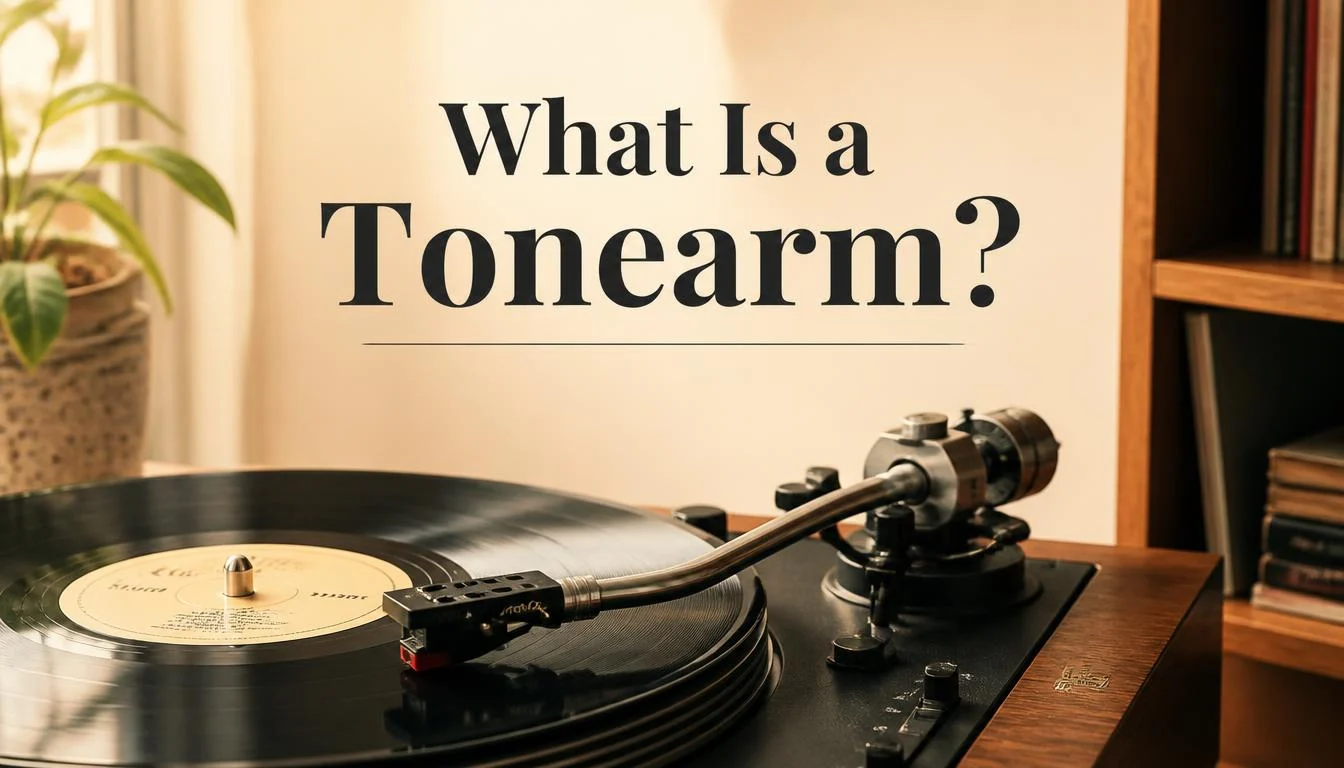
Tonearm Meaning refers to the pivoted arm on a record player that holds and guides the cartridge and stylus across a vinyl record.
It helps the stylus track the record groove accurately and produces clear, balanced sound.
The Tonearm Meaning is simple: it is the movable arm on a turntable that supports the cartridge and stylus while a record plays. It carefully positions the stylus inside the record’s grooves as the vinyl spins. Although it looks like a basic component, its design can affect tracking and sound quality. That makes the tonearm an important part of any traditional vinyl playback system.
Understanding Tonearm Meaning can help beginners appreciate how a turntable actually produces music from a record. Different tonearms can vary in shape, length, weight, and adjustment features. These differences influence how smoothly the stylus follows the grooves during playback. Whether you are new to vinyl or exploring turntable components, knowing the tonearm’s purpose is useful.
Tonearm Meaning: Quick Definition
Tonearm (noun): The pivoted, movable arm on a turntable that holds the cartridge and stylus (needle), guiding it across a vinyl record’s grooves so the stylus can pick up the audio signal and send it to the amplifier.
In simpler terms: it’s the “arm” that swings the needle over the record and lets it play. No tonearm, no sound it’s the physical bridge between the spinning record and the electronics that turn those grooves into music.
- Part of speech: Noun
- Pronunciation: TOHN-arm
- Category: Audio equipment / turntable component
- Also seen as: tone arm, tone-arm (all refer to the same part)
That’s the one-line answer. Now let’s dig into where this word came from and why it’s a bigger deal than it sounds.
Where Does the Word “Tonearm” Come From?
The term is a straightforward compound of two words: “tone” (referring to sound or musical pitch) and “arm” (the mechanical, arm-like structure). Put them together and you get a literal description of what the part does — it’s the arm responsible for carrying the tone.
The tonearm as a concept dates back to the earliest phonographs of the late 1800s and early 1900s. Thomas Edison’s original phonograph used a rigid horn-and-needle assembly, but as record players evolved through the acoustic era and into electric models in the 1920s and 1930s, engineers needed a way to let the needle track the groove smoothly without damaging the record or skipping. That’s when the pivoted arm design what we now call the tonearm became standard.
By the mid-20th century, as hi-fi culture exploded and companies like Technics, Rega, SME, and Thorens started competing on turntable quality, the tonearm became a specialized engineering focus in its own right. Audiophiles started talking about tonearm geometry, mass, and materials the way car enthusiasts talk about suspension systems. The word stuck, and it’s been standard audio terminology ever since.
Popularity today: With the vinyl revival of the last decade Gen Z buying record players at thrift stores, artists releasing vinyl-exclusive editions, and turntables becoming a lifestyle aesthetic again “tonearm” has moved from niche audiophile vocabulary into more everyday conversation. You’ll now see it in:
- Turntable product listings and reviews (Amazon, Crutchfield, Audio-Technica pages)
- YouTube unboxing and setup videos
- Reddit communities like r/vinyl and r/audiophile
- Buying guides and “how to use a record player” articles
- Repair and maintenance tutorials
How “Tonearm” Is Used in Real Life
The word shows up most often in three contexts: buying advice, troubleshooting, and technical/audiophile discussion. Here’s how it plays out with actual tone and context.
Friendly / Everyday Tone
Used casually when someone’s just getting into vinyl or setting up their first record player.
“Hey, be careful lifting the tonearm you don’t want to drop the needle right on the record.” 🎶
“I just got my first turntable and I’m still nervous about touching the tonearm!”
Neutral / Informational Tone
Used in reviews, manuals, and buying guides where accuracy matters more than emotion.
“This model features a straight tonearm with adjustable counterweight for precise tracking force.”
“The tonearm length affects tracking accuracy across the record’s surface.”
Technical / Audiophile Tone
Used by hobbyists and collectors who care about performance specifics.
“I upgraded to a carbon-fiber tonearm and the difference in detail retrieval is night and day.”
“Anti-skate on this tonearm is a little finicky took me a few tries to dial it in.”
Negative / Frustrated Tone
Used when something’s gone wrong, usually during setup or a malfunction.
“Ugh, the tonearm keeps skipping across the record no matter what I do.” 😤
“My tonearm won’t stay balanced I think the counterweight is loose.”
Tonearm vs. Related Turntable Terms
This is where a lot of beginners get tripped up. The tonearm is just one part of a larger system, and it’s easy to confuse it with the parts attached to it. Here’s a side-by-side breakdown to clear things up for good.
| Term | What It Actually Is | Common Confusion |
|---|---|---|
| Tonearm | The full pivoting arm assembly that holds and guides the cartridge/stylus across the record | Often used loosely to refer to “the whole needle mechanism” |
| Stylus | The tiny needle tip at the very end that physically touches the record groove | Frequently confused with “tonearm” or “cartridge” |
| Cartridge | The small unit at the end of the tonearm that holds the stylus and converts vibrations into an electrical signal | Mistaken for the stylus itself, though the stylus is just one part of it |
| Headshell | The small detachable mount that connects the cartridge to the tonearm | Sometimes thought to be part of the tonearm’s main body |
| Counterweight | The adjustable weight at the back of the tonearm that balances tracking force | Sometimes just called “the tonearm weight” |
| Anti-skate | A mechanism (dial or weight) that counteracts the inward pull on the tonearm during playback | Often mixed up with tracking force adjustment |
| Platter | The rotating disc the record sits on | Not related to the tonearm at all, but often mentioned together |
Quick way to remember it: The tonearm is the arm. The stylus is the fingertip. The cartridge is the hand. They work together, but they’re not interchangeable words.
Types of Tonearms (Because Not All Are the Same)
If you go shopping for a turntable, you’ll notice tonearms come in a few distinct styles. Knowing these helps you understand product descriptions instantly.
- Straight tonearm – A simple, straight design; common on entry-level and mid-range turntables.
- S-shaped (curved) tonearm – Curves slightly to help reduce tracking error; a classic vintage look.
- J-shaped tonearm – A hybrid curve style, common on many mid-tier hi-fi decks.
- Tangential (linear-tracking) tonearm – Moves in a straight line across the record instead of pivoting, mimicking how the record was originally cut; found on premium and specialty turntables.
- Uni-pivot tonearm – Balances on a single point, favored by some audiophiles for its low friction, though it requires more careful setup.
Are There Other Meanings of “Tonearm”?
Not really and that’s part of what makes this term easy to learn. Unlike a lot of English words that carry multiple unrelated meanings, “tonearm” is almost exclusively used in the audio and turntable context. You won’t find it used as slang, in idioms, or with a figurative meaning in everyday speech.
The only loose overlap you might come across:
- In some older or translated texts, you may see “tone arm” (two words) used interchangeably same meaning, just an older spelling convention.
- Occasionally, “arm” alone is used as shorthand for “tonearm” in casual audiophile chat (e.g., “swap the arm out for a better one”), but this only works in context where turntables are already being discussed.
Polite or Professional Alternatives
If you’re writing product copy, a technical manual, or a formal review and want variety instead of repeating “tonearm” over and over, here are acceptable substitutes depending on context:
| Situation | Suggested Alternative |
|---|---|
| Technical/engineering writing | “pickup arm” |
| Marketing/product copy | “arm assembly” |
| General description | “needle arm” (informal, less precise) |
| Formal audio engineering documents | “tonearm assembly” |
| Historical/vintage context | “pickup” (used more in older British terminology) |
Note: “pickup arm” is the most historically accurate and widely accepted formal alternative, especially in British and vintage audio literature.
Common Usage Tips
- ✅ Use “tonearm” (one word) in modern writing it’s the standard spelling today.
- ✅ “Tone arm” (two words) is acceptable and still used, especially in older or more formal texts, but one word is more common now.
- ❌ Don’t use “tonearm” to refer to the stylus or cartridge specifically it refers to the whole arm mechanism.
- ✅ When troubleshooting, be specific: say whether the issue is with the tonearm’s balance, the cartridge, or the stylus. It saves a lot of confusion in forums and customer support chats.
- ✅ In casual conversation, it’s fine to just say “the arm” once you’ve already established you’re talking about a turntable.
Tonearm Meaning: Example Sentences by Context
| Context | Example Sentence | Tone |
|---|---|---|
| Beginner setup | “Gently lower the tonearm onto the record edge.” | Friendly/instructional |
| Product review | “The tonearm on this model tracks smoothly with minimal vibration.” | Neutral/informative |
| Audiophile discussion | “A well-damped tonearm reduces resonance and improves clarity.” | Technical |
| Troubleshooting | “If the tonearm skips, check your anti-skate settings first.” | Practical/helpful |
| Frustration | “This cheap tonearm keeps drifting off the record entirely.” | Negative |
| Marketing copy | “Featuring a precision-balanced tonearm for audiophile-grade playback.” | Promotional |
FAQs
1. What Does Tonearm Mean on a Record Player?
A tonearm is the pivoted arm that holds the cartridge and stylus. It guides the stylus across the record’s grooves so it can read and play the audio.
2. Is It “Tonearm” or “Tone Arm”?
Both spellings are used, but “tonearm” as one word is more common and modern in most audio-related writing.
3. What’s the Difference Between a Tonearm and a Stylus?
The tonearm is the entire arm mechanism that moves across the record. The stylus is the tiny needle at the end of the tonearm that physically touches the record groove.
4. Why Does Tonearm Length Matter?
Tonearm length affects tracking accuracy. Longer tonearms generally create less tracking error across the record’s surface, which can help provide more consistent and accurate sound reproduction.
5. Can You Replace a Tonearm on a Turntable?
On some higher-end and modular turntables, the tonearm can be replaced or upgraded. However, many entry-level or all-in-one models have fixed tonearms that are not designed for user replacement.
6. What Is Tonearm Tracking Force?
Tonearm tracking force is the amount of downward pressure the stylus applies to the record groove. It is typically adjusted using the tonearm’s counterweight. Incorrect tracking force can cause skipping, poor sound quality, or even record damage.
7. Why Is My Tonearm Skipping or Not Staying in the Groove?
Common causes include incorrect tracking force, improperly adjusted anti-skate settings, a dirty or worn stylus, or an uneven turntable surface. Checking these factors can often resolve tracking problems.
8. Do All Turntables Have the Same Type of Tonearm?
No. Turntables can use different tonearm designs, including straight, S-shaped, J-shaped, and linear-tracking arms. Each design has different characteristics that can affect tracking behavior and performance.
Conclusion:
At its core, the tonearm meaning comes down to one simple idea: it’s the arm on a turntable that carries the needle across the record, making playback possible. It’s not the stylus, it’s not the cartridge it’s the mechanical bridge that holds everything together and guides it smoothly across the vinyl.
Quick recap:
- A tonearm is the pivoting arm that holds the cartridge and stylus on a turntable.
- The term dates back to early phonograph engineering and became standard hi-fi vocabulary by the mid-1900s.
- It’s distinct from the stylus, cartridge, and headshell, even though people often mix these up.
- Common types include straight, S-shaped, J-shaped, and linear-tracking tonearms.
- “Pickup arm” is the most accepted formal alternative.
- Getting tonearm setup right (tracking force, anti-skate, balance) makes a real difference in sound quality and record longevity.
Whether you’re buying your first turntable or troubleshooting a skipping record, knowing exactly what a tonearm is and isn’t will save you a lot of confusion (and a few scratched records) down the line. 🎧
Read More Related Articles:
- Pars Meaning | Decode This Word in Seconds In 2026
- Eno Meaning | Uncover Its Meaning With Real Examples In 2026

Alex Morgan is a creative mind behind SimileVibe.com, focused on building clean digital experiences that feel simple, modern, and real. He works closely with ideas, design, and user experience to create projects that connect naturally with people online.