Quick Answer
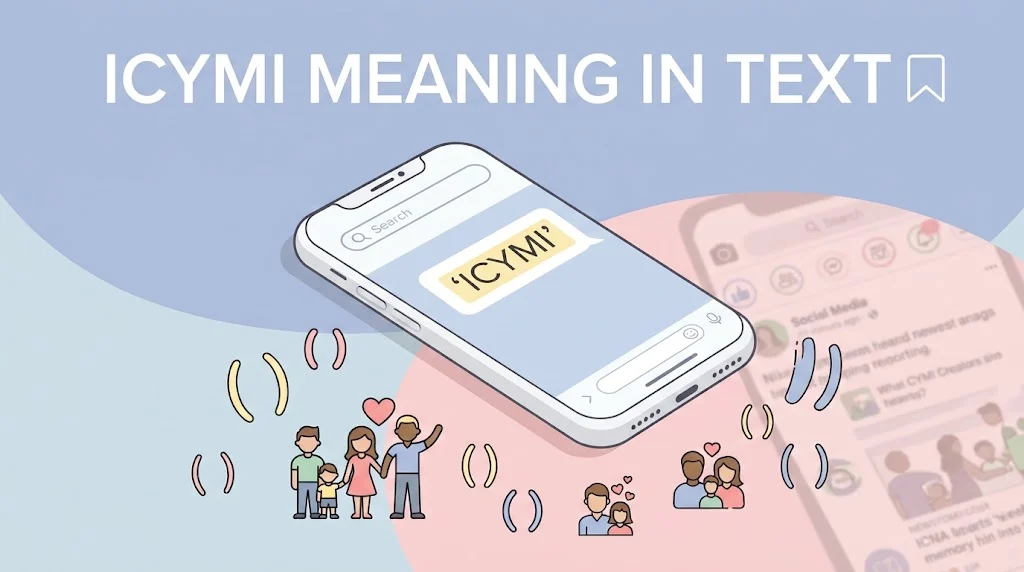
ICYMI Meaning in Text is “In Case You Missed It.” It’s commonly used online to share or highlight information someone may have missed.
ICYMI Meaning in Text is useful to know if you often see internet slang in messages or social media posts. ICYMI stands for “In Case You Missed It.” People use it when bringing attention to something previously shared. It can make messages shorter, casual, and easy to understand.
Understanding ICYMI Meaning in Text can help you follow conversations more naturally online. You may see it in texts, posts, comments, emails, and group chats. It often introduces an update, announcement, interesting fact, or earlier message. Its meaning is usually friendly and simply suggests that someone may have missed the information.
ICYMI stands for “In Case You Missed It.”
This article breaks down everything you need to know about ICYMI meaning in text, from its most common uses to how you should reply when someone sends it your way.
What Does ICYMI Stand For?
ICYMI is an acronym that has become increasingly common in digital communication over the past decade. It stands for:
In
Case
You
Missed
It
The phrase essentially means, “I’m sharing this with you because you might not have seen it when it was originally posted or discussed.
| Detail | Explanation |
|---|---|
| Most Common Meaning | In Case You Missed It |
| Full Form | In Case You Missed It |
| Tone | Generally neutral, often helpful |
| Common Platforms | Twitter, Facebook, Instagram, Reddit, email newsletters, group chats |
| Formal or Informal | Usually informal |
People typically use ICYMI to highlight news articles, social media updates, event announcements, or significant information that has already been shared but deserves a second mention.
The abbreviation serves a practical purpose: it signals that the sender knows you might not have encountered this information yet, so they’re thoughtfully sharing it with you.
For example, if a friend sends you a message that reads:
“ICYMI, the concert tickets go on sale tomorrow at 10 AM”
They’re letting you know that this information was probably shared somewhere else (maybe in a group chat you missed or on social media), and they want to make sure you’re in the loop.
This simple abbreviation saves time while conveying consideration. Rather than typing out “I know you might not have seen this yet,” you can just drop four letters and get straight to the point.
Alternative Meanings of ICYMI
Unlike many internet abbreviations that evolve to carry multiple meanings across different contexts, ICYMI is refreshingly consistent.
Unlike terms like TS meaning in text or ATP on TikTok, which can mean different things depending on the platform or conversation, ICYMI doesn’t have significant alternate interpretations. It almost always means “In Case You Missed It.
That said, there are subtle variations in how people use it:
| Meaning | Context | Tone | Example |
|---|---|---|---|
| In Case You Missed It | News, social media, group chats | Helpful, informative | “ICYMI: The store is having a 50% off sale this weekend” |
| In Case You Missed It (Recap) | Long email threads or newsletters | Friendly, professional | “ICYMI: Here’s what happened this week” |
| In Case You Missed It (Self-promotion) | Content creators sharing their own work | Direct, promotional | “ICYMI: I posted a new video yesterday” |
The meaning remains the same across all these contexts. The only real difference lies in the sender’s intent and the recipient’s relationship with the sender.
Unlike WYLL meaning in text or WSG in texting, which can be genuinely confusing because their meanings shift depending on who you’re talking to, ICYMI is one of the more straightforward abbreviations you’ll encounter.
That simplicity is part of why it has become so widely adopted. People know exactly what they’re getting when they see ICYMI, which makes communication clearer and more efficient.
How Context Changes the Meaning of ICYMI
Although ICYMI has a stable core meaning, how it comes across depends heavily on the context surrounding it.
Surrounding Words
The words that accompany ICYMI help determine whether the sender is being genuinely helpful, slightly passive-aggressive, or simply sharing information.
Consider these variations:
- Helpful: “ICYMI, here’s the link to that article we discussed.”
- Passive-aggressive: “ICYMI, I already sent this to the group chat yesterday.”
- Neutral: “ICYMI: Meeting time changed to 3 PM.”
Emojis and Punctuation
A simple emoji can change the entire tone of an ICYMI message.
- With a 🤷♀️: “ICYMI, the store closes at 6 🤷♀️” (suggests this is out of the sender’s control)
- With an 😅: “ICYMI, I posted the photo 😅” (apologetic, acknowledging you missed something)
- With a ✅: “ICYMI, we’re going to that restaurant tonight ✅” (confirming information)
- With a ❗: “ICYMI! The deadline is today” (urgent, important)
Punctuation matters, too. Using all caps (“ICYMI!”) often indicates importance or slight frustration, while lowercase (“icymi”) tends to feel more casual and relaxed.
Relationship Between Speakers
How you interpret ICYMI depends on who sends it to you:
- Close friends: Usually helpful and casual, sometimes teasing
- Coworkers: Usually professional, sharing work-related information
- Social media accounts: Informational, often promotional
- Family members: Usually helpful, sometimes gently chiding
Message Timing
When someone sends ICYMI long after the original information was shared, it can come across as:
- Considerate (“I’m thinking of you and want you to know”)
- Dismissive (“You should already know this, but since you clearly don’t…”)
- Professional (“This is important information you need”)
The same ICYMI message from the same person can mean something completely different depending on how soon after the original event it was sent.
ICYMI Meaning on Different Platforms
While the basic ICYMI meaning remains consistent across social media platforms, how and why people use it can vary.
Twitter/X
On Twitter, ICYMI is extremely common. Users often include it when sharing:
- News articles that have been posted before
- Their own content (videos, threads, articles)
- Important announcements that might have been buried in the timeline
Example tweet: “ICYMI: I wrote a thread about why this movie is actually a masterpiece.”
The character limit on Twitter makes abbreviations like ICYMI particularly useful it saves precious space while clearly indicating the purpose of the post.
Facebook and Instagram
On Facebook and Instagram, ICYMI often appears when:
- Sharing the same photo or video in multiple stories
- Posting a recap of what happened at an event
- Reminding followers about an upcoming event or sale
Instagram caption: “ICYMI, here are some behind-the-scenes shots from our latest shoot.”
The visual nature of these platforms means ICYMI helps explain why you’re seeing content that might otherwise seem repetitive.
Email Newsletters and Professional Communication
In email newsletters, ICYMI is used professionally to:
- Recap important information from previous emails
- Highlight key articles or announcements
- Direct readers to content they might have overlooked
Newsletter subject line: “ICYMI: Our biggest announcement yet”
Even in professional contexts, ICYMI is generally acceptable because it’s widely understood and conveys exactly what it means without unnecessary wordiness.
Reddit and Forums
On Reddit, ICYMI appears frequently in:
- Reposted content (with the acknowledgment that it’s been shared before)
- Update threads
- Time-sensitive information
Reddit post title: “ICYMI: The community Q&A session is happening tomorrow”
Reddit users value transparency, and using ICYMI signals that the poster is aware of the original posting but is sharing it again for those who missed it.
Group Chats and Text Messages
In private messages and group chats, ICYMI takes on a more personal tone:
- Letting friends know about plans
- Sharing important family news
- Reminding people of tasks or responsibilities
Text: “ICYMI, we’re meeting at 7 PM now, not 8.”
In personal chats, the abbreviation feels natural and conversational.
Real Conversation Examples with ICYMI
Seeing ICYMI in actual conversations helps clarify its role in everyday communication.
Example 1: Friends Making Plans
Person A: “Are we still meeting at the coffee shop tomorrow?”
Person B: “Oh, did you miss the message earlier? ICYMI, we changed it to the new bakery on Main Street.”
Meaning: Person B is politely explaining that the plan has changed and assumes Person A might not have seen the update. There’s no frustration here just helpful clarification.
Example 2: Group Chat Update
Person A: “Wait, did I miss something? What happened to the project timeline?”
Person B: “ICYMI: The deadline got pushed back two weeks because the client requested changes.”
Meaning: Person B is providing important information directly in response to Person A’s question. The ICYMI acknowledges that this information was likely shared earlier, but it doesn’t imply blame.
Example 3: Work Communication
Person A: “I haven’t seen the updated budget sheet yet.”
Person B: “ICYMI, I emailed it to everyone yesterday. Let me resend it.”
Meaning: Person B is informing Person A that the information was already distributed. The tone could be interpreted as slightly frustrated depending on the relationship, but it primarily serves as a helpful reminder that the information was previously available.
Example 4: Social Media
Content creator: “ICYMI, I posted a new video about sustainable fashion. Link in bio!”
Meaning: The creator is letting their audience know about content they might have missed while scrolling through their feed.
Example 5: Family Group Chat
Person A: “Is Grandma still coming to dinner?”
Person B: “ICYMI, she said she can’t make it because she’s not feeling well.”
Meaning: Person B is sharing family news that was already communicated in the group chat. The tone is practical and informative.
Is ICYMI Rude?
Generally, no. ICYMI is not inherently rude.
However, like any phrase, it can be used in a way that comes across negatively depending on how it’s delivered and the relationship between the people communicating.
When ICYMI Might Sound Rude
1. When it’s used to express frustration or blame.
If someone says “ICYMI” with the implication that you should have already known something, it can sound like:
- “You weren’t paying attention”
- “I already told you this”
- “You should have known better”
Example: “ICYMI, I told you about this meeting three times already.”
2. When the tone suggests superiority.
If a sender repeatedly uses ICYMI to point out that someone is uninformed, it can create a dynamic that feels condescending.
Example: “ICYMI, we covered this last week. Maybe try keeping up.”
3. When it’s used sarcastically.
If someone sends ICYMI about something obviously impossible to miss, it can come across as snarky rather than helpful.
Example: “ICYMI, the sky is blue today.
When ICYMI Is Usually Neutral or Helpful
Most of the time, ICYMI is neutral or even thoughtful. It’s simply a way to say, “You might not have seen this, so here it is.”
The same ICYMI message can be helpful in one relationship and slightly passive-aggressive in another, which is why understanding the person you’re communicating with matters.
How to Reply to ICYMI
When someone sends you a message containing ICYMI, your reply should match the tone of the original message and your relationship with the sender.
Friendly Replies
These work well in casual conversations with friends or family members:
- “Got it, thanks!” (Simple and appreciative)
- “Ah, I did miss that. Appreciate the heads up.” (Acknowledges you missed the information)
- “Thanks for letting me know!” (Helpful and polite)
- “Cool, I’ll check it out now.” (Indicates you’re taking action)
- “Oh, I missed that somehow. Thanks for making sure I saw it.” (More detailed appreciation)
Professional Replies
Use these in workplace or formal settings:
- “Thank you for sharing this. I’ll review it shortly.” (Professional and responsive)
- “I appreciate the update. Thanks for making sure I saw it.” (Expresses gratitude while acknowledging the ICYMI)
- “Got it. Thanks for the reminder.” (Brief and efficient)
- “Thanks for circling back on this.” (Acknowledges the sender’s effort)
Funny Replies
These are best for close friends who appreciate humor:
- “Jokes on you, I saw it and just ignored it.” (Playful and teasing)
- “Oh, I didn’t miss it. I just chose not to read it the first time.” (Sarcastic but friendly)
- “ICYMI, I’m always out of the loop.” (Self-deprecating humor)
- “Okay, but what if I miss it again?” (Continues the joke)
- “I didn’t miss it, I was just waiting for you to tell me.” (Playful deflection)
Polite Replies When You’re Confused
Sometimes ICYMI messages require clarification:
- “I think I missed more than just that. Can you fill me in?” (Asks for more context)
- “When was this originally shared? I don’t remember seeing it.” (Gently asks for more details)
- “I’m not sure I saw the original message. Can you catch me up?” (Directly asks for clarification)
- “Wait, was this in the group chat? I might have missed it entirely.” (Explains why you missed it)
- “Could you send the original link? I think I missed that post.” (Asks for the original content)
When to Use ICYMI
ICYMI works well in a variety of situations where you want to share information that has already been shared elsewhere.
Casual Texts
Using ICYMI in casual text messages with friends is perfectly natural:
- Sharing plans that were discussed earlier
- Reminding people about events
- Sending links or articles that were previously posted
Social Media
On social media platforms, ICYMI is widely accepted and expected:
- Sharing your own content again
- Highlighting important announcements
- Recapping events or news
Group Chats
Group chats are where ICYMI truly shines:
- Keeping everyone in the loop
- Sharing updates people might have missed
- Re-sharing important information from earlier in the chat
Work Communication
In workplace settings, ICYMI can be appropriate when:
- Sharing meeting recaps
- Sending updates to large teams
- Circulating important announcements
It’s generally acceptable in internal communications, though it’s best to avoid it in external correspondence with clients or customers unless your relationship is informal.
Content Sharing
Newsletters, email blasts, and content creators frequently use ICYMI to:
- Direct readers to previous content
- Share important announcements
- Recap what was shared earlier
When to Avoid ICYMI
While ICYMI is widely accepted, there are situations where it’s better to skip the abbreviation and communicate more clearly.
Professional Emails to Clients
When communicating with clients, especially those you don’t know well, it’s generally better to spell out the meaning:
- Instead of: “ICYMI, the project timeline changed”
- Use: “As a reminder, the project timeline changed”
Job Applications
Never use ICYMI in a job application or cover letter. Professional communication requires complete sentences and clear language.
Academic Writing
ICYMI has no place in academic papers, research, or formal educational settings.
Formal Announcements
If you’re making a formal announcement, especially to people who might not be familiar with internet abbreviations, spell out the full phrase.
Sensitive Conversations
When discussing serious or emotional topics, abbreviations like ICYMI can seem dismissive. It’s better to use full sentences that convey empathy and care.
Messages to Strangers
If you don’t know the person well, avoid using ICYMI. They might not be familiar with internet slang, and the abbreviation could cause confusion.
Common Mistakes with ICYMI
Mistake 1: Assuming Everyone Knows What It Means
While ICYMI is common online, not everyone is familiar with internet abbreviations. Older generations, people who aren’t frequent social media users, or individuals from different cultural backgrounds might not understand it.
Better approach: When in doubt, spell it out. “In case you missed it, here’s the information again.”
Mistake 2: Using It Too Frequently
Repeatedly using ICYMI can make you sound repetitive or passive-aggressive. If you’re constantly sharing information with the ICYMI disclaimer, it might come across as:
- You think people aren’t paying attention
- You’re taking on a “mom” role in the group
- You’re annoyed that people keep missing things
Better approach: Use ICYMI sparingly, only when you genuinely think someone might have missed something important.
Mistake 3: Using It When Information Is Brand New
ICYMI means “In Case You Missed It.” If you’re sharing information that was just posted or shared, it doesn’t make sense to use ICYMI.
Better approach: Save ICYMI for content that’s at least a few hours old or has been previously shared.
Mistake 4: Misunderstanding It as Something Else
Unlike some internet abbreviations that have multiple meanings, ICYMI only has one widely recognized meaning. This is a benefit it means there’s no confusion about what the abbreviation stands for.
Similar Slang Terms
While ICYMI is fairly unique in its purpose, there are related terms you might encounter.
| Term | Meaning | Main Difference |
|---|---|---|
| FYI | For Your Information | FYI is about sharing new information, while ICYMI is about re-sharing something someone might have missed. |
| IMO/IMHO | In My Opinion / In My Humble Opinion | These are about personal perspectives, not about sharing missed information. |
| TL;DR | Too Long; Didn’t Read | TL;DR is a summary of long content, while ICYMI is a pointer to existing content someone might have missed. |
| PSA | Public Service Announcement | PSA is about sharing important information with a broad audience, while ICYMI is more personal. |
| BCC | Blind Carbon Copy | This is an email feature for sharing without recipients seeing each other, not a slang term for sharing missed information. |
Origin and Popularity of ICYMI
ICYMI originated on internet forums and social media platforms as a way to save time while directing people to information they might have missed.
The phrase “In Case You Missed It” dates back well before the internet, but the ICYMI abbreviation gained popularity during the rise of Twitter and Reddit, where space was limited and speed was valued.
Today, ICYMI is used across:
- Twitter/X: Often attached to news links, threads, and announcements
- Facebook: Used by brands, content creators, and everyday users
- Instagram: Found in captions and stories
- Reddit: Used to flag reposts or highlight important information
- Email newsletters: A standard tool for recap sections
- Group chats: Used casually among friends and colleagues
- Professional communication: Widely recognized in tech and media industries
The abbreviation has become so mainstream that it’s recognized well beyond the internet it’s even used in corporate communications, marketing materials, and journalism.
Quick Recap of ICYMI
- Main meaning: ICYMI stands for “In Case You Missed It”
- Purpose: To share information that might have been overlooked
- Tone: Generally helpful and neutral, but can become passive-aggressive depending on delivery
- Best used: In casual communication, social media, and professional contexts where everyone understands the abbreviation
- Avoid: In formal writing, job applications, or conversations with people who might not understand internet slang
- How to reply: Match the tone of the original message and your relationship with the sender
ICYMI is a valuable tool for modern communication. It saves time, conveys meaning clearly, and helps people stay informed. Used thoughtfully, it can make your messages more effective and considerate.
FAQs
What does ICYMI mean in text?
ICYMI stands for “In Case You Missed It” and is used to share information someone might have overlooked.
Is ICYMI rude?
No, ICYMI is not inherently rude, but its tone depends on the sender’s intent and the surrounding context.
What does ICYMI mean on social media?
On social media, ICYMI is used to highlight content that has already been posted but viewers might have missed.
How do you reply to ICYMI?
Reply by thanking the sender, acknowledging you missed the information, or asking for clarification if needed.
Can ICYMI have different meanings?
No, ICYMI consistently means “In Case You Missed It” across all platforms and contexts.
Conclusion
ICYMI is one of the internet’s most straightforward and useful abbreviations. It means exactly what it says: “In Case You Missed It.”
Whether someone sends it in a text message, includes it in a tweet, or uses it in an email, ICYMI serves the same purpose letting you know there’s something you might not have seen and helping you get caught up.
The key to using it effectively is understanding the context. Consider your relationship with the person you’re communicating with, the tone of the conversation, and whether the abbreviation is appropriate for the situation.
When used thoughtfully, ICYMI can make your communication more helpful, efficient, and considerate. When used carelessly, it can come across as frustrating or dismissive.
The next time you see ICYMI in a message or post, you’ll know exactly what it means and how to interpret it. And if someone sends it your way, you’ll be prepared with the perfect reply.
Read More Related Articles:
- Habibi Meaning | Why This Arabic Word Feels So Personal In 2026
- Parens Meaning In Text | From Confusing Shortcut to Clear Meaning In 2026
- Finlet Meaning | Surprising Definition You Should Know In 2026