Quick Answer
Confusion similes compare a state of mental disorientation, perplexity, or uncertainty to vivid, relatable experiences using words like “as” or “like.” They help writers show the sensation of a scattered mind, a lapse in understanding, or a puzzling situation through sensory imagery rather than simply stating that a character is “confused.”
Confusion is a universal human experience, yet it is notoriously difficult to describe without sounding clinical or vague.
Saying a character is “confused” often falls flat. It doesn’t tell the reader what it feels like to have your thoughts scattered, to misunderstand a situation, or to be lost in a conversation that is moving too fast. This is precisely where similes become indispensable.
By comparing confusion to familiar experiences like navigating through fog, trying to solve an unsolvable puzzle, or being lost in an unfamiliar city writers can create instant, visceral understanding.
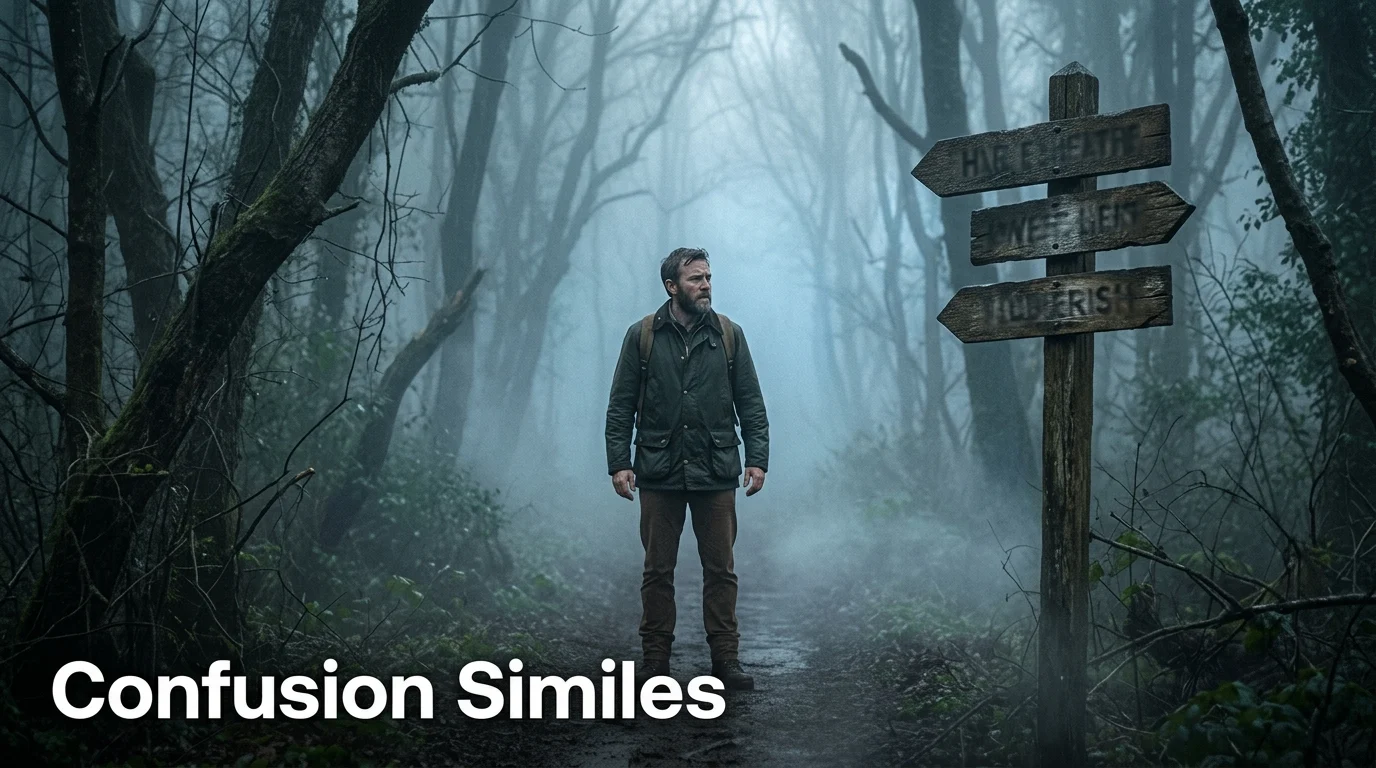
A confused mind might be “as foggy as a mountain road at dawn” or “like a browser with too many tabs open.” These comparisons transform abstract cognitive states into physical sensations and images that resonate deeply with readers.
Whether you are writing a novel, a poem, a psychological profile, a blog post, or a school essay, mastering similes for confusion will allow you to paint a clear picture of mental chaos, uncertainty, and disorientation.
This guide explores the most powerful similes for confusion, complete with meanings, explanations, examples, and practical tips to enhance your descriptive writing.
Quick List of Similes for Confusion
| Simile | Meaning |
|---|---|
| As foggy as a mountain road | Mentally unclear and unable to think straight |
| Like a deer in headlights | Frozen by shock and uncertainty |
| As lost as a needle in a haystack | Unable to find a solution or direction |
| Like a maze with no exit | Trapped in a cyclical, unsolvable problem |
| As tangled as a ball of yarn | Thoughts are knotted and impossible to separate |
| Like a foreign language | Unable to comprehend basic information |
| As mixed up as a jigsaw puzzle | Pieces of information don’t fit together |
| Like a boat without a rudder | Lacking direction or control |
| As hazy as a half-remembered dream | Memory and reality blending indistinctly |
| Like a radio stuck between stations | Receiving conflicting or static signals |
Similes for Mental Fog and Unclear Thinking
These comparisons are perfect for describing moments when a character’s brain feels slow, heavy, or obscured, preventing clear thought.
1. As Foggy as a Mountain Road at Dawn
Meaning
Describes a mental state where thoughts are obscured, slow, and difficult to navigate.
Why It Works
Fog physically limits visibility. Comparing a mind to a foggy road instantly conveys the idea of being unable to see the path ahead or make sense of immediate surroundings.
Alternative Expression
“As murky as a swamp at twilight”
Examples in Writing
- Formal Example: After the accident, his memory was as foggy as a mountain road at dawn, obscuring the details of the event.
- Casual Example: I haven’t had my coffee yet; my brain is totally foggy.
- Creative Example: Her thoughts drifted through her mind as foggy as a mountain road, where every idea was a shadow lurking just out of sight.
2. Like a Browser with Too Many Tabs Open
Meaning
Represents a modern state of mental overload where too many thoughts compete for attention, resulting in a crash or freeze.
Why It Works
This is a highly relatable, contemporary image. It describes the specific anxiety of a scattered mind that cannot focus on a single task because background “noise” is constantly interrupting.
Alternative Expression
“Like a computer stuck on the loading screen”
Examples in Writing
- Formal Example: The project requirements left her mind feeling like a browser with too many tabs open, unable to process the influx of data.
- Casual Example: I have so much to do today that my head feels like a browser with fifty tabs open.
- Creative Example: His consciousness spun with anxiety, like a browser with too many tabs open, each one blaring a different alarm.
3. As Hazy as a Half-Remembered Dream
Meaning
Describes confusion that involves a blurring of lines between reality, memory, and imagination.
Why It Works
Dreams are inherently illogical and fleeting. This simile suggests that the person is struggling to grasp what is real versus what is imagined.
Alternative Expression
“As blurry as a watercolor painting left in the rain”
Examples in Writing
- Formal Example: The patient’s sense of time was as hazy as a half-remembered dream.
- Casual Example: I was so tired that the lecture seemed hazy, like a dream I couldn’t remember.
- Creative Example: The days following the tragedy blended together, as hazy as a half-remembered dream where faces float and voices echo.
4. Like Static on an Old Television
Meaning
Represents a state of mind where no coherent thoughts can form; only white noise and chaos exist.
Why It Works
The visual and auditory crackle of static perfectly captures the sensation of a brain that has stopped processing information and is simply buzzing with empty energy.
Alternative Expression
“Like a radio stuck on a dead frequency”
Examples in Writing
- Formal Example: When asked to solve the complex equation, his mind went blank, filling with static like an old television.
- Casual Example: I’m so exhausted my brain is just static.
- Creative Example: Panic overwhelmed her logic, turning her thoughts into static on an old television, loud but meaningless.
Similes for Disorientation and Being Lost
These comparisons are ideal for situations involving physical confusion, getting lost, or feeling out of place in a familiar environment.
5. Like a Deer in Headlights
Meaning
Describes a sudden, paralyzing confusion caused by shock, fear, or an unexpected confrontation.
Why It Works
The image of a deer frozen in the middle of the road conveys a total loss of cognitive function; the brain is screaming “danger” but the body cannot move or decide.
Alternative Expression
“Like a rabbit caught in a trap”
Examples in Writing
- Formal Example: The witness looked like a deer in headlights when the prosecutor presented the damning evidence.
- Casual Example: I froze like a deer in headlights when the teacher called my name.
- Creative Example: He stood on the stage, a deer in headlights, the lines of the play scattering from his memory like startled birds.
6. As Lost as a Needle in a Haystack
Meaning
Describes a situation or a thought process where finding the correct answer or memory feels impossible due to the sheer volume of irrelevant information.
Why It Works
It emphasizes the futility of searching. The scale of the haystack compared to the needle perfectly illustrates being overwhelmed by data.
Alternative Expression
“As lost as a single grain of sand on a beach”
Examples in Writing
- Formal Example: Trying to find the error in the thousand lines of code was like looking for a needle in a haystack.
- Casual Example: I can’t find my keys in this messy room; it’s a needle in a haystack.
- Creative Example: The memory of her name was lost in the haystack of his aging mind, buried under years of other faces.
7. Like a Boat Without a Rudder
Meaning
Represents a loss of control and direction in life or in a specific situation. It describes the anxiety of drifting without a purpose.
Why It Works
A boat without a rudder is at the mercy of the currents and wind. It powerfully conveys the helplessness of being unable to steer one’s thoughts back to safety.
Alternative Expression
“Like a kite with a broken string”
Examples in Writing
- Formal Example: After losing his job, he felt like a boat without a rudder, drifting through a sea of uncertainty.
- Casual Example: I have no idea what to do next; I’m just a boat without a rudder.
- Creative Example: Her mind spun in circles, a boat without a rudder caught in the whirlpool of conflicting advice.
8. Like a Tourist Without a Map
Meaning
Describes the specific confusion of being in an unfamiliar situation, whether literally in a new place or metaphorically in a new topic or role.
Why It Works
It highlights the ignorance of local customs, language, or direction. It is a very literal depiction of being out of one’s depth.
Alternative Expression
“Like a stranger in a strange land”
Examples in Writing
- Formal Example: He was a tourist without a map in the world of high finance, unaware of the dangerous currents beneath the surface.
- Casual Example: I walked into the advanced physics class feeling like a tourist without a map.
- Creative Example: In the social gathering, she was a tourist without a map, unable to read the subtle signs of the cliques and conversations around her.
Similes for Confusing Situations and Puzzles
These comparisons focus not just on the feeling of confusion, but on the nature of the problem itself complex, tangled, or illogical.
9. Like a Maze with No Exit
Meaning
Represents a problem or situation that seems impossible to solve, where every turn leads to a dead end.
Why It Works
Mazes are designed to confuse. Adding “no exit” increases the stakes from difficult to hopeless, trapping the thinker in a loop.
Alternative Expression
“Like a labyrinth that shifts its walls”
Examples in Writing
- Formal Example: The investigation was like a maze with no exit, every new clue leading only to more questions.
- Casual Example: Trying to understand tax law is like trying to escape a maze with no exit.
- Creative Example: His logic was a maze with no exit, a labyrinth of contradictions that left his listeners dizzy.
10. As Tangled as a Ball of Yarn
Meaning
Describes thoughts or problems that are knotted together, making it impossible to separate one thread (or idea) from another.
Why It Works
The physical frustration of untangling yarn is universally understood. It perfectly mirrors the mental frustration of trying to isolate a single thought in a web of confusion.
Alternative Expression
“As knotted as a fisherman’s net in a storm”
Examples in Writing
- Formal Example: The legal case was as tangled as a ball of yarn, with motives and alibis knotted beyond recognition.
- Casual Example: My headphones are always as tangled as a ball of yarn.
- Creative Example: The family history was as tangled as a ball of yarn, full of secrets that could not be unknotted without breaking the thread of trust.
11. As Mixed Up as a Jigsaw Puzzle in a Blender
Meaning
Describes a situation where the pieces of information are all present but completely out of order and perhaps damaged, making assembly impossible.
Why It Works
This combines the idea of a puzzle (a problem to solve) with the violence of a blender (total chaos). It suggests that the information has been shattered and shuffled randomly.
Alternative Expression
“As scrambled as eggs”
Examples in Writing
- Formal Example: The evidence was as mixed up as a jigsaw puzzle in a blender, with witness statements contradicting each other.
- Casual Example: My schedule for next week is all mixed up.
- Creative Example: He tried to explain the plan, but the words came out mixed up as a jigsaw puzzle in a blender, pieces flying everywhere.
12. Like Reading a Map Upside Down
Meaning
Represents a fundamental misunderstanding of a core concept, causing every subsequent action to be wrong.
Why It Works
The user believes they are navigating correctly, but their entire framework is inverted. This simile is perfect for describing characters who are confidently incorrect.
Alternative Expression
“Like trying to fit a square peg in a round hole”
Examples in Writing
- Formal Example: His interpretation of the philosophy text was like reading a map upside down; he was confidently heading in the wrong direction.
- Casual Example: I was trying to fix the car like I was reading a map upside down I had no idea what I was doing.
- Creative Example: Their marriage was built on miscommunication, two people reading the same map upside down and wondering why the terrain didn’t match.
Similes for Emotional and Existential Confusion
These comparisons delve into deeper psychological states where identity, reality, or purpose are unclear.
13. Like a Chameleon on a Plaid Shirt
Meaning
Describes the frantic feeling of trying to adapt to an environment that is too complex or contradictory to blend into.
Why It Works
The chameleon’s defining trait is adaptation, but a plaid shirt presents a chaotic, multi-colored pattern that makes camouflage impossible. It perfectly captures the anxiety of an identity crisis.
Alternative Expression
“Like an actor who has forgotten the play”
Examples in Writing
- Formal Example: He felt like a chameleon on a plaid shirt, trying to be everything to everyone but ending up as nothing to himself.
- Casual Example: I felt like a chameleon on a plaid shirt trying to fit in with all the different groups at the party.
- Creative Example: Her personality shifted with the wind, a chameleon on a plaid shirt, desperate for a stable color to claim as her own.
14. As Disoriented as a Bat in Sunlight
Meaning
Represents the discomfort and confusion of being forced out of one’s natural element or comfort zone.
Why It Works
Bats are masters of the night but blind and clumsy in the day. This simile suggests that the confusion stems from an environment that is hostile or too bright for the person’s nature.
Alternative Expression
“As awkward as a fish on a bicycle”
Examples in Writing
- Formal Example: The reclusive author was as disoriented as a bat in sunlight during the crowded press conference.
- Casual Example: I’m a night owl, so I feel like a bat in sunlight at this 7 AM meeting.
- Creative Example: Thrust into the spotlight, he blinked and stumbled, a bat in sunlight, longing for the comforting darkness of anonymity.
15. Like a Ship Trying to Sail on Sand
Meaning
Describes an effort that is futile because the fundamental understanding of the environment is wrong.
Why It Works
A ship is perfectly designed for water but useless on sand. This simile conveys a deep, structural confusion about the nature of a task or relationship.
Alternative Expression
“Like trying to drink the ocean with a fork”
Examples in Writing
- Formal Example: Trying to explain the concept to the board was like a ship trying to sail on sand; they simply lacked the foundation to understand it.
- Casual Example: Using logic with a toddler is like sailing a ship on sand.
- Creative Example: She tried to love him, but it was like sailing a ship on sand, grinding against a reality that would not support the journey.
Why Confusion Similes Matter in Writing
Confusion is an internal, cognitive state. It lacks physical substance, making it hard to “show” rather than “tell.”
Strong similes are essential because they:
- Externalize the Internal: They turn a mental state into a physical picture the reader can see.
- Create Empathy: Readers have all felt lost, tangled, or foggy. Using these universal experiences builds a bridge of understanding.
- Enhance Pacing: A short, sharp simile (like “a deer in headlights”) can freeze a moment in time, while an extended one (like “a boat without a rudder”) can emphasize a long period of drifting.
- Add Voice: The choice of simile can tell the reader about the character’s background. A mechanic might compare confusion to “a stripped gear,” while a musician might compare it to “a broken metronome.”
How to Use Confusion Similes Naturally
Match the Intensity
For a fleeting moment of confusion, use a simple, quick simile like “as blank as a new page.” For deep existential dread, use a heavier, more complex simile like “a chameleon on a plaid shirt.”
Reflect the Character’s World
Ensure the simile fits the character’s perspective. If your character is a chef, “a recipe with missing ingredients” is perfect. If they are a programmer, “a recursion with no base case” is ideal.
Keep it Visceral
Confusion is often accompanied by physical sensations: dizziness, heat, a racing heart, or a headache. Pair your simile with a physical reaction to deepen the impact.
- Example: “He felt as tangled as a ball of yarn, his face flushing hot as he tried to find the thread of the conversation.”
Common Mistakes When Writing Confusion Similes
Overcomplicating the Image
A simile should clarify confusion, not cause it. If the reader has to pause to figure out what your simile means, it has failed.
- Bad Example: “As confused as a quantum particle in a state of superposition.”
- Good Example: “As confused as a kid in a candy store with no money.”
Using Mixed Metaphors
Do not combine unrelated similes back-to-back.
- Bad Example: “He was a boat without a rudder, stuck in a maze, tangled in a web.”
- Good Example: “He was a boat without a rudder, drifting aimlessly through the sea of information.”
Ignoring Context
A humorous simile (like “a chameleon on a plaid shirt”) might be inappropriate in a tense thriller scene. Tone is key.
Similes vs. Metaphors for Confusion
Simile
Uses “like” or “as.”
- Example: “His mind was like a locked room.”
Metaphor
Makes a direct comparison.
- Example: “His mind was a locked room.”
While both are effective, similes often allow for a brief moment of distance that highlights the process of being confused, whereas metaphors can feel more immersive and immediate.
Writing Exercise: Create Better Confusion Similes
Start with a simple sentence:
“He was confused.”
Now, rewrite it using different domains:
- Nature: “He was as lost as a leaf in a whirlwind.”
- Technology: “He was like a buffering video, frozen mid-action.”
- Construction: “His thoughts were like a building with no blueprint.”
- Music: “He was like a violinist playing in the dark.”
- Food: “His mind was like a recipe where the ingredients didn’t match the instructions.”
Practicing this regularly will help you build a diverse vocabulary of descriptive imagery.
FAQs
1. What are similes for confusion?
Similes for confusion compare the feeling of being perplexed, disoriented, or unclear to familiar sensations or objects using “like” or “as,” such as “like a deer in headlights.”
2. Why should writers use confusion similes?
They allow writers to show a character’s mental state in a vivid, relatable way, deepening reader immersion and empathy without relying on flat, clinical adjectives.
3. What makes a strong confusion simile?
A strong simile is easy to visualize, fits the tone of the scene, and reflects the character’s background or the nature of the problem they are facing.
4. Can confusion similes be humorous?
Yes. Similes like “a chameleon on a plaid shirt” or “a screen door on a submarine” can add a layer of wit and levity to a confusing scenario.
5. How can I create original confusion similes?
Think of a time you were confused. What did it physically feel like? Did you feel heavy (like sand), scattered (like marbles), or blank (like paper)? Connect that feeling to an object from the character’s world.
Conclusion
Confusion is more than just a lack of knowledge; it is an active, often unsettling state of being lost in a space where the rules have changed. It is a fog, a maze, a tangled knot, or a broken compass.
The best similes for confusion do not just describe a blank mind; they paint a picture of a mind struggling, searching, and crashing into walls. They turn the abstract anxiety of “not knowing” into something the reader can see, touch, and feel.
By drawing on images from nature, modern technology, and the physical world, you can transform a dull statement like “He was confused” into a compelling portrait of a mind in turmoil. Whether it is the frozen terror of a “deer in headlights” or the slow drift of “a boat without a rudder,” the right simile will make your readers feel the chaos alongside your characters.
As you write, remember that the goal is not just to label the confusion, but to make the reader experience it. Choose your images carefully, and you will guide your audience through the fog with clarity and skill.
Read More Related Articles:
- Similes for Dancing | Comparisons to Describe Movement in 2026
- Similes for Patience | Express Calmness Beautifully In 2026
- Similes for Hard Work | Comparisons That Capture Dedication and Effort In 2026

Alex Morgan is a creative mind behind SimileVibe.com, focused on building clean digital experiences that feel simple, modern, and real. He works closely with ideas, design, and user experience to create projects that connect naturally with people online.