Quick Answer
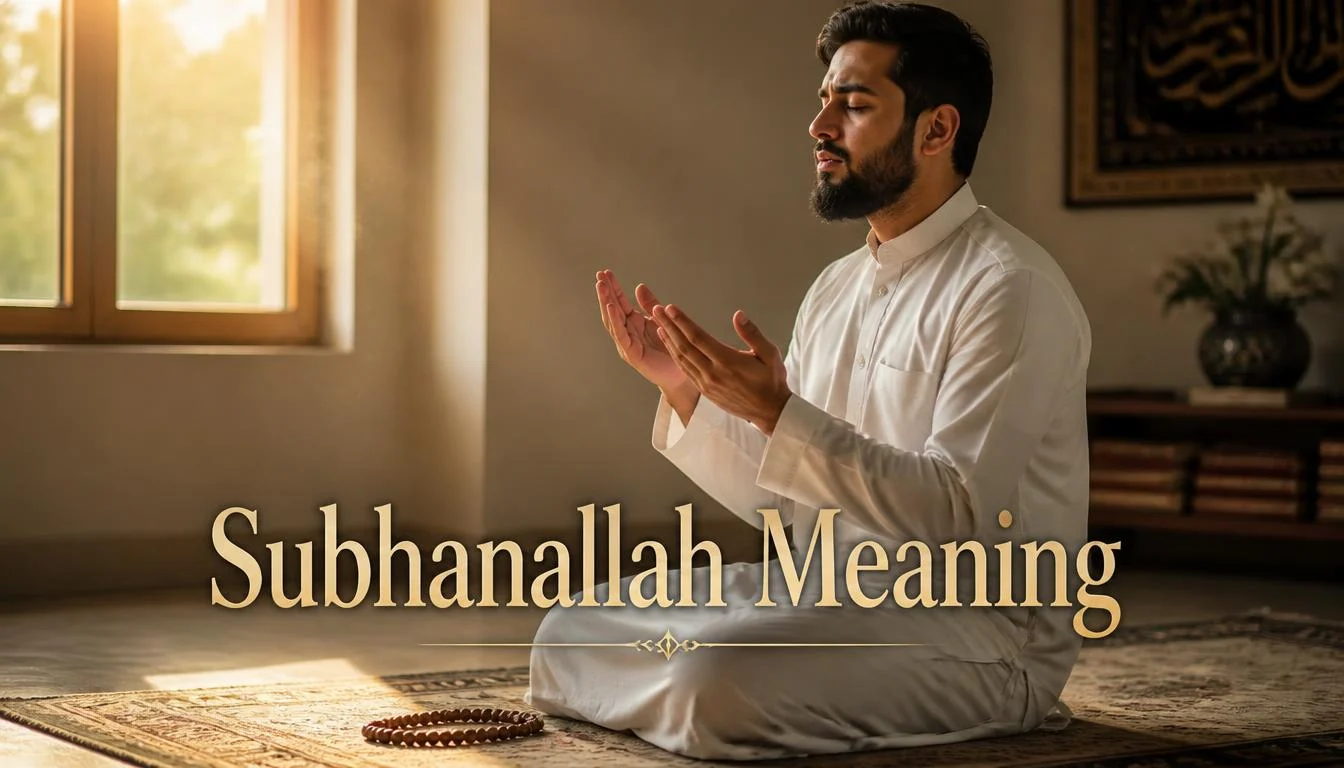
Subhanallah Meaning is “Glory be to Allah” or “Allah is free from all imperfections.” Muslims say Subhanallah to praise Allah, express amazement at His creation and recognize His perfection.
Understanding the Subhanallah Meaning helps you appreciate one of the most beautiful expressions in Islam. The Arabic phrase “Subhanallah” (سُبْحَانَ ٱللَّٰهِ) means “Glory be to Allah” and expresses that Allah is perfect and free from every flaw. Muslims use this phrase in daily life to remember Allah and acknowledge His greatness. It is a simple yet meaningful way to express faith and gratitude.
The Subhanallah Meaning becomes especially powerful when someone witnesses something beautiful, remarkable or unexpected. For example, you might say Subhanallah while watching a breathtaking sunset or seeing the wonders of nature. It is also used during Islamic worship and daily remembrance of Allah. Learning when and why to say Subhanallah can help you understand its spiritual value and use it with greater awareness.
What Does Subhanallah Actually Mean
The phrase carries a weight that simple translations often miss. At its core subhanallah is an act of glorification called tasbih in Arabic. When a Muslim says these words they are not just praising God. They are actively declaring that Allah is beyond any deficiency or fault that anyone might attribute to Him.
Linguists trace the word subhan to an ancient root meaning to praise or to glorify. Interestingly this root does not exist as a standard verb in Arabic itself. Scholars believe the word entered Arabic from Aramaic and was also adopted in Hebrew and Ethiopic languages. This shared linguistic heritage shows how deeply connected these Semitic languages are.
The term functions as what grammarians call an accusative of exclamation. That is a fancy way of saying it is a verbal gasp of awe and wonder. When you say subhanallah you are essentially saying I am speechless at God’s perfection and I declare Him free from everything that contradicts that perfection.
One important nuance distinguishes this phrase from ordinary praise. Alhamdulillah expresses gratitude and thankfulness for blessings received. Subhanallah goes deeper. It affirms God’s essential nature as perfect regardless of what happens to you personally. Even in difficulty even when nothing good seems apparent a Muslim can still say subhanallah because God’s perfection is not contingent on circumstances.
The Difference Between Subhanallah Alhamdulillah and Allahu Akbar
These three phrases appear together constantly in Islamic practice but each one does something different. Knowing the distinctions helps you understand why Muslims cycle through all three after every prayer.
| Phrase | Core Meaning | Primary Function | When Typically Used |
|---|---|---|---|
| Subhanallah | Glory be to Allah / How perfect is Allah | Declares God free from imperfections | During prayer in moments of awe when rejecting something inappropriate |
| Alhamdulillah | All praise is due to Allah | Expresses gratitude and acknowledgment of blessings | After good news after eating when something pleasant happens |
| Allahu Akbar | Allah is greater / Allah is the greatest | Affirms God’s superiority over everything | Call to prayer at the start of prayer when witnessing something overwhelming |
A helpful way to remember the difference: Subhanallah focuses on God’s perfection Alhamdulillah focuses on His generosity and Allahu Akbar focuses on His greatness relative to all things. The Prophet Muhammad peace be upon him recommended saying each phrase thirty three times after every obligatory prayer completing the set with a declaration of God’s oneness.
Where Subhanallah Appears in the Quran
The phrase appears throughout the Quran in significant contexts. It is placed in the mouths of prophets angels and even the blessed in Paradise. Moses is described saying it in the Quran and Jesus likewise. The angels themselves constantly declare God’s perfection.
One particularly beautiful usage comes when the Quran describes the night journey of the Prophet Muhammad. The chapter opens with the words Glory be to the One who took His servant by night from the Sacred Mosque to the Farthest Mosque. This framing sets the tone for the entire miraculous event. The phrase signals that something beyond ordinary human comprehension is about to be described.
The Quran also teaches that all of creation engages in tasbih. Everything in the heavens and the earth glorifies God but humans cannot fully understand how they do so. This idea extends the practice far beyond human speech. When you say subhanallah you are joining a chorus of praise that includes stars mountains trees and creatures you will never meet.
How Muslims Use Subhanallah in Daily Life
The phrase is not confined to ritual worship. It spills into everyday moments naturally. Here are the most common situations where you will hear it.
During Prayer
Subhanallah appears in the physical postures of the five daily prayers. In bowing Muslims say Subhana Rabbi al-Azim meaning Glory to my Lord the Most Great. In prostration they say Subhana Rabbi al-Ala meaning Glory to my Lord the Most High. These phrases accompany the deepest moments of submission.
After Obligatory Prayers
As mentioned above saying subhanallah thirty three times after each prayer is a recommended practice. It takes only a minute or two and serves as a way to transition from formal worship back into ordinary life while keeping the heart connected to God.
Expressing Amazement or Surprise
When something astonishing happens when you see something beautiful or when you learn something extraordinary subhanallah is the natural response. Oxford Reference notes that the phrase is commonly used as an expression of surprise or admiration. It is the Muslim equivalent of saying Wow combined with an acknowledgment that God deserves the credit.
Rejecting Something Inappropriate
There is another dimension to subhanallah that many non-Arabic speakers miss. The phrase can function as a gentle correction or expression of disapproval. If someone says something that attributes imperfection to God or suggests something inappropriate about the divine subhanallah serves as a verbal rejection. The Quran uses it in this way when addressing claims that God has a son or partners. In this context the phrase means something closer to God forbid or How can you say such a thing.
One well known example comes from a hadith. When a companion assumed that a Muslim becomes ritually impure after intimate relations the Prophet responded with Subhanallah meaning something like How can you say that.
Subhanallah vs Mashallah: What Is the Real Difference
These two phrases get confused constantly especially by new Muslims and non-Muslims. Both contain Allah and both get said in moments of appreciation. But they do completely different things.
Mashallah means What Allah has willed or This is what Allah willed. It is used to express appreciation joy or thankfulness for something that has happened. When you see a beautiful child or a new house or someone achieve something impressive mashallah acknowledges that God willed it into existence.
Subhanallah is about God’s nature. Mashallah is about God’s will in action.
One practical distinction involves protection from the evil eye. Many Muslims say mashallah to protect a blessing from jealousy or harm. Subhanallah does not serve that function. You would not say subhanallah when admiring someone’s garden. You would say mashallah or a combination like Mashallah la quwwata illa billah.
The grammatical structures also differ. Mashallah comes from the root meaning to will. Subhanallah comes from a root meaning to praise or glorify a root shared across multiple Semitic languages. They sound similar to untrained ears but function like completely different tools.
The Deeper Significance of Tasbih
Beyond the phrase itself tasbih the act of glorifying God holds a central place in Islamic spirituality. Scholars describe tasbih as tanzeeh which means removing or distancing. When you perform tasbih you are mentally and verbally distancing God from every imperfection that ignorance or malice might suggest.
This is more than a verbal exercise. It is a form of spiritual hygiene. The human mind naturally anthropomorphizes. We imagine God in human terms with human limitations. We project our frustrations our disappointments and our flaws onto the divine. Tasbih corrects this tendency. Every time you say subhanallah you reset your mental image of God back toward what He actually is.
The Prophet Muhammad described subhanallah as the worship of creation. This is a striking statement. It suggests that glorifying God is not just one religious practice among many but the fundamental activity of every created being. When you engage in tasbih you are doing what you were made to do.
Some scholars have noted that the phrase contains a subtle but important theological point. You cannot actually make God more perfect by saying subhanallah. God’s perfection is eternal and unchanging. What you are doing is aligning your own perception with reality. You are acknowledging what is already true. The benefit of saying it goes entirely to the person saying it not to God.
Common Mistakes and Misunderstandings
Is Subhanallah Only for Muslims
The phrase is Arabic and Islamic in origin but it appears in the speech of Arabic speaking Christians and Jews as well. Many Arabic speaking Christians say subhanallah in roughly the same way Muslims do. The word Allah is simply the Arabic word for God used by Arabic speakers of all three Abrahamic faiths. However the specific theological framework behind the phrase differs between traditions.
Does Saying It Require a Specific Number
No. The recommended repetitions after prayer thirty three times are part of a specific sunnah practice not a requirement for every usage. You can say subhanallah once or a hundred times. The phrase is valid either way.
Do You Need to Be Ritually Pure
Subhanallah is a form of dhikr remembrance of God. Traditional Islamic scholarship recommends performing dhikr in a state of ritual purity but it is not always required. You can say subhanallah while walking cooking driving or lying in bed. The phrase is meant for constant use not just formal worship settings.
Does Pronunciation Matter
Arabic pronunciation always matters to some degree but the phrase is forgiving. Say it as best you can. Subhanallah is not a magic formula that requires perfect phonetics to work. Intent matters far more than accent.
FAQs
What is the exact translation of subhanallah in English
The most accurate short rendering is Glory be to Allah or How perfect is Allah. A fuller explanation would be I declare Allah free from every imperfection and deficiency that does not befit His majesty. No single English phrase captures the full weight but these come closest.
Can non-Muslims say subhanallah
Yes. There is no restriction on who can utter these words. Many non-Muslims who work in Muslim majority countries or interact closely with Muslim communities pick up the phrase naturally. Saying it does not make someone Muslim any more than saying a phrase in French makes someone French.
Is it acceptable to write subhanallah in English instead of Arabic
Absolutely. The phrase is transliterated in multiple ways including Subhan Allah SubhanAllah and Subhanallah. All are acceptable. Arabic script is preferred by many for religious texts but everyday communication in any language is fine.
What is the reward for saying subhanallah
Islamic tradition holds that dhikr carries spiritual reward. The Prophet described the phrase as one of the two light expressions that are heavy on the scales of good deeds. However the specific reward is a matter of divine discretion and Islamic scholars discourage reducing the practice to a transactional calculation.
How is subhanallah different from Alhamdulillah
Subhanallah focuses on God’s perfection and freedom from flaws. Alhamdulillah focuses on gratitude and praise for blessings. You say subhanallah when you encounter something that reminds you of God’s greatness. You say alhamdulillah when you receive something good or when you want to express thankfulness in any circumstance.
Can you say subhanallah during salah
Yes. Subhanallah is part of the prescribed prayers. It appears in the bowing and prostration positions. It is also permissible to say it silently or aloud in other parts of prayer depending on the specific situation.
Conclusion
Subhanallah is one of those phrases that rewards deeper understanding. It looks simple on the surface just three syllables that millions of people say every day. But underneath it carries a complete theology of divine perfection. Every time a Muslim says these words they are participating in an act that the Quran describes as universal. The stars do it. The trees do it. The angels have been doing it since before humans existed. When you say subhanallah you are joining that ancient chorus and reminding yourself that whatever problem seems overwhelming at this moment God is greater and God is perfect.









