Quick Answer:
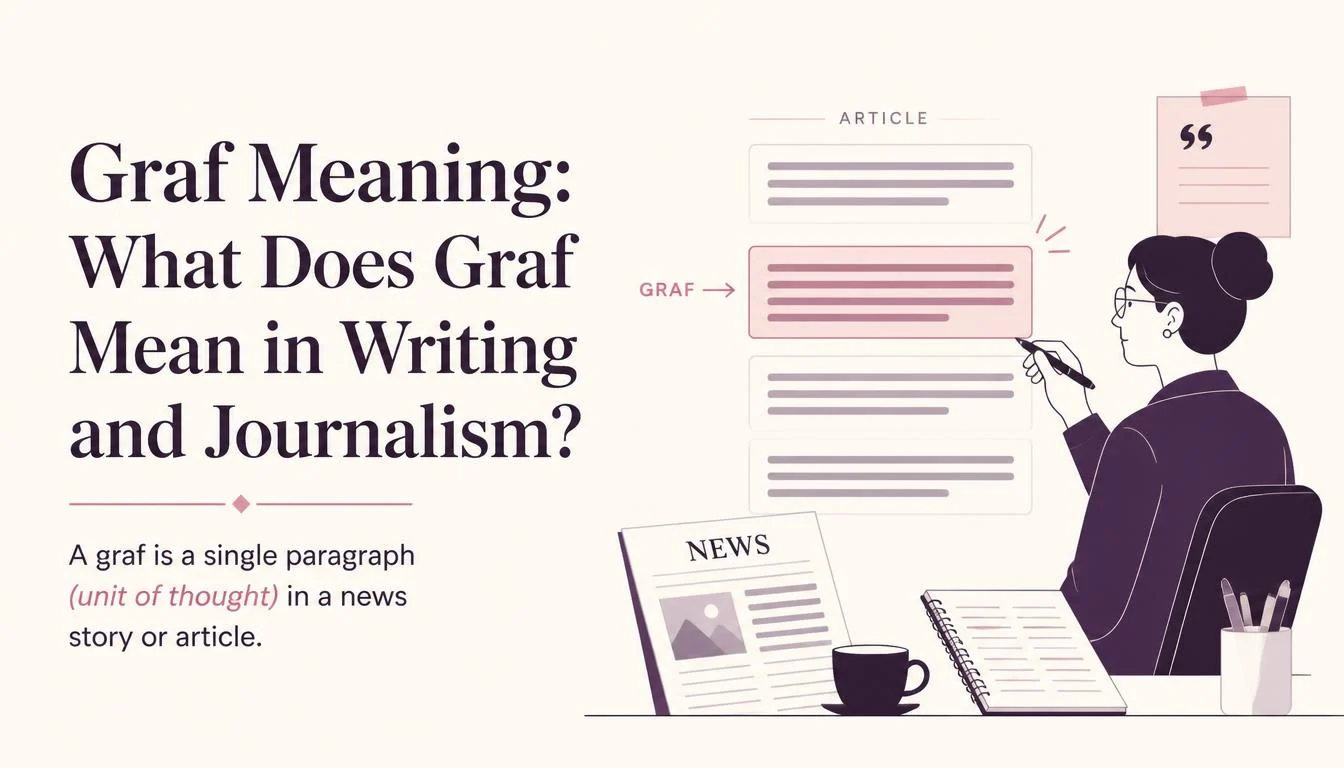
The graf meaning is usually a paragraph in journalism or professional writing. It is a shortened form of “paragraph” and is commonly used by journalists and editors. You may also see graf in the phrase “nut graf” which refers to a paragraph that explains the main point of a story.
If you have ever read about journalism or watched writers discuss a news story you may have come across the word graf. At first glance it can look like a typo for “graph.” However the two words have different meanings.
The graf meaning is simple once you know its context. In journalism a graf is a paragraph. Writers and editors often use this shortened form when talking about the structure of an article or news story.
The term can also appear in phrases such as nut graf. This makes the word especially important for anyone learning about journalism or trying to understand professional writing terminology.
What Does Graf Mean?
So what does graf mean? In journalism graf means paragraph. It is an informal shortened form of the word “paragraph.”
A journalist may say that a story needs a stronger graf. An editor might ask a writer to rewrite the second graf. In both cases they are talking about a paragraph in the story.
The term is especially common in newsrooms. It helps writers and editors refer to individual paragraphs quickly.
For example:
“The third graf needs more context.”
This simply means:
“The third paragraph needs more context.”
Graf Definition in Simple Words
The basic graf definition is a paragraph used in written content. It can refer to any paragraph within a journalistic story.
The word is not normally used in everyday conversation. You are more likely to encounter it in journalism schools, newsrooms, editing discussions and writing guides.
Here is the simplest way to remember it:
Graf = paragraph in journalism
The meaning becomes clearer when you see the word used naturally in a sentence.
“The opening graf introduces the main issue.”
Here “graf” means the opening paragraph.
Graf Meaning in Writing
The graf meaning in writing is closely connected to paragraph structure. Writers use the word to identify a specific paragraph within a piece of content.
It is particularly common when discussing articles and news stories. An editor may refer to the first graf or final graf when giving feedback.
For example:
“The first graf is too long.”
The editor is saying that the first paragraph should be shorter.
Another example is:
“Move this detail to the next graf.”
That means the detail should be moved to the next paragraph.
This use makes graf a practical writing term rather than a separate type of paragraph.
Graf Meaning in Journalism
The graf meaning in journalism is simply a paragraph within a news story. Journalists often use this term when discussing how a story is organized.
A typical news article contains several grafs. Each paragraph can serve a different purpose.
The opening graf may introduce the main event. Another graf may provide important details. Later grafs can include background, quotes and additional information.
Good journalism depends on clear organization. That is why journalists often pay close attention to every graf.
A weak paragraph can make a story difficult to follow. A strong paragraph helps readers understand the information quickly.
Why Do Journalists Say Graf Instead of Paragraph?
You may wonder why journalists use graf when “paragraph” already exists.
The main reason is convenience. Journalism has developed its own vocabulary over many years. Newsrooms use short terms because writers and editors often need to discuss stories quickly.
The word also helps distinguish newsroom terminology from everyday writing language.
For example an editor might say:
“Rewrite the fourth graf.”
This is shorter and more natural within a newsroom than saying:
“Rewrite the fourth paragraph of the article.”
The meaning remains the same.
Graf Abbreviation and Shortened Form
The term graf abbreviation can be understood as a shortened form of “paragraph.” It is not an abbreviation in the same way as common acronyms.
Instead it is a shortened journalism term.
You may see it written as graf in writing discussions. Some writers may use other shortened forms depending on their newsroom style.
The important point is that graf refers to a paragraph.
What Is a Nut Graf?
One of the most important expressions connected with the term is nut graf.
A nut graf is a paragraph that explains the main point or significance of a story. It gives readers the context they need to understand why the story matters.
The nut graf often appears near the beginning of a news article. It may come after the opening paragraph or several introductory grafs.
For example a story might begin with an interesting scene involving a local business. The next paragraph could explain that the business is part of a larger trend affecting small companies.
That explanatory paragraph may serve as the nut graf.
Nut Graf Definition
The nut graf definition is a paragraph that tells readers what a story is really about and why it matters.
Think of it as the paragraph that connects the opening to the larger meaning of the story.
It can answer questions such as:
Why should readers care?
What is the bigger issue?
What does this event mean?
Why is this story being reported?
The exact placement can vary. The function is what matters most.
Nut Graf Meaning Explained With an Example
Imagine a journalist writes a story about a small bookstore that has been operating for fifty years.
The first graf could describe the owner opening the store early in the morning. The scene gives the article an engaging beginning.
The next few grafs could discuss customers and the history of the store.
Then the journalist explains that several independent bookstores in the city have recently closed because of rising rent.
That paragraph provides the bigger picture. It tells readers why the individual bookstore story matters.
That is the basic idea behind a nut graf.
Graf vs Graph
A common question is about graf vs graph.
The words sound similar but they are not interchangeable.
Graf is commonly used as a shortened journalism term for paragraph.
Graph normally refers to a visual representation of information. It can show numbers, trends or relationships between different values.
For example:
“The article has ten grafs.”
Here “grafs” means paragraphs.
“The report includes a graph showing sales growth.”
Here “graph” means a visual chart.
This distinction is important because confusing the two can change the meaning of a sentence.
Graf Meaning in Text
If you see graf meaning in text discussions related to journalism the word usually means paragraph.
For example:
“The final graf summarizes the story.”
This means:
“The final paragraph summarizes the story.”
However context always matters. Some words can have different meanings in different communities.
If you encounter “graf” in a social media post or casual conversation you should look at the surrounding text before assuming it means paragraph.
In professional writing contexts the journalism meaning is usually the most relevant one.
Graf Slang Meaning
People sometimes search for graf slang meaning because the word sounds informal.
In journalism “graf” is informal professional terminology rather than typical internet slang.
It has a specific connection to writing and editing.
The word can appear casually among journalists. For example:
“I need to fix the lead graf.”
This is a newsroom style of communication.
It does not mean that “graf” is general slang used by everyone. Its strongest association is with journalism and writing.
Graf Meaning in English
The graf meaning in English depends on context. In modern journalism it is commonly understood as a shortened form of “paragraph.”
The term is mainly associated with professional writing.
If you are reading a journalism article and see phrases such as “first graf” or “last graf” you can safely interpret them as “first paragraph” or “last paragraph.”
This makes the term easy to understand once you recognize the context.
How to Use Graf in a Sentence
Learning how to use graf is easier with a few examples.
Here are some natural examples:
- “The opening graf needs a stronger hook.”
- “Add the source to the second graf.”
- “The final graf gives useful background.”
- “The editor asked me to rewrite the third graf.”
- “The nut graf explains why the issue matters.”
- “The story has a short opening graf.”
In each example graf refers to a paragraph.
Graf Examples in Journalism
Consider this simple structure for a news story.
First graf: Introduces the main event.
Second graf: Adds an important detail.
Third graf: Provides a quote from someone involved.
Fourth graf: Gives background information.
Fifth graf: Explains the wider significance.
Each section is a graf.
The exact structure can change depending on the story. A breaking news article may use a different structure from a feature story.
Still the basic graf example remains the same. A graf is simply a paragraph within the story.
What Is the Difference Between a Graf and a Paragraph?
There is very little difference in meaning.
A paragraph is the standard English term. Graf is a shortened term that is especially common in journalism.
You can think of it this way:
Paragraph is the general term.
Graf is the newsroom term.
Both can refer to a group of sentences that forms one section of written content.
The difference is mainly about context and professional vocabulary.
Lede and Graf
Another phrase you may encounter is lede and graf.
The lede is the opening section of a news story. It is designed to introduce the most important or engaging part of the story.
A graf is a paragraph.
Together these terms are often used when journalists discuss story structure.
For example an editor might say:
“The lede works but the second graf needs more context.”
The editor is evaluating the opening and the paragraph that follows it.
Understanding both terms makes journalism terminology much easier to follow.
Why Is the First Graf Important?
The first graf can have a major effect on whether readers continue with an article.
In many news stories the opening paragraph gives readers the most important information. It quickly establishes what happened and why it matters.
A strong first graf should be clear. It should also give readers a reason to keep reading.
For online journalism this matters even more. Readers often scan an article before deciding whether to continue.
A confusing opening can cause readers to leave. A focused opening can pull them into the story.
How Editors Evaluate a Graf
Editors look at several things when reviewing a graf.
They may check whether the paragraph has a clear purpose. They may also look for unnecessary words or information that belongs elsewhere.
A good graf should move the story forward.
It should not repeat information without a reason.
Editors may also check transitions between grafs. Each paragraph should connect naturally with the information around it.
This helps create a smooth reading experience.
Graf and Story Structure
A series of well organized grafs gives a story its structure.
The writer may introduce an event. Then they can add details. Quotes can provide another perspective. Background information can give readers context.
Each graf should contribute something useful.
This does not mean every paragraph needs to contain completely new information. Some grafs can clarify or expand on ideas from previous sections.
The goal is to keep the story clear and meaningful.
Is Graf Used Outside Journalism?
The term is most strongly associated with journalism. However it can also appear in broader writing and editing conversations.
Copy editors, content editors and professional writers may use it when discussing paragraphs.
You are less likely to hear it in everyday conversation.
If someone outside a writing environment says “graf” the meaning may depend on their specific context. That is why checking the surrounding words is useful.
Origin of the Word Graf
The origin of graf is connected to the shortened form of “paragraph” used in journalism.
Journalistic language often develops compact terms for common writing concepts. Graf became part of newsroom vocabulary as writers and editors needed quick ways to refer to paragraphs.
The word has remained useful because it is short and easy to recognize in a professional writing environment.
Its exact history is less important for everyday use than understanding its modern meaning.
Graf Synonyms
If you are looking for graf synonyms there is one obvious choice:
Paragraph
Other terms may describe specific types of paragraphs rather than being direct synonyms.
For example:
Nut graf: A paragraph explaining the main point or significance of a story.
Opening paragraph: The first paragraph of an article.
Closing paragraph: The final paragraph.
These terms describe a graf based on its role in the story.
Common Mistakes With the Word Graf
One common mistake is assuming that graf means graph.
It does not in standard journalism terminology.
Another mistake is assuming that every paragraph is automatically a nut graf. A nut graf has a specific purpose. It explains the central point or significance of the story.
Some readers also assume that graf is internet slang. While it may look informal the term is better understood as professional journalism terminology.
Knowing the context prevents these misunderstandings.
FAQs
What does graf mean?
Graf means paragraph in journalism and professional writing. It is a shortened form of the word paragraph and is commonly used by journalists and editors.
What does graf mean in journalism?
In journalism graf means a paragraph within a news story or article. Writers may refer to the first graf, second graf or final graf when discussing story structure.
What is a nut graf?
A nut graf is a paragraph that explains the main point or significance of a story. It gives readers important context and explains why the story matters.
Is graf the same as paragraph?
Yes. In journalism a graf generally means a paragraph. Paragraph is the standard English term while graf is common newsroom terminology.
Is graf the same as graph?
No. Graf usually means paragraph in journalism. Graph usually refers to a visual display of information such as numbers, trends or data.
How do you use graf in a sentence?
You can say “The second graf needs more detail.” This means “The second paragraph needs more detail.”
Is graf slang?
Graf is informal professional terminology associated mainly with journalism. It is not normally considered general internet slang.
What is the difference between a lede and a graf?
A lede is the opening section of a news story while a graf is a paragraph. A lede can consist of one or more paragraphs depending on the style and structure of the story.
Conclusion
The graf meaning is straightforward. In journalism and professional writing graf means paragraph.
You may see journalists talk about an opening graf, second graf or final graf. These phrases simply refer to individual paragraphs within a story.
The term becomes even more useful when you encounter nut graf. A nut graf explains the main point of a story and helps readers understand why the subject matters.
It is also important to remember the difference between graf vs graph. Graf relates to paragraphs while graph usually refers to a visual representation of information.
Once you understand these basic terms reading journalism vocabulary becomes much easier. Whether you are studying journalism, editing articles or simply trying to understand a writing discussion, knowing what a graf means gives you a useful piece of professional writing knowledge.










17 thoughts on “Graf Meaning | Uncover the Story Behind This Unique Word In 2026”