Quick Answer
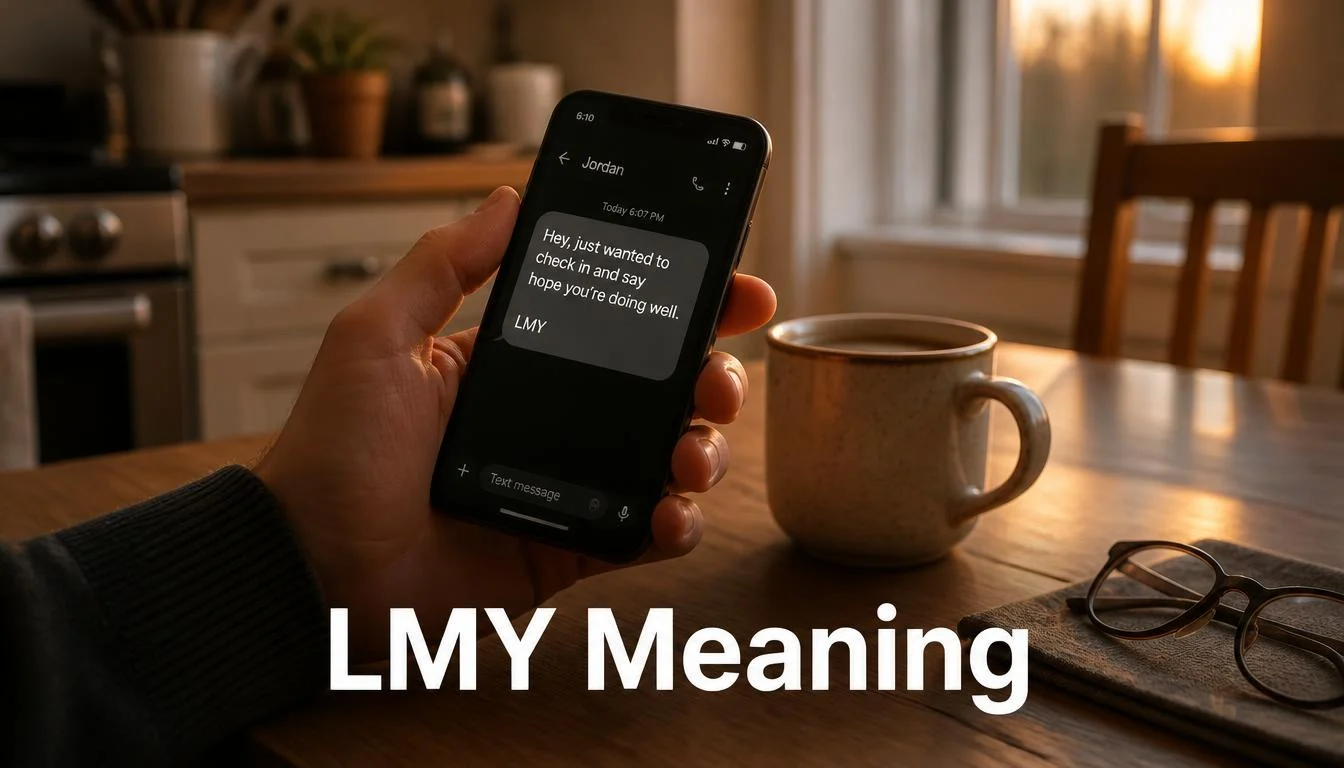
LMY meaning in text can vary by context, but it may mean “Love and Miss You” in personal messages. Check the conversation to understand the intended meaning.
Understanding LMY meaning in text can help you interpret abbreviations used in text messages, social media posts, and online chats. People often use short forms to express feelings quickly, especially when messaging friends, family, or someone they care about.
The meaning of LMY can depend on the person and the conversation. It may be used to express affection or that someone misses another person, but it is not a universally standardized abbreviation. Looking at the surrounding message can help you understand what the sender really means.
What LMY Stands For in Everyday Texting
In ordinary personal messages, LMY is an initialism for “Love and Miss You.” The “and” often disappears in casual use, so “Love Miss You” shows up too, sometimes with a comma: “Love, Miss You.” Records the abbreviation under textspeak rather than as a formal dictionary entry, which tells you something about its register. It belongs to the same informal family as ILY and IMY, not to the language of cover letters and term papers.
Acronym Finder, a database that catalogs abbreviations across industries, lists the affectionate reading as the leading slang definition of the letters. That ranking matters because the same source also records technical expansions. The meaning of LMY is not one thing; it is a hierarchy of readings, and the personal one sits near the top because so many people use it in daily conversation.
It is also not pronounced as a word. Nobody says “limmy.” People read the letters individually, either in their head or aloud, which keeps the phrase tied to its written form. The abbreviation works because it fuses two sentiments that usually require separate sentences. “I love you” can sound like a milestone. “I miss you” can sound like a complaint. LMY does both with less weight.
The Anatomy of a Three-Letter Sign-Off
The letters are simple: L for love, M for miss, Y for you. The order carries a quiet logic. Love comes first, then the admission of absence. That sequence keeps the message from sounding needy. If the letters were rearranged into something like “MYL,” the emotional emphasis would shift, and the phrase would lose the balance that makes it work.
Placement matters as much as sequence. LMY usually appears at the end of a message, not the beginning. “Safe flight tomorrow. LMY.” “Long day. LMY.” That closing position turns it into a gesture, something closer to a hug than a declaration. It is most common between people who already share a bond: long-distance partners, siblings, parents and adult children, and close friends across time zones.
The abbreviation is intimate without being theatrical. It does not demand a response, which is part of its appeal. A full “I love you” can put the other person on the spot; LMY can be sent as a final note and left there. That low-pressure quality is easy to overlook, but it explains why the phrase survived while other texting shortcuts faded.
LMY vs. ILY, IMY, and Other Close Cousins
| Acronym | Expansion | Emotional register | Typical use |
|---|---|---|---|
| LMY | Love and Miss You | Warm, longing, sincere | A sign-off with someone you miss |
| ILY | I Love You | Broad; can be casual or serious | Everyday affection, often spoken aloud |
| IMY | I Miss You | Focused on absence | When longing is the main point |
| LYM | Love You More | Playful, competitive | Replying to “I love you” |
| LMK | Let Me Know | Practical, neutral | Logistics and planning |
The table shows why LMY occupies a narrow lane. ILY is everywhere and can feel routine. IMY names the missing but not the love. LMY declares both without turning the message into a confession. LYM flips affection into a gentle contest, usually after someone says “I love you” and the other person wants the last word. LMK belongs to scheduling, not sentiment.
Confusing LMY with LYM is easy on a phone keyboard because the middle letters sit close together, and autocorrect does not always catch the swap. The two look similar and sound identical when read letter by letter, but they do different emotional work. One is a statement of longing. The other is a playful reply. Reading the surrounding message is the only reliable way to tell them apart.
Same Letters, Different Worlds
Outside personal communication, LMY takes on meanings that have nothing to do with affection. The range is wider than most people expect, and each reading belongs to its own professional or cultural context.
- Lean Meat Yield (agriculture). In livestock science, LMY measures the proportion of saleable meat in an animal’s carcass. Iowa State University’s Cattle QTL Database uses LMY as the symbol for this trait, which breeders track when selecting for muscling and efficiency.
- La Monte Young (music). The American composer, born in 1935, is often described as the first minimalist composer. Abbreviation lists include his name as an LMY expansion in music circles, though the usage is niche.
- Lamy, New Mexico (rail). Amtrak’s station code for Lamy is LMY. The station serves Santa Fe and sits on the route of the Southwest Chief.
- Lake Murray, Papua New Guinea (aviation). The airport code LMY belongs to Lake Murray Airport, a small airstrip serving the surrounding region.
- Late Model Year (automotive). Dealers and parts databases use LMY to describe a vehicle built late in a model year, often when manufacturers introduce running changes.
- “Like My” post or picture (social media). In some captions and comments, LMY is a request for engagement rather than a statement of affection.
- “Let Me Know Yesterday” (workplace humor). A mock-urgent expansion used when a deadline has already passed, usually delivered with dry sarcasm.
This range is not unusual for three-letter combinations. Short codes get reused across industries because the supply of letter combinations is finite, and every field builds its own vocabulary. Context, not the letters themselves, determines which meaning applies. A text from a partner and a spreadsheet from a cattle geneticist are using the same code for entirely different reasons.
Why “Love and Miss You” Stuck
Digital writing compresses emotion. LMY grew alongside ILY and IMY as text messaging became a daily habit in the mid-2000s, and texting dictionaries trace it to the same period that popularized those older abbreviations. But it does something the others do not: it stretches the word “love” beyond romance. Friends use it. Parents use it. Adult siblings use it. That flexibility is the real reason it lasted.
The phrase also protects the sender. A full “I love you” invites a response, and sometimes the sender does not want to wait for one. LMY can be sent as a closing note without demanding anything back. It reads as sincere because it stays private. Unlike public slang that becomes ironic after enough exposure, this one lives in one-to-one conversations, away from comment sections and group performances. The people who use it usually mean it.
There is a practical lesson here about how language survives online. Abbreviations that last are not always the cleverest ones. They are the ones that fill a gap people actually feel. LMY fills the gap between “I love you” and “I miss you” without forcing the sender to choose.
When LMY Is the Wrong Tool
In a work email, LMY is risky. A project manager might read it as “Let Me Know Yesterday,” or a client might misread the tone as overly familiar. Save it for personal channels. In a brand-new relationship, it can land harder than intended because the “love” part is explicit. If you are unsure, “miss you” or “thinking of you” carries less weight and leaves room for the relationship to develop its own rhythm.
Sarcasm is possible, but it usually needs a marker like “lol” or an eye-roll emoji to signal the joke. Without that signal, the default reading is sincere. Replying is simple: match the energy. “Miss you too” works. “Love you more” raises the warmth. A thumbs-up does not. The abbreviation is a small gesture, and it deserves a small gesture back.
FAQs
Does LMY need periods or spaces between the letters?
No. Most people write it as a solid block, LMY. Periods (L.M.Y.) appear in older abbreviation styles but look formal in a text. A space between letters is rare and can read as three separate initials. Lowercase “lmy” is common in casual chats and does not change the meaning.
Can people say LMY out loud?
Almost never. It is a written shorthand. Saying “LMY” in speech would sound like a code rather than a phrase. The spoken equivalents are “love and miss you” or “love you and miss you.” A few friend groups might turn it into an inside joke, but that is not general usage.
How is LMY different from typing out “I love and miss you”?
The abbreviation is lighter. Spelling out the full sentence adds emphasis and can feel more vulnerable or more formal. LMY keeps the sentiment but lowers the emotional volume. It also fits the rhythm of a quick sign-off, while the full sentence often becomes the main point of the message.
What does LMY mean in a group chat?
The affectionate reading still dominates, but the audience changes. It can be a collective goodnight or a message to one person that everyone else can see. Because group chats are less private, some people avoid LMY there and save it for one-to-one messages. In a close-knit group, it works as a warm sign-off.
What should I do if someone sends LYM instead of LMY?
LYM usually means “Love You More,” not “Love and Miss You.” The two are easy to mix up on a phone. If the message is a reply to “I love you,” LYM is a playful one-up. If it seems out of place, ask a light question rather than assuming. Autocorrect and fast typing cause the swap often.
Conclusion
The next time LMY appears on your screen, the context will tell you most of what you need. In a late-night text from a partner or a quick note from a parent, it is a small, deliberate gesture of closeness. In a spreadsheet about cattle, it is a measurement. Three letters can carry a lot, but they cannot carry everything. The reader supplies the rest.