Quick Answer:
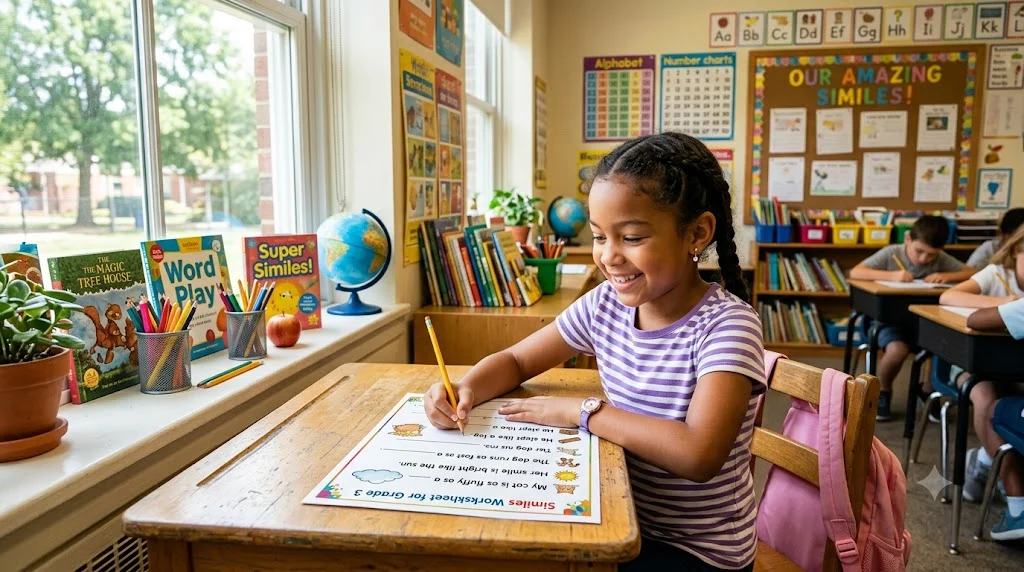
A Similes Worksheet for Grade 3 helps students practice identifying and creating similes using “like” or “as.” These fun activities improve reading comprehension, vocabulary, and creative writing while making figurative language easy for third graders to understand.
Teaching similes to Grade 3 students opens a door to more vivid, expressive writing. At this age, children are moving beyond basic sentences and beginning to explore how language can paint pictures in the reader’s mind. A well-designed similes worksheet for Grade 3 transforms this abstract concept into a concrete, enjoyable learning experience.
Similes are comparisons that use the words “like” or “as” to show how two different things are alike. For example, “as brave as a lion” or “runs like the wind” helps readers instantly visualize and understand the description. This figurative language tool is essential for developing strong reading comprehension and creative writing skills in young learners.
The beauty of similes lies in their ability to make descriptions more relatable and memorable. When a third grader writes “my smile is as bright as the sun,” they are not just practicing grammar they are learning to express themselves with creativity and precision.
Understanding Similes: A Grade 3 Foundation
What Is a Simile?
Before diving into worksheets, it is important to establish a clear definition that resonates with Grade 3 students. A simile is a figure of speech that compares two different things using connecting words like “like,” “as,” or even “than”. It is a tool that helps readers create mental images.
For example, consider the sentence “The baby is as gentle as a lamb.” This does not mean the baby is actually a lamb or has wool. It means the baby has a gentle nature, similar to the gentle reputation of a lamb. The comparison makes the description more vivid and interesting.
Similarly, “The car runs like a dream” does not mean the car is dreaming. It means the car runs smoothly and perfectly, much like an ideal dream experience. These comparisons bring writing to life.
Why Similes Matter for Third Grade Writers
Third grade is a pivotal year for language development. Students are expected to read more complex texts and write more detailed compositions. Similes help them achieve this goal by providing a simple yet powerful tool to add descriptive depth to their work.
When students learn to use similes effectively, they:
- Improve reading comprehension by understanding figurative language
- Enhance their own writing by making it more descriptive
- Develop critical thinking skills by identifying similarities between different objects or concepts
- Build vocabulary through exposure to new and creative comparisons
The use of simile worksheets for third grade helps transform these learning objectives into achievable, structured activities.
Common Simile Patterns for Grade 3
Grade 3 students typically encounter two main patterns when working with similes. Understanding these patterns helps them identify and create similes more easily.
| Pattern | Structure | Example |
|---|---|---|
| “As…as” Pattern | Subject + verb + as + adjective + as + noun | “The pillow is as soft as a cloud.” |
| “Like” Pattern | Subject + verb + like + noun | “He swims like a fish.” |
Both patterns are used in grade 3 simile worksheet activities to reinforce the concept.
Essential Similes Worksheets for Grade 3
Worksheet 1: Identifying Similes
This foundational worksheet helps students recognize similes in sentences. Identifying similes is the first step toward using them independently.
Objective: Identify and circle similes in given sentences.
Instructions: Read each sentence. Circle the simile. Underline the two things being compared.
Sample Exercise:
- The brothers are as different as chalk from cheese.
- When I ski I feel free as a bird.
- Right now I’m mad as a hornet.
- My car works like a dream.
- When you’re in a bad mood, you’re as thorny as a rose bush.
- My throat is as dry as dust.
This activity teaches students to spot the comparison and the connecting words “like” or “as.” It also introduces them to commonly used similes, building their familiarity with the concept.
Worksheet 2: Completing Similes with a Word Bank
This worksheet encourages students to think creatively while providing scaffolding. It is perfect for students who are still building confidence with figurative language.
Objective: Complete similes using words from a help box.
Instructions: Use the words in the box to complete each simile.
Help Box:
deer, monkey, ocean, desert, tree, elephant, bat, ice, feather, fish, bee
Sample Exercise:
- The cashier at the grocery store is as busy as a ________.
- The track star runs like a ________.
- She dives well and swims like a ________.
- Don’t call Chad; he chatters like a ________.
- The angel food cake is as light as a ________.
- Her eyes are as deep as the ________.
- The sound was as clear as an ________.
- I’m so thirsty, my mouth is as dry as a ________.
- Without her glasses on, Judy felt as blind as a ________.
- My older brother is as tall as ________.
- If my dog keeps eating so much, it will become as big as an ________.
Answer Key:
Worksheet 3: Matching Simile Beginnings and Endings
This interactive worksheet works well for pair work or small group activities. It helps students understand how common similes are constructed and encourages them to think about word combinations.
Objective: Match the beginning of each simile with the correct ending.
Instructions: Draw a line to match the first part of the simile with the second part.
Sample Exercise:
| Column A | Column B |
|---|---|
| As busy as a | fox |
| As sly as a | beaver |
| As quiet as a | mouse |
| As stubborn as a | mule |
This activity helps students internalize common simile expressions and understand how different adjectives pair with specific nouns to create vivid imagery.
Worksheet 4: Writing Original Similes
This worksheet is ideal for students ready to apply their knowledge independently. Creating original similes demonstrates mastery of the concept.
Objective: Write original similes based on prompts.
Instructions: Write a simile for each description below.
Sample Exercise:
- A person who always refuses to do what they are told
Example: As stubborn as a mule. - Someone who is not afraid of anything
Student answer: (Examples: As brave as a lion, As fearless as a warrior) - Someone who can run and jump with great ease
Student answer: (Examples: As agile as a monkey, As quick as a cat) - A task that is very simple to perform
Student answer: (Examples: As easy as pie, As simple as ABC)
This activity encourages creative thinking and allows students to produce their own figurative language examples, which strengthens their writing skills.
Worksheet 5: Writing a Simile Poem
A simile poem is an engaging way to combine creative writing with learning. In this activity, students describe a special person using multiple similes, which makes the concept more memorable and personal.
Objective: Write a simile poem about a special person.
Instructions: Use similes to describe someone special to you. Each line should be a simile.
Sample Poem Template:
(Person’s name) is as (adjective) as a (noun).
She is like a (noun) when she (action).
Example:
My mother is as warm as the morning sun.
She is like a cozy blanket on a cold night.
Her smile is as bright as a star.
This activity is available with differentiated versions to support various learning levels. Some students may use a template with sentence starters, while others may write freely.
Worksheet 6: Simile Log
A simile log encourages students to become active readers and find similes in the books they read independently.
Objective: Track examples of similes found during independent reading.
Instructions: As you read, record any similes you find. Include the title, author, page number, the simile itself, and your interpretation of its meaning.
Template:
| Title | Author | Page | Simile Example | My Interpretation |
|---|---|---|---|---|
This activity develops critical thinking and reading comprehension skills while reinforcing the concept.
Worksheet 7: Similes vs. Metaphors
This worksheet helps students distinguish between similes and metaphors, a more advanced skill suitable for some third graders.
Objective: Identify whether each sentence contains a simile or a metaphor.
Instructions: Read each sentence. Write “simile” or “metaphor” in the space provided.
Sample Exercise:
- Her voice is music to my ears. (metaphor)
- He is as tall as a tree. (simile)
- The classroom was a zoo. (metaphor)
- The baby cried like a hungry kitten. (simile)
This activity helps prepare students for more advanced figurative language work and ensures they understand the key difference between similes and metaphors.
Creating Effective Simile Worksheets for Grade 3
Key Elements of a Good Simile Worksheet
When designing or selecting a simile worksheet for third grade, consider these essential elements:
Clear Instructions: Instructions should use simple language appropriate for third-grade reading levels. Use examples to demonstrate expectations.
Visual Support: Illustrations or images help students understand the comparisons and make the worksheet more engaging. For example, a picture of a feather alongside the sentence “as light as a feather” reinforces the meaning.
Gradual Difficulty: Worksheets should progress from simple identification to more challenging creation tasks. This scaffolding allows students to build confidence as they advance.
Varied Activity Types: Including matching, fill-in-the-blank, and creative writing activities keeps the learning experience varied and prevents boredom.
Answer Keys: Providing answer keys saves teacher time and allows for self-checking or peer-checking opportunities.
Differentiating Instruction with Simile Worksheets
Third-grade classrooms often include a range of ability levels. Differentiating simile worksheets ensures all students can access the content.
For Students Needing More Support:
- Use sentence starters that require filling in only the missing word
- Provide a word bank of possible answers
- Offer visual supports like picture cues
- Use simpler comparisons
For On-Level Students:
- Use a mix of matching and fill-in-the-blank activities
- Include prompts for writing complete similes
- Provide both common and less familiar comparisons
For Students Needing Enrichment:
- Challenge them to write simile poems
- Have them find similes in independent reading material
- Ask them to distinguish between similes and metaphors
- Encourage them to write a short story incorporating multiple similes
Where to Find Free Simile Worksheets
Several online resources offer free printable simile worksheets suitable for Grade 3 students. These resources save teachers valuable preparation time and provide high-quality materials.
Super Teacher Worksheets: Offers a variety of simile and metaphor worksheets, including identification, writing, and matching activities. Many worksheets include answer keys.
Wayground (formerly Quizizz): Provides millions of teacher-created worksheets covering similes, metaphors, and other figurative language concepts for third grade. Available in printable PDF and interactive digital formats.
Teach Starter: Features creative resources like writing simile poems, which combine poetry with figurative language learning. The website offers differentiated versions for various ability levels.
K5 Learning: Provides free vocabulary worksheets, including simile practice sheets with simple sentences suitable for third grade.
Education.com: Offers worksheets such as “Similes: Clear as Crystal,” which uses pictures as clues for completing similes.
Teaching Strategies for Similes in Grade 3
Introducing Similes to Third Graders
Start with concrete examples that third graders can easily understand. Use objects in the classroom to demonstrate the concept:
- Hold up a pillow: “This pillow is as soft as a cloud.”
- Point to a fast student: “He runs like the wind.”
- Show a picture of a bee: “She is as busy as a bee.”
Ask students to think of their own comparisons. Prompt them with questions like:
- “What is as quiet as a mouse?”
- “What is as tall as a tree?”
- “What is as sweet as honey?”
Incorporating Similes Across the Curriculum
Similes are not limited to language arts lessons. They can be integrated across the curriculum to reinforce learning and make lessons more engaging.
Science: Describe animals using similes. “A turtle is as slow as a snail.” “A cheetah runs like a rocket.”
Social Studies: Describe historical figures. “Abraham Lincoln was as honest as the day is long.” “The explorers were as brave as lions.”
Math: Use comparisons for shapes and patterns. “The circle was as round as the sun.” “The triangle was as sharp as a needle.”
Art: Describe colors and textures. The blue was as deep as the ocean.” “The paper was as smooth as silk.
Making Simile Learning Interactive
Interactive activities keep students engaged and reinforce learning through multiple modalities.
Simile Charades: Write similes on slips of paper. Students act out the comparison while others guess the simile.
Simile Bingo: Create Bingo cards with common similes. Read descriptions or show pictures, and students mark the matching simile on their cards.
Simile Drawing: Have students read a simile and draw a picture representing the comparison. Display the drawings to create a simile gallery.
Simile Hunt: Challenge students to find similes in their reading books, classroom materials, or even songs and television shows.
Common Similes for Grade 3 Practice
Animal Similes
Animal similes are often the most familiar to third graders. They create strong visual images and are frequently used in everyday language.
| Simile | Meaning |
|---|---|
| As busy as a bee | Very busy |
| As free as a bird | Having complete freedom |
| As gentle as a lamb | Very gentle and kind |
| As brave as a lion | Very courageous |
| As sly as a fox | Clever and tricky |
| As quiet as a mouse | Very quiet |
| As stubborn as a mule | Very stubborn |
| As fast as a cheetah | Very fast |
| As blind as a bat | Having very poor vision |
| As clumsy as a bear | Very clumsy or awkward |
Object Similes
Similes comparing people to objects help students understand how descriptive language works.
| Simile | Meaning |
|---|---|
| As light as a feather | Very light in weight |
| As cold as ice | Very cold |
| As hard as rock | Very hard or solid |
| As sweet as honey | Very sweet or kind |
| As sharp as a knife | Very sharp or smart |
| As flat as a pancake | Completely flat |
| As smooth as silk | Very smooth |
| As clear as crystal | Very clear or easy to understand |
Nature Similes
Nature similes help students connect figurative language to the world around them.
| Simile | Meaning |
|---|---|
| As green as grass | Very green or inexperienced |
| As blue as the sky | Very blue |
| As dry as a desert | Very dry |
| As deep as the ocean | Very deep |
| As bright as the sun | Very bright or cheerful |
Human Trait Similes
These similes describe personality traits and characteristics using comparisons.
| Simile | Meaning |
|---|---|
| As wise as an owl | Very wise |
| As happy as a clam | Very happy |
| As cool as a cucumber | Very calm and composed |
| As mad as a hornet | Very angry |
| As different as chalk from cheese | Completely different |
Assessment and Progress Monitoring
Formative Assessment Ideas
Use these quick checks to monitor student understanding of similes.
Exit Tickets: Before students leave the room, have them write one simile on a small slip of paper. Review the responses to gauge understanding.
Thumbs Up/Down: Read a sentence aloud. Ask students to show thumbs up if it is a simile and thumbs down if it is not. This provides immediate feedback on class-wide understanding.
Think-Pair-Share: Give students a prompt and time to think of a simile. They share their ideas with a partner, then some share with the whole class.
Summative Assessment Options
Use these more formal assessments to evaluate mastery of similes.
Simile Quiz: Include identification, completion, and creation questions. This provides a comprehensive picture of student ability.
Writing Portfolio: Review student writing for appropriate use of similes over time. Look for evidence of understanding and creativity.
Student Self-Assessment: Have students evaluate their own understanding. This develops metacognitive skills and helps students take ownership of their learning.
FAQs
What is a simile for Grade 3?
A simile is a comparison between two different things using the words “like” or “as.” For example, “as brave as a lion” or “runs like the wind.” Third graders learn to identify and create similes to make their writing more descriptive and interesting.
How do you explain similes to a third grader?
Explain that similes are like special clues that help readers picture what you are describing. They compare two things that are usually different using “like” or “as.” Provide simple examples: “You are as quiet as a mouse” and “She sings like a bird.” Ask students to think of their own comparisons.
What are some common similes for third graders to learn?
Common similes for third graders include:
- As busy as a bee
- As brave as a lion
- As quiet as a mouse
- As stubborn as a mule
- As light as a feather
- As cold as ice
- As gentle as a lamb
- As fast as a cheetah
Where can I find free printable simile worksheets for Grade 3?
Free printable simile worksheets for Grade 3 are available from Super Teacher Worksheets, Wayground (Quizizz), Teach Starter, K5 Learning, and Education.com. These resources include identification, matching, and creative writing activities suitable for third-grade students.
How can I help my child practice similes at home?
Read books together and look for similes. Ask your child to write a simile poem about family members. Play simile games by asking “What is as…” questions. Encourage your child to use similes when describing daily experiences, meals, or weather.
What is the difference between a simile and a metaphor for third graders?
A simile uses “like” or “as” to compare two things: “Her voice is like music.” A metaphor compares directly without these words: “Her voice is music.” Both are types of figurative language, but similes are often easier for third graders to identify and create.
Conclusion:
Similes are a powerful tool for helping Grade 3 students develop their descriptive writing skills. When students learn to compare unlike things using “like” or “as,” they gain the ability to create vivid images that engage readers and add depth to their writing.
A well-structured similes worksheet for Grade 3 provides the practice and reinforcement students need to master this important figurative language concept. From simple identification activities to creative poem writing, these worksheets support student learning at every stage.
Teaching similes to third graders is not just about grammar it is about helping students see the beauty and power of language. When a student writes “My smile is as bright as the sun,” they are not just completing an assignment. They are expressing themselves with creativity, confidence, and joy.
The resources, strategies, and activities provided in this guide offer teachers and parents everything needed to make simile learning engaging and effective for Grade 3 students. By incorporating these tools into daily instruction, students will develop their figurative language skills, build vocabulary, and become more confident and expressive writers.