Quick Answer
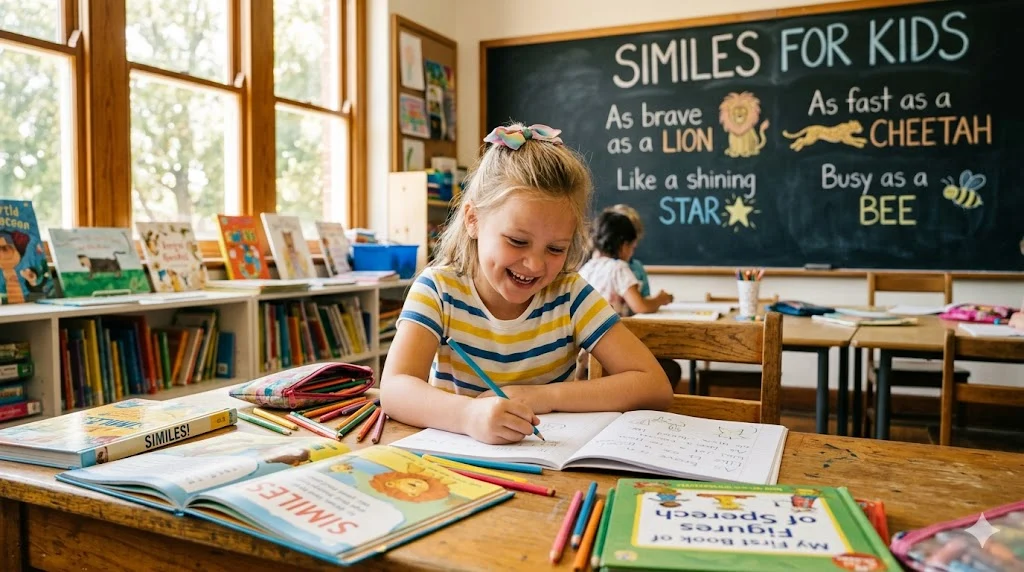
Similes for kids are simple comparisons that use the words “like” or “as” to describe people, animals, feelings, and objects in a fun and imaginative way. They help children understand language better, improve their creative writing, and express their thoughts more vividly.
If you are looking for Similes for Kids, the easiest way to begin is by understanding how comparisons make ideas more fun and easier to remember. Many parents and teachers ask, what is a simile for kids because children often learn best through simple examples. Similar comparisons can also introduce analogies for children and help them understand new ideas through familiar things.
Learning similes and metaphors for kids can make reading and writing more creative. A simile kids can easily understand often uses words such as “like” or “as” to compare two things. This collection of similes for children includes easy similes for kids with clear examples of similes for kids that are simple to read, understand and use in everyday writing.
What Is a Simile?
A simile is a figure of speech that compares two different things using the words “like” or “as.
Here are two simple examples:
“She was as quiet as a mouse.”
“He ran like the wind.”
In the first example, a girl is being compared to a mouse to show how quiet she was. In the second, a boy’s speed is compared to the wind to show how fast he moved.
Similes are different from metaphors. A metaphor makes a direct comparison without using “like” or “as.
For example, “He was a rocket on the track” is a metaphor. He ran like a rocket” is a simile. Both are useful, but similes tend to be easier for younger writers to understand and use.
Similes appear everywhere in everyday speech, books, songs, poems, and stories. Learning to recognize and use them is a great step toward becoming a stronger, more creative writer.
Why Similes Are Important for Kids
Similes do much more than make sentences sound prettier. Here is why they matter for children:
They make writing more interesting. Plain sentences are fine, but sentences with similes are more exciting and memorable. A story that says “the giant was scary” is far less vivid than one that says “the giant was as scary as a thunderstorm in the middle of the night.”
They help kids express feelings. Sometimes children struggle to explain how they feel inside. Similes give them a bridge. Saying “I felt as small as an ant” communicates embarrassment or insignificance in a way that is instantly clear.
They improve reading comprehension. When kids understand similes, they can better understand books, poems, and stories. They know that “the girl was like a ray of sunshine” is describing a cheerful personality, not an actual beam of light.
They build vocabulary. Learning similes introduces kids to new words and ideas in a natural, memorable way.
They make learning fun. Coming up with creative comparisons is playful and enjoyable. Even reluctant writers tend to enjoy the challenge of thinking up a funny or clever simile.
Quick List of Similes for Kids
| Simile | Meaning |
|---|---|
| As fast as a cheetah | Very quick |
| Like a fish out of water | Uncomfortable or out of place |
| As brave as a lion | Very courageous |
| Like a bull in a china shop | Clumsy or careless |
| As quiet as a mouse | Very silent |
| Like a shining star | Special and admired |
| As hungry as a bear | Extremely hungry |
| Like a ray of sunshine | Cheerful and happy |
| As cold as ice | Very cold or unfriendly |
| Like a sponge | Absorbing everything quickly |
| As tall as a tree | Very tall |
| Like a broken record | Repeating the same thing |
| As busy as a bee | Always working or moving |
| Like a dream come true | Something wonderful happening |
| As sharp as a tack | Very smart or clever |
Similes About Feelings and Emotions
Helping children describe their inner world is one of the most valuable uses of similes. These examples cover common emotions kids experience every day.
1. As Happy as a Clam
Meaning
Describes someone who feels completely content, cheerful, and satisfied.
Why It Works
Clams are often imagined as resting peacefully in calm waters without worries or disturbances. This image makes them a fitting symbol of happiness and contentment.
Examples in Writing
Formal Example:
After receiving the scholarship, she was as happy as a clam.
Casual Example:
I was as happy as a clam when summer vacation finally started.
Creative Example:
A smile spread across his face as he sat beneath the warm sun, as happy as a clam in quiet coastal waters.
2. Like a Volcano Ready to Explode
Meaning
Represents someone who is extremely angry, frustrated, or close to losing their temper.
Why It Works
A volcano builds pressure beneath the surface before erupting. In the same way, strong emotions can grow quietly until they suddenly burst out.
Alternative Expression
“Like a storm cloud ready to break”
Examples in Writing
Formal Example:
After being blamed for something he did not do, he sat like a volcano ready to explode.
Casual Example:
She looked like a volcano about to erupt during the argument.
Creative Example:
Anger churned inside him like molten lava, and he stood there like a volcano ready to explode into the sky.
3. As Nervous as a Long-Tailed Cat in a Room Full of Rocking Chairs
Meaning
Describes someone who feels extremely anxious, worried, or uneasy.
Why It Works
The image of a cat trying to protect its tail in a room full of moving rocking chairs instantly conveys tension and nervousness.
Alternative Expression
“As jumpy as a rabbit in a thunderstorm”
Examples in Writing
Formal Example:
Before stepping onto the stage, she was as nervous as a long-tailed cat in a room full of rocking chairs.
Casual Example:
I was so nervous before my driving test.
Creative Example:
Her hands trembled and her thoughts raced, as nervous as a long-tailed cat surrounded by rocking chairs.
4. Like a Deflated Balloon
Meaning
Represents feelings of sadness, disappointment, or a sudden loss of excitement.
Why It Works
A balloon loses its shape, lift, and energy when the air escapes. This mirrors the emotional feeling of being let down or discouraged.
Alternative Expression
“Like a candle blown out by the wind”
Examples in Writing
Formal Example:
When the trip was cancelled, the children felt like deflated balloons.
Casual Example:
I felt like a deflated balloon after hearing the bad news.
Creative Example:
The excitement vanished from her face, and she sank into her seat like a deflated balloon after a celebration had ended.
5. As Proud as a Peacock
Meaning
Describes someone who feels very proud, confident, or pleased with an achievement.
Why It Works
Peacocks display their colorful feathers with confidence, making them a classic symbol of pride and self-assurance.
Alternative Expression
“As confident as a champion holding a trophy”
Examples in Writing
Formal Example:
After completing the project successfully, he was as proud as a peacock.
Casual Example:
She walked around as proud as a peacock after winning first place.
Creative Example:
With his head held high and a smile on his face, he stood as proud as a peacock displaying its brilliant feathers.
Similes About Animals
Children love animals, which makes animal similes especially fun and easy to understand.
6. As Strong as an Ox
Meaning:
Describes someone who is exceptionally strong, powerful, and capable of handling difficult physical tasks.
Why It Works:
Oxen have long been used to pull heavy loads and work tirelessly in fields. Their reputation for strength makes them one of the most recognizable symbols of power and endurance.
Alternative Expression:
“As powerful as a draft horse pulling a loaded wagon”
Examples in Writing
Formal Example:
The athlete proved as strong as an ox, carrying his team through the most demanding moments of the competition.
Casual Example:
My dad is as strong as an ox. He can lift things I can barely move.
Creative Example:
He hoisted the heavy crate without hesitation, as strong as an ox pulling a wagon across a muddy country road.
7. Like a Fish Out of Water
Meaning:
Represents the feeling of being uncomfortable, awkward, or completely out of place in an unfamiliar situation.
Why It Works:
A fish depends on water to survive. Once removed from its natural environment, it struggles to function. People often experience a similar discomfort when placed in unfamiliar surroundings.
Alternative Expression:
“Like a traveler lost in a city without a map”
Examples in Writing
Formal Example:
Starting at a new school left her feeling like a fish out of water for the first few weeks.
Casual Example:
I felt like a fish out of water at the party because I didn’t know anyone.
Creative Example:
He lingered near the edge of the playground, unsure where to go, like a fish out of water beneath the bright afternoon sky.
8. As Wise as an Owl
Meaning:
Describes someone who is highly intelligent, thoughtful, and capable of offering sound advice.
Why It Works:
Owls have symbolized wisdom in myths, literature, and folklore for centuries. Their calm appearance and watchful nature make them a natural representation of knowledge and insight.
Alternative Expression:
“As knowledgeable as an old scholar surrounded by books”
Examples in Writing
Formal Example:
The retired professor was as wise as an owl, offering guidance shaped by decades of experience.
Casual Example:
My grandmother is as wise as an owl. She always knows exactly what to say.
Creative Example:
She listened before speaking, her thoughts gathering quietly, as wise as an owl surveying the forest from a high branch.
9. Like a Bull in a China Shop
Meaning:
Describes someone who behaves in a clumsy, reckless, or careless way that causes disruption or damage.
Why It Works:
The image of a large bull moving through a room filled with delicate china instantly conveys chaos, lack of control, and unintended destruction.
Alternative Expression:
“Like a whirlwind moving through a stack of papers”
Examples in Writing
Formal Example:
The energetic puppy rushed through the living room like a bull in a china shop, knocking over everything in its path.
Casual Example:
He came charging into the room like a bull in a china shop and bumped into three chairs.
Creative Example:
She burst through the doorway laughing, scattering books, cups, and papers like a bull in a china shop.
10. As Stubborn as a Mule
Meaning:
Represents someone who refuses to change their mind, even when presented with good reasons to do so.
Why It Works:
Mules are famous for standing their ground when they decide not to move. This reputation has made them a lasting symbol of determination and stubbornness.
Alternative Expression:
“As unmovable as a rock rooted in the earth”
Examples in Writing
Formal Example:
Despite every attempt to persuade him, he remained as stubborn as a mule.
Casual Example:
My little brother can be as stubborn as a mule when he wants something.
Creative Example:
No amount of reasoning could change his decision. He sat with folded arms and a determined expression, as stubborn as a mule on a mountain trail.
Similes About School and Learning
These similes relate directly to a child’s school experience, making them highly relatable for young writers.
11. Like a Sponge
Meaning:
Describes someone who absorbs information, skills, and experiences quickly and effortlessly.
Why It Works:
A sponge instantly soaks up water from its surroundings and holds far more than it appears capable of carrying. Fast learners often process new information in exactly the same way, taking in knowledge with remarkable ease.
Alternative Expression:
“Like dry soil drinking in rainfall”
Examples in Writing
Formal Example:
The young student absorbed every lesson like a sponge, quickly mastering concepts that challenged many of her classmates.
Casual Example:
She learns everything like a sponge. Show her once and she remembers it.
Creative Example:
Every idea the teacher offered disappeared into her mind like water into a sponge, absorbed eagerly and held with surprising ease.
12. As Sharp as a Tack
Meaning:
Represents someone who is highly intelligent, quick-thinking, and able to understand things rapidly.
Why It Works:
A sharp tack pierces through resistance with ease. Likewise, a sharp mind cuts through confusion and reaches understanding quickly and accurately.
Alternative Expression:
“As quick-minded as a chess player planning three moves ahead”
Examples in Writing
Formal Example:
Her teacher quickly recognized that she was as sharp as a tack, consistently solving problems ahead of the rest of the class.
Casual Example:
He figured out the answer in seconds. He’s as sharp as a tack.
Creative Example:
Questions barely left the teacher’s lips before she found the solution, as sharp as a tack from the very first day.
13. Like a Broken Record
Meaning:
Describes someone who repeats the same words, reminders, or ideas over and over again.
Why It Works:
When an old vinyl record becomes scratched, it can get stuck and repeat the same sound endlessly. This creates a perfect comparison for repetitive speech.
Alternative Expression:
“Like an echo that refuses to fade away”
Examples in Writing
Formal Example:
The coach reminded the team about discipline so often that he began to sound like a broken record.
Casual Example:
My mom keeps telling me to clean my room like a broken record.
Creative Example:
His excuse circled the conversation again and again, repeating like a broken record that nobody could stop.
14. As Busy as a Bee
Meaning:
Represents someone who is constantly active, productive, and hard-working.
Why It Works:
Bees spend their days gathering nectar, building hives, and supporting their colony. Their nonstop activity has made them a universal symbol of diligence and industry.
Alternative Expression:
“As hardworking as ants preparing for winter”
Examples in Writing
Formal Example:
During exam season, the students were as busy as bees, studying late into the evening.
Casual Example:
She’s been as busy as a bee getting everything ready for the school fair.
Creative Example:
The classroom buzzed with activity as notebooks opened and pencils raced across pages, every student as busy as a bee.
15. Like a Dream Come True
Meaning:
Describes an experience that fulfills a long-held wish, hope, or ambition.
Why It Works:
Dreams often represent our deepest desires. When something wonderful finally happens, it can feel almost too good to be real, just like a dream becoming reality.
Alternative Expression:
“Like finding the treasure you always hoped existed”
Examples in Writing
Formal Example:
Winning the scholarship was like a dream come true for the hardworking student.
Casual Example:
Making the team felt like a dream come true.
Creative Example:
She checked the results again and again, hardly believing what she saw. Her name stood at the top of the list, like a dream come true unfolding before her eyes.
Similes About Nature and Weather
Nature provides some of the most vivid and easy-to-visualize images for young writers.
16. As Bright as the Sun
Meaning:
Describes someone who is cheerful, energetic, and full of positivity that naturally lifts the people around them.
Why It Works:
The sun is the world’s most familiar source of light and warmth. Its brightness fills every corner it reaches, making it a powerful symbol of joy, energy, and optimism.
Alternative Expression:
“As radiant as a golden sunrise”
Examples in Writing
Formal Example:
Her smile was as bright as the sun, bringing warmth and encouragement to everyone she met.
Casual Example:
She walked into the room and was as bright as the sun, instantly lifting everyone’s mood.
Creative Example:
Happiness spread across her face as bright as the sun rising above distant hills, filling the morning with light.
17. Like a Bolt of Lightning
Meaning:
Represents something that happens with incredible speed, suddenness, or unexpected force.
Why It Works:
Lightning appears in an instant, flashing across the sky before anyone has time to react. This makes it an ideal comparison for rapid movement or sudden action.
Alternative Expression:
“Like an arrow released from a bow”
Examples in Writing
Formal Example:
The runner surged ahead like a bolt of lightning, leaving the competition behind.
Casual Example:
The moment he heard the ice cream truck, he took off like a bolt of lightning.
Creative Example:
Before anyone could blink, she was gone across the field, fast and brilliant like a bolt of lightning tearing through a summer storm.
18. As Solid as a Rock
Meaning:
Describes someone who is dependable, trustworthy, and emotionally or physically strong.
Why It Works:
Rocks withstand weather, time, and pressure without easily changing. Their strength and stability make them a natural symbol of reliability.
Alternative Expression:
“As dependable as a lighthouse in a storm”
Examples in Writing
Formal Example:
Throughout every challenge, her support remained as solid as a rock.
Casual Example:
You can always count on him. He’s as solid as a rock.
Creative Example:
While uncertainty swirled around her, she remained as solid as a rock standing firm against crashing waves.
19. Like a Gentle Breeze
Meaning:
Represents someone who is calm, peaceful, and comforting to be around.
Why It Works:
A gentle breeze refreshes and soothes without disturbing anything around it. People with quiet kindness often have the same calming effect on others.
Alternative Expression:
“Like soft rain on a quiet afternoon”
Examples in Writing
Formal Example:
Her calm nature was like a gentle breeze, bringing comfort wherever she went.
Casual Example:
Being around her feels like a gentle breeze. Everything just seems easier.
Creative Example:
She drifted through the afternoon like a gentle breeze across tall grass, peaceful and effortless in her presence.
20. As Cold as Ice
Meaning:
Describes something extremely cold, or a person who seems distant, unfriendly, or lacking warmth.
Why It Works:
Ice is one of the clearest symbols of coldness. Its physical chill easily translates into emotional coldness when describing behavior or attitudes.
Alternative Expression:
“As frosty as a winter morning”
Examples in Writing
Formal Example:
His reaction to the apology was as cold as ice, offering no sign of forgiveness.
Casual Example:
She barely acknowledged me today. She was as cold as ice.
Creative Example:
His words landed between them as cold as ice, freezing the conversation and leaving an uncomfortable silence behind.
Similes About Food
Food-related similes are especially fun for kids because they connect to everyday sensory experiences.
21. As Sweet as Honey
Meaning:
Describes someone who is exceptionally kind, gentle, pleasant, or easy to love.
Why It Works:
Honey is one of the most familiar symbols of sweetness. Its rich, natural flavor makes it a perfect comparison for a warm and caring personality.
Alternative Expression:
“As kind as a warm smile on a difficult day”
Examples in Writing
Formal Example:
Her grandmother was as sweet as honey, treating every child with patience and affection.
Casual Example:
She’s as sweet as honey to everyone she meets.
Creative Example:
Every word she spoke carried warmth and kindness, as sweet as honey stirred into tea on a rainy afternoon.
22. Like Melting Ice Cream on a Hot Day
Meaning:
Represents someone who is quickly losing energy, enthusiasm, or the ability to keep going.
Why It Works:
Ice cream melts rapidly in the heat, gradually losing its shape and structure. People often feel the same way when they become exhausted or overwhelmed.
Alternative Expression:
“Like a candle burning low at the end of the night”
Examples in Writing
Formal Example:
After hours of hiking in the summer heat, the children looked like melting ice cream on a hot day.
Casual Example:
I was so tired after practice that I felt like melting ice cream.
Creative Example:
By the third hour of the journey, she had sunk into her seat like melting ice cream on a sunlit sidewalk, too tired to move.
23. As Nutty as a Fruitcake
Meaning:
Describes someone who is amusingly eccentric, delightfully silly, or wonderfully unpredictable.
Why It Works:
Fruitcake is packed with a surprising mixture of ingredients, giving it a reputation for being unusual and quirky. The comparison perfectly captures harmless, entertaining oddness.
Alternative Expression:
“As quirky as a squirrel hiding treasures in strange places”
Examples in Writing
Formal Example:
The class entertainer was as nutty as a fruitcake, always finding creative ways to make others laugh.
Casual Example:
He’s as nutty as a fruitcake sometimes, but that’s what makes him fun.
Creative Example:
She rushed into the room wearing mismatched shoes and a paper crown, as nutty as a fruitcake and twice as entertaining.**
Similes About Speed and Energy
These similes are perfect for writing about sports, play, and active characters.
24. As Fast as a Cheetah
Meaning:
Describes someone or something moving with incredible speed and agility.
Why It Works:
Cheetahs are the fastest land animals in the world, capable of reaching remarkable speeds in just a few seconds. Their reputation makes them an instantly recognizable symbol of quickness and acceleration.
Alternative Expression:
“As swift as an arrow shot from a bow”
Examples in Writing
Formal Example:
On the football field, he was as fast as a cheetah, outrunning every defender with ease.
Casual Example:
She ran as fast as a cheetah during the relay race and finished well ahead of everyone else.
Creative Example:
The instant the whistle sounded, he burst forward as fast as a cheetah racing across the open savanna, leaving only a blur behind him.
25. Like a Spinning Top
Meaning:
Represents someone who is constantly moving, full of energy, and unable to stay still for long.
Why It Works:
A spinning top twirls endlessly in circles until its energy finally runs out. Energetic children often seem to operate the same way, moving from one activity to another without slowing down.
Alternative Expression:
“Like a pinball bouncing from place to place”
Examples in Writing
Formal Example:
The toddler moved through the house like a spinning top, exploring every room before breakfast was finished.
Casual Example:
My little sister is like a spinning top from the moment she wakes up until bedtime.
Creative Example:
From sunrise to sunset, he bounced, twirled, and darted through the house like a spinning top that had forgotten how to stop turning.
How to Help Kids Write Their Own Similes
One of the best ways to teach children similes is to guide them through the process of creating their own. Here is a simple three-step method that works well in classrooms and at home.
Step one:
Start with a describing word. Ask the child to think of an adjective that describes something or someone. For example, brave, fast, quiet, warm, or happy.
Step two:
Ask the question “as what?” or “like what?” Once they have their adjective, encourage them to think of something from the real world that shares that quality. Brave like what? “Like a firefighter.” Quiet like what? “Like a sleeping cat.”
Step three:
Put it together. Combine the two using “as” or “like.” “She was as brave as a firefighter” or “The library was as quiet as a sleeping cat.”
Encourage children to use things from their own lives, their pets, their favorite foods, and their hobbies. Personal comparisons are always the most vivid and original.
Common Mistakes Kids Make with Similes
Mixing up similes and metaphors.
Many children confuse the two. Remind them that similes always use “like” or “as,” while metaphors make direct comparisons without those words.
Choosing comparisons that do not match.
If a child writes “she was as fast as a turtle,” it creates confusion unless it is intentional humor. The comparison needs to make logical sense.
Using the same simile too many times.
Encourage variety. If every brave character is “as brave as a lion,” stories start to feel repetitive. Challenge kids to come up with fresh comparisons.
Being too complicated.
The best similes for young writers are simple and clear. If the comparison needs a long explanation, it is probably too complex.
Fun Classroom Activities for Teaching Similes
Simile of the Day:
Write a new simile on the board each morning. Ask students to discuss what it means and use it in a sentence.
Finish the Simile:
Give students half a simile and ask them to complete it creatively. “She was as brave as…” and let each child fill in the blank differently.
Simile Illustrations:
Ask children to illustrate a simile literally and figuratively side by side. Drawing “as hungry as a bear” both ways is always entertaining.
Story Swaps:
Have children write a short paragraph without any similes, then trade with a partner who must add at least two similes to the writing.
Simile Scavenger Hunt:
Ask students to find similes in books, songs, or movies and bring them to class to share and discuss.
Similes vs Metaphors for Kids
Simile:
Uses “like” or “as” to compare.
Example:
“She was like a shining star.”
Metaphor:
Makes a direct comparison without “like” or “as.”
Example:
“She was a shining star.”
Both tools make writing more vivid.
Similes are usually easier for younger children to understand and identify because the comparison words act as a signal. Once children are confident with similes, introducing metaphors becomes a natural next step.
Writing Exercise for Kids
Start with a plain sentence and then rewrite it using a simile in three different ways.
Plain sentence:
“The dog was excited.”
Nature version:
“The dog was as excited as a wave crashing onto the shore.”
Animal version:
“The dog bounced around like a kangaroo that had just heard good news.”
Food version:
“His tail wagged like a spoon stirring through sparkling lemonade.”
Practicing this exercise regularly helps children see how the same idea can be expressed in dozens of creative ways, building flexibility and imagination in their writing.
FAQs
1. What is a simile in simple terms for kids?
A simile is a figure of speech that compares two different things using the words “like” or “as.” For example, “as fast as a cheetah” or “like a shining star.
2. How is a simile different from a metaphor?
A simile uses “like” or “as” to make a comparison, while a metaphor makes a direct comparison without those words. For example, “She is like the sun” is a simile, while “She is the sun” is a metaphor.
3. Why do teachers teach similes?
Teachers use similes to help children improve their writing, express ideas more creatively, and better understand figurative language in stories, poems, and books.
4. What are some easy similes for young children?
Simple similes include “as fast as a cheetah,” “as quiet as a mouse,” “like a sponge,” and “as sweet as honey.” These are easy to understand and remember.
5. Can similes be funny?
Yes. Similes can be humorous and playful. Examples include “as nutty as a fruitcake” or “like a bull in a china shop.” Funny similes make writing more entertaining.
6. How many similes should a child use in a story?
It’s best to use one or two strong similes per paragraph. Too many comparisons can make writing feel crowded, so quality is more important than quantity.
Conclusion
Similes are one of the most enjoyable and useful tools young writers can learn. They take ordinary sentences and transform them into vivid pictures that readers can see, feel, and remember.
Whether a child is describing a brave hero, a funny moment in the playground, an exciting race, or a quiet afternoon reading, similes give their words more life and color. Learning to use them well is not just a school skill. It is a lifelong communication tool that makes every story, speech, and conversation richer.
The best similes come from paying attention to the world around us. A child who notices how a spider web glistens in the morning or how a warm slice of toast smells on a cold day already has everything they need to write something brilliant.
Encourage young writers to keep a simile journal where they jot down comparisons they think of or discover in books. Over time, those pages will fill with their own creative voice, and that voice will grow stronger with every comparison they make.
After all, a child discovering the power of a well-placed simile is like a painter finding a new color. Suddenly everything they create looks a little brighter.








1 thought on “Similes for Kids | Fun and Easy Comparisons to Help Children Learn and Write Better In 2026”