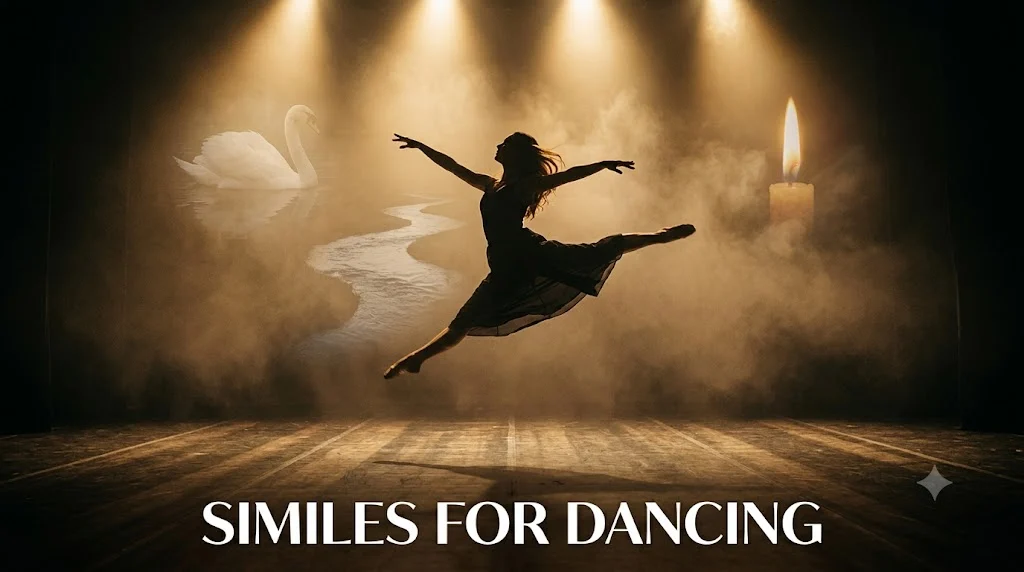
Dancing is a universal language. It can speak volumes without uttering a single word, expressing emotions ranging from unbridled joy to deep sorrow. When you watch a dancer, you might see someone gliding across the floor, spinning with wild abandon, or leaping into the air with impossible lightness.
But how do you capture that feeling in writing?
Simply saying “she danced beautifully” is flat and underwhelming. The reader’s mind needs help visualizing the movement. This is where similes come in. A simile is a figure of speech that compares two different things using the words “like” or “as.
By comparing a dancer to a leaf in the wind, a flame in the dark, or water flowing in a stream, you create a mental picture that is instant and powerful. These comparisons are not just decorative; they clarify movement in the same way a choreographer might use a metaphor to help a dancer understand a complex sequence . Good similes make writing more colorful and help the reader feel the magic, rhythm, and emotion of the dance .
Whether you are a writer, a poet, a student working on an assignment, or a dancer trying to describe your own choreography, this guide is for you. We will explore over 50 similes for dancing, categorized by the style of movement they describe.
Quick List of Similes for Dancing
Similes for Graceful and Elegant Dancing
These similes capture the beauty, poise, and smooth fluidity of dancers who make everything look easy.
As graceful as a swan
Meaning: Describes movements that are smooth, elegant, and incredibly beautiful. A swan gliding across a lake is the ultimate symbol of refined beauty .
Why It Works: The visual of a swan’s long neck and effortless glide on the water translates perfectly to a dancer’s posture and the way they move across a stage.
Examples in Writing:
- Formal: “The prima ballerina was as graceful as a swan, her arms rippling like wings as she floated across the stage.”
- Casual: “For a kid who just started dance class, she’s as graceful as a swan, it’s surprising.”
- Creative: “Her soul poured out through her limbs, moving as graceful as a swan on a still, moonlit lake.”
Like a butterfly in the garden
Meaning: This simile emphasizes a light, delicate, and beautiful quality. It suggests the dancer is flitting around with charming ease .
Why It Works: The imagery of a butterfly gently landing on flowers evokes a sense of whimsy, softness, and natural beauty. It implies the dancer is not forcing the movements but letting them happen naturally.
Examples in Writing:
- Formal: “The soloist moved like a butterfly in the garden, her steps a blur of color and gentle motion against the stark stage.”
- Casual: “The little girls in their pink tutus danced like butterflies in the garden, fluttering from one spot to the next.”
- Creative: “Her happiness was so pure it danced like a butterfly in the garden of her soul.”
Like water flowing
Meaning: This is a classic simile for a seamless, continuous, and unbroken flow of movement .
Why It Works: Water is the ultimate symbol of fluidity. It adapts to any shape, never stops, and moves with a natural, unstoppable rhythm. “As fluid as water” is used to describe dancers who have mastered the art of connecting every step without hesitation .
Examples in Writing:
- Formal: “The contemporary piece was like water flowing, each dancer’s body intertwining with the others in an endless stream.”
- Casual: “His choreography was like water flowing; there were no jerky stops, just a smooth, non-stop jam.”
- Creative: “Her limbs moved like water flowing over smooth stones, finding the path of least resistance with exquisite grace.”
As delicate as a butterfly / As light as a feather
Meaning: These similes focus on the lightness of the dancer. They suggest the dancer is barely touching the floor, gliding with an airy quality that seems to defy gravity .
Why It Works: Feathers and butterflies are things that float on the air. Using them to describe dancing instantly communicates a sense of weightlessness. This is particularly effective for describing ballet leaps and jumps .
Examples in Writing:
- Formal: “Her jumps were as light as a feather, suspending her in the air for a moment too long to be natural.”
- Casual: “When she dances, it’s like she’s as light as a feather, just floating there.”
- Creative: “Sorrow danced on his shoulders, as delicate as a butterfly and just as fragile.”
Similes for Energetic and Fast Dancing
When the music is pumping and the feet are flying, you need strong, dynamic comparisons to capture the energy.
Like popcorn popping / Like firecrackers popping
Meaning: These similes describe movement that is quick, sudden, bouncy, and full of energy . It suggests a series of small, quick bursts of motion.
Why It Works: The visual of popcorn kernels exploding and jumping in a pan perfectly captures a high-energy dance with lots of jumps and sharp moves. It feels playful and fun.
Examples in Writing:
- Formal: “The hip-hop crew’s feet were like popcorn popping, executing rapid-fire steps that left the audience breathless.”
- Casual: “My little cousin was dancing like popcorn popping, bouncing all over the living room.”
- Creative: “Excitement danced in his chest, each heartbeat like popcorn popping against his ribs.”
As fast as lightning / As quick as a flash
Meaning: This is the go-to simile for describing incredibly fast movement .
Why It Works: Lightning is one of the fastest things in nature. It is sharp, sudden, and impossible to fully track with the naked eye. It conveys a sense of impressive speed and precision.
Examples in Writing:
- Formal: “The dancer’s pirouettes were as fast as lightning, a blur of motion that was over before it began.”
- Casual: “I couldn’t even see his feet, they were moving as fast as lightning!
- Creative: “Anger flashed in his eyes, moving as fast as lightning across his face.
H3: Like a whirlwind / As wild as a thunderstorm
Meaning: These similes describe a dance that is chaotic, powerful, and full of intense, forceful energy .
Why It Works: A whirlwind and a thunderstorm are natural phenomena that are untamed and have an immense, unstoppable presence. They suggest the dancer is lost in the movement, spinning and moving with raw power that is almost out of control.
Examples in Writing:
- Formal: “The modern dance was as wild as a thunderstorm, pounding the stage with its relentless intensity.”
- Casual: “When he hears his favorite song, he dances like a whirlwind, you just have to get out of his way!”
- Creative: “Her emotions were a tornado, dancing like a whirlwind through the room, leaving chaos in its wake.”
Like a race car zooming / As energetic as a whirlwind
Meaning: These similes highlight relentless speed and energy that never seems to run out .
Why It Works: They evoke a sense of controlled power. The dancer is moving with purpose and incredible energy, navigating the stage with the precision of a race car on a track or the unstoppable force of a tornado.
Examples in Writing:
- Formal: “He danced like a race car zooming, hitting every mark with the precision and speed of a professional driver.”
- Casual: “She was dancing as energetic as a whirlwind, pulling the whole crowd into her orbit.”
- Creative: “He was a race car zooming through the obstacles of life, finding speed in every challenge.”
Similes for Controlled and Sharp Dancing
Some dances are not about flow but about precise, sharp, and powerful movements that hit on the beat.
Like a puppet on strings
Meaning: This simile describes movements that are controlled, jerky, and precise, often with a playful or mechanical quality . It can also imply a lack of freedom, as if someone else is controlling the dancer.
Why It Works: The image of a marionette with its sharp, exaggerated movements perfectly captures the style of popping or robotic dancing. It emphasizes a disconnect between the body parts and a sense of being manipulated.
Examples in Writing:
- Formal: “The choreography was jarring, the dancers moving like puppets on strings, their limbs snapping to attention with eerie precision.”
- Casual: “He’s so good at that robotic dance, he really moves like a puppet on strings!”
- Creative: “Fear held him captive, moving him like a puppet on strings, not a single action his own.”
As sharp as a knife / As neat as a pencil line
Meaning: This refers to movements that are perfectly defined, clean, and very precise . There is no sloppiness; every angle and arm position is exact.
Why It Works: It creates an image of a dancer who is in complete control of their body, executing movements that are clear and mathematically precise. This is often used to describe strong, clean lines in modern dance or jazz.
Examples in Writing:
- Formal: “The company’s synchronized lines were as sharp as a knife, cutting through the air with breathtaking unity.”
- Casual: “The routine was super clean, their arm movements were as neat as a pencil line.”
- Creative: “Her gaze was as sharp as a knife, cutting through the noise and finding the truth.”
Like a robot on stage
Meaning: This is a more specific and literal modern simile, often used to describe popping or animation styles .
Why It Works: It gives the reader an instant visual of stiff, mechanical, and sometimes staggered movements that mimic machinery, contrasting sharply with the fluidity of other dance styles.
Examples in Writing:
- Formal: “The street dancer’s routine was flawless, moving like a robot on stage, his joints locking with a precise, metallic rhythm.”
- Casual: “He broke out the robot at the party and started dancing like a robot on stage. It was hilarious.”
- Creative: “He felt his soul was trapped, dancing like a robot on stage in a play he never wanted to be a part of.”
Similes for Joyful and Free Dancing
Dancing is often about happiness, and these similes perfectly capture the feeling of unbridled joy and freedom in movement.
Like a kid on a sugar rush / As joyful as a child
Meaning: These are simple, relatable similes that describe dancing with pure, uninhibited joy . The movement is not about perfection but about the sheer fun of it.
Why It Works: Everyone understands the image of a hyperactive child who can’t stop moving. It’s carefree, silly, and full of life.
Examples in Writing:
- Formal: “He danced like a kid on a sugar rush, his joy filling the entire room with a contagious, unbridled energy.”
- Casual: “At the wedding, everyone was dancing like a kid on a sugar rush, just letting loose.”
- Creative: “Hope danced in his heart as joyful as a child, chasing away all the shadows.”
Like a leaf in the wind / As free as the wind
Meaning: These similes symbolize a sense of freedom and natural, unforced movement .
Why It Works: The wind is not restricted by anything; it moves where it pleases. A dancer moving like a leaf in the wind is surrendering to the music, letting it carry them wherever it wants to go. It suggests a feeling of liberation.
Examples in Writing:
- Formal: “In her final solo, she danced like a leaf in the wind, the music carrying her across the stage in a beautiful display of freedom.”
- Casual: “For the first time in weeks, she let go and danced as free as the wind.”
- Creative: “His spirit was a kite, dancing like a leaf in the wind of possibility.”
Like a bird in the sky
Meaning: This simile symbolizes soaring joy, lightness, and a feeling of absolute freedom from the constraints of the ground .
Why It Works: It suggests a dance that is not just on the floor, but one that takes flight. The dancer is “soaring” through the music, without a care in the world . The imagery is uplifting and inspiring.
Examples in Writing:
- Formal: “The prima ballerina’s grand jeté was so high, it was like she was a bird in the sky, soaring above the stage.”
- Casual: “When that song comes on, I just feel like a bird in the sky, I can’t stop moving.”
- Creative: “She was a bird in the sky, never looking back, only flying towards the horizon.”
Similes for Dancing Based on Animal Movements
Animals are a great source of inspiration for dance. Their unique ways of moving can be a powerful comparison.
Like a cat on a hot sidewalk / As quick as a cat
Meaning: Describes a dancer who is fast, nimble, and alert .
Why It Works: Cats are known for their agility, quick reflexes, and ability to land on their feet. This simile suggests the dancer is light on their feet and ready for anything.
Examples in Writing:
- Formal: “He darted across the stage like a cat on a hot sidewalk, his footwork impossibly fast and precise.”
- Casual: “She’s got cat-like reflexes on the dance floor, always one step ahead of the beat.”
- Creative: “He moved like a cat through the corridors, silent and unseen, his mission his only focus.”
Like a kangaroo on a trampoline / Like a frog leaping
Meaning: These similes describe jumps that are high, springy, and full of bounding energy .
Why It Works: Kangaroos and frogs are famous for their powerful leaps. Using these similes tells the reader that the dancer is bouncing high into the air with incredible strength and bounce.
Examples in Writing:
- Formal: “The male dancer leaped across the floor like a kangaroo on a trampoline, his elevation in the jumps astounding.”
- Casual: “He was hopping all over the dance floor like a frog leaping from lily pad to lily pad.”
- Creative: “My heart started dancing like a kangaroo on a trampoline the moment I saw you.”
Like a fish out of water
Meaning: This is a perfect simile for describing someone who is dancing awkwardly or clumsily . They are out of their element.
Why It Works: This is a well-known phrase that conveys a lack of coordination and a feeling of being uncomfortable. It paints a vivid picture of someone who is struggling to find the rhythm and move their body in a way that feels natural .
Examples in Writing:
- Formal: “His attempt at the salsa was valiant, but he danced like a fish out of water, unable to find the rhythm.”
- Casual: “I was so nervous at the wedding, I danced like a fish out of water. It was so embarrassing!”
- Creative: “In the corporate world, he felt like a fish out of water, longing for the freedom of the ocean.
Similes for Dancing Based on Nature and Elements
The natural world provides some of the most beautiful and evocative imagery for dance.
Like a flame on a candle / Like sparks from a fire
Meaning: Describes a dance that is flickering, lively, and full of energy . It can also suggest a dancer who is delicate and bright, like a soft light in the darkness.
Why It Works: A candle flame is hypnotic and graceful, but it’s also alive and constantly moving. This is a great way to describe a dancer who is both fluid and subtly energetic. Sparks from a fire are more explosive, suggesting quick jumps and powerful bursts of movement .
Examples in Writing:
- Formal: “The dancer’s movements were like a flame on a candle, flickering and bending gracefully, never extinguished.”
- Casual: “He was on fire out there! Jumping like sparks from a fire!”
- Creative: “Desire burned in her, dancing like a flame on a candle, casting shadows on the walls.”
As soothing as ocean waves / Like waves crashing on a beach
Meaning: These similes can describe dance in two ways: either a calm, rhythmic, and hypnotic flow, or a powerful, relentless, and strong motion .
Why It Works: Ocean waves are a perfect metaphor for the ebb and flow of dancing. They can be gentle and soothing or powerful and crashing. The imagery is natural and universally understood.
Examples in Writing:
- Formal: “The contemporary ballet was as soothing as ocean waves, its repetitive and flowing movements calming the audience.”
- Casual: “The crowd was moving like waves crashing on a beach, a sea of energy.”
- Creative: “Her breathing was as soothing as ocean waves, a rhythm I could dance to forever.”
Like snowflakes falling / As pure as fresh snow
Meaning: Describes dancing that is delicate, slow, and beautiful, often with a sense of quiet wonder and innocence .
Why It Works: Snowflakes are unique, delicate, and float down with a soft, ethereal quality. It suggests a dancer who is light, graceful, and perhaps a little magical.
Examples in Writing:
- Formal: “The children’s performance was a delight, dancing like snowflakes falling, their movements soft and full of magic.”
- Casual: “Her routine felt so pure and gentle, like snowflakes falling.”
- Creative: “Memories danced in the cold air, like snowflakes falling in the long winter night.”
Like a breeze through the trees / As smooth as silk
Meaning: These similes suggest a natural, effortless flow that is smooth and pleasing to watch .
Why It Works: They both point to a quality of softness and ease. The movement is not forced. It’s as if the dancer is being moved by an external, gentle force.
Examples in Writing:
- Formal: “Her arms moved like a breeze through the trees, delicate and uninterrupted.”
- Casual: “That dancer is as smooth as silk, absolutely effortless to watch!”
- Creative: “Peace settled over him like a breeze through the trees, carrying away the tension.”
Similes for Dancing Based on Objects and Concepts
Sometimes, comparing dance to an inanimate object creates the most powerful and creative images.
Like a spinning top
Meaning: The ultimate simile for constant, rapid turning .
Why It Works: This is a very clear image. It immediately tells the reader that the dancer is spinning around and around, likely in a sustained pirouette or a series of fast turns, without getting dizzy or falling over.
Examples in Writing:
- Formal: “He executed a series of fouettés, spinning like a top with impossible momentum.”
- Casual: “She was so excited she was dancing like a spinning top around the room.”
- Creative: “My thoughts were dancing like a spinning top, spinning out of control.”
Like a roller coaster
Meaning: This simile is used to describe dancing with many highs and lows, twists and turns . It’s an exciting and unpredictable ride.
Why It Works: A roller coaster is a journey with dramatic changes in speed and direction. This simile suggests that the dance is dynamic, thrilling, and takes the audience on an emotional ride.
Examples in Writing:
- Formal: “The emotionally charged performance was like a roller coaster, taking the audience from moments of tender intimacy to explosive passion.”
- Casual: “That dance was wild! It was like a roller coaster, you never knew what was coming next.”
- Creative: “Life has been like a roller coaster lately, and my emotions are dancing right along with it.”
As bright as fireworks / As stunning as fireworks
Meaning: Describes a dance that is spectacular, eye-catching, and full of dazzling energy .
Why It Works: Fireworks are a symbol of celebration and beauty. They are bright, explosive, and impossible to ignore. This simile suggests a performance that is stunning and draws the full attention of the audience.
Examples in Writing:
- Formal: “The finale was as bright as fireworks, a culmination of color, sound, and movement that left the audience in awe.”
- Casual: “Her outfit was sparkling and her moves were as bright as fireworks.”
- Creative: “Inspiration struck him, bright as fireworks, and he danced until dawn.”
How to Choose the Right Simile for Your Dancing Description
Selecting the perfect simile can elevate your writing from good to unforgettable. Here is a simple guide to help you choose:
1. Match the Mood
The mood of your writing should guide your simile choice.
- For a sad or melancholic dance: You might use “like a leaf in the autumn wind” or “like a candle flickering in the dark” to evoke a sense of fragility and loss.
- For an angry or powerful dance: You could use “like a storm” or “as powerful as a drumbeat” to convey strength and aggression.
- For a romantic or graceful dance: You might choose “like a swan” or “like water flowing” to emphasize elegance and fluidity.
2. Consider the Dance Style
A ballet dancer moves very differently than a hip-hop dancer. The right simile reflects the movement’s core quality.
- Ballet: “As graceful as a swan,” “as light as a feather,” “like a bird in the sky” .
- Hip-hop: “Like popcorn popping,” “like a puppet on strings,” “as sharp as a knife” .
- Contemporary: “Like water flowing,” “like a leaf in the wind,” “like clouds in the sky” .
3. Use the 5 Senses
The best similes are often based on sensory experiences . Ask yourself: What does the dancing look like? What does it sound like? What does it feel like to watch?
- Sight: “Like a spinning top” or “as bright as fireworks.”
- Sound: “Her feet tapped like rain on a window” .
- Movement: “He leaped like a dolphin jumping from the water” .
4. Avoid Clichés
While classic similes like “as graceful as a swan” are great, try to be creative. Think of unique comparisons that are specific to the scene you are describing. For instance, instead of saying “she moved like a leaf in the wind,” you could say, “she moved like a crumpled piece of paper tossed by the city breeze.” The metaphor uses a different, but equally effective, image.
The Difference Between Similes and Metaphors in Dance
It is easy to confuse similes and metaphors, but they are slightly different. A good simile for dancing is a powerful tool, but a metaphor can be just as potent .
Simile
Uses the words “like” or “as” to make a comparison.
- Example: “She danced like a butterfly in the breeze” .
- Example: “His movements were as quick as lightning” .
Metaphor
Makes a direct comparison by stating one thing is another.
- Example: “She was a butterfly on stage.”
- Example: “His dance was a storm.”
Which is better? Both are valid. A simile can feel a bit softer and more descriptive, as if you are suggesting a similarity. A metaphor is more direct and definitive, creating a stronger, more immediate image. They can even be used together in the same sentence to layer meaning .
Common Mistakes When Using Similes for Dancing
Even the most experienced writers can make mistakes with similes. Here is what to avoid:
- Mixing Inconsistent Images: Don’t use a simile for grace and a simile for clumsiness to describe the same dancer in the same context. Stay consistent. For instance, don’t say “she was as graceful as a swan, but stumbled like a deer on ice” unless you are showing a transformation.
- Overusing Clichés: While similes like “light as a feather” are effective, using them too often can make your writing feel stale. Try to create a few original comparisons to surprise the reader.
- Using a Comparison That is Too Complex: The best simile is one that the reader will understand instantly. Don’t try to compare a dancer to a complex scientific concept or a highly specific piece of history unless it is clear from the context.
- Forgetting the Context: A funny and silly simile like “like a giraffe on skates” would be inappropriate if you were describing a moving and emotional dance piece. Save it for a comedic moment.
Creative Exercise: Write Your Own Similes for Dancing
Creating your own similes is a fantastic way to improve your descriptive skills. Follow this simple exercise:
Step 1: Observe a Dance
Think of a specific dance moment. It could be a professional performance you saw, a friend dancing at a party, or even a scene from a music video.
Step 2: Identify the Key Feeling
What is the most prominent feeling you get from the dance?
- Is it Joy? Maybe it’s “like bubbles in a glass of champagne.”
- Is it Anger? Maybe it’s “like a knife slicing through a curtain.”
- Is it Grace? Maybe it’s “like smoke rising from a dying fire.”
Step 3: Ask “Like What?”
Look at the dancer’s movements.
- Are they fast? “Her feet moved like a hummingbird’s wings.”
- Are they bouncy? “He jumped like a jackrabbit in a field.”
- Are they stiff? “His body was moving like an old, rusty gate.”
Step 4: Write Your Sentences
Put it all together into sentences. Here are some original similes created with this method:
- “The crowd went wild, dancing like rain on a tin roof.”
- “He was a silent star, dancing like a shadow against the light.”
- “The dancer’s arms rippled and waved, like the seaweed in the tide.”
Similes for Dancing in Different Dance Styles
Let’s apply some of our favorite similes to specific dance styles you might see in the world.
For Ballet
Ballet is all about precision, grace, and an illusion of weightlessness.
- “She looked as delicate as a butterfly, fluttering across the stage.”
- “The choreography flowed like water, smooth and unstoppable.”
- “Each movement was as neat as a pencil line, perfectly executed.”
For Hip-Hop
Hip-hop is the opposite of ballet. It is grounded, sharp, explosive, and full of personality.
- “The crew was like popcorn popping, hitting every beat with a sudden burst of energy.”
- “His feet were as quick as lightning, a blur against the concrete.”
- “They danced like they were fired up, full of the power of a thunderstorm.”
For Salsa
Salsa is passionate, fast, and rhythmic, with an emphasis on partnership.
- “They moved like a single, spinning top, never breaking their connection.”
- “Her hips swayed like waves on the shore, fluid and hypnotic.”
- “The pair danced as if their feet were in a race, as fast as lightning across the floor.”
FAQs
1. What is the best simile for dancing?
There is no single “best” simile. It depends entirely on what you are trying to describe. For elegance, “as graceful as a swan” is a classic. For energy, “like popcorn popping” is very effective. The best one is the one that fits your specific context.
2. Why use similes for dancing?
Similes help readers visualize the movement and feel the emotion of the dance. A simple statement like “she danced beautifully” is vague. A simile, like “she danced like a flame in the wind,” paints a clear, memorable picture and adds depth to the description .
3. Can I use similes to describe my own dancing?
Absolutely! Dancers are often asked to describe their work in writing for applications, awards, or to communicate their vision. Using strong imagery, like these similes, helps you effectively convey the feeling and intention of your choreography to others .
4. How can I practice creating my own similes?
The best practice is to observe people dancing and then think of creative comparisons. Watch a video, write down 3-5 words that describe the dancer’s movement, and then think of a thing, animal, or force of nature that shares those qualities.
Conclusion
Dancing is an art form that is seen and felt, but describing it with the right words is a skill. Similes are one of the most powerful tools in a writer’s arsenal for capturing the beauty, energy, and emotion of movement. Whether you are comparing a dancer to a majestic swan, a flickering flame, or a spinning top, these vivid comparisons bridge the gap between the dance floor and the reader’s mind.
By using the similes in this guide and learning how to craft your own, you can transform flat descriptions into vibrant, moving prose. The next time you see a dancer and feel the urge to write about them, remember that a simple comparison can make all the difference. As the saying goes, dancing is a metaphor for life itself . It deserves language that is just as colorful and expressive.
So go ahead, use these comparisons to make your writing dance off the page.





5 thoughts on “Similes for Dancing | Comparisons to Describe Movement in 2026”