Quick Answer
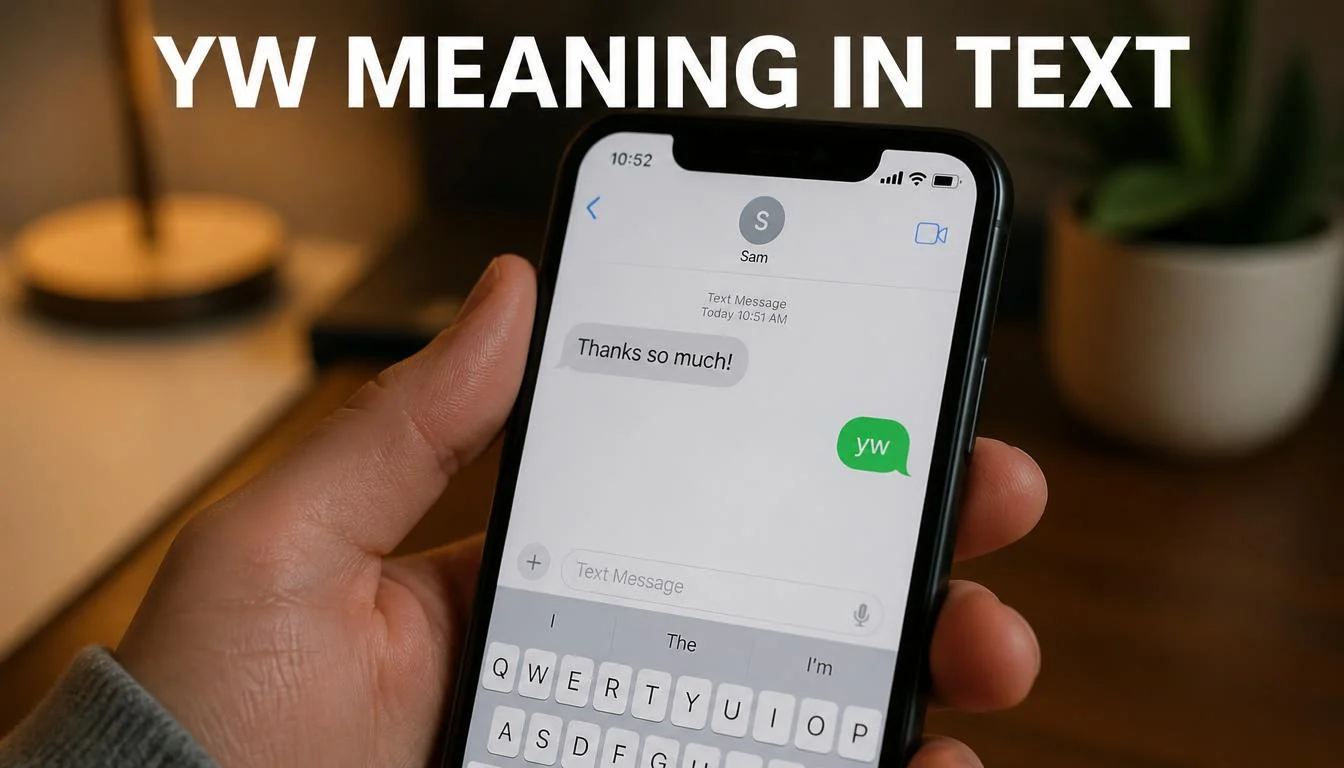
YW meaning in text is “You’re welcome.” People use it in text messages, online chats, and social media to respond casually when someone says thank you.
Understanding YW meaning in text helps you follow everyday digital conversations more easily. This popular abbreviation saves time and keeps messages short, especially when chatting with friends, family, or classmates.
People commonly use “YW” after receiving a thank-you message. For example, if someone texts “Thanks for helping me!”, you can reply “YW!” to mean “You’re welcome!” The abbreviation usually sounds friendly and casual, making it suitable for informal conversations rather than formal emails or professional documents.
The Short Answer: YW Means “You’re Welcome”
The most common meaning of YW in a text is straightforward: it is shorthand for “you’re welcome.” Someone thanks you, and you send back two letters instead of typing out the full phrase. That is the entire transaction.
The pattern shows up in conversations like this one:
Sam: Thanks for sending me those notes!
Jordan: yw
No punctuation. No capital letters. Just a quick acknowledgment that the favor was no big deal. This is the default use case, and it covers the vast majority of YW sightings in the wild.
The abbreviation works because “you’re welcome” is one of the most repeated phrases in casual digital conversation. Typing thirteen characters every time someone says thanks gets old fast. Two letters do the same job without slowing the exchange down. It is the written equivalent of a friendly nod across a table.
One clarification matters here: YW is an initialism, not an acronym. An acronym is pronounced as a word, like NASA or SCUBA. An initialism is read letter by letter, like YW, TY, or BRB. People use the terms interchangeably in casual conversation, but the distinction is real. No one walks around saying “yuh-wuh” out loud.
Where YW Came From
Like most internet slang, YW does not have a single documented birthday. Dictionary.com traces the abbreviation to online communication in the 1990s and early 2000s, when instant messaging platforms like AIM (AOL Instant Messenger) and early SMS texting were teaching people to type fast and short. Character limits were tight, and typing speed mattered. Abbreviations like LOL, BRB, and TY became the default language of chat.
By the mid-2000s, YW was embedded enough that Urban Dictionary logged it in 2006. As smartphones spread through the 2010s, the abbreviation moved from chat windows into social media comment sections, DMs, and group threads.
The term also picked up new senses along the way. Dictionary.com records that by 2009, YW was being used for “yeah, whatever,” a dismissive phrase meant to signal annoyance without explaining it. By 2010, it appeared as a racially offensive slur targeting white people, though that usage is rare and carries obvious hostility. Those alternate meanings exist, but they sit far outside the default reading. If someone replies to your thank-you with YW, they are almost certainly saying “you’re welcome,” not insulting you.
How YW Shows Up Across Platforms
The meaning does not change from app to app. The style does. Here is how the abbreviation tends to appear in different digital spaces.
| Platform | How YW Appears | Typical Context |
| SMS and iMessage | Bare “yw,” sometimes “yw!” | Quick reply to a thank-you |
| “yw” or “yw 👍” | Group chats, bilingual conversations | |
| Instagram DMs | “yw” with a heart or smiley | Casual, friendly exchanges |
| TikTok comments | “yw” in reply threads | Brief acknowledgment under a comment |
| Discord | “yw” or “yw np” | Gaming sessions, community servers |
| Snapchat | “yw” after a snap or chat | Fast, temporary messaging |
The pattern across all of these spaces is the same: short, casual, and low-effort. YW fits the rhythm of platforms built for speed. It saves characters on older SMS systems, keeps group chats moving, and pairs naturally with other short forms like TY (thank you), TYSM (thank you so much), and NP (no problem).
Group chats deserve a special mention. In a thread with ten people, long polite replies slow everything down. A quick “yw” closes the loop and lets the conversation move on. That efficiency is a feature, not a flaw.
The Tone Spectrum: Why “yw” Can Feel Warm, Neutral, or Cold
Two letters can carry a surprising amount of emotion in a text message. Written conversations lack vocal tone, facial expressions and body language. As a result, punctuation, capitalization and emojis often help communicate the sender’s mood. The same “yw” can feel friendly, neutral or cold depending on how it is written.
Why a Bare “yw” Feels Neutral
A lowercase “yw” without punctuation usually comes across as a quick, neutral response. It is a simple way to acknowledge someone’s thanks without adding extra emotion. In casual conversations between friends, this is generally perfectly fine.
However, context can change how the message feels. If someone spends hours helping you and you respond to their heartfelt thanks with only “yw,” the reply might seem a little flat. It is not necessarily rude, but the short response may feel out of proportion to the situation.
How “yw!” and Emojis Make a Message Warmer
Adding an exclamation mark can make “yw!” sound more cheerful and enthusiastic. Emojis can make the friendly intention even clearer.
For example, “yw ❤️” feels affectionate, while “yw 😊” adds a gentle and friendly touch. A thumbs-up emoji can also make the response feel casual and positive.
These small additions help show that the sender means well, even when they want to keep their message short.
Why “yw.” Can Feel Cold or Passive-Aggressive
The period at the end of a short text message can sometimes make the response feel more serious or distant. For example, “yw.” may sound colder than “yw” in a casual conversation.
This does not mean the sender is necessarily annoyed. They might simply use proper punctuation in every message. However, when someone normally texts in a relaxed style, the sudden use of a full stop can feel unusually formal or dismissive.
The surrounding conversation matters more than punctuation alone. A single period is not enough to prove that someone is upset.
How Capitalization Changes the Tone of “YW”
Capitalization can also influence how a message feels. Lowercase “yw” often fits a relaxed, informal texting style, while uppercase “YW” may look more deliberate or emphatic.
Some people prefer lowercase messages because they feel natural and effortless. Others use capital letters and punctuation consistently, regardless of their mood. These habits vary from person to person, so capitalization should not be treated as a reliable sign of emotion.
How to Make “yw” Sound Friendly
If you want your reply to feel warmer, adding a few words can make a difference. Instead of sending only “yw,” you could write “yw, anytime!” or “you’re welcome 😊.”
A simple addition reassures the other person that your response is friendly rather than dismissive. If you prefer a neutral tone, a bare “yw” is usually enough.
Ultimately, the meaning of “yw” depends on the relationship, the situation and the sender’s usual texting habits. Use a little extra warmth when the moment calls for it, and avoid reading too much into two letters alone.
YW vs. NP vs. No Worries: A Quick Comparison
YW is not the only way to acknowledge thanks. English has several short replies, and each carries a slightly different flavor. Here is how they compare.
| Reply | Literal Meaning | Tone | Best For |
| yw | You’re welcome | Neutral to friendly | Quick text replies, casual chats |
| np | No problem | Laid-back, casual | Friends, informal exchanges |
| No worries | It’s not a burden | Warm, relaxed | Friendly conversation, especially in British and Australian English |
| Anytime | I’m happy to help whenever | Warm, generous | When you genuinely enjoyed helping |
| Of course | It was nothing | Modest, polite | Slightly more formal than yw |
| My pleasure | I was glad to do it | Formal, courteous | Professional or service contexts |
The distinctions are subtle but real. “No problem” and “no worries” imply that the favor was not an inconvenience. “Anytime” implies willingness to do it again. “My pleasure” belongs in a customer service email, not a text to your roommate. YW sits in the middle: polite enough for most situations, casual enough for a friend group, and short enough to keep the conversation moving.
British and American texting habits overlap heavily here. Americans often reach for “yw” or “np.” British texters tend to mix in “no worries,” “no bother,” or “cheers”. All of these do the same social work: they acknowledge gratitude without making the exchange feel heavy.
The Other Meanings of YW
“ You’re welcome” is the most common meaning of YW in texting, but the abbreviation has several other uses. Some are specific to certain communities or situations, while one is racially offensive. Understanding the context can help you interpret the intended meaning correctly.
1. YW Meaning “Yeah, Whatever”
“Yeah, whatever” is another possible meaning of YW. It usually conveys annoyance, dismissal or passive-aggressive behavior.
For example, someone might use YW after a disagreement or when responding to a request they did not want to fulfill. In a normal thank-you exchange, however, “you’re welcome” is the more likely interpretation.
2. YW Meaning “You Whitey”
YW can also represent a racially offensive expression directed at white people. This usage is uncommon and may convey hostility or mockery.
Unlike the polite meaning of YW, this interpretation depends on a specific context. It is not a typical meaning you would expect in an ordinary, friendly text conversation.
3. YW Meaning “Young Women”
Outside texting, YW can stand for Young Women, the organization for young women within The Church of Jesus Christ of Latter-day Saints.
This is a formal, organizational abbreviation rather than internet slang. You may encounter it on church websites, event schedules or program materials.
4. YW Meaning “Youkai Watch”
In gaming and anime communities, YW may refer to Yo-kai Watch, a Japanese multimedia franchise featuring supernatural creatures.
This meaning is specific to the franchise and its fandom. If YW appears in a gaming discussion, fan forum or related conversation, this interpretation may fit better than the usual texting meaning.
5. Other Less Common Meanings of YW
YW has several additional interpretations in niche settings. For example, some people may use it as “Yo, Wassup” in casual chats or “Yes, Way” as a playful response to “No way.”
In technical contexts, yottawatt refers to a unit of power equal to \(10^{24}\) watts. However, this is a unit name rather than a common texting interpretation of YW.
The intended meaning depends on where the abbreviation appears and how it is used. Unless the surrounding conversation suggests otherwise, “you’re welcome” remains the most likely interpretation in everyday texting.
6. Quick Comparison of Different YW Meanings
| Meaning | Context | Tone |
|---|---|---|
| You’re welcome | Everyday texting | Polite and casual |
| Yeah, whatever | Disagreements or dismissive replies | Dismissive or passive-aggressive |
| You whitey | Offensive slang | Hostile or mocking |
| Young Women | Church organization | Formal and organizational |
| Yo-kai Watch | Gaming and anime fandom | Informal and fandom-specific |
| Yottawatt | Physics and technical discussions | Technical |
When Not to Use YW
YW belongs in informal communication. It does not belong in every message.
Professional emails are the clearest no-go. If a colleague or client thanks you for something, “yw” reads as too casual, especially in a first exchange or a formal thread. Write out “You’re welcome” or use “My pleasure.” The extra characters cost you nothing and signal that you take the context seriously.
Spoken conversation is another mismatch. YW is rarely said aloud. People say “you’re welcome” or “no problem” out loud; they type YW. Reading it in a script or saying it in a meeting would sound strange. The abbreviation lives in text.
There is also the warmth problem. If someone does you a significant favor driving you to the airport, covering a shift, helping you through a rough week a bare “yw” can feel underwhelming. The full phrase, or a short sentence with actual warmth, matches the size of the gesture better. “Happy to help” or “anytime, seriously” does more emotional work than two lowercase letters.
The rule of thumb is simple. Use YW when the exchange is quick, casual, and low-stakes. Use something fuller when the thanks carried real weight.
FAQs
1. Is “YW” Rude?
Not inherently. A simple “yw” is usually neutral and casual. It may seem rude when the conversation calls for a warmer response and the reply feels too brief. Adding a friendly word or emoji can make the message sound more welcoming.
2. Does Capitalization Change the Meaning of YW?
No. “yw,” “Yw,” and “YW” generally have the same meaning: “you’re welcome.” Capitalization can slightly affect the tone, as uppercase letters may feel more deliberate, but it does not change the definition.
3. What Does “YW” Mean From a Girl?
It usually means “you’re welcome,” just as it would from anyone else. A short reply does not automatically indicate romantic interest or disinterest. Consider the entire conversation rather than reading too much into two letters.
4. Is YW an Acronym or an Initialism?
YW is technically an initialism because its letters are read individually rather than pronounced as a single word. Although people often use the term “acronym” for abbreviations in general, initialism is the more precise term for YW.
5. How Should I Reply to “YW”?
You often do not need to reply because the exchange is already complete. If you want to acknowledge the message, you can say “appreciate it” or send a thumbs-up reaction. Another “thank you” is also fine, but it is not necessary.
6. Can “YW” Mean “Yeah, Whatever” in a Text?
Yes, “YW” can sometimes mean “yeah, whatever,” but the context must support that interpretation. If the message follows a disagreement or a dismissive exchange, that meaning may fit. In a typical conversation after someone says thank you, “you’re welcome” is the most likely meaning.
Conclusion
YW is one of the quiet workhorses of digital communication. It does a small job acknowledging thanks and it does that job thousands of times a day across every messaging platform people use. The default meaning is “you’re welcome,” and it will stay that way for the foreseeable future.
What makes these two letters interesting is not the definition. It is the way punctuation, platform, and context turn the same abbreviation into a warm smile, a neutral nod, or a closed door. A bare “yw” and a “yw ❤️” are technically the same phrase. They do not feel the same.
Use the short version when the moment is casual. Add a little warmth when the moment deserves it. And if someone sends you a bare “yw” after you thank them for something big, do not overthink it. They probably just type fast.









