Quick Answer
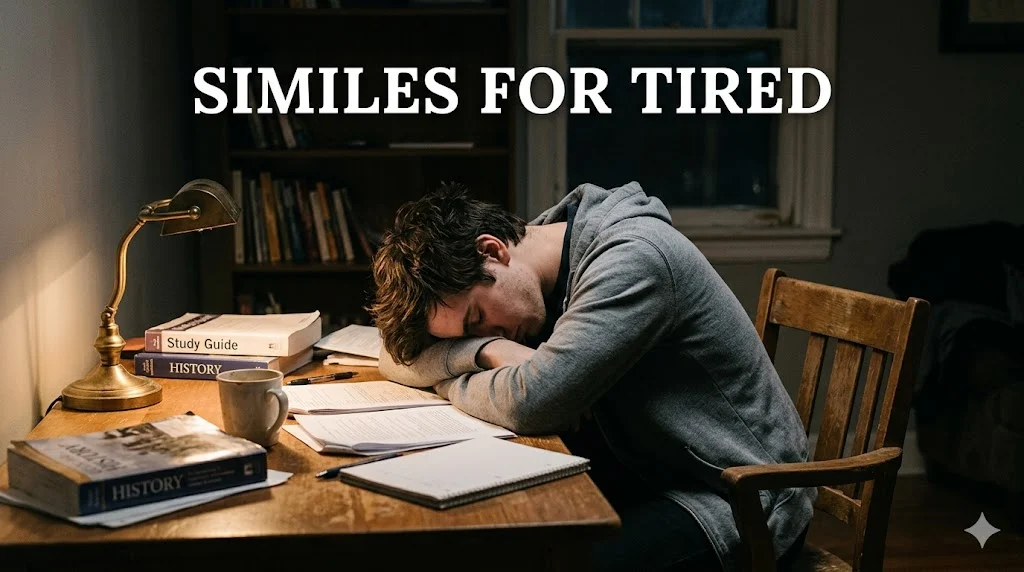
Similes for tired compare the feeling of exhaustion to familiar experiences using words like “as” or “like.” They help writers describe physical fatigue, emotional weariness, and deep burnout through vivid, relatable imagery rather than flat, overused labels.
Finding the right words to describe exhaustion can make your writing more vivid and relatable. Similes for Tired help compare tiredness to familiar experiences, while metaphors for being tired can describe exhaustion in a more imaginative and expressive way. A well-crafted tired simile makes the feeling easier to picture and understand.
Whether you are writing creatively or looking for everyday comparisons, similes for tired offer plenty of ways to express fatigue. From simple tired similes to a specific simile for tired, these comparisons can suit different situations, moods, and writing styles. Common phrases such as as tired as can also make descriptions feel natural and instantly recognizable.
Quick List of Similes for Tired
| Simile | Meaning |
|---|---|
| As heavy as lead | Weighed down and barely able to move |
| Like a battery drained to zero | Completely out of energy |
| As slow as a setting sun | Moving sluggishly toward rest |
| Like a wilting flower | Losing vitality and strength |
| As worn as an old road | Weathered by long use and time |
| Like a candle burned to its end | Running on the very last reserves |
| As limp as a wet cloth | Lacking strength or resistance |
| Like a clock winding down | Slowing steadily toward a stop |
| As hollow as an empty drum | Emotionally and physically depleted |
| Like a ship taking on water | Struggling to stay afloat under pressure |
Similes for Physical Tiredness
1. As Heavy as Lead
Meaning
Describes the physical sensation of limbs and body feeling impossibly weighty.
Why It Works
Lead is one of the densest, heaviest materials in common experience. When the body is exhausted, movement itself becomes an effort, and this comparison captures that precisely.
Alternative Expression
“As weighed down as a stone”
- Formal Example After three consecutive night shifts, her limbs felt as heavy as lead.
- Casual Example My arms feel as heavy as lead right now.
- Creative Example She dragged herself up the stairs, each leg as heavy as lead, each step a small victory against gravity.
2. Like a Battery Drained to Zero
Meaning
Represents complete physical and mental depletion.
Why It Works
A dead battery is a modern, instantly recognizable image of total shutdown. It perfectly mirrors how exhaustion empties a person of all energy.
Alternative Expression
“Like a phone left on overnight”
Examples in Writing
- Formal Example By Friday evening, he functioned like a battery drained to zero.
- Casual Example I’m completely done, like a battery at zero.
- Creative Example Words had stopped forming. She sat staring at the ceiling like a battery drained to zero, waiting for a recharge that would not come until morning.
3. As Limp as a Wet Cloth
Meaning
Describes the loss of physical strength and posture that accompanies deep fatigue.
Why It Works
A wet cloth hangs without shape or resistance, surrendering entirely to gravity. Extreme tiredness does the same to the body.
Alternative Expression
“As slack as a broken kite”
Examples in Writing
- Formal Example After the long hike, his legs were as limp as a wet cloth.
- Casual Example I just collapsed on the couch, limp as a wet cloth.
- Creative Example She fell into the chair as limp as a wet cloth, arms dangling, shoulders surrendered, done fighting for the day.
4. Like a Machine Running Without Oil
Meaning
Captures the grinding, labored quality of movement and thought when deeply tired.
Why It Works
A machine without lubrication slows, stutters, and strains. Exhaustion creates exactly that kind of painful, effortful functioning.
Alternative Expression
“Like an engine on its last drops of fuel”
Examples in Writing
- Formal Example He kept working, but like a machine running without oil, every task cost twice what it should have.
- Casual Example My brain is running without oil today.
- Creative Example Thoughts came slowly, scraping against each other like a machine running without oil, reluctant and worn.
5. As Slow as a Setting Sun
Meaning
Describes the gradual, inevitable descent into rest and sleep.
Why It Works
The setting sun moves with quiet, unstoppable slowness toward the horizon. This simile captures the way true tiredness pulls a person downward with calm, undeniable weight.
Alternative Expression
“As slow as evening settling in”
Examples in Writing
- Formal Example His movements grew as slow as a setting sun toward the end of the shift.
- Casual Example I’m moving as slow as a setting sun today.
- Creative Example She drifted through the kitchen as slow as a setting sun, each motion fading gently toward the horizon of sleep.
Similes for Mental and Emotional Tiredness
6. Like a Fog Rolling In
Meaning
Represents the clouding of thought and concentration that comes with mental exhaustion.
Why It Works
Fog obscures, confuses, and slows everything down. Mental fatigue does the same to thinking, focus, and decision-making.
Alternative Expression
“Like a sky full of low clouds”
Examples in Writing
- Formal Example After eight hours of reading reports, her concentration felt like a fog rolling in.
- Casual Example My brain is like a fog right now.
- Creative Example Thought arrived slowly, like a fog rolling in from the coast, softening the edges of everything she tried to hold in her mind.
7. As Empty as an Abandoned House
Meaning
Describes emotional depletion and the hollowness that follows prolonged stress or grief.
Why It Works
An abandoned house still stands but holds nothing living. This simile captures how emotional exhaustion can leave a person functional but hollow.
Alternative Expression
“As hollow as an empty drum”
Examples in Writing
- Formal Example After months of caregiving, she felt as empty as an abandoned house.
- Casual Example I’m just empty, like a house nobody lives in anymore.
- Creative Example She smiled at the right moments and said the right things, but inside she was as empty as an abandoned house, windows dark, no warmth left.
8. Like a River Running Low
Meaning
Represents the gradual depletion of mental and emotional resources.
Why It Works
A river running low still moves but has lost its strength, depth, and force. This mirrors how mental exhaustion diminishes capacity without completely stopping it.
Alternative Expression
“Like a well nearly run dry”
Examples in Writing
- Formal Example His patience had grown like a river running low after weeks of overwork.
- Casual Example My energy is like a river running low these days.
- Creative Example Compassion still moved through her, but slowly now, like a river running low in late summer, unable to carry what it once did.
9. As Dim as a Fading Bulb
Meaning
Describes the way mental sharpness and awareness fade when exhausted.
Why It Works
A bulb losing power grows dim, flickers, and struggles to illuminate. Mental fatigue produces the same dimming of awareness, creativity, and focus.
Alternative Expression
“As dull as a flickering light”
Examples in Writing
- Formal Example His concentration was as dim as a fading bulb by the third hour of the exam.
- Casual Example My brain is as dim as a fading bulb right now.
- Creative Example Ideas that had once sparked easily now came as dim as a fading bulb at the end of a long corridor.
10. Like a Book Read Too Many Times
Meaning
Represents the worn-out feeling of someone who has given too much for too long.
Why It Works
A book read many times becomes soft, fragile, and worn at the edges. This simile captures the exhaustion of someone whose reserves have been depleted through overuse and over-giving.
Alternative Expression
“Like a song played until it loses its feeling”
Examples in Writing
- Formal Example After years in the role, she felt like a book read too many times, her enthusiasm worn thin.
- Casual Example I just feel like a book someone read too many times.
- Creative Example There was a time when mornings felt fresh. Now she opened her eyes like a book read too many times, familiar and tired and slightly frayed.
Similes for Deep and Extreme Exhaustion
11. Like a Candle Burned Down to Its Last Inch
Meaning
Represents someone functioning on the absolute edge of their remaining energy.
Why It Works
A candle nearly burned out still gives light but is about to go dark. This vividly captures the state of someone who is almost but not quite done.
Alternative Expression
“Like a flame about to go out”
Examples in Writing
- Formal Example He continued working like a candle burned down to its last inch.
- Casual Example I’m running on nothing, like a candle at the very end.
- Creative Example She graded the last paper at midnight like a candle burned down to its last inch, wax pooled around the base, light guttering and small.
12. As Worn as an Old Road
Meaning
Describes exhaustion accumulated over a very long time.
Why It Works
An old road bears the marks of countless journeys. Its surface is cracked, worn smooth in places, and weathered by seasons. This simile captures long-term fatigue beautifully.
Alternative Expression
“As weathered as driftwood”
Examples in Writing
- Formal Example After decades of early mornings, he was as worn as an old road.
- Casual Example She looks as worn as an old road lately.
- Creative Example His face told the story of too many hard years, as worn as an old road crossed by too many heavy wheels.
13. Like a Wilting Flower
Meaning
Represents the visible, physical collapse of energy and posture under exhaustion.
Why It Works
A wilting flower droops, loses its shape, and surrenders to weight. Tiredness does exactly this to the body and spirit.
Alternative Expression
“Like a plant without water”
Examples in Writing
- Formal Example By afternoon, the children were wilting like flowers in the heat.
- Casual Example I’m wilting like a flower by three o’clock every day.
- Creative Example She had walked in that morning with energy and purpose, but by noon she was wilting like a flower cut and left too long without water.
14. As Spent as a Burned-Out Match
Meaning
Represents total energy depletion with nothing left to give.
Why It Works
A spent match has fulfilled its purpose and has nothing remaining. This simile captures the feeling of having given everything and arrived at empty.
Alternative Expression
“As used up as an old battery”
Examples in Writing
- Formal Example After the presentation, she sat as spent as a burned-out match.
- Casual Example Completely done. Burned-out match. That’s me.
- Creative Example He dropped into his chair as spent as a burned-out match, the energy that had carried him through the day already gone cold.
15. Like a Clock Winding Down
Meaning
Describes the slow, inevitable loss of energy as sleep approaches.
Why It Works
A winding-down clock slows steadily, each tick slightly weaker than the last, heading toward stillness. This mirrors how exhaustion overcomes the body and mind.
Alternative Expression
“Like an engine losing steam”
Examples in Writing
- Formal Example As the evening wore on, she moved like a clock winding down.
- Casual Example I’m winding down like an old clock.
- Creative Example Conversation had slowed. Laughter came less easily. The whole room was winding down like a clock no one had remembered to wind.
Similes for Tired Eyes and Body Language
16. Eyes Like Heavy Curtains
Meaning
Describes eyelids too tired to stay open.
Why It Works
Heavy curtains fall naturally, pulled by their own weight. This perfectly captures the involuntary drooping of tired eyes.
Alternative Expression
“Eyes like stones too heavy to lift
Examples in Writing
- Formal Example His eyes hung like heavy curtains through the second half of the lecture.
- Casual Example My eyes feel like heavy curtains right now.
- Creative Example She fought sleep with the concentration of someone disarming a clock, but her eyes fell like heavy curtains regardless.
17. Moving Like Water Through Sand
Meaning
Represents the slow, resistant quality of movement under extreme tiredness.
Why It Works
Water moves through sand slowly and with effort, filtered through resistance. This captures the effortful, sluggish movement of an exhausted body perfectly.
Alternative Expression
“Moving like feet through wet concrete”
Examples in Writing
- Formal Example He crossed the room moving like water through sand, each step deliberate and slow.
- Casual Example I’m moving like water through sand this morning.
- Creative Example Progress came slowly, each step moving like water through sand, resistance everywhere, destination still far away.
18. Like a Puppet With Cut Strings
Meaning
Describes the collapse of physical tension and control that comes with extreme fatigue.
Why It Works
A puppet without strings crumples immediately, all structure gone. This vividly captures the boneless feeling of genuine exhaustion.
Alternative Expression
“Like a body without its frame”
Examples in Writing
- Formal Example She fell onto the sofa like a puppet with cut strings.
- Casual Example I just collapsed like a puppet with cut strings.
- Creative Example The moment she closed the door, every muscle gave up at once and she dropped to the floor like a puppet with cut strings, finally allowed to stop.
Similes for Tired in Different Contexts
19. Like Carrying Rocks Uphill
Meaning
Represents exhaustion that comes from sustained effort against resistance.
Why It Works
Carrying rocks uphill requires constant energy with no relief or momentum. This describes the exhaustion of pushing through difficulty day after day.
Alternative Expression
“Like climbing with weights on your back”
Examples in Writing
- Formal Example Working under those conditions felt like carrying rocks uphill.
- Casual Example This week has felt like carrying rocks uphill every single day.
- Creative Example Every morning she rose and began again, picking up the same invisible weight, like carrying rocks uphill toward a summit she could not see.
20. As Drained as a Lake in a Drought
Meaning
Represents complete depletion of energy reserves.
Why It Works
A drought-dried lake reveals only cracked earth and emptiness where there was once fullness and life. This simile captures the feeling of having nothing left.
Alternative Expression
“As emptied as a turned-over cup”
Examples in Writing
- Formal Example After the emotional conversation, he felt as drained as a lake in a drought.
- Casual Example Completely drained, like a lake in drought.
- Creative Example She had given comfort all day, and now she sat drained as a lake in a drought, the generous water of her patience entirely gone.
21. Like a Traveler at the End of a Long Road
Meaning
Captures the deep, satisfied exhaustion of someone who has given everything to a long journey.
Why It Works
A traveler at road’s end has earned their rest. The tiredness is real but dignified, connected to effort and distance covered.
Alternative Expression
“Like someone who has walked a thousand miles
Examples in Writing
- Formal Example He retired from his position feeling like a traveler at the end of a long road.
- Casual Example I feel like a traveler who has finally reached the end.
- Creative Example She stood at the door of her home like a traveler at the end of a long road, grateful, exhausted, and quietly proud.
22. As Faded as an Old Photograph
Meaning
Describes the way prolonged exhaustion dims a person’s vitality and presence.
Why It Works
An old photograph once vivid with color becomes pale and indistinct. This captures how chronic fatigue can dull a person’s energy and warmth over time.
Alternative Expression
“As washed out as old paint”
Examples in Writing
- Formal Example After six months of overwork, she seemed as faded as an old photograph.
- Casual Example He looks faded lately, like an old photo.
- Creative Example The brightness she once carried had dimmed. She moved through rooms now as faded as an old photograph, the vivid colors of her energy gone soft and pale.
23. Like a Wave That Has Broken on Shore
Meaning
Represents the complete release of energy following a period of great effort or emotion.
Why It Works
A wave builds force as it travels and then spends everything in the moment it breaks. What remains is stillness and retreat. This beautifully captures exhaustion after intense effort.
Alternative Expression
“Like water that has finally reached the shore”
Examples in Writing
- Formal Example After the competition, the team collapsed like waves that had finally broken on shore.
- Casual Example I’ve broken on shore. Nothing left.
- Creative Example She had wept and spoken and remembered, and now she was still, like a wave that had broken on shore, all force released, the ocean calm again.
24. As Quiet as a Town After a Storm
Meaning
Represents the deep, settled stillness that follows exhaustion.
Why It Works
After a storm passes, a town is quiet in a particular way, not peaceful but emptied. This captures post-exhaustion stillness.
Alternative Expression
“As still as the air after a long rain”
Examples in Writing
- Formal Example The house was as quiet as a town after a storm once the children were finally in bed.
- Casual Example Everything just went quiet like after a storm.
- Creative Example She lay still and the room held her, as quiet as a town after a storm, the noise of the day finally passed.
25. Like a Fire Burned Down to Embers
Meaning
Represents a person still present and alive but reduced to the last, quiet remnants of their energy.
Why It Works
A fire at the ember stage has lost its flame but holds warmth. This is one of the most complete and poetic similes for tired because it captures exhaustion without extinguishment.
Alternative Expression
“Like a hearth gone cold”
Examples in Writing
- Formal Example By the end of the year, his enthusiasm had burned down to embers.
- Casual Example I’m just embers right now. Nothing more.
- Creative Example He sat by the window as the night deepened, like a fire burned down to embers, still warm, still present, but quietly done.
Why Tiredness Similes Matter in Writing
Tiredness is felt more than explained.
A reader who encounters “she was tired” understands the word but does not feel anything. A reader who encounters “she moved like a puppet with cut strings” feels the collapse immediately, in their body, before their mind has processed it.
Strong similes for tired help readers understand:
Physical exhaustion and the weight of a depleted body Mental fatigue and the clouding of thought and focus Emotional depletion after grief, stress, or sustained effort Burnout and the long-term wearing away of energy Peaceful tiredness earned after meaningful effort.
The difference between these states matters enormously in storytelling. A character who is “like a candle burned to its last inch” is in a different place than a character who is “like a traveler at the end of a long road.” Both are tired, but the emotional quality is entirely different, and the right simile conveys that instantly.
How to Use Tiredness Similes Naturally
Match the Type of Exhaustion Not all tiredness is the same.
Choose imagery that reflects the specific kind of fatigue.
Physical tiredness pairs well with imagery of weight, slowness, and collapse. Mental fatigue pairs well with imagery of fog, dimness, and blurring. Emotional depletion pairs well with imagery of emptiness, drought, and fading. Earned, satisfied exhaustion pairs well with imagery of journeys, sunsets, and embers.
Reflect the Character’s World
The most effective similes draw from the world the character inhabits.
A farmer might describe tiredness as “like soil that has given everything to a harvest.” A teacher might feel “like a textbook copied too many times.” A musician might describe fatigue as “like a song played until the strings go slack.”
Use Similes at Moments of Peak Feeling
Similes land hardest when they arrive at the moment of greatest emotional weight. Do not scatter them throughout a passage. Save them for the sentence where the feeling peaks.
Keep the Comparison Clear and Quick
The strongest similes are understood instantly. If a reader needs to stop and work out the comparison, the image has failed. The best tiredness similes hit immediately and physically.
Common Mistakes When Writing Tiredness Similes
Overusing the Same Images
Phrases like “dead tired” or “exhausted like a dog” have been used so often they no longer produce any feeling. Look for fresher comparisons rooted in specific, sensory detail.
Mixing Emotional Tones
A humorous simile inserted into a serious moment of exhaustion will break the mood. Make sure the tone of the comparison matches the emotional register of the scene.
Making Comparisons Too Abstract
“As tired as the weight of history” is poetic but vague. Readers respond to physical, concrete imagery. “As heavy as lead” is more effective because every reader has lifted something heavy.
Forgetting That Tiredness Has Varieties
Using the same simile for a character who is burnout-weary versus one who is pleasantly sleepy after a good day will produce a false emotional note. Choose images that match the exact shade of exhaustion you are portraying.
Similes vs Metaphors for Tiredness
Simile
Uses “like” or “as” to draw a comparison.
Example: “He moved like a clock winding down.”
Metaphor
Makes a direct statement of equivalence.
Example: “He was a clock winding down.”
Similes generally feel more observational and allow the reader space to make the comparison themselves. Metaphors fuse the comparison directly into identity and tend to carry more emotional force. Both are valuable tools. Similes for tired often work better in descriptive passages, while metaphors land harder in moments of character revelation or emotional climax.
Writing Exercise: Build Your Own Tiredness Similes
Start with a plain statement:
“She was tired.”
Now rebuild it using different types of imagery:
Weight imagery:
“She was as heavy as a bag of wet sand.”
Light imagery:
“She was like a candle burned past its wick.”
Nature imagery:
“She was like a lake at the end of a long drought.”
Movement imagery:
“She moved like water pushing through sand.”
Sound imagery:
“She was as quiet as a town after a storm.”
Practicing this exercise regularly builds the habit of reaching for original, vivid comparisons rather than defaulting to familiar descriptions that carry no weight.
FAQs
1. What are similes for tired?
Similes for tired are comparisons that describe exhaustion using “like” or “as.” They help writers express physical fatigue, mental depletion, and emotional weariness through vivid, sensory imagery.
2. Why should writers use similes for tiredness?
They make descriptions of exhaustion feel real and immediate. A simile allows a reader to feel tiredness rather than simply acknowledging it, which creates stronger emotional engagement.
3. What makes a strong tiredness simile?
A strong tiredness simile is concrete, physically grounded, instantly understood, and emotionally accurate to the specific type of fatigue being described.
4. Can tiredness similes improve storytelling?
Yes. They deepen characterization, strengthen pacing, and give readers physical entry points into a character’s inner state. Exhaustion is one of the most relatable human experiences, and the right simile connects readers to it immediately.
5. How can I create original tiredness similes?
Pay attention to how your own body and mind actually feel when tired. What objects, sensations, or natural images capture that experience for you personally? The most original similes come from honest, specific observation.
Conclusion
Tiredness is one of the most common human feelings, and yet it is one of the most commonly underdescribed.
The word tired does its job as information but fails as experience. It tells readers something without making them feel anything. Similes bridge that gap by anchoring exhaustion in physical, sensory, and emotionally resonant imagery that readers recognize immediately in their own bodies.
A person who is “like a candle burned to its last inch” is not merely tired. They are on the edge of something, still present but barely so, warmth nearly spent. A person who is “as faded as an old photograph” carries a different kind of exhaustion, one marked by time and slow diminishment rather than acute depletion.
The right simile does not just describe tiredness. It reveals what kind of tired a person is, how they got there, and what it costs them to keep going.
As you write, pay attention to the specific texture of the exhaustion you are trying to convey. Choose imagery that matches not just the intensity of the fatigue but its quality, its history, and its emotional weight. A single well-chosen comparison can communicate more about a character’s state than several paragraphs of explanation.
Tiredness, at its deepest, is not merely the absence of energy. It is a story told by the body about everything it has carried and given. The best similes for tired help readers hear that story.








1 thought on “Similes for Tired | Comparisons That Capture Exhaustion In 2026”