Quick Answer
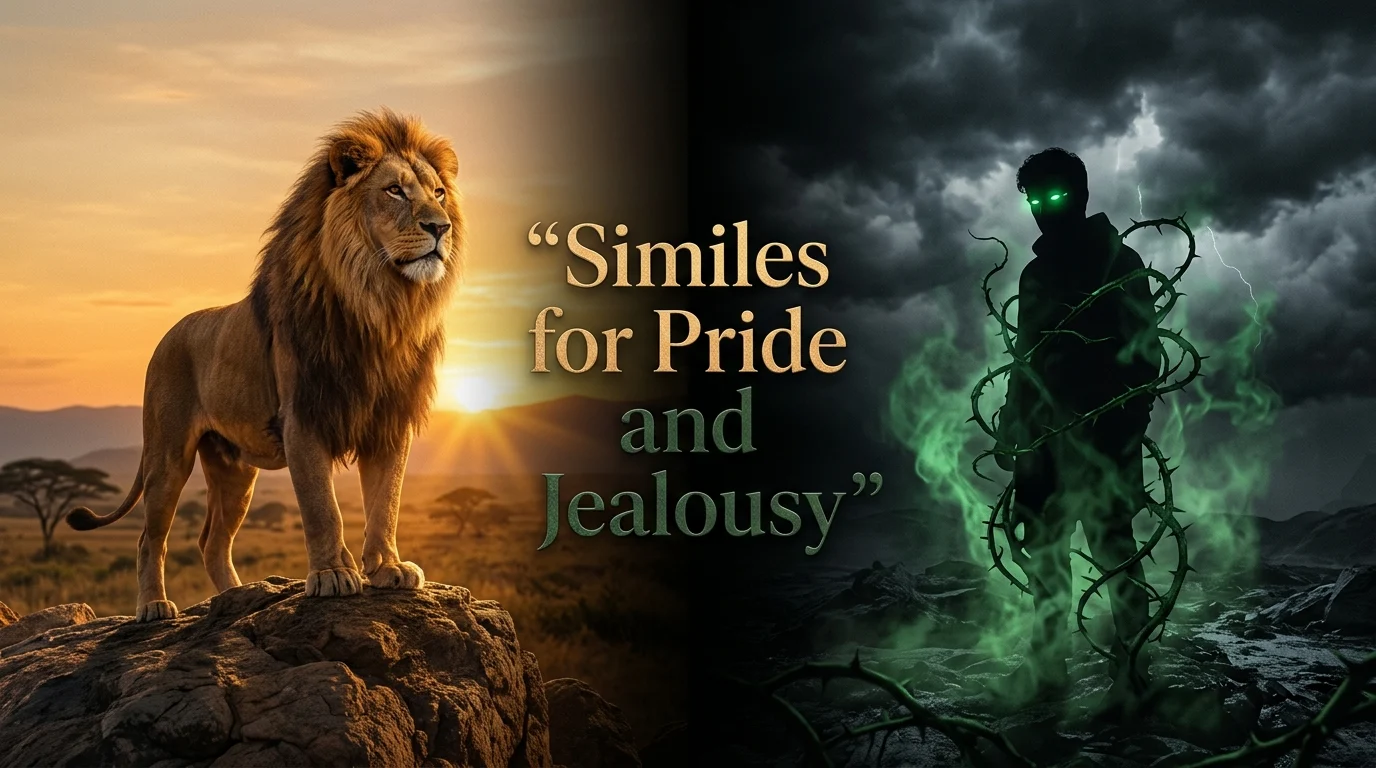
Similes for pride and jealousy compare these intense emotions using “like” or “as” to create vivid, memorable descriptions. Pride similes can express healthy self-respect or destructive arrogance; jealousy similes capture envy, insecurity, possessiveness, and resentment through relatable imagery like lions, peacocks, shadows, thorns, storms, and green fire. This guide offers 30+ original similes with meanings, examples, and practical writing tips.
Pride and jealousy are two of the most complex emotions human beings experience. Pride can lift a person toward confidence, dignity, and self-respect or it can harden into arrogance, vanity, and isolation. Jealousy can reveal deep insecurity, fear of loss, and envy that quietly poisons relationships. Both emotions are difficult to describe without falling back on tired phrases. Writers need precise, sensory language to make readers feel the weight of a proud character or the sting of a jealous heart.
That is exactly where similes shine. By comparing pride to a lion surveying its kingdom or jealousy to a snake coiling around the heart, writers transform abstract emotions into images readers can see, hear, and feel. A well-chosen simile can show the difference between earned pride and hollow arrogance, between protective jealousy and destructive envy.
This guide explores powerful similes for pride and jealousy, organized by emotional tone. Each simile includes its meaning, why it works, alternative expressions, and examples for formal, casual, and creative writing. Whether you are working on fiction, poetry, essays, speeches, or personal reflections, these comparisons will help you write with more emotional precision.
Quick List of Similes for Pride and Jealousy
| Simile | Meaning |
| As proud as a lion surveying its kingdom | Confident, dignified self-respect |
| Like a mountain standing against the wind | Unshakable self-belief |
| As tall as a sunflower turning toward the sun | Healthy self-esteem seeking growth |
| Like a craftsman admiring his finished work | Earned pride in one’s effort |
| As radiant as a diamond reflecting its own light | Self-respect without external validation |
| Like a bird soaring on its own wings | Pride in self-reliance |
| As dignified as an ancient oak | Quiet, rooted self-worth |
| Like a crown worn with quiet grace | Humble authority and confidence |
| As vain as a peacock fanning its feathers | Arrogant self-display |
| Like a balloon inflated with hot air | Overblown, fragile ego |
| As arrogant as a rooster crowing at dawn | Loud, unwarranted pride |
| Like a mirror that only reflects itself | Narcissistic vanity |
| As cold as a marble statue admiring its own perfection | Detached arrogance |
| Like a wall too high to see over | Pride that isolates |
| As green as unripe fruit turned sour | Envy and resentment |
| Like a snake coiling around the heart | Possessive jealousy |
| As bitter as gall on the tongue | Resentful envy |
| Like a shadow that follows every success | Inescapable jealousy |
| As sharp as a thorn hidden in a rose | Hidden envy |
| Like fire that burns the one who feeds it | Self-destructive jealousy |
| As suffocating as ivy choking a tree | Jealousy that smothers |
| Like a wolf circling another’s feast | Predatory envy |
| As fragile as glass pretending to be diamond | Insecure pride |
| Like a cracked vase holding water | Fragile self-image |
| As watchful as a hawk guarding prey | Possessive jealousy |
| Like a child clutching a toy too tightly | Fearful possessiveness |
Similes for Healthy Pride: Self-Worth and Dignity
Healthy pride is not about looking down on others. It is the quiet confidence that comes from knowing one’s worth, the satisfaction of honest effort, and the strength to stand by one’s values. These similes use nature, light, and craftsmanship to show pride as a source of warmth and stability.
As Proud as a Lion Surveying Its Kingdom
Meaning
Describes a confident, dignified pride rooted in accomplishment and self-respect, not arrogance.
Why It Works
A lion symbolizes natural authority, calm strength, and a sense of earned dominance. The image suggests confidence without aggression.
Alternative Expression
“Like an eagle perched on a high cliff”
Examples in Writing
Formal Example
His pride was as dignified as a lion surveying its kingdom after years of quiet leadership.
Casual Example
After the promotion, he walked into the office looking like a lion on his own turf.
Creative Example
Pride settled over him as calm as a lion watching the savanna from a sun-warmed rock.
Like a Mountain Standing Against the Wind
Meaning
Represents steadfast self-belief that remains unshaken by criticism, doubt, or external pressure.
Why It Works
Mountains are ancient, immovable, and enduring. They suggest a pride that does not need to prove itself.
Alternative Expression
“As solid as bedrock beneath shifting sand”
Examples in Writing
Formal Example
Her confidence stood like a mountain against the wind, unaffected by the committee’s doubts.
Casual Example
No matter what people say, she just stands there like a mountain.
Creative Example
His self-respect rose like a mountain against the wind, its peak hidden in clouds but its roots deep in the earth.
As Tall as a Sunflower Turning Toward the Sun
Meaning
Describes healthy pride that seeks growth, positivity, and self-improvement.
Why It Works
Sunflowers naturally orient toward light, symbolizing a self-esteem that is open, warm, and life-affirming.
Alternative Expression
“Like a sapling stretching toward the sky”
Examples in Writing
Formal Example
Her confidence was as tall as a sunflower turning toward the sun, always reaching for better things.
Casual Example
She carries herself like a sunflower always looking up.
Creative Example
Pride grew in her as tall as a sunflower turning toward the sun, its golden face open to the morning.
Like a Craftsman Admiring His Finished Work
Meaning
Represents earned pride in one’s own effort, skill, and dedication.
Why It Works
A craftsman’s satisfaction is honest and grounded in labor. There is no vanity, only the quiet joy of a job well done.
Alternative Expression
“Like a gardener after the first bloom”
Examples in Writing
Formal Example
His sense of accomplishment was like a craftsman admiring his finished work earned, detailed, and sincere.
Casual Example
He looked at the repaired engine like a proud craftsman, even if nobody else understood.
Creative Example
Pride glowed in her hands like a craftsman admiring the smooth grain of a table shaped by his own patience.
As Radiant as a Diamond Reflecting Its Own Light
Meaning
Describes self-respect that shines from within without needing external validation or applause.
Why It Works
Diamonds are valued for clarity, brilliance, and inner strength. The image suggests pride that is pure and self-sustaining.
Alternative Expression
“Like a pearl resting in an open shell”
Examples in Writing
Formal Example
Her self-worth was as radiant as a diamond reflecting its own light, independent of outside praise.
Casual Example
She doesn’t need compliments. She shines on her own.
Creative Example
Confidence radiated from her like a diamond reflecting its own light in a dark room.
Like a Bird Soaring on Its Own Wings
Meaning
Represents freedom and pride in self-reliance and independence.
Why It Works
Flight suggests liberation, grace, and the ability to rise above limitations.
Alternative Expression
“As free as a falcon riding an updraft”
Examples in Writing
Formal Example
His independence was like a bird soaring on its own wings, unbounded by the expectations of others.
Casual Example
She finally moved out and felt like a bird flying on its own.
Creative Example
Pride lifted him like a bird soaring on its own wings above the noise of the world below.
As Dignified as an Ancient Oak
Meaning
Describes quiet, rooted self-worth that comes from experience, resilience, and inner stability.
Why It Works
Ancient oaks are symbols of endurance, wisdom, and quiet strength. They do not sway with every breeze.
Alternative Expression
“Like a deep-rooted tree that has weathered many winters”
Examples in Writing
Formal Example
Her pride was as dignified as an ancient oak, silent and unshakable in the face of change.
Casual Example
He carries himself like an old oak steady and calm.
Creative Example
Dignity wrapped around her like the bark of an ancient oak, rough from years but impossible to break.
Like a Crown Worn with Quiet Grace
Meaning
Represents humble authority and confidence that does not need to announce itself.
Why It Works
A crown signifies worth and leadership, but “quiet grace” removes arrogance. The image suggests earned respect carried lightly.
Alternative Expression
“Like a queen who has nothing to prove”
Examples in Writing
Formal Example
His confidence sat on him like a crown worn with quiet grace, present but never heavy-handed.
Casual Example
She carries her success like a crown she doesn’t need to show off.
Creative Example
Pride rested on her brow like a crown worn with quiet grace, invisible to all but those who knew her true worth.
Similes for Arrogant Pride: Vanity and Overconfidence
Arrogant pride is pride that has soured. It demands attention, belittles others, and often masks deep insecurity. These similes use inflated, hard, and reflective imagery to show how excessive pride can isolate and distort a person’s character.
As Vain as a Peacock Fanning Its Feathers
Meaning
Describes loud, showy pride that seeks admiration and cannot tolerate being overlooked.
Why It Works
A peacock’s display is beautiful but excessive. It suggests vanity that is more about appearance than substance.
Alternative Expression
“Like a model posing for an empty room”
Examples in Writing
Formal Example
His arrogance was as vain as a peacock fanning its feathers before an audience that had long stopped caring.
Casual Example
He won’t stop talking about his new car. He’s strutting like a peacock.
Creative Example
Vanity spread behind him like a peacock fanning its feathers, bright and empty at the center.
Like a Balloon Inflated with Hot Air
Meaning
Represents overblown ego that is fragile and likely to burst under pressure.
Why It Works
A balloon filled with hot air appears large but is hollow. The image captures arrogance without substance.
Alternative Expression
“Like a paper crown in the rain”
Examples in Writing
Formal Example
His pride was like a balloon inflated with hot air, impressive only until someone spoke a sharp truth.
Casual Example
He thinks he’s a big deal, but he’s just full of hot air.
Creative Example
His ego swelled like a balloon inflated with hot air, each compliment pushing it closer to bursting.
As Arrogant as a Rooster Crowing at Dawn
Meaning
Describes loud, unwarranted pride that announces itself constantly, as if the world needs to be reminded of its presence.
Why It Works
A rooster’s crow is piercing and repetitive, but the bird’s actual power is small. The image mocks misplaced confidence.
Alternative Expression
“Like a mosquito declaring itself king of the swamp”
Examples in Writing
Formal Example
His manner was as arrogant as a rooster crowing at dawn, convinced the sun rose only for him.
Casual Example
Every meeting he talks over everyone he’s such a rooster.
Creative Example
Arrogance spilled from his mouth like a rooster crowing at dawn, sharp and impossible to ignore.
Like a Mirror That Only Reflects Itself
Meaning
Represents self-centered vanity that cannot see beyond its own image and needs.
Why It Works
A mirror’s purpose is to reflect, but here it reflects only itself, suggesting a closed loop of self-admiration.
Alternative Expression
“Like a camera that only takes self-portraits”
Examples in Writing
Formal Example
Her vanity was like a mirror that only reflects itself, blind to the people standing just outside the frame.
Casual Example
He only talks about himself like a mirror facing another mirror.
Creative Example
His pride turned him into a mirror that only reflects itself, every conversation bending back to his own reflection.
As Cold as a Marble Statue Admiring Its Own Perfection
Meaning
Describes detached arrogance that is beautiful but lifeless, admiring its own flawlessness from a distance.
Why It Works
Marble is cold and hard, suggesting pride that has lost warmth and human connection.
Alternative Expression
“Like an ice sculpture in a locked room”
Examples in Writing
Formal Example
His sense of superiority was as cold as a marble statue admiring its own perfection.
Casual Example
She’s beautiful but untouchable like a marble statue.
Creative Example
Arrogance chilled the room like a marble statue admiring its own perfection in silence.
Like a Wall Too High to See Over
Meaning
Represents pride that isolates, creating distance between the proud person and everyone else.
Why It Works
A high wall blocks connection and empathy. The image conveys the loneliness of excessive pride.
Alternative Expression
“Like a fortress with no gate”
Examples in Writing
Formal Example
His pride was like a wall too high to see over, leaving him alone on the other side.
Casual Example
You can’t talk to him. He’s built a wall around himself.
Creative Example
Arrogance rose around him like a wall too high to see over, its stones carved from old victories no one else remembered.
As Blind as a Man Staring at His Own Reflection
Meaning
Describes pride that prevents self-awareness, making a person unable to see their flaws or the needs of others.
Why It Works
Staring at one’s reflection blocks the wider view. The image suggests self-obsession causing blindness.
Alternative Expression
“Like a ship captain watching only the bow”
Examples in Writing
Formal Example
He was as blind as a man staring at his own reflection, unable to see the harm his pride caused.
Casual Example
She can’t hear criticism. She’s too busy looking in the mirror.
Creative Example
His arrogance made him blind as a man staring at his own reflection while the world burned behind him.
Like a Throne Built on Hollow Bones
Meaning
Represents pride that appears powerful but is built on empty achievements, lies, or the belittling of others.
Why It Works
A throne suggests authority, but hollow bones reveal weakness and cruelty beneath the surface.
Alternative Expression
“Like a golden crown made of tin”
Examples in Writing
Formal Example
His superiority sat on him like a throne built on hollow bones, grand from a distance but fragile at the core.
Casual Example
He acts like a king, but his confidence is all show.
Creative Example
Pride lifted him onto a throne built on hollow bones, each victory cracking under the weight of his own self-image.
Similes for Jealousy and Envy
Jealousy often begins quietly a flicker of envy, a tightening in the chest before it grows into something corrosive. These similes draw on nature’s darker sides, poison, shadows, and storms to capture the painful intensity of jealousy.
As Green as Unripe Fruit Turned Sour
Meaning
Describes envy that starts as desire but turns bitter and unpleasant over time.
Why It Works
Green fruit is unready and sour, just as jealousy is immature and sharp on the tongue. The color green is culturally associated with envy.
Alternative Expression
“Like a sour grape on the vine”
Examples in Writing
Formal Example
Her envy was as green as unripe fruit turned sour, a bitter taste she could not swallow.
Casual Example
He turned green when he saw his friend’s new house.
Creative Example
Jealousy grew in him like unripe fruit turned sour, its juice staining every kind thought he had.
Like a Snake Coiling Around the Heart
Meaning
Represents possessive jealousy that squeezes affection and trust until there is no room for anything else.
Why It Works
A snake coils slowly and tightens its grip. The image captures how jealousy can feel like a physical constriction.
Alternative Expression
“Like vines strangling a garden”
Examples in Writing
Formal Example
Jealousy wrapped around her like a snake coiling around the heart, cold and unrelenting.
Casual Example
Every time he talks to another girl, she gets that tight feeling like a snake around her chest.
Creative Example
Envy coiled around his heart like a snake, its scales scraping against every beat.
As Bitter as Gall on the Tongue
Meaning
Describes resentment that rises when someone else receives what we desire, leaving a bitter aftertaste.
Why It Works
Gall is a bitter digestive fluid, and the image conveys a visceral, physical disgust.
Alternative Expression
“Like vinegar in an open wound”
Examples in Writing
Formal Example
His jealousy was as bitter as gall on the tongue, poisoning even his congratulations.
Casual Example
She smiled at their engagement, but the words tasted like gall.
Creative Example
Envy coated her words as bitter as gall on the tongue, turning kindness into acid.
Like a Shadow That Follows Every Success
Meaning
Represents jealousy that attaches itself to another person’s achievements, never allowing the jealous person to escape comparison.
Why It Works
A shadow is always present, silent and persistent. The image suggests envy that stalks and darkens every moment of joy.
Alternative Expression
“Like a second footprint beside your own”
Examples in Writing
Formal Example
His envy followed his friend like a shadow that follows every success, growing longer with each new triumph.
Casual Example
I can’t be happy for her because my jealousy keeps following me around.
Creative Example
Jealousy clung to her like a shadow that follows every success, stretching across the floor when the spotlight found someone else.
As Sharp as a Thorn Hidden in a Rose
Meaning
Describes hidden envy that appears beautiful or polite on the surface but carries a painful sting underneath.
Why It Works
A rose is admired for its beauty, but thorns can wound. The image captures jealousy disguised as friendship or admiration.
Alternative Expression
“Like a splinter beneath smooth skin”
Examples in Writing
Formal Example
Her compliments were as sharp as a thorn hidden in a rose, lovely until they drew blood.
Casual Example
She’s sweet to your face but stings you behind your back.
Creative Example
Envy hid in her smile like a thorn hidden in a rose, its point waiting beneath silken petals.
Like Fire That Burns the One Who Feeds It
Meaning
Represents self-destructive jealousy that consumes the jealous person more than the object of their envy.
Why It Works
Fire consumes its fuel. Jealousy often hurts the person feeling it far more than anyone else.
Alternative Expression
“Like a moth circling a flame”
Examples in Writing
Formal Example
His jealousy was like fire that burns the one who feeds it, destroying his peace night after night.
Casual Example
She’s only hurting herself by obsessing over her ex’s new relationship.
Creative Example
Envy blazed inside him like fire that burns the one who feeds it, his own hands adding the wood.
As Suffocating as Ivy Choking a Tree
Meaning
Describes jealousy that smothers a relationship, cutting off air, light, and freedom.
Why It Works
Ivy may look green and alive, but it slowly overwhelms whatever it climbs. The image conveys gradual, suffocating control.
Alternative Expression
“Like weeds smothering a garden”
Examples in Writing
Formal Example
Her possessiveness became as suffocating as ivy choking a tree, leaving no space for his old friendships.
Casual Example
His jealousy is suffocating she can’t even go out with friends anymore.
Creative Example
Jealousy wound around their love like ivy choking a tree, each tendril tightening until the leaves turned pale.
Like a Wolf Circling Another’s Feast
Meaning
Represents predatory envy that waits for an opportunity to take what belongs to someone else.
Why It Works
A wolf circling is patient, hungry, and watchful. The image captures jealousy with an edge of threat.
Alternative Expression
“Like a hyena pacing near a kill”
Examples in Writing
Formal Example
His envy was like a wolf circling another’s feast, patient and starving at the edges.
Casual Example
He watches his brother’s success like a wolf watching a meal.
Creative Example
Jealousy paced around his mind like a wolf circling another’s feast, yellow eyes fixed on what it could not have.
As Restless as the Sea Before a Storm
Meaning
Describes churning, anxious jealousy that cannot find calm and builds toward an emotional outburst.
Why It Works
The sea before a storm is uneasy, dark, and full of motion. The image suggests inner turmoil.
Alternative Expression
“Like leaves trembling before thunder”
Examples in Writing
Formal Example
Her jealousy was as restless as the sea before a storm, each thought crashing against the shore of her composure.
Casual Example
He couldn’t sit still he was churning inside like the sea before a storm.
Creative Example
Envy moved in him like the sea before a storm, pulling at the depths of his better nature.
Like a Storm Cloud Darkening a Clear Sky
Meaning
Represents jealousy that suddenly ruins happiness, casting gloom over previously bright situations.
Why It Works
A storm cloud appears quickly and blocks out the sun, just as envy can darken a moment of joy.
Alternative Expression
“Like smoke staining a blue afternoon”
Examples in Writing
Formal Example
His mood turned like a storm cloud darkening a clear sky when he heard the news.
Casual Example
She was happy until jealousy rolled in like a storm cloud.
Creative Example
Envy gathered in his chest like a storm cloud darkening a clear sky, the sun of his friendship disappearing behind it.
Similes for Insecurity and Possessive Jealousy
Jealousy often masks a deeper fear: the fear of not being enough, of losing love or status. These similes focus on fragility, hunger, and watchfulness to show the insecure side of jealousy.
As Fragile as Glass Pretending to Be Diamond
Meaning
Describes insecure pride or possessiveness that tries to appear strong but breaks easily under pressure.
Why It Works
Glass can be cut to shine like diamond, but it shatters. The image captures false confidence and hidden fragility.
Alternative Expression
“Like ice painted to look like marble”
Examples in Writing
Formal Example
His possessiveness was as fragile as glass pretending to be diamond, cracking the moment someone questioned his worth.
Casual Example
He acts tough, but he’s fragile underneath.
Creative Example
Her jealousy was as fragile as glass pretending to be diamond, its edges glittering until the first hard truth shattered it.
Like a Cracked Vase Holding Water
Meaning
Represents a fragile self-image that can still function but is always at risk of leaking, crumbling, or breaking completely.
Why It Works
A cracked vase may look whole, but water slowly seeps out. The image suggests insecurity that cannot hold confidence for long.
Alternative Expression
“Like a boat with a slow leak”
Examples in Writing
Formal Example
His self-esteem was like a cracked vase holding water, beautiful from a distance but never able to keep what it held.
Casual Example
She smiles, but inside she feels like a cracked pot.
Creative Example
Jealousy leaked from her like water from a cracked vase, seeping through every smile she forced.
As Watchful as a Hawk Guarding Prey
Meaning
Describes possessive jealousy that monitors a partner or possession obsessively, afraid of losing what it feels belongs solely to them.
Why It Works
A hawk is intensely focused and protective, but its watchfulness comes from hunger and fear of theft.
Alternative Expression
“Like a dragon curled around its hoard”
Examples in Writing
Formal Example
His possessiveness was as watchful as a hawk guarding prey, tracking every conversation she had.
Casual Example
He’s always checking her phone like a hawk watching its nest.
Creative Example
Jealousy perched on his shoulder like a hawk guarding prey, its eyes never closing even in sleep.
Like a Child Clutching a Toy Too Tightly
Meaning
Represents fearful possessiveness that clings out of insecurity rather than love, often causing the very loss it fears.
Why It Works
A child squeezing a toy may break it or push it away. The image reveals how jealousy can become self-defeating.
Alternative Expression
“Like a fist closed around a butterfly”
Examples in Writing
Formal Example
His jealousy held her like a child clutching a toy too tightly, love turning into control.
Casual Example
He’s so scared of losing her that he’s pushing her away like squeezing too hard.
Creative Example
Fear gripped his heart like a child clutching a toy too tightly, the plastic edges digging into his palm.
As Hungry as a Well That Never Fills
Meaning
Describes insecurity that craves constant reassurance, attention, or validation but is never satisfied.
Why It Works
A well that cannot hold water suggests an unquenchable need. Jealousy often feeds on this endless hunger.
Alternative Expression
“Like a desert that swallows every rain”
Examples in Writing
Formal Example
Her need for reassurance was as hungry as a well that never fills, each compliment disappearing without trace.
Casual Example
No matter how much you tell her you love her, it’s never enough.
Creative Example
Insecurity yawned inside him like a well that never fills, swallowing every proof of love and demanding more.
Like a Shadow That Grows When Light Fades
Meaning
Represents jealousy that becomes stronger in moments of darkness, doubt, or isolation.
Why It Works
Shadows expand as light disappears. The image captures how insecurity feeds on uncertainty and distance.
Alternative Expression
“Like frost spreading at night”
Examples in Writing
Formal Example
Her doubts grew like a shadow that grows when light fades, stretching wider with every unanswered message.
Casual Example
When he’s alone, his jealousy gets worse like a shadow at dusk.
Creative Example
Envy lengthened inside him like a shadow that grows when light fades, swallowing the last warmth of trust.
Why Pride and Jealousy Similes Matter
Pride and jealousy are felt before they are understood. A person may not say, “I am jealous,” but their chest tightens, their thoughts circle, and their words turn sour. Similes bridge the gap between inner emotional reality and external expression.
Strong similes help readers understand:
- The difference between earned pride and empty arrogance
- The physical sensation of envy
- The way jealousy can distort perception
- The loneliness hidden inside excessive pride
- The fragility beneath possessive behavior
Rather than telling readers a character is proud or jealous, similes allow them to experience that emotion through imagery. This creates deeper empathy, stronger characterization, and more memorable writing.
How to Use Pride and Jealousy Similes Naturally
Match the Emotional Register
Healthy pride should use light, height, warmth, and nature imagery. Arrogant pride works best with hard, cold, inflated, or reflective imagery. Jealousy suits dark, green, suffocating, and poisonous images. Choose comparisons that match the exact emotional tone you want to convey.
Reflect the Character’s World
A farmer might compare pride to a harvest. A musician might compare jealousy to a discordant note. A sailor might see envy as a riptide. Use the character’s environment to make similes feel organic.
Layer Contrasting Similes
Show emotional complexity by pairing pride and jealousy in the same scene. A character may feel proud of his achievement while a friend’s jealousy coils nearby. Contrasting similes create tension.
Keep Comparisons Grounded
The strongest similes are often the easiest to visualize. A simple, concrete image thorn, shadow, snake, mountain can carry more emotional weight than an elaborate or abstract metaphor.
Common Mistakes When Writing Pride and Jealousy Similes
Relying on Clichés
Phrases like “proud as a peacock” or “green-eyed monster” are well-known but can feel tired. Refresh these images with specific, unexpected contexts or use them deliberately with a twist.
Mixing Metaphors
Avoid combining unrelated images in the same sentence. For example, “His pride was a mountain, but it burned like a jealous fire” mixes solid and flammable imagery confusingly.
Overusing Similes in One Scene
Too many comparisons can overwhelm readers and dilute emotional impact. Choose one or two powerful similes per scene.
Ignoring Positive vs Negative Pride
Not all pride is arrogance. Make sure your similes show the difference between healthy self-respect and destructive vanity.
Making Comparisons Too Abstract
A simile like “as complex as emotional thermodynamics” may sound intelligent but fails to create a concrete image. Keep comparisons sensory and immediate.
Similes vs Metaphors for Pride and Jealousy
Simile
Uses “like” or “as” to compare two different things.
Examples:
“His pride was like a wall too high to see over.”
“Her jealousy burned as green as unripe fruit.”
Metaphor
Makes a direct comparison without “like” or “as.”
Examples:
“His pride was a wall too high to see over.”
“Jealousy was a green fire in her chest.”
Similes often feel gentler and more descriptive, allowing readers to process the comparison consciously. Metaphors create a stronger, more immediate fusion of images. Both have their place. Use similes when you want clarity and vividness; use metaphors when you want emotional intensity.
Writing Exercise: Create Better Pride and Jealousy Similes
Start with simple sentences:
“He was proud.”
“She felt jealous.”
Now rewrite each using different types of imagery.
Pride Exercise
Healthy pride
“He stood like a mountain after a storm, calm and unshaken.”
Arrogant pride
“He strutted like a rooster whose crow could wake the dead.”
Earned pride
“She looked at the finished painting like a craftsman admiring her own hand.”
Jealousy Exercise
Nature imagery
“Jealousy grew in her like weeds after rain, choking the garden of her happiness.”
Color imagery
“Envy turned his thoughts as green as unripe grapes.”
Body imagery
“Jealousy tightened around her ribs like a snake coiling in the dark.”
Practicing this exercise regularly helps you discover fresh comparisons that match your characters and emotional scenes.
FAQs
What are similes for pride?
Similes for pride compare feelings of self-worth, confidence, dignity, arrogance, or vanity to familiar images using “like” or “as.” Examples include “as proud as a lion surveying its kingdom” or “like a balloon inflated with hot air.”
How do you describe jealousy using similes?
Jealousy can be described using images of poison, shadows, storms, snakes, thorns, or sour fruit. For example, “as bitter as gall on the tongue” or “like a snake coiling around the heart.”
What is the difference between healthy pride and arrogance in similes?
Healthy pride similes use warm, grounded, life-affirming images such as mountains, oaks, sunlight, and craftsmanship. Arrogant pride similes use cold, hollow, inflated, or overly self -absorbed images such as balloons, mirrors, marble statues, and peacocks.
Can similes make pride and jealousy more relatable?
Yes. Similes translate internal emotional states into sensory experiences readers can see, hear, and feel. This creates empathy and vivid characterization.
What are some original similes for jealousy?
Original similes for jealousy include “like a shadow that follows every success,” “like fire that burns the one who feeds it,” “as suffocating as ivy choking a tree,” and “like a wolf circling another’s feast.”
How can I avoid clichés when writing about pride and jealousy?
Avoid overused phrases like “proud as a peacock” or “green with envy” unless you subvert them. Instead, observe real situations and connect emotions to unique sensory images from nature, craft, anatomy, or environment.
Conclusion
Pride and jealousy are not simple emotions. Pride can lift a person toward self-respect or drag them into isolation. Jealousy can reveal love’s fragility or poison it completely. Simple labels rarely capture these complexities. Similes offer writers a way to make these feelings tangible to show a proud person as a mountain or a mirror, a jealous heart as a snake or a storm.
A healthy pride might stand like an ancient oak, while arrogant pride inflates like a balloon. Jealousy can burn like fire that consumes the one who feeds it or coil around the heart like a snake. Each comparison carries its own emotional weight and reveals something true about the character experiencing it.
The best similes do more than decorate language. They open a window into the human psyche. They help readers understand why pride can feel like freedom or a cage, why jealousy can feel like hunger or a wound. As you write, listen for the images that naturally rise when you think of these emotions. Often, a single well-chosen simile can reveal more about a character’s inner world than pages of explanation ever could.
Read More Related Articles :
- Similes for Books | Comparisons to Bring Stories to Life In 2026
- Similes for Stars | Comparisons That Capture Brilliance and Wonder In 2026
- Similes for Dark | Comparisons That Capture Mystery & Fear Unknown In 2026