Quick Answer
The poison tree tattoo meaning is most closely associated with hidden anger, resentment, emotional conflict, and the consequences of feelings that are allowed to grow in silence. Its strongest literary connection comes from William Blake’s poem “A Poison Tree,” first published in Songs of Experience in 1794.
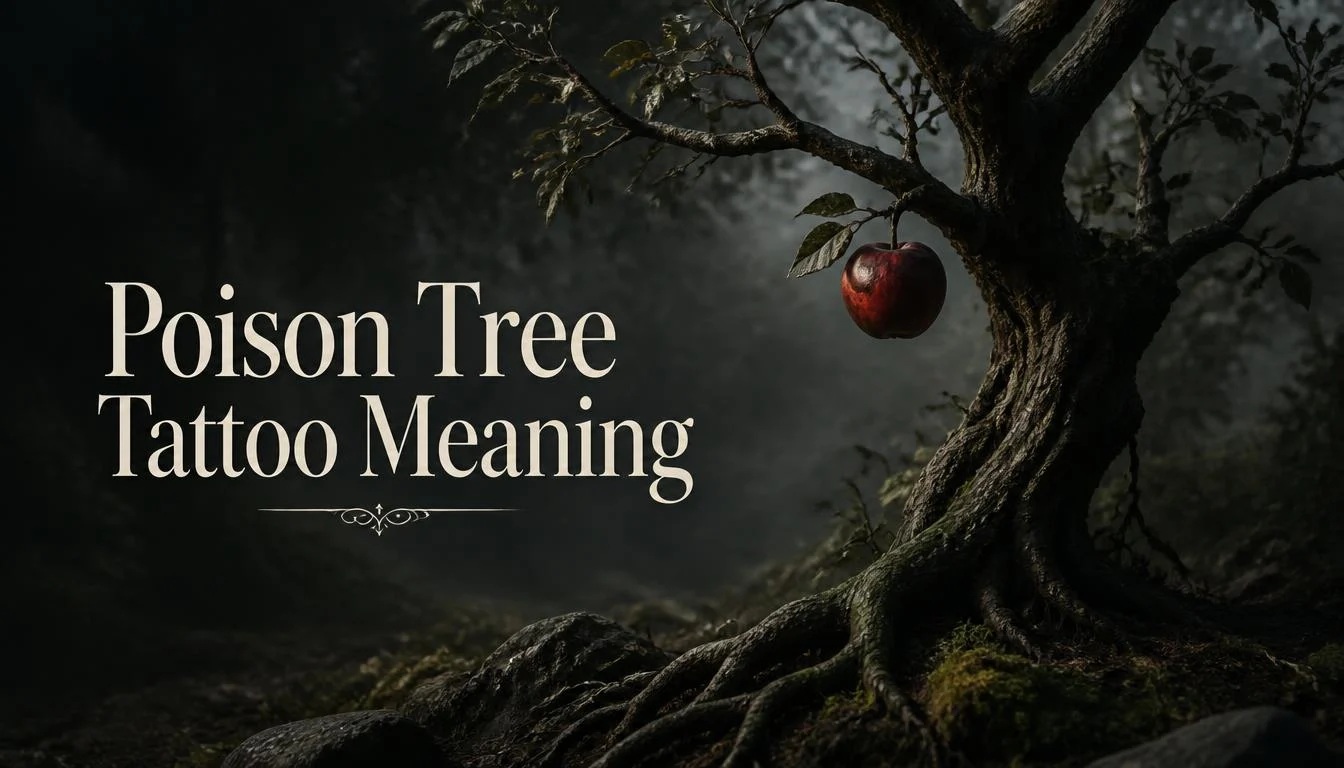
The Poison Tree Tattoo Meaning is often connected to emotions that are kept hidden instead of being expressed. It can represent anger, resentment, betrayal, or pain that slowly grows over time. The design is inspired by the idea of a tree that produces poisonous fruit from negative emotions. For many people, it reflects a personal experience or difficult chapter in life.
A poison tree tattoo can also carry a deeper message about consequences and emotional growth. Its roots may represent painful experiences while its branches show how those feelings develop over time. The fruit can symbolize the final outcome of anger, revenge, or unresolved emotions. Because of this, the tattoo can have both a dark meaning and a powerful reminder to let go.
What Does a Poison Tree Tattoo Mean?
A poison tree tattoo usually carries a darker message than an ordinary tree design. Instead of representing growth, family roots, peace, or renewal, it can portray what happens when negative emotions are allowed to take root.
The central idea is unresolved emotion that grows over time. Anger may begin as something small, but silence, resentment, fear, and repeated memories can make it feel much larger. The tree becomes a visual metaphor for that process.
This interpretation comes primarily from William Blake’s “A Poison Tree.” In the poem, the speaker explains that anger toward a friend ends after it is expressed. Anger toward an enemy, however, is hidden, and the speaker describes it as growing until it produces a bright apple.
That gives the tattoo an unusual emotional contrast. A tree normally suggests life and growth, while the word “poison” changes the direction of that growth. Something is developing, but it is developing into something harmful.
It is also important not to treat this as a universal tattoo dictionary definition. Tattoos are personal symbols. One person may use the image to represent resentment, while another may use it as a reminder not to repeat an unhealthy emotional pattern.
The William Blake Connection
The most recognizable literary source behind this tattoo is English poet, artist, and printmaker William Blake.
His poem “A Poison Tree” belongs to Songs of Experience, a collection associated with Blake’s exploration of darker and more difficult aspects of human experience. The University of Toronto’s Representative Poetry Online identifies the poem as part of Blake’s 1794 Songs of Experience.
The poem is only 16 lines long, arranged into four four-line stanzas. Its simple structure makes the central metaphor particularly memorable.
The opening establishes the important contrast. The speaker is angry with a friend and communicates that anger. The emotion ends. When the speaker is angry with a foe and chooses not to express it, the anger grows instead.
Blake then turns that emotional growth into a tree.
The speaker describes watering it with fears and tears and giving it sunlight through smiles and deceptive behavior. Eventually, the tree bears a bright apple. The poem ends with the enemy lying beneath the tree.
That progression explains why the image works so well as body art. A single tree can represent an entire emotional story without requiring a long quotation or explanation.
What the Tree Symbolizes
The tree itself represents growth, but not necessarily healthy growth.
In Blake’s poem, the tree grows because the speaker continually feeds the underlying anger. This makes the roots especially meaningful in tattoo artwork. Deep roots can suggest emotions that have existed for a long time or memories that remain buried beneath the surface.
Branches can carry a different interpretation. They may represent how one unresolved emotion spreads into other areas of life. Anger can influence relationships, decisions, memories, and the way someone views another person.
The trunk can represent endurance. It stands through the entire process of emotional growth, connecting the hidden roots with the eventual fruit.
This is where the image becomes more interesting than a simple “dark tattoo.” The tree is not merely dangerous. It represents a process.
- Something begins.
- Something is fed.
- Something grows.
Then consequences appear.
That sequence is the heart of the symbol.
What the Poisoned Fruit Represents
The fruit is often the most important detail in a poison tree design.
In Blake’s poem, the tree produces an apple that attracts the speaker’s enemy. The fruit looks appealing, but its connection with the tree makes it dangerous. The University of Toronto edition also notes the poem’s connection with the Tree of the Knowledge of Good and Evil from Genesis.
Because of this literary background, an apple can add several layers to the tattoo.
- It may represent temptation.
- It may represent revenge.
- It may represent consequences.
- It can also represent something that appears beautiful while hiding something harmful underneath.
A bright red apple against a dark tree therefore creates more than visual contrast. It can show the difference between appearance and reality.
That contrast is especially useful when someone wants a tattoo that reflects a complicated experience rather than a simple positive or negative message.
Common Symbolic Elements and Their Possible Meanings
There is no official symbolism chart for poison tree tattoos. Still, different visual elements can change the way viewers understand the design.
| Tattoo Element | Possible Interpretation | Literary Connection |
|---|---|---|
| Twisted tree | Inner conflict or emotional turmoil | Reflects the unnatural growth of the metaphorical tree |
| Deep roots | Buried feelings or a long emotional history | Anger growing beneath the surface |
| Poisoned apple | Consequences, temptation, or revenge | Directly connected to Blake’s poem |
| Bare branches | Loss, isolation, or emotional exhaustion | Can reinforce the poem’s darker atmosphere |
| Thorns | Defense, pain, or emotional boundaries | Fits the idea of something dangerous developing |
| New leaves | Recovery or transformation | A modern interpretation beyond Blake’s ending |
| Snake | Deception or temptation | Adds a broader symbolic layer rather than a direct Blake reference |
| Flowers | Renewal or change | Creates a contrast between beauty and darker imagery |
These meanings should be treated as interpretations, not fixed rules. A tattoo featuring an apple does not automatically mean revenge, just as flowers do not automatically mean healing.
The person wearing the tattoo ultimately determines its personal meaning.
Poison Tree Tattoo vs. Tree of Life Tattoo
The two designs can look visually related because both use a tree as their central image. Their symbolic direction, however, can be very different.
| Feature | Poison Tree Tattoo | Tree of Life Tattoo |
|---|---|---|
| Main theme | Hidden conflict and consequences | Life, connection, and growth |
| Emotional tone | Darker and more introspective | Often hopeful and uplifting |
| Roots | Buried emotions or past experiences | Family, ancestry, or grounding |
| Fruit | Temptation or consequence | Often abundance or renewal |
| Branches | Emotional spread or conflict | Connection and expansion |
| Literary association | William Blake’s “A Poison Tree” | Appears in several religious and cultural traditions |
| Personal message | A warning, memory, or emotional lesson | Continuity, identity, or belonging |
This contrast does not mean every poison tree tattoo is negative. A person may intentionally combine both concepts to show two sides of personal experience.
For example, a tree with dark roots but fresh leaves could suggest that difficult experiences remain part of someone’s history without controlling their future.
The Difference Between Anger and Revenge
One subtle point is often missed when discussing this design.
The original poem is not simply about being angry.
It is about what happens when anger is nurtured rather than addressed.
The speaker does not merely experience anger and then forget it. The poem describes deliberately feeding the emotion through fear, tears, smiles, and deceptive behavior. The result becomes destructive.
That makes revenge one possible interpretation, but it should not replace the broader idea of unresolved anger.
Someone could choose this tattoo because they have learned how destructive a grudge can become. They may not be celebrating revenge at all. The design could instead serve as a permanent warning against becoming consumed by resentment.
That distinction matters.
A dark image does not automatically mean the wearer supports the darker behavior represented in it.
How a Poison Tree Tattoo Can Represent Healing
The original Blake poem ends on a disturbing note, but modern tattoo symbolism does not have to stop there.
A person might choose a poison tree after surviving a difficult relationship, betrayal, conflict, or period of intense anger. In that situation, the tree can become a record of what happened rather than a celebration of bitterness.
Design choices can shift that message.
A tree with damaged bark and fresh leaves might represent recovery after hardship. A dead apple beside new growth could suggest that an old source of pain no longer controls the person. Open branches can create a sense of release instead of confinement.
This interpretation is not the literal conclusion of Blake’s poem. It is a modern personal reading of the image.
That difference is important because the original literary meaning and a modern tattoo wearer’s private meaning do not have to be identical.
Why the Design Feels So Personal
Trees already carry strong associations with time, memory, family, roots, and growth. Adding poison creates tension between those familiar ideas and something dangerous.
That tension gives the design room for personal interpretation.
Someone might see the roots as childhood experiences. Someone else might see them as a past relationship. Another person might connect the fruit with a decision that had serious consequences.
The same artwork can therefore communicate very different stories.
This is also why adding words can sometimes be unnecessary. A tree, apple, roots, and branches can communicate the concept visually. A viewer familiar with Blake may recognize the reference immediately, while someone unfamiliar with the poem can still understand the broader idea of something beautiful carrying danger.
Literary References Behind the Imagery
William Blake is the clearest reference, but the imagery can also remind viewers of other well-known stories.
The Tree of the Knowledge of Good and Evil in Genesis is one relevant literary and religious association. The University of Toronto’s edition of Blake’s poem specifically points to this connection when discussing the apple and the tree.
The poisoned apple can also remind modern audiences of Snow White, where an apple is used as a vehicle for poison. That association is not the source of Blake’s poem, but it can influence how contemporary viewers interpret a tattoo featuring a dark tree and dangerous fruit.
These references should not be treated as interchangeable. Blake’s poem is specifically concerned with anger, resentment, deception, and destructive consequences. The Genesis story and Snow White carry different narratives.
A tattoo may borrow visual associations from several sources without having one single literary origin.
Five Real References to Know
If you want to understand this tattoo beyond surface-level symbolism, these named references provide useful context:
- William Blake The English poet and artist who wrote “A Poison Tree.”
- A Poison Tree Blake’s 16-line poem about anger that grows when it remains unspoken.
- Songs of Experience The Blake collection in which the poem was published in 1794.
- Poetry Foundation A recognized literary organization that publishes the text of Blake’s poem and categorizes it under themes including anger, relationships, and friendship.
- Representative Poetry Online at the University of Toronto Its scholarly edition identifies the poem’s 1794 publication information and provides notes on its imagery, including the biblical tree connection.
These references help separate the established literary history from newer interpretations that have developed around tattoo culture.
What Different Designs Can Say
The overall message can change dramatically depending on how the artist draws the tree.
- A bare poison tree can emphasize loss, isolation, or emotional emptiness.
- A tree with one bright apple can place attention on temptation and consequence.
- A tree with exposed roots can make the idea of buried emotions more obvious.
- A tree surrounded by thorns can suggest pain and emotional protection.
- A tree with both dead and living branches can communicate a transition between an old experience and a new stage of life.
A poison tree with flowers can create a deliberate contradiction. The design may suggest that beauty and pain can exist together.
A tree with an open garden can also change the feeling. Instead of looking trapped, the wearer may be suggesting that the past has been acknowledged and left behind.
None of these visual choices has a universal tattoo definition. Their value comes from how well they match the story the wearer wants to tell.
Is a Poison Tree Tattoo Always About a Toxic Person?
No.
The imagery is often associated with toxicity, resentment, or difficult relationships, but the symbol can point inward as well.
A person may be reflecting on their own anger rather than accusing someone else. They may be acknowledging a period when they held onto resentment. They may also use the tattoo as a reminder to communicate instead of allowing difficult emotions to accumulate.
That makes the design more reflective than simply blaming.
In Blake’s poem, the speaker’s own actions are central to the story. The anger is not presented as something that simply happens to the speaker. The speaker feeds it, hides it, and watches it grow.
For that reason, a Blake-inspired tattoo can symbolize self-reflection as much as conflict with another person.
FAQs
Does a poison tree tattoo have one official meaning?
No. There is no universal tattoo authority that assigns one fixed definition to the design. Its strongest established literary association is Blake’s “A Poison Tree,” but individual wearers can give the imagery their own meaning.
Is the poison tree tattoo connected to William Blake?
Often, yes. William Blake’s poem is the clearest literary source for the modern symbolism of a tree connected with hidden anger, poisoned fruit, and destructive consequences. The poem was published in Songs of Experience in 1794.
What does a poison apple mean in this tattoo?
A poison apple can represent temptation, danger, revenge, or consequences. When the design specifically references Blake, the apple connects to the result of anger that has been secretly nurtured.
Can a poison tree tattoo have a positive meaning?
Yes. Someone can use the image to represent awareness, recovery, or a decision to stop feeding resentment. These are personal modern interpretations rather than the literal ending of Blake’s poem.
Is a poison tree an actual tree species?
Not necessarily. In the tattoo context, “poison tree” is primarily a symbolic phrase rather than the name of one specific botanical species. The tattoo concept is most strongly associated with Blake’s metaphorical tree.
Why is an apple often included in the design?
The apple comes directly from Blake’s poem, where the metaphorical tree eventually produces a bright apple. Because that fruit is central to the poem’s final events, it can make a tattoo reference Blake much more clearly than a generic dark tree would.
Conclusion
A poison tree tattoo turns a simple natural image into a story about emotion, growth, and consequences. Its strongest literary foundation is William Blake’s “A Poison Tree,” where hidden anger develops into something destructive.
For a modern wearer, the design can also mark survival, self-reflection, or a decision to leave resentment behind. The most meaningful version is usually the one whose roots, branches, and fruit connect to a personal story rather than a fixed definition.









