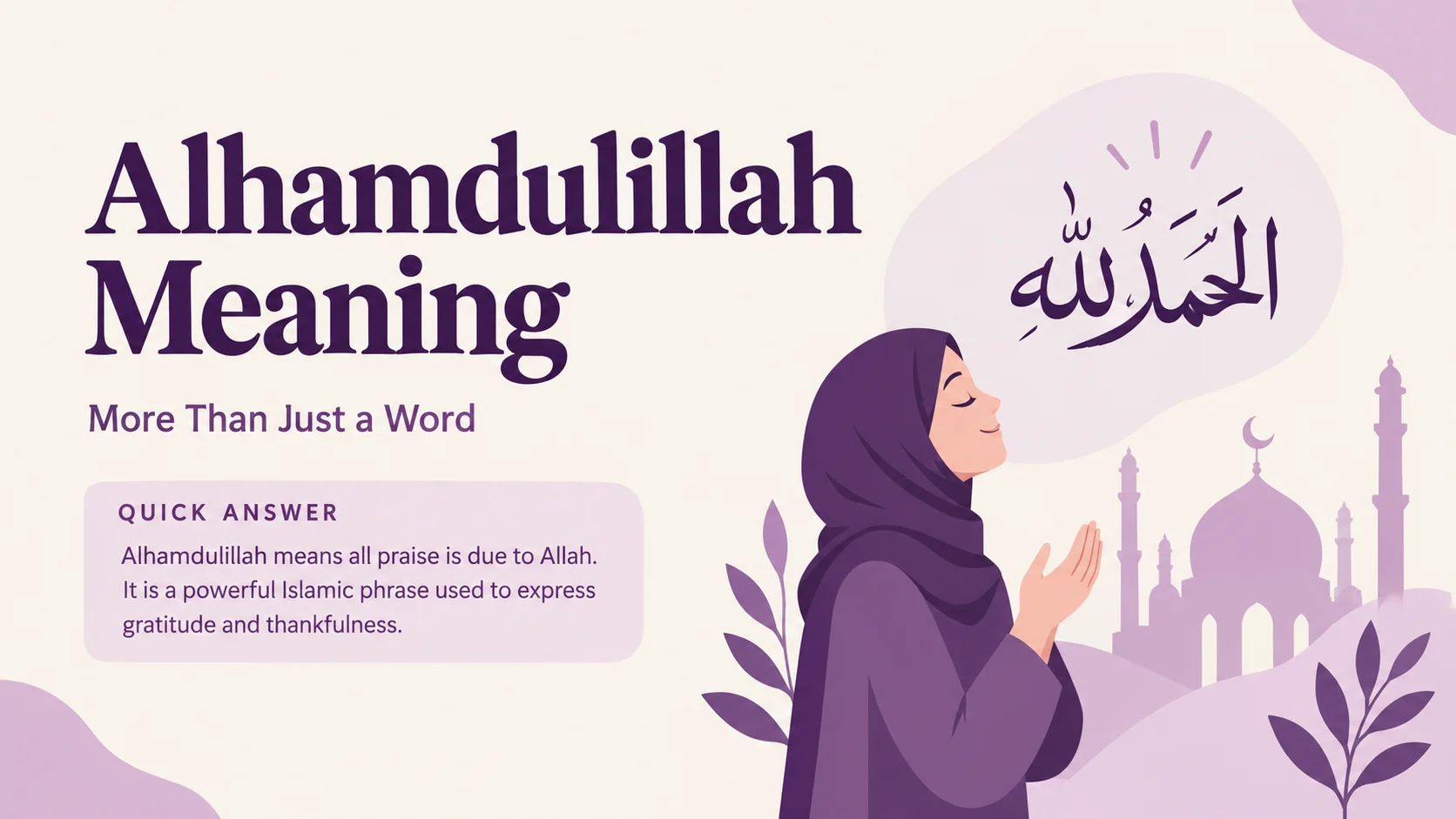
Quick Answer:
Alhamdulillah meaning is “all praise is due to Allah” or “all praise belongs to Allah.” Muslims use this phrase to praise Allah and express gratitude for His blessings, mercy and guidance. It can be said during happy moments as well as difficult times.
Alhamdulillah Meaning is rooted in the Arabic words Al-hamdu lillah, which translate to “all praise belongs to Allah.” It is a common phrase used by Muslims around the world. People say it when expressing gratitude or acknowledging a blessing.
Alhamdulillah Meaning can also convey relief, contentment or thankfulness in everyday situations. Someone may say it after receiving good news or when asked how they are doing. The phrase reflects gratitude and recognition of Allah’s role in one’s life.
What Does Alhamdulillah Mean?
The meaning of Alhamdulillah is closely connected with praise and gratitude toward Allah. It is one of the most familiar expressions used by Muslims in everyday conversation. A person may say it after receiving good news or when simply appreciating the blessings in life.
The phrase is written in Arabic as الحمد لله. In English it is commonly translated as “Praise be to Allah” or “All praise is due to Allah.” Both translations communicate the central idea of recognizing Allah as the source of goodness and expressing thankfulness to Him.
The Alhamdulillah definition can therefore be understood in a simple way. It is an expression of praise directed toward Allah. It also carries a strong sense of gratitude because Muslims recognize that their blessings ultimately come from Him.
Alhamdulillah Meaning in English
The Alhamdulillah meaning in English is generally given as “All praise is due to Allah.” Another common translation is “Praise be to Allah.”
The phrase contains an important spiritual idea. It does not simply mean saying thank you for one particular thing. It recognizes Allah as deserving of praise in every situation.
The Alhamdulillah translation can vary slightly depending on the context. Some translations focus on praise while others emphasize gratitude. Neither approach captures every layer of the Arabic expression by itself.
The Alhamdulillah phrase meaning becomes clearer when it is understood as both praise and thankfulness. It is a way of acknowledging Allah with appreciation and devotion.
Alhamdulillah Arabic Meaning
The Alhamdulillah Arabic meaning comes from the original Arabic phrase الحمد لله.
The word “hamd” relates to praise and commendation. “Allah” refers to God in Islam. The phrase therefore conveys the idea that praise belongs to Allah.
This is why Alhamdulillah in English is often translated as “all praise is due to Allah.” It expresses a relationship between the believer and Allah rather than simply describing an emotion.
The phrase can be written in several English forms. Al Hamdulillah meaning and Alhamdu lillah meaning refer to the same Arabic expression. These variations usually come from different ways of representing Arabic words using English letters.
Alhamdulillah Meaning in Islam
The Alhamdulillah meaning in Islam has deep religious significance. Muslims use the phrase to acknowledge Allah’s greatness and express gratitude for His blessings.
It is not limited to one particular situation. A Muslim may say Alhamdulillah after receiving something they hoped for. They may also say it when discussing ordinary blessings such as family, health, food, safety or another moment of happiness.
The Islamic meaning of Alhamdulillah also involves recognizing that praise ultimately belongs to Allah. This understanding encourages humility because a person does not view blessings only as the result of personal effort.
At the same time, saying Alhamdulillah does not mean that a person cannot feel sadness or difficulty. Muslims can acknowledge hardship while still expressing faith and gratitude.
Alhamdulillah Meaning in the Quran
The phrase Alhamdulillah meaning in Quran is especially important because the Quran begins with the famous words Alhamdu lillahi Rabbil Alamin in Surah Al Fatiha.
This expression is commonly translated as “All praise is due to Allah, Lord of the worlds.” It establishes praise of Allah at the beginning of one of the most important chapters of the Quran.
The Quran also contains the phrase in other places. For Muslims, this gives Alhamdulillah a strong connection with worship and remembrance of Allah.
Understanding the phrase through its Quranic context helps explain why it is so common in Muslim speech. It is not merely a cultural expression. It has a clear place within Islamic religious language.
What Does Alhamdulillah Express?
Saying Alhamdulillah can express several related ideas. The most obvious is gratitude. A person may use it to show appreciation for something good that has happened.
It can also express praise. The speaker is not simply thanking Allah for a particular blessing. They are recognizing Allah as worthy of praise.
Another important idea is contentment. Saying Alhamdulillah can remind a person to notice what they already have instead of focusing only on what they lack.
For this reason, Alhamdulillah and gratitude are closely connected. The phrase can become a simple daily reminder to appreciate blessings.
When to Say Alhamdulillah
Many people wonder when to say Alhamdulillah in everyday life. There is no need to wait for a special occasion.
A person may say it after receiving good news. For example, someone who learns that they passed an exam might say Alhamdulillah to express gratitude.
It may also be used after eating or drinking. Muslims commonly praise Allah for the food and blessings they have received.
Another situation is when someone asks how you are doing. A Muslim might answer “Alhamdulillah” to express that they are thankful to Allah.
The phrase can also be used after completing an important task. It can express appreciation for the ability and opportunity to accomplish it.
How to Use Alhamdulillah
Learning how to use Alhamdulillah is simple because the phrase fits naturally into many conversations.
For example:
- “I finished my work today. Alhamdulillah.”
- “Alhamdulillah, I received good news.”
- “Alhamdulillah, everyone is safe.”
- “Alhamdulillah for another beautiful day.”
These examples show how the phrase can appear in different contexts. It can be used as a complete response or as part of a longer sentence.
The important point is understanding what you are expressing. Saying Alhamdulillah means directing praise and gratitude toward Allah.
Why Do Muslims Say Alhamdulillah?
A common question is why do Muslims say Alhamdulillah so often.
One reason is that gratitude is an important part of Islamic faith. Muslims are encouraged to recognize the blessings they receive and remember Allah.
The phrase also keeps remembrance of Allah present in everyday life. Something as ordinary as receiving food or hearing good news can become an opportunity to express gratitude.
There is also a spiritual aspect to the expression. Alhamdulillah and thankfulness can help a person focus on blessings rather than taking them for granted.
This does not mean that Muslims ignore problems. Rather, the phrase can coexist with patience during difficult circumstances.
Alhamdulillah for Everything
The expression Alhamdulillah for everything is widely used among Muslims. It reflects the idea of remaining grateful to Allah in different circumstances.
When something good happens, Alhamdulillah can express happiness and gratitude. When something difficult happens, it can reflect faith, patience and trust in Allah.
This does not mean that every difficult event is viewed as pleasant. A person can experience pain or disappointment while still maintaining faith.
In this sense, Alhamdulillah can become a reminder that gratitude is not dependent only on immediate circumstances.
Alhamdulillah for Blessings
The phrase Alhamdulillah for blessings reflects a simple habit of recognizing what Allah has provided.
Blessings can be obvious or easy to overlook. Food, shelter, family, friendship, knowledge, safety and opportunities can all become reasons for gratitude.
People sometimes notice their blessings most clearly when something changes. A routine ability may suddenly feel valuable when it is temporarily unavailable.
Saying Alhamdulillah encourages awareness of these everyday gifts. It can turn ordinary moments into opportunities for reflection.
Alhamdulillah After Good News
Many Muslims say Alhamdulillah after good news because good news naturally creates a feeling of gratitude.
Someone might receive a new job, complete an important goal or hear positive news about a family member. Saying Alhamdulillah allows them to acknowledge Allah while celebrating the moment.
- For example, a person might say:
- “Alhamdulillah, I got the job.”
- “Alhamdulillah, my exam went well.”
- “Alhamdulillah, everything worked out.”
The phrase adds a spiritual dimension to these ordinary moments.
Alhamdulillah When Thankful
Alhamdulillah when thankful is one of the most natural uses of the expression.
A person does not need a complicated reason to say it. Sometimes simply recognizing a peaceful moment can inspire gratitude.
It can be helpful to pause and notice what is going well. Saying Alhamdulillah can provide a simple way to acknowledge that appreciation.
This is why the phrase is heard so frequently in Muslim communities. It fits both formal religious settings and ordinary daily conversations.
Alhamdulillah After Sneezing
Another familiar use appears after sneezing. In Islamic practice, a Muslim says “Alhamdulillah” after sneezing.
This is part of a well known etiquette related to sneezing. When another Muslim hears the person say Alhamdulillah, they may respond with “Yarhamukallah,” meaning “May Allah have mercy on you.”
The person who sneezed can then respond with “Yahdikumullahu wa yuslihu balakum,” commonly understood as a prayer that Allah guides you and improves your condition.
This is one reason many people first encounter Alhamdulillah in childhood. It becomes part of everyday Islamic manners.
Alhamdulillah and Gratitude in Daily Life
The connection between Alhamdulillah and gratitude goes beyond simply saying a phrase.
Gratitude can influence how a person looks at ordinary experiences. Instead of seeing every blessing as something automatically owed to them, they can recognize it as something valuable.
A person might say Alhamdulillah after a meal. They might say it when spending time with family or when reaching home safely.
These small moments can make gratitude part of a daily routine. The phrase becomes a verbal reminder of appreciation.
Alhamdulillah and Thankfulness
Alhamdulillah and thankfulness are closely related but the phrase has a deeper religious meaning than the simple English word “thanks.”
When someone says “thank you,” they are usually thanking another person for a particular action. When a Muslim says Alhamdulillah, they are praising Allah and acknowledging Him as the ultimate source of blessings.
This distinction helps explain why direct translations can sometimes feel incomplete. The phrase carries religious meaning that goes beyond one English word.
Praise Be to Allah Meaning
The praise be to Allah meaning is one of the simplest ways to understand Alhamdulillah.
It expresses praise directed toward Allah. It can also communicate gratitude for His blessings.
The phrase is often used when discussing good events. However, its meaning is broader than happiness alone.
A Muslim can praise Allah in many different circumstances. The expression can therefore represent faith, gratitude, praise and remembrance.
All Praise Is Due to Allah
The phrase all praise is due to Allah is another common translation.
This translation emphasizes that Allah deserves praise. It is particularly familiar to people who have read English translations of the Quran.
The wording also explains why Alhamdulillah is more than a casual expression of thanks. It carries an element of worship and recognition.
When Muslims say Alhamdulillah, they are acknowledging Allah with words of praise.
All Praise Belongs to Allah
The phrase all praise belongs to Allah communicates the same central idea.
Different English translations may use slightly different wording. Some say “Praise be to Allah.” Others say “All praise is due to Allah.”
These translations can all help English speakers understand the basic concept. The original Arabic remains the source expression.
The important meaning is that praise is directed toward Allah.
Gratitude to Allah
Gratitude to Allah is an important concept within Islamic life.
Muslims express gratitude through words such as Alhamdulillah. Gratitude can also be reflected through actions, worship and responsible use of blessings.
Saying Alhamdulillah is therefore one part of a broader attitude of thankfulness.
It can remind a person that blessings should not simply be noticed. They should also inspire appreciation and humility.
Praising Allah
Praising Allah is at the heart of the phrase Alhamdulillah.
The word “hamd” refers to praise with appreciation. This gives the expression a broader meaning than a simple statement of thanks.
When someone says Alhamdulillah, they are praising Allah while recognizing His blessings.
This is why the phrase appears naturally in prayers, religious discussions and everyday conversations among Muslims.
Expressing Gratitude in Islam
Expressing gratitude in Islam can take many forms. Words are one of the simplest forms.
Alhamdulillah provides a short and meaningful way to verbally acknowledge Allah. It can be said privately or as part of a conversation.
Gratitude can also be shown through good actions and responsible behavior. In this way, thankfulness becomes something that influences a person’s daily life.
The phrase serves as a reminder that gratitude is not limited to special occasions.
Significance of Alhamdulillah
The significance of Alhamdulillah comes from its combination of praise and gratitude.
It is short enough to say in a few seconds. Yet its meaning connects everyday experiences with faith.
For many Muslims, the phrase is part of ordinary speech. It can appear naturally when answering a question, sharing news or appreciating a blessing.
Its frequent use also keeps remembrance of Allah present throughout the day.
Importance of Alhamdulillah
The importance of Alhamdulillah can be understood through its role in Islamic worship and daily life.
It reminds Muslims to recognize blessings. It also encourages humility because the believer acknowledges Allah rather than viewing every success as purely personal.
The phrase can become especially meaningful during difficult periods. It may help a person maintain patience and remember that faith is not based only on comfortable circumstances.
This makes Alhamdulillah a powerful expression of Islamic gratitude.
Benefits of Saying Alhamdulillah
The benefits of saying Alhamdulillah are often discussed in terms of spiritual awareness and gratitude.
First, it encourages a person to notice blessings. Many good things in life become invisible when they are treated as ordinary.
Second, it keeps remembrance of Allah present in everyday moments. A simple phrase can connect routine experiences with faith.
Third, it can encourage humility. A person recognizes that blessings are not something to take for granted.
These benefits are best understood as spiritual practices rather than guaranteed emotional or worldly results.
Alhamdulillah in Everyday Life
Alhamdulillah in everyday life can be heard in many different situations.
Someone may say it after waking up. Another person may use it after finishing a meal or receiving a message from a loved one.
It can also appear in social media posts, text messages and casual conversations.
For Muslims, this everyday use reflects how faith can remain connected with ordinary experiences. A short phrase can carry a meaningful reminder throughout the day.
Alhamdulillah in Muslim Culture
Alhamdulillah in Muslim culture is widespread across different countries and communities.
Muslims speak many languages and come from diverse cultural backgrounds. Yet Arabic Islamic expressions such as Alhamdulillah are commonly recognized across these communities.
The pronunciation may vary slightly because different languages have different sound systems. The central meaning remains the same.
You may hear Alhamdulillah in homes, schools, workplaces, religious gatherings and online conversations.
Common Islamic Phrases Related to Alhamdulillah
Alhamdulillah is one of several common Islamic phrases that Muslims use in everyday life.
“SubhanAllah” is commonly used to express glorification of Allah.
“Allahu Akbar” means “Allah is the Greatest.”
“InshaAllah” means “if Allah wills.”
“MashaAllah” is commonly used when expressing admiration while acknowledging Allah’s will.
These expressions have their own meanings and contexts. Understanding them can make Islamic conversations easier to follow.
How Do You Pronounce Alhamdulillah?
The Alhamdulillah pronunciation is commonly represented as:
Al ham doo lil lah
The exact pronunciation can vary slightly depending on the speaker’s language and accent.
The Arabic form is:
الحمد لله
The Alhamdulillah transliteration can also appear as “Alhamdu lillah,” “Al Hamdulillah” or “Alhamdulillah.”
These spellings represent the same phrase. The differences usually come from different approaches to transliterating Arabic into English.
Is Alhamdulillah Only Used for Good Things?
No. Alhamdulillah is commonly used after good news and blessings but its meaning is broader.
A Muslim may say Alhamdulillah during difficult circumstances as an expression of faith and gratitude.
This does not mean that the person is denying sadness or difficulty. Rather, they are maintaining a connection with Allah while dealing with the situation.
The phrase can therefore express gratitude in both comfortable and challenging moments.
FAQs
1. What does Alhamdulillah mean?
Alhamdulillah means “all praise is due to Allah” or “praise be to Allah.” Muslims use it to express praise and gratitude toward Allah for His blessings, mercy and guidance.
2. What is the Alhamdulillah meaning in English?
The Alhamdulillah meaning in English is commonly translated as “all praise is due to Allah.” It can also be translated as “praise be to Allah” or “all praise belongs to Allah.”
3. What is the Alhamdulillah meaning in Islam?
The Alhamdulillah meaning in Islam refers to praising and thanking Allah. Muslims use this phrase to recognize Allah’s blessings and express gratitude in both everyday and religious settings.
4. When should you say Alhamdulillah?
You can say Alhamdulillah when you receive good news, experience a blessing or feel thankful. Muslims may also say it during difficult situations as an expression of faith, patience and gratitude.
5. What does Alhamdulillah mean in Arabic?
The Arabic phrase الحمد لله means “all praise is due to Allah.” The word “hamd” is associated with praise and appreciation while “Allah” refers to God in Islam.
6. Why do Muslims say Alhamdulillah?
Muslims say Alhamdulillah to praise Allah and express gratitude. It is also a way of remembering Allah during ordinary moments and acknowledging that blessings ultimately come from Him.
7. What does Alhamdulillah for everything mean?
“Alhamdulillah for everything” expresses gratitude to Allah in different circumstances. It can reflect appreciation during good times and faith and patience during challenging situations.
8. How do you pronounce Alhamdulillah?
Alhamdulillah is commonly pronounced approximately as al ham doo lil lah. The Arabic spelling is الحمد لله and English transliterations can vary slightly.
Conclusion
The Alhamdulillah meaning goes beyond a simple translation such as “thank God.” It is an expression of praise, gratitude and remembrance directed toward Allah.
From everyday conversations to Quranic language, Alhamdulillah has an important place in Muslim life. Understanding its meaning makes the phrase more meaningful when you hear or use it.
Whether someone says it after good news or during a difficult moment, the expression reflects an awareness of Allah and appreciation for His blessings. That simple reminder is what gives Alhamdulillah its lasting significance.









