Quick Answer
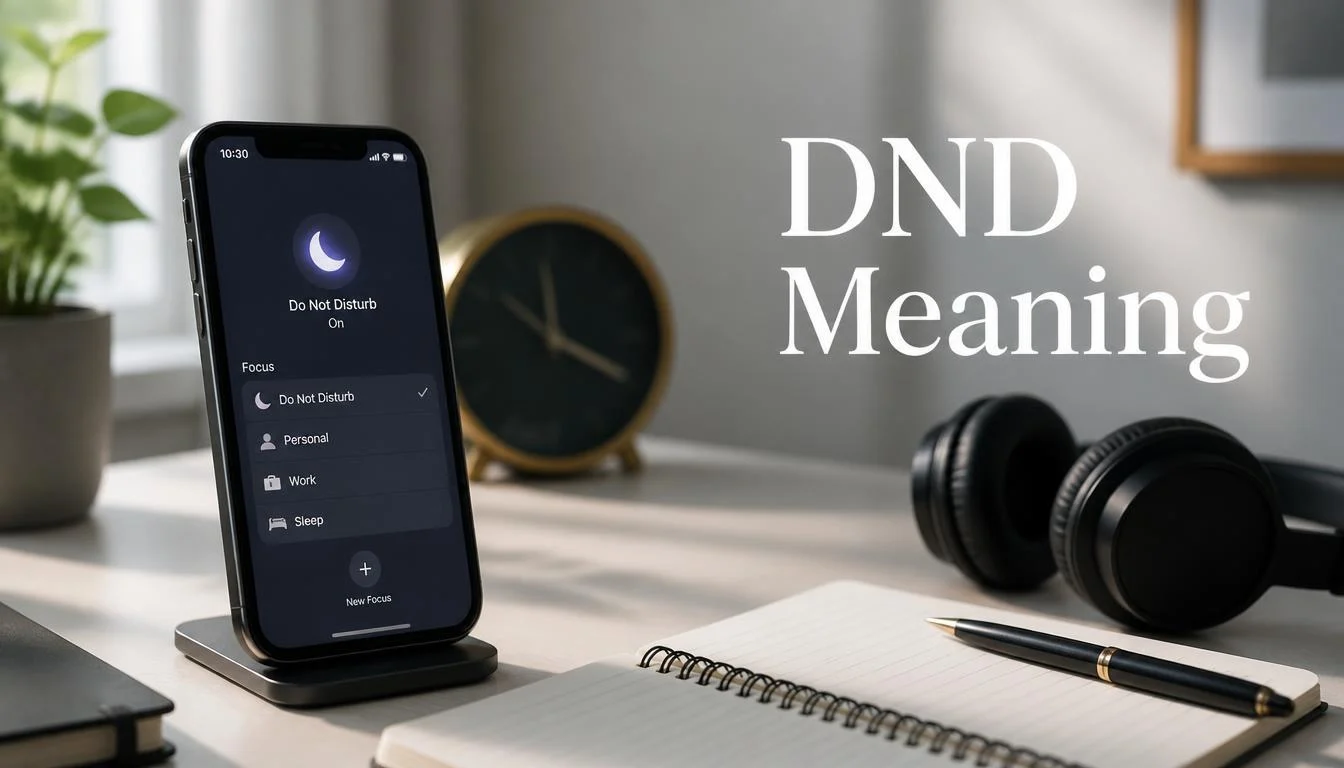
DND Meaning usually refers to “Do Not Disturb” in texting and digital communication. It signals that someone does not want calls, messages or notifications for a while. In gaming, DND can also mean Dungeons & Dragons.
The DND Meaning can change depending on where you see it, but it most commonly stands for “Do Not Disturb” in text messages and online chats. People use this abbreviation when they need some quiet time, want to focus on work or prefer not to receive interruptions. It is a simple way to communicate that they may not respond immediately.
You might see DND in text conversations, phone settings, social media posts or gaming communities. While it usually means “Do Not Disturb” in everyday communication, it can also refer to Dungeons & Dragons, a popular tabletop role-playing game. Understanding the context helps you identify which meaning fits the conversation.
What Does DND Mean?
DND is an abbreviation for Do Not Disturb. In everyday digital communication, it works as a short way to tell someone that you do not want interruptions at the moment.
The phrase can describe an actual phone or app setting. It can also describe a person’s availability. Someone might say, “I’m on DND,” even when they are using their phone normally but do not want calls or messages pulling their attention away.
This is what makes the abbreviation useful. Three letters can communicate a complete boundary without requiring a long explanation.
For example:
- “On DND, studying for my exam.”
- “I’ll be on DND during the meeting.”
- “Sorry, I had DND on.”
- “DND until tomorrow morning.”
- “Please call twice if it’s urgent.”
The meaning is usually straightforward, but the tone can change depending on the situation. A message such as “DND, working” sounds practical. A short “DND” sent during an argument may feel much firmer.
DND in Text Messages and Online Chats
In texting, people generally use DND when they want to manage expectations about a delayed response.
It does not necessarily mean that someone is ignoring you. They may be sleeping, studying, working, driving, exercising, attending a meeting, or simply taking a break from notifications.
Consider this exchange:
Friend: “Are you free to talk?”
Reply: “Not right now. DND until 8.”
The message means the person does not want to be interrupted until around 8 o’clock. It is less about rejecting the person and more about setting a temporary communication boundary.
You may also see the abbreviation used as a status rather than a direct message. Someone could put “DND” in a profile status, group-chat note, or workplace messaging app to indicate that they are not currently available.
The important clue is what surrounds the abbreviation. Words such as “study,” “meeting,” “sleep,” “work,” “phone,” and “notifications” strongly point toward Do Not Disturb.
Common Ways People Use DND
Although the basic idea remains the same, people use the abbreviation in several everyday situations.
1. To Show That They Are Busy
A person may write “DND” when they are occupied and do not want to answer messages immediately.
For example:
“DND for the next two hours. Finishing a project.”
Here, the abbreviation gives the reader a simple expectation: do not wait for an immediate reply.
2. To Protect Study or Work Time
Students and professionals often need uninterrupted periods for concentration.
A message such as “DND, I’m studying” is usually not hostile. It simply signals that notifications could interfere with the task at hand.
The same idea works in a workplace:
“Going DND for an hour to finish the report.”
The person may still be online, but they are temporarily limiting interruptions.
3. To Indicate Sleep or Rest
DND is also common when someone wants to sleep.
For instance:
“Phone on DND. Good night!”
In this context, the phrase usually means the person does not want calls, alerts, or messages disturbing their sleep.
4. To Set a Personal Boundary
Sometimes the abbreviation is less about a device setting and more about personal space.
Someone might say:
“I need some time alone. DND today.”
Here, the person is communicating a boundary rather than simply describing a technical setting.
The tone depends heavily on the relationship between the people involved. Between close friends, it may sound casual. In a tense conversation, the same phrase can sound more direct.
DND as a Phone or Device Setting
Do Not Disturb is also a real feature built into modern digital devices and communication systems.
The basic purpose is to reduce unwanted interruptions by controlling how calls, alerts, and notifications reach the user. Exact behavior depends on the device and the settings selected by the owner.
For example, a person can configure DND to remain active during sleeping hours or during a scheduled period of focused work.
This explains why the abbreviation moved naturally from technology into everyday language. Instead of saying, “My phone is currently configured to suppress notifications,” people simply say, “My phone is on DND.”
The phrase has therefore developed two closely connected uses:
- Technical: a device or app is using a Do Not Disturb setting.
- Social: a person is asking others not to interrupt them.
These meanings overlap, but they are not identical.
Someone can be on DND while actively using their phone. Likewise, someone can say “DND” simply because they want privacy even if they have not activated a formal device setting.
DND vs. D&D: Why the Difference Matters
One of the easiest mistakes is confusing DND with D&D, particularly in gaming communities.
D&D stands for Dungeons & Dragons, the tabletop role-playing game originally created by Gary Gygax and Dave Arneson. Players create characters, interact with a fictional world, make decisions, and use dice and rules to determine the outcomes of many actions.
The two abbreviations can look similar in casual writing, especially when punctuation is omitted.
| Abbreviation | Meaning | Common Context | Typical Clues |
|---|---|---|---|
| DND | Do Not Disturb | Texting, phones, social media, work chats | Notifications, sleep, meetings, studying |
| D&D / DnD | Dungeons & Dragons | Tabletop gaming, Discord, fantasy communities | Dice, campaign, character, Dungeon Master |
| DND | Department of National Defence or Defense | Government and military contexts | Defense, military, government |
| DND | Drag and drop | Computing and technical writing | Files, interface, mouse, software |
Context usually makes the intended meaning obvious.
If someone writes, “I have DND on because I’m sleeping,” they clearly mean Do Not Disturb.
If they write, “Are we playing DND Saturday?” while discussing characters, dice, campaigns, or a Dungeon Master, they are probably talking about Dungeons & Dragons.
D&D is commonly written with an ampersand, but informal online writing may use forms such as DnD or DND.
How to Tell Which Meaning Someone Intended
When an abbreviation has multiple meanings, the words around it provide the best clue.
Look at the subject of the conversation first.
If the conversation involves:
- Phones
- Notifications
- Sleep
- Studying
- Work
- Meetings
- Calls
- Being unavailable
Then DND almost certainly means Do Not Disturb.
If the conversation involves:
- Dice
- Characters
- Campaigns
- Monsters
- Spells
- Classes
- A Dungeon Master
- Fantasy adventures
Then it probably refers to Dungeons & Dragons.
This distinction is particularly useful on Discord and other online communities where gaming conversations and ordinary messaging can happen in the same place.
For example, “DND tonight?” could mean “Are you playing Dungeons & Dragons tonight?” if the group regularly plays tabletop games.
But “DND tonight, I’m exhausted” is much more likely to mean “Do Not Disturb.”
The surrounding sentence is your decoder.
What Tone Does DND Have?
DND is generally neutral, but it can sound different depending on how it is delivered.
A friendly version might be:
“Going DND for a couple hours. I’ll text you later!”
That sounds like a simple heads-up.
A more formal workplace version could be:
“I’ll be on DND from 2 to 3 while I finish the presentation.”
This communicates availability without sounding personal.
A very short response such as “DND” can feel colder. If someone asks several questions and receives only those three letters, they may interpret it as “leave me alone.”
That does not mean the abbreviation itself is rude. Tone comes from context, timing, punctuation, and the relationship between the people communicating.
Adding a little information can make the message much clearer:
“On DND until 6. Nothing personal, just catching up on work.”
That version leaves less room for misunderstanding.
DND vs. Similar Status Terms
DND is sometimes confused with other expressions that indicate limited availability. The differences are small but useful.
| Term | Main Idea | Can the Person Still Be Active? |
|---|---|---|
| DND | Avoid interruptions or notifications | Yes |
| AFK | Away from the keyboard or device | Usually not actively using it |
| Offline | Not currently connected or shown as online | Usually unavailable |
| Busy | Occupied with another task | Yes |
| Silent mode | Device sounds are reduced or disabled | Yes |
| Airplane mode | Wireless connections are restricted | Usually, depending on settings |
The distinction between DND and AFK is especially important.
If someone says they are AFK, they are telling you that they are away from their device or keyboard.
If they say they are on DND, they may still be sitting there and actively using the device. They simply do not want incoming interruptions to demand their attention.
That makes DND more about communication boundaries, while AFK is more about physical or digital presence.
Why People Use DND So Often
Modern communication creates a strange problem: being reachable does not mean being available.
A person can receive messages all day while working, studying, eating, exercising, or spending time with family. Each notification creates a small demand for attention.
DND gives people a simple way to create a temporary barrier.
Instead of explaining every missed call or delayed reply, a person can activate the setting or tell others that they are on DND.
This is particularly useful for focused tasks. Reading, writing, studying, meetings, and sleep all benefit from fewer interruptions.
The social meaning matters, too. When someone tells you they are on DND, they are often asking you to respect a temporary boundary rather than asking you to disappear permanently.
That distinction can prevent unnecessary misunderstandings.
Is DND Rude?
Not usually.
In most situations, DND is simply a practical way of saying that someone is unavailable. The tone becomes rude only when the surrounding communication makes it feel dismissive.
Compare these two messages:
“DND right now.”
and
“I’m going on DND for a bit. I’ll get back to you later.”
The second version gives the other person more context and reassurance.
A bare abbreviation can sound abrupt, especially if the other person is waiting for an important answer. When the situation matters, a few extra words can make the boundary easier to understand.
Still, using DND does not automatically mean someone is angry, avoiding you, or upset with you.
Other Meanings of DND
Although Do Not Disturb is the most familiar interpretation in everyday messaging, the abbreviation appears in other fields.
Dungeons & Dragons is the most recognizable alternative in gaming. The game is a tabletop role-playing system in which players create characters and participate in adventures guided by rules and a Dungeon Master.
In Canadian government and military contexts, DND can refer to the Department of National Defence.
In the Philippines, DND can refer to the Department of National Defense.
In computing, DND can also appear as shorthand for drag and drop.
These uses are not interchangeable. A reader should always consider the subject before assigning a meaning to the abbreviation.
That is especially important when reading short messages because three letters provide very little information by themselves.
FAQs
Does DND mean Do Not Disturb?
Yes. In ordinary texting, DND most commonly means Do Not Disturb. It can describe a phone setting or simply tell someone that the person does not want interruptions.
Does DND mean someone is ignoring you?
Not necessarily. A person using DND may be sleeping, studying, working, driving, or concentrating on something else. The abbreviation alone does not show that they are intentionally ignoring a particular person.
Can DND mean Dungeons & Dragons?
Yes. DND can be used informally for Dungeons & Dragons, although the game’s name is commonly written as D&D or DnD. Gaming-related words such as campaign, dice, character, and Dungeon Master usually reveal this meaning.
Is DND the same as silent mode?
No. Silent mode generally concerns sounds or alerts, while Do Not Disturb can provide broader control over which calls, notifications, or interruptions are allowed. The exact behavior depends on the device and its settings.
Can I use DND in a professional message?
Yes. The abbreviation is generally understandable in digital communication, but a professional audience may appreciate a little context. “I’ll be on DND for the next hour while I finish this report” is clearer than sending only “DND.”
What should I reply when someone says DND?
If they are simply informing you that they are unavailable, a short response such as “Okay,” “No problem,” or “Talk later” is appropriate. If the message indicates an urgent situation, follow any instructions they provided about how to contact them.
Conclusion
DND is a small abbreviation with a very practical purpose. In everyday messages, it usually signals Do Not Disturb, whether someone has activated a device setting or simply wants uninterrupted time. In gaming conversations, the same letters can point to Dungeons & Dragons, so context remains the best clue. When in doubt, look at the words surrounding the abbreviation before deciding what the sender means.