Quick Answer
Similes for shows compare a show to something familiar using “like” or “as,” making descriptions more vivid and expressive.
Examples include “as captivating as a magnet” and “like a window into another world.”
Similes for shows can make your writing more colorful by helping readers imagine the atmosphere, excitement, or emotional impact of a performance. Whether you are describing a TV show, stage performance, or live event, a well-chosen simile adds depth to your words.
Using similes for shows also helps you avoid repetitive descriptions and express your ideas creatively. From a thrilling performance to a slow and dramatic production, these comparisons can make your writing more engaging and memorable.
The Similes, One by One
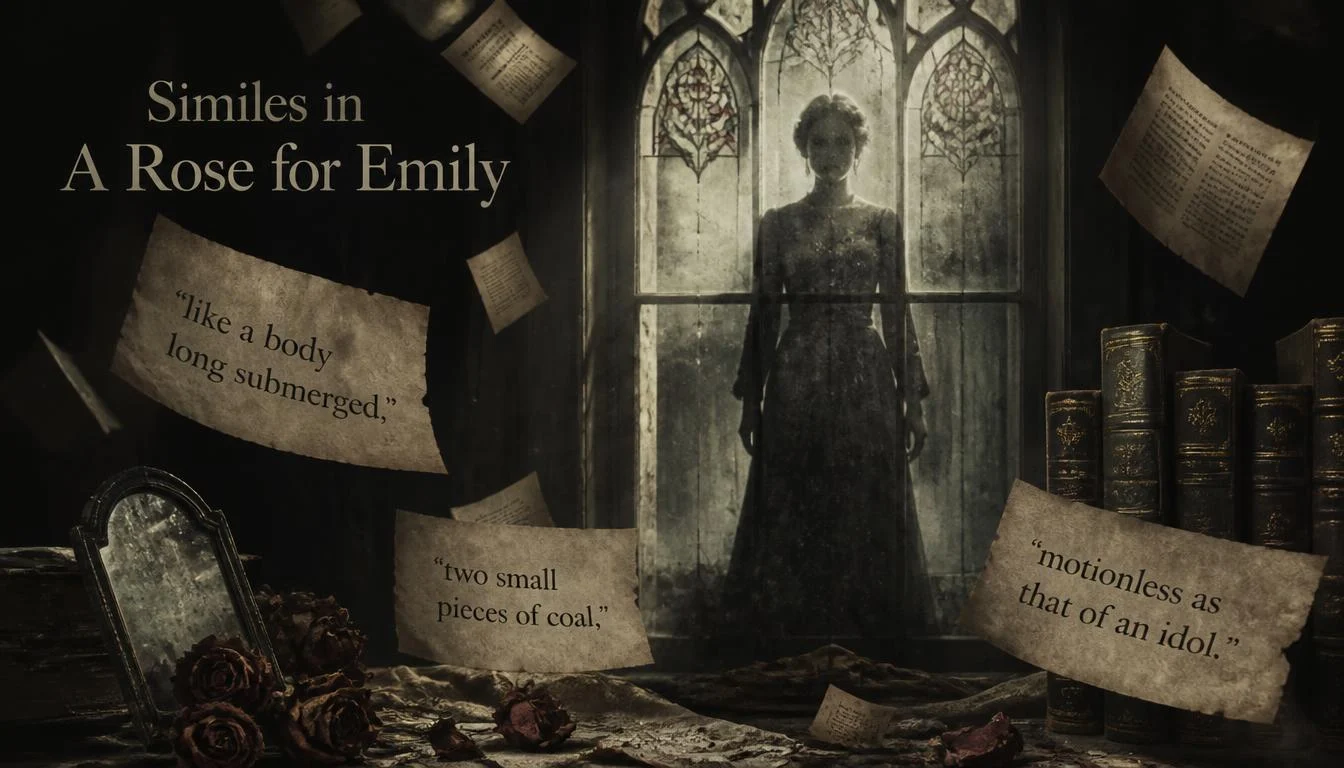
1. “She looked bloated, like a body long submerged in motionless water.”
Meaning: Emily’s body is swollen, pale, and dead in appearance, though she is still alive. The comparison turns her into a drowned corpse that hasn’t finished dying.
Why It Works: Faulkner chooses “motionless water” instead of “drowning” or “dead.” Motionless water suggests stagnation, not violence. Emily isn’t drowning. She’s been submerged for decades. The simile makes her death-in-life literal, and it sets the tone for everything that follows.
Alternative Expression: “Her flesh had the stillness of something left too long in standing water.”
Formal Example: The decline of the Grierson name is rendered in her body: she looked bloated, like a body long submerged in motionless water, a living monument to a drowned era.
Casual Example: After weeks without leaving the house, she looked bloated, like a body long submerged in motionless water alive but not really living.
Creative Example: She sat in the parlor with the curtains drawn, bloated like a body long submerged in motionless water, and the town called it dignity.
2. “Her eyes… looked like two small pieces of coal pressed into a lump of dough.”
Meaning: Emily’s eyes are dark, hard, and unnaturally embedded in a soft, formless face. The coal is dead matter; the dough is passive and shapeless.
Why It Works: This simile isolates her gaze from her body. The coal doesn’t see; it sits. The dough doesn’t resist; it receives. Together, they render Emily as an object being observed rather than a person observing back.
Alternative Expression: “Her eyes were dark stones sunk in soft clay.”
Formal Example: The aldermen saw her eyes, like two small pieces of coal pressed into a lump of dough, and understood that negotiation was impossible.
Casual Example: Her eyes looked like two small pieces of coal pressed into a lump of dough flat, dark, and completely unreadable.
Creative Example: Coal in dough, that was her face now: hard points of life buried in something soft and rising toward nothing.
3. “Her face like a strained flag.”
Meaning: Emily’s face is stretched tight, holding itself together through sheer will. A flag strains in wind but doesn’t tear.
Why It Works: The simile appears when she demands arsenic. She is erect, facing the druggist. “Strained” carries both physical tension and emotional suppression. She is holding the flag of her dignity up, but the fabric is about to rip.
Alternative Expression: “Her features were pulled taut, like canvas before a storm.”
Formal Example: She looked back at him, erect, her face like a strained flag, and the druggist did not ask a second question.
Casual Example: She stood there with her face like a strained flag, and nobody had the nerve to say no.
Creative Example: Her face was a strained flag in a wind that had been blowing since the Confederacy fell.
4. “Like a carven torso of an idol in a niche.”
Meaning: Emily, framed in her window, is a carved, silent object of worship and observation.
Why It Works: “Carven” suggests something made, not born. “Idol” suggests worship without relationship. “Niche” suggests a designated slot for display. The town doesn’t see a woman. It sees a relic it has placed on a shelf.
Alternative Expression: “She sat in the window like a saint in a roadside shrine.”
Formal Example: Now and then we would see her in one of the downstairs windows, like the carven torso of an idol in a niche, looking or not looking at us.
Casual Example: She was always in that window, like a carven torso of an idol in a niche, and we could never tell if she saw us.
Creative Example: She had become the idol in the niche, and the niche was the window, and the window was the whole town’s eye.
5. “Like a girl, with a vague resemblance to those angels in colored church windows.”
Meaning: After her father’s death, Emily cuts her hair short and appears almost childlike, tragically serene, like stained-glass angels.
Why It Works: This is one of the few similes in the story that carries warmth. “Tragic and serene” is the key. The angels are beautiful because they are removed from life. The simile makes Emily’s brief rebirth feel like a stained-glass scene frozen, holy, and already over.
Alternative Expression: “She looked like a figure from a stained-glass window, beautiful and already gone.”
Formal Example: When we saw her again, her hair was cut short, making her look like a girl, with a vague resemblance to those angels in colored church windows sort of tragic and serene.
Casual Example: She came out looking like one of those angels in colored church windows, you know, sad and peaceful at the same time.
Creative Example: She was a stained-glass angel in a house that had become a tomb, and the light through her was already fading.
6. “Like the hair of an active man.”
Meaning: Emily’s iron-gray hair stays vigorous and strong even in old age, resembling a man’s hair.
Why It Works: The simile appears late, after Homer’s disappearance. The hair is “active” while Emily is not. It suggests something still moving beneath the surface a secret, a will, a grip that hasn’t loosened. Some critics read it as an iron helmet, protecting what she has buried.
Alternative Expression: “Her hair had the stubborn vigor of a man who refuses to rest.”
Formal Example: Up to the day of her death at seventy-four it was still that vigorous iron-gray, like the hair of an active man.
Casual Example: Her hair was still strong and gray, like the hair of an active man, even when everything else about her had stopped.
Creative Example: Her hair was the only thing still working, iron-gray and active, like the hair of a man who had something to guard.
7. “Motionless as that of an idol.”
Meaning: Emily’s upright torso in the window is statue-still, idol-like.
Why It Works: This is a near-repeat of the “carven torso” simile, but the repetition matters. Faulkner returns to the idol image because the town returns to the window. The simile isn’t just describing Emily. It’s describing the town’s habit of watching her.
Alternative Expression: “She sat as still as a stone figure in a temple.”
Formal Example: Miss Emily sat in the window, the light behind her, and her upright torso motionless as that of an idol.
Casual Example: She sat there motionless as an idol, and we just kept looking up at her like idiots.
Creative Example: She was motionless as an idol, and the town was motionless in its watching, and neither of them moved for forty years.
8. “Like a man.”
Meaning: When Emily buys arsenic, the druggist looks at her and she looks back “like a man,” erect and unflinching.
Why It Works: The simile is about gender performance. Emily doesn’t just stand tall. She stands like a man, in a world where women were expected to defer. The comparison is brief, almost thrown away, but it tells you everything about her refusal to be small.
Alternative Expression: “She met his gaze the way a man meets another man’s.”
Formal Example: She looked back at him, erect, like a man, and the druggist handed over the poison without further protest.
Casual Example: She stared him down like a man, and he just gave her the arsenic.
Creative Example: She looked at him like a man, which is to say she looked at him like someone who had already decided.
9. “Eyes lighter than his face.”
Meaning: Homer Barron’s eyes are noticeably lighter than his dark skin, an odd, almost animal detail that sets him apart.
Why It Works: This isn’t a classic “like” or “as” simile, but it functions as one through implied comparison. Homer is described as “a big, dark, ready man” with eyes that don’t match his face. The detail makes him vivid and slightly uncanny a man who doesn’t fully belong to his own body, which foreshadows his fate.
Alternative Expression: “His eyes were pale stones in a dark riverbed.”
Formal Example: Homer Barron was a big, dark, ready man, with a big voice and eyes lighter than his face.
Casual Example: He had those eyes lighter than his face, like something you’d see in a photograph that didn’t quite develop right.
Creative Example: His eyes were lighter than his face, two pale coins dropped into dark water.
10. “Like a lighthouse-keeper’s face ought to look.”
Meaning: Emily’s face, with its cold, haughty eyes and strained features, resembles the imagined face of a lighthouse-keeper isolated, weathered, watching.
Why It Works: The lighthouse-keeper lives alone, far from shore, looking out at nothing. The simile places Emily in that same solitude. She is not just alone. She is professionally alone, structurally alone, a person whose entire life is watching water that will never come close.
Alternative Expression: “Her face had the wind-burned stillness of a lighthouse keeper.”
Formal Example: She looked at him with cold, haughty black eyes, like a lighthouse-keeper’s face ought to look.
Casual Example: She had that lighthouse-keeper look, like she’d been staring at an empty sea for years.
Creative Example: Her face was a lighthouse-keeper’s face, built for solitude and the long watching of nothing.
11. “Like the carven torso of an idol in a niche” (repeated).
Meaning: The repeated idol simile reinforces the town’s fixed image of Emily as an object of display.
Why It Works: Faulkner doesn’t just use the simile once. He brings it back, because the town brings Emily back. The repetition is structural, not lazy. It mimics the town’s inability to see her any other way.
Alternative Expression: “She remained the carved figure in the window, never changing.”
Formal Example: Now and then we would see her in one of the downstairs windows, like the carven torso of an idol in a niche.
Casual Example: She was still that carven torso of an idol in a niche, looking or not looking, we could never tell.
Creative Example: She stayed in the niche, the carven idol, and the window became the town’s altar.
12. “Like a body long submerged” (repeated).
Meaning: The drowned-body simile returns implicitly when Emily’s body is found dead, completing the comparison.
Why It Works: The first simile described her as a submerged body while alive. At the end, she is a body in a bed, not water, but the image lingers. The simile has done its work across the whole story, so the final death feels like a confirmation, not a surprise.
Alternative Expression: “She had been drowning for forty years, and now the water had finally taken her.”
Formal Example: Her body, bloated and pallid, fulfilled the earlier simile: a body long submerged, now finally still.
Casual Example: She looked like a body long submerged in motionless water, and now she was one.
Creative Example: The motionless water had been her house all along, and she had been submerged since her father died.
13. “Like two small pieces of coal” (repeated).
Meaning: The coal-eyed simile returns whenever Emily’s gaze is described as hard, dark, and unreadable.
Why It Works: Eyes are supposed to reveal. Coal reveals nothing. By repeating the image, Faulkner cements Emily’s opacity. She is not mysterious in a romantic way. She is impenetrable in a geological way.
Alternative Expression: “Her eyes were always coal, never windows.”
Formal Example: Her eyes, like two small pieces of coal pressed into dough, remained fixed on the visitors.
Casual Example: Same coal eyes, same dough face. Nothing had changed.
Creative Example: Coal eyes, dough face, and a house that swallowed everything she looked at.
14. “Erect, like a soldier.”
Meaning: Emily’s posture is military, disciplined, unyielding.
Why It Works: Although the exact phrase “like a soldier” doesn’t appear verbatim, her “erect” stance throughout the story functions as a soldier simile. She stands the way soldiers stand: because surrender is not an option. The posture is the simile.
Alternative Expression: “She stood at attention, as if awaiting inspection.”
Formal Example: She stood erect, like a soldier on parade, and the druggist did not question her.
Casual Example: She stood up straight like a soldier and asked for poison.
Creative Example: She stood like a soldier in a war that had ended before she was born.
15. “Like a girl” (after cutting her hair).
Meaning: Emily briefly looks young and girlish after her father’s death, a contrast to her usual aged severity.
Why It Works: “Like a girl” is a simple simile, but it does something brutal. It reminds you that Emily was once a girl, and that girlhood was taken from her. The comparison is tender and accusing at once.
Alternative Expression: “She looked like a girl again, as if time had briefly forgiven her.”
Formal Example: When we saw her again, her hair was cut short, making her look like a girl.
Casual Example: She cut her hair and looked like a girl again, for about five minutes.
Creative Example: She looked like a girl, and we remembered that she had been one once, before the house ate her.
16. “Like angels in colored church windows” (full simile).
Meaning: Emily resembles stained-glass angels tragic and serene.
Why It Works: Stained-glass angels are beautiful, passive, and permanently framed. They exist to be looked at. The simile captures Emily’s position in the town: admired, pitied, and completely trapped in a frame.
Alternative Expression: “She was a stained-glass figure, holy and fixed.”
Formal Example: She looked like one of those angels in colored church windows sort of tragic and serene.
Casual Example: She looked like a church window angel, sad and peaceful.
Creative Example: She was a church-window angel, and the light that came through her was already cold.
17. “Like a man’s hair” (iron-gray).
Meaning: Emily’s hair resembles a man’s in its vigor and color.
Why It Works: The simile does double duty. It describes the hair’s texture and color, and it quietly suggests that Emily has taken on a masculine role the role of the surviving Grierson, the one who protects the family name at any cost.
Alternative Expression: “Her hair had the iron strength of a man’s.”
Formal Example: Her hair was still vigorous iron-gray, like the hair of an active man.
Casual Example: Her hair looked like a man’s hair, strong and gray.
Creative Example: Her hair was like a man’s, active and iron, the only live thing in a dead house.
18. “Like a drowned thing.”
Meaning: Emily’s body is repeatedly compared to something drowned.
Why It Works: The drowning motif runs through the similes. She is “submerged,” “bloated,” “pallid.” The cumulative effect is a woman who has been drowning since the first page, and the story is just the slow surfacing.
Alternative Expression: “She looked like something the water had given back.”
Formal Example: Her body, bloated and pale, looked like a drowned thing finally come to shore.
Casual Example: She looked like a drowned thing, and nobody knew how long she’d been under.
Creative Example: She was a drowned thing in a dry house, and the water was time.
19. “Like an idol” (repeated).
Meaning: Emily is repeatedly compared to an idol carved, silent, worshipped.
Why It Works: The idol simile is the story’s central comparison. It appears at least twice in explicit form and shadows every window scene. The repetition is the point: the town cannot stop making Emily into a statue.
Alternative Expression: “She was the idol the town had carved without her consent.”
Formal Example: She sat in the window like an idol, and the town worshipped without knowing what it worshipped.
Casual Example: She was like an idol, just sitting there, and we kept looking.
Creative Example: She was the idol, and the niche was the window, and the worship was gossip.
20. “Like a strained flag” (repeated).
Meaning: The strained-flag simile marks moments when Emily’s composure is under maximum pressure.
Why It Works: Flags strain in wind. They don’t break easily, but they feel the pressure. Faulkner uses the simile at the pharmacy, when Emily is buying poison. She is holding herself together, and the flag is straining.
Alternative Expression: “She held herself like a flag in a gale.”
Formal Example: Her face was like a strained flag, holding its shape against a wind only she could feel.
Casual Example: She looked like a strained flag, like one wrong word would tear her in half.
Creative Example: She was a strained flag in a wind that had been blowing since the war, and she had not torn yet.
21. “Like coal pressed into dough.”
Meaning: The coal-in-dough simile describes Emily’s eyes as hard, dark points in a soft, shapeless face.
Why It Works: Coal and dough are both dead materials. Coal is dead plant matter. Dough is dead grain. Together they make a face that is not just unattractive but inert a face that has stopped participating in life.
Alternative Expression: “Her eyes were dark coals in a face gone soft and blank.”
Formal Example: Her eyes, like two small pieces of coal pressed into dough, moved from face to face without recognition.
Casual Example: Coal in dough. That was her face. Nothing behind it.
Creative Example: Coal in dough, and the dough was rising, and the coal was never going to burn.
22. “Like the hair of an active man” (full context).
Meaning: Emily’s iron-gray hair remains vigorous, like a working man’s.
Why It Works: “Active” is the key word. Emily is inactive. She has been inactive for decades. But her hair is active. Something in her is still working, still holding, still guarding. The simile is the closest Faulkner comes to giving Emily a pulse.
Alternative Expression: “Her hair was the only active thing left in her.”
Formal Example: Her hair, vigorous iron-gray, like the hair of an active man, suggested a vitality her body no longer possessed.
Casual Example: Her hair was still active, like a working man’s, even when she wasn’t.
Creative Example: Her hair was active, iron-gray, like a man who had a job to do, and the job was keeping a secret.
How to Use Similes Naturally
Faulkner’s similes work because they are specific, thematic, and unexpected. Here’s how to apply that to your own writing.
Choose comparisons that carry theme, not just image. The drowned-body simile isn’t just a picture of bloating. It’s a picture of a town that has drowned its own past and refuses to let it surface. When you write a simile, ask: what idea does this image secretly argue for?
Use repetition deliberately. Faulkner repeats the idol and coal similes because the town repeats its gaze. If you repeat a simile, make sure the repetition does structural work. One-off similes decorate. Repeated similes build.
Avoid the obvious comparison. “Her eyes were like stars” is dead. “Her eyes were like two small pieces of coal pressed into a lump of dough” is alive because it’s ugly and precise. The less expected the vehicle, the more the tenor will linger.
Match the simile to the point of view. Faulkner’s similes are all filtered through the town’s judgmental, slightly cruel gaze. A simile from a child’s point of view should use images a child would know. A simile from a scientist should be precise. The comparison is never neutral.
Use similes at pressure points. Faulkner places his strongest similes at moments of confrontation: the tax visit, the pharmacy, the window. Similes land hardest when the character is under pressure. Don’t waste them on description for its own sake.
Common Mistakes When Writing Similes
Overexplaining the comparison. If you have to explain why your simile works, it doesn’t. Trust the image.
Mixing clichés with originality. One fresh simile in a paragraph of dead ones will not save the paragraph. Cut the dead ones.
Using similes to avoid specificity. “She looked like a mess” is a simile that tells you nothing. “She looked like a body long submerged in motionless water” tells you everything. Similes should increase precision, not replace it.
Forgetting the emotional temperature. A simile can be beautiful and completely wrong for the moment. Match the comparison’s emotional charge to the scene’s emotional charge.
Similes vs. Metaphors in Faulkner’s Story
Faulkner uses both, and the difference matters. “Emily is a fallen monument” is a metaphor. “She looked bloated, like a body long submerged” is a simile. The metaphor collapses the distance between Emily and the monument. The simile keeps the distance and makes you look at it.
In practice, similes are often gentler and more observational. They say “this is like that,” which means the thing remains itself while being compared. Metaphors are more aggressive. They say “this is that,” which erases the thing’s identity. Faulkner uses metaphors for theme and similes for perception. When you write, choose based on whether you want to fuse or compare.
Creating Your Own Original Similes
Start with the emotion you want the reader to feel. Then find an image that carries that emotion without naming it. If you want dread, don’t write “she felt dread.” Write “the room was like a held breath.” If you want decay, don’t write “the house was decaying.” Write “the house sat like a tooth in a dying gum.”
- Then test the simile by asking three questions.
- Does the image come from the character’s world?
- Does it add information the reader didn’t have?
- Does it make the familiar strange?
- If the answer to any is no, revise.
FAQs
What is the most famous simile in A Rose for Emily?
The drowned-body simile “She looked bloated, like a body long submerged in motionless water” is the most quoted. It appears early and colors every later description of Emily.
Why does Faulkner use so many similes to describe Emily?
Emily is observed by the town from a distance. Similes let Faulkner describe her without claiming direct access to her interior. The town can only say what she looks like, not what she is. The similes are acts of surveillance.
What does the “carven torso of an idol” simile mean?
It means Emily has been turned into a statue by the town’s gaze. She is displayed, worshipped, and completely isolated. The simile captures her role as a public relic rather than a private person.
How is the “strained flag” simile different from other similes in the story?
Most similes in the story describe Emily as dead or inert. The strained flag describes her as holding on, under pressure. It’s one of the few similes that grants her effort rather than decay.
Are Faulkner’s similes in A Rose for Emily outdated or still useful for writers today?
Still useful. Their specificity, thematic weight, and point-of-view discipline are craft lessons that never expire. The vocabulary is dated, but the method is timeless.
Conclusion
Similes in A Rose for Emily do more than decorate a sentence. They build the story’s entire atmosphere of decay, surveillance, and buried life. Faulkner teaches us that a comparison is never neutral. Every “like” is a judgment, a framing, a way of looking at someone and deciding what they are. Write your similes with that awareness, and your descriptions will stop being descriptions and start being arguments.









