Quick Answer:
JIT Meaning depends on the context. In texting and slang, JIT often means “just in time” or refers to a young person, especially in regional slang. In business and technology, JIT commonly stands for “Just-In-Time.”
JIT Meaning can vary depending on where you see it, whether in a text message, on social media or in a professional setting. Many people use JIT as a short form of “just in time” when discussing something that happens at the right moment. However, its meaning can change when used in casual conversations or online slang.
Understanding JIT Meaning becomes easier when you look at the sentence and the situation in which it appears. In business, JIT often describes a system for receiving supplies when they are needed. In texting and slang, it may carry a more informal meaning. Knowing the context helps you understand what someone actually means when they use JIT.
What Does JIT Actually Mean
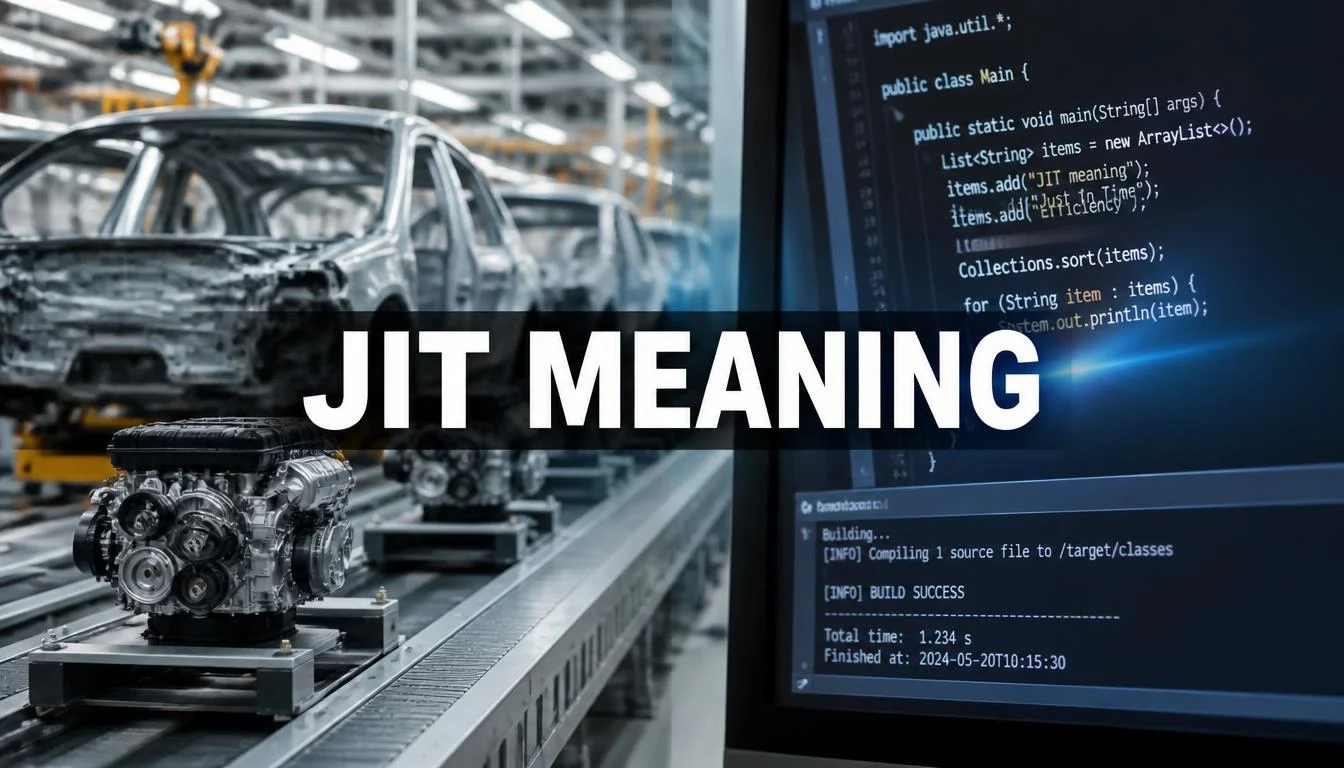
At its simplest JIT means doing something at the last responsible moment instead of ahead of schedule. The phrase gets attached to very different fields but the logic stays consistent. A factory using JIT does not fill a warehouse with parts it might need next month. It orders those parts so they arrive right before assembly starts. A software system using JIT does not translate every line of code before a program launches. It translates pieces of that code the moment they are actually run.
This is different from casual uses of “just in time” in everyday speech such as arriving right before a meeting starts. In technical contexts the term refers to a formal system or process with defined rules rather than a lucky coincidence of timing.
Where the Term Comes From
JIT did not originate in a textbook. It came out of Toyota’s factories in Japan during the mid twentieth century. Engineer Taiichi Ohno is widely credited with developing the approach as part of what became known as the Toyota Production System. The goal was straightforward. Reduce the amount of inventory sitting around a factory because unused inventory ties up money space and labor without adding value.
The idea eventually moved beyond car manufacturing into general business management and then into computer science where engineers borrowed the name for a completely different kind of timing problem involving how software translates its own instructions.
The Main Types of JIT
JIT is not one single system. It shows up in a few distinct contexts and knowing which one someone means depends on the setting. The table below lays out the most common versions.
| Context | What Gets Timed | Typical Goal | Common Example |
|---|---|---|---|
| Manufacturing JIT | Raw materials and parts | Lower inventory costs and reduce waste | Toyota Production System |
| Software JIT compilation | Program instructions | Faster execution without slow startup | Java’s HotSpot virtual machine |
| Retail or supply chain JIT | Stock replenishment | Match supply closely to real demand | Dell’s build to order model |
| Financial or project JIT | Resource allocation | Avoid tying up capital early | Lean project budgeting |
Each version solves a timing problem but the stakes and tools involved look nothing alike. A factory manager thinking about JIT cares about shipping schedules and supplier contracts. A software engineer thinking about JIT cares about how a virtual machine decides which code to optimize.
JIT in Manufacturing and Supply Chains
In a factory setting JIT means parts and materials show up right before they are needed on the production line rather than sitting in a stockroom for weeks. This cuts down on storage costs insurance and the risk of parts becoming outdated or damaged before use.
Toyota remains the textbook example and its production approach influenced manufacturing worldwide. Dell became known for a related idea in the computer industry by building machines only after a customer placed an order rather than guessing demand in advance.
The tradeoff is real. JIT systems depend heavily on reliable suppliers and steady transportation. When a single link in that chain breaks the whole system can stall because there is little backup inventory to absorb the shock. This became especially visible during global supply disruptions in recent years when factories that relied on precise delivery schedules faced production halts once shipments were delayed.
JIT in Software and Compilers
In computing JIT refers to a way of running programs where code gets compiled while the program is actually executing instead of being fully compiled ahead of time. A compiler is the tool that turns human readable code into instructions a computer’s processor can run directly.
There are two traditional approaches. One is ahead of time compilation where the entire program is translated into machine instructions before anyone runs it. The other is interpretation where a program reads and executes code line by line without ever producing standalone machine instructions.
JIT compilation sits between these two. The program starts in a form that is not yet fully translated and as it runs a JIT compiler converts the frequently used parts into fast machine code on the fly. This gives a balance of quick startup and strong performance for code that runs repeatedly.
Several major platforms rely on this approach. The Java Virtual Machine uses a JIT compiler known as HotSpot. Microsoft’s Common Language Runtime which powers the dotnet platform uses JIT compilation for languages like C sharp. Modern web browsers also lean on JIT techniques inside their JavaScript engines such as Google’s V8 engine which powers Chrome and Node.js.
JIT Compilation Versus Ahead of Time Compilation
People sometimes confuse JIT with AOT or ahead of time compilation and the two solve the same general problem in opposite ways.
Ahead of time compilation finishes all the translation work before the program ever runs which usually means faster startup and more predictable performance since nothing needs to be figured out mid execution. The downside is that it cannot adapt to how the program actually behaves once it is running.
JIT compilation waits and watches. It can notice which parts of a program run most often and optimize those specific sections more aggressively something an ahead of time compiler cannot do since it has no visibility into real usage patterns. The tradeoff is a short delay at startup known as warmup time while the JIT compiler gets to work.
Some modern systems combine both strategies using ahead of time compilation for a baseline and JIT techniques layered on top for extra optimization during execution.
Why JIT Systems Matter
The appeal of JIT whether in a factory or inside a computer comes down to avoiding waste. In manufacturing that waste looks like excess inventory tying up cash. In software it looks like wasted processor time compiling code nobody ends up running or wasted memory holding a fully compiled program that starts too slowly.
Organizations like the Institute of Industrial and Systems Engineers study and teach lean manufacturing principles that trace directly back to the JIT philosophy Toyota pioneered decades ago. The core lesson transfers well beyond factory floors which is part of why the term kept getting borrowed by new fields.
Common Challenges With JIT Approaches
JIT is not free of downsides regardless of the field. In manufacturing a single supplier delay can halt an entire assembly line since there is little cushion of spare stock. Natural disasters labor strikes and transportation bottlenecks have all exposed this fragility in real world supply chains.
In software JIT compilation introduces startup delay since the system needs a moment to begin translating code before performance ramps up. It can also use more memory while running since the compiler itself consumes resources during the compilation process. Engineers often weigh these costs against the performance benefits when deciding whether JIT fits a particular application.
JIT Versus Related Terms
It helps to separate JIT from a few terms people often mix it up with.
Just in sequence is a manufacturing variation where parts do not just arrive on time but arrive in the exact order they will be installed which adds another layer of precision beyond standard JIT.
Lean manufacturing is the broader philosophy that JIT belongs to. JIT is one tool inside the larger lean toolkit which also includes ideas like continuous improvement and waste reduction across an entire operation.
Interpreted languages are sometimes confused with JIT compiled languages. A purely interpreted language translates and runs code line by line with no compiled machine code ever produced while a JIT compiled language eventually produces real compiled instructions after the program has been running for a bit.
FAQs
1. Is JIT Only Used in Manufacturing?
No. Although JIT originally became popular in manufacturing, the term is now widely used in software engineering. In programming, JIT often refers to just-in-time compilation, a process in which code is compiled while a program is running.
2. Does Every Programming Language Use JIT Compilation?
No. Not every programming language uses JIT compilation. Some languages rely on ahead-of-time compilation, while others use interpretation. JIT compilation is commonly used by platforms such as Java and .NET, along with several JavaScript engines.
3. Why Would a Company Choose JIT Inventory Instead of Keeping Extra Stock?
Companies use just-in-time inventory to reduce storage costs and avoid holding materials that may become outdated or unnecessary. However, this approach requires reliable suppliers and efficient delivery systems to prevent stock shortages and production delays.
4. Can JIT Compilation Make Software Slower in Some Cases?
Yes. JIT compilation can sometimes make software slower, especially when a program runs for only a short time. The initial compilation process may take longer than the performance benefits it provides, leaving little opportunity for optimization.
5. What Industries Outside Manufacturing and Software Use JIT Ideas?
Retail, logistics and project management can also apply just-in-time principles. These approaches help organizations reduce excess inventory, manage resources efficiently and avoid tying up money or staff time before they are needed.
Conclusion
JIT is one of those terms that proves a good idea travels well. What began as a way to keep Toyota’s factory floors lean turned into a foundational concept in how modern software runs efficiently. Whether the context is a shipment of auto parts or a line of code being compiled the moment it executes the underlying logic stays the same. Do the work exactly when it is needed and not a moment before.









