Quick Answer
Soliciting means asking for something from someone. The request can be for money help business or a criminal act. In law it usually refers to urging another person to commit a crime . In everyday settings it describes charity requests sales pitches and sometimes prostitution-related offenses .
The Soliciting Meaning can be understood as actively asking someone for something. It is often used when a person seeks money, business, support, advice, or participation from others. The word can appear in everyday conversations as well as formal or professional settings.
Understanding the Soliciting Meaning also requires looking at how the word is being used. Soliciting can describe a polite request for donations or customers, but it can have a different meaning in legal or social contexts. The surrounding words usually make the intended meaning clear.
What Does Soliciting Mean
The word soliciting comes from the Latin solicitare which means to disturb or agitate. Over centuries the term shifted toward its current sense of asking urging or requesting something from another person .
In plain English soliciting is the act of making a request. The request could be for money help votes business or something illegal. What separates soliciting from casual asking is intent and persistence. When you solicit you are actively trying to obtain something from a specific person or group .
The term carries different weight depending on context. A charity volunteer soliciting donations sounds noble. A person soliciting a bribe sounds criminal. Same word completely different moral valence.
Most dictionaries list several core meanings. The most common is to make a petition or request. Another is to approach someone with a plea. A third involves enticing someone toward wrongdoing . The prostitution-related meaning is specific and narrow but often dominates public perception of the word.
Soliciting in Criminal Law
This is where the term gets serious. In legal usage solicitation is an inchoate offense which means it is a crime that happens before or in preparation for another crime .
The core idea is simple. If you ask someone to commit a crime for you that request itself is illegal. The person you asked does not even need to agree. The crime is complete the moment you make the request with the required intent .
What Makes It a Crime
Three elements usually need to be present. First there must be an intent that another person commit a specific crime. Second there must be a request command or encouragement to commit that crime. Third the request must be communicated to the other person .
Notably the person solicited does not have to actually commit the crime. They do not even have to intend to commit it. If you ask someone to kill your business partner and they immediately refuse you have still committed solicitation of murder. The offense is complete at the moment of communication .
Real Legal Examples
Courts across jurisdictions have applied solicitation laws to many situations. A person who offers money to someone to burn down a building commits solicitation of arson. Someone who asks a friend to steal merchandise from a store commits solicitation of theft. The request itself is the crime.
Some statutes define soliciting more broadly than others. Michigan law for instance defines it in the context of its solicitation statute as offering to give money services or anything of value to persuade someone to commit a crime . Illinois law uses the word solicit to mean commanding authorizing urging inciting requesting or advising another to perform an act .
Solicitation of a Minor
This category deserves special attention. Laws against indecent solicitation of a child typically prohibit asking a minor to engage in sexual conduct. Illinois law defines the offense with specific age thresholds and felony classifications based on what the act would have been if completed .
These laws apply to communication through any medium including in person by phone in writing or by computer. The specific method of contact does not matter. What matters is the request and the age of the person solicited.
Commercial and Business Solicitation
In the business world soliciting takes on a more mundane meaning. It refers to the marketing of a product or service to a particular consumer .
Federal regulations define solicitation in the financial context as marketing initiated by a person to a specific consumer based on eligibility information. Importantly marketing directed at the general public does not count as solicitation. Television ads billboard campaigns and magazine advertisements are not solicitations under this definition .
What does count? Telemarketing calls direct mail emails and other communications aimed at a specific individual based on information the sender has about them. The key distinction is targeting. General advertising casts a wide net. Solicitation aims at you specifically .
Procurement and Government Contracting
Solicitation has a specific technical meaning in government contracting. It refers to the formal process by which agencies request bids or proposals from vendors .
The federal government publishes solicitations through the Governmentwide Point of Entry which is accessible through SAM.gov. Contracting officers must make solicitations available through this system including specifications technical data and other necessary information. There are exceptions for national security concerns or when the nature of the files makes electronic posting impractical .
State governments have similar processes. Iowa administrative rules for example distinguish between formal and informal solicitations. Informal requests may be made electronically by phone or by fax. Formal solicitations require complete descriptions of what is needed bid due dates public bid opening times and evaluation criteria .
Charitable and Political Solicitation
One of the oldest uses of soliciting involves asking for donations. Charities solicit funds door to door by mail by phone and online. Political campaigns solicit contributions to support candidates and causes.
The First Amendment protects solicitation as a form of speech but with limits. The Supreme Court has recognized that municipalities have the power to protect citizens from crime and undue annoyance by regulating soliciting and canvassing .
What Courts Have Said
In Martin v. City of Struthers the Supreme Court struck down an ordinance that completely banned door to door soliciting and distribution of literature. The Court said the dangers of distribution can be controlled by traditional legal methods leaving each householder the right to decide whether to receive strangers .
Later cases addressed regulations on charitable fundraising. In Village of Schaumburg v. Citizens for a Better Environment the Court invalidated an ordinance that required charities to use at least 75 percent of receipts for charitable purposes to solicit door to door. The Court found the regulation overbroad and noted that disclosure requirements could serve the government interest without restricting speech .
The takeaway is that governments can regulate solicitation to protect privacy and prevent fraud. But regulations must be narrow and must not give officials undefined power to decide which messages residents can hear.
Soliciting vs Selling: What Is the Difference
People often use these terms interchangeably but they mean different things.
| Aspect | Soliciting | Selling |
|---|---|---|
| Core activity | Asking for something | Exchanging goods or services for money |
| Direction | Request goes outward | Transaction happens between parties |
| Common contexts | Charitable donations political contributions criminal requests | Retail commerce business deals |
| Legal weight | Can be criminal if request is unlawful | Rarely criminal unless fraud involved |
| Key element | The ask | The exchange |
Selling involves a transaction where money goods or services change hands . Soliciting is the ask that precedes or enables a transaction.
- You solicit donations.
- You sell products.
- You can solicit someone to buy something but the solicitation is the request not the sale itself.
The distinction matters in law. Laws against solicitation target the request. Laws against fraud target deceptive selling practices. A legitimate sales pitch is not solicitation in the legal sense unless it targets a specific consumer based on eligibility information as federal regulations define it .
Legal Limits on Solicitation
Regulation of solicitation balances free speech against public order. Courts have consistently held that some regulation is permissible but sweeping bans are not.
Time Place and Manner Restrictions
Governments can impose reasonable restrictions on when where and how solicitation occurs. A city can prohibit door to door soliciting after dark. It can require permits for commercial solicitation. It can ban soliciting in certain public spaces.
What it cannot do is ban speech entirely based on content. An ordinance that lets charity groups solicit but bans political groups would likely fail. An ordinance that lets religious groups canvass but bans commercial solicitors would face similar problems.
Prostitution Related Solicitation
The word soliciting often appears in news reports about prostitution arrests. In this context it means offering to engage in sexual conduct for money .
This usage is specific but has shaped public perception of the word. When people hear soliciting without context they may think of this meaning first. That is unfortunate because the term covers a much wider range of lawful and unlawful activity.
Commercial Speech Protections
Commercial solicitation receives less First Amendment protection than political or charitable speech. The Supreme Court has defined commercial speech as communication of the terms of an actual or potential transaction that has economic motivation .
Governments can regulate commercial solicitation more strictly including through do not call lists restrictions on telemarketing hours and requirements for accurate disclosures. The Beverly Hills based retailer in one case violated federal law by sending telephone solicitations before 8 a.m. or after 9 p.m. local time .
FAQs
What is the legal definition of soliciting?
In criminal law soliciting is the offense of offering money or other valuables to someone with the specific intent of persuading them to commit a crime . The request itself is the crime regardless of whether the other person agrees.
Is soliciting always illegal?
No. Soliciting is only illegal when the request itself seeks something unlawful. Asking a friend to buy you lunch is soliciting in the dictionary sense but it is not a crime. Asking someone to commit a crime or offering sex for money are criminal forms of solicitation.
What does no soliciting mean?
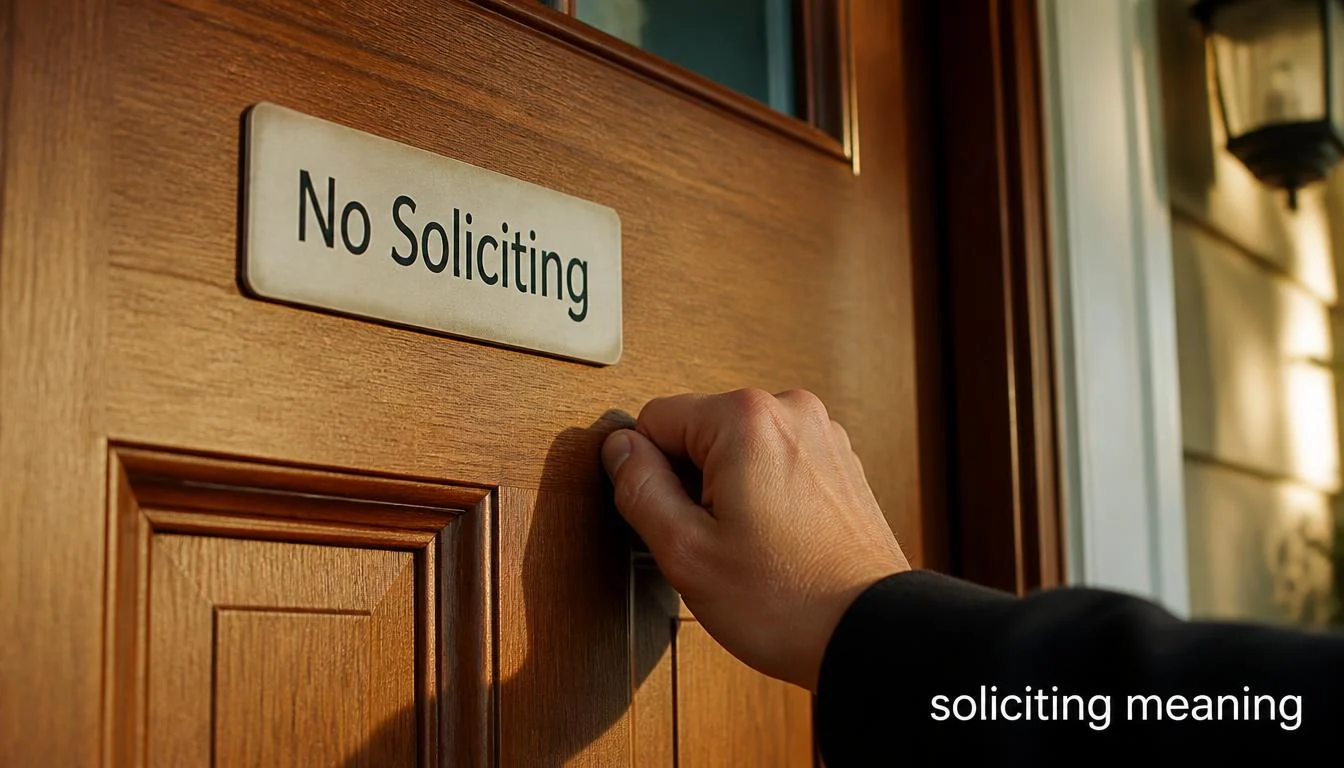
When you see a no soliciting sign it usually means the property owner does not want people coming to the door to sell products or ask for donations. The sign is a request not to be disturbed by these types of requests.
Can you be arrested for soliciting if the other person says no?
Yes. In criminal solicitation the crime is complete when the request is made with the required intent. The other person’s response does not matter . If you ask someone to commit a crime and they immediately refuse you have still committed the offense.
What is the difference between solicitation and conspiracy?
Solicitation involves one person asking another to commit a crime. Conspiracy requires an agreement between two or more people to commit a crime. In solicitation the person asked does not need to agree. In conspiracy the agreement itself is the crime.
Does soliciting require money to change hands?
No. Money is not required. Solicitation can involve asking for services information votes or anything of value. The key is the request not any exchange of money.
Conclusion
Soliciting is a word that moves between ordinary requests and serious crimes. In everyday life it describes charity collections sales calls and political fundraising. In legal language it names a specific offense of urging someone toward criminal conduct. The common thread is the act of asking. Understanding which meaning applies depends on context. A door to door volunteer solicits donations. A telemarketer solicits business. A person offering money for a criminal act commits a crime. Same word three very different situations.









