Quick Answer
Bowler meaning: A bowler is a person who throws a ball toward a target, especially a player who delivers the ball to a batter in cricket or bowling.
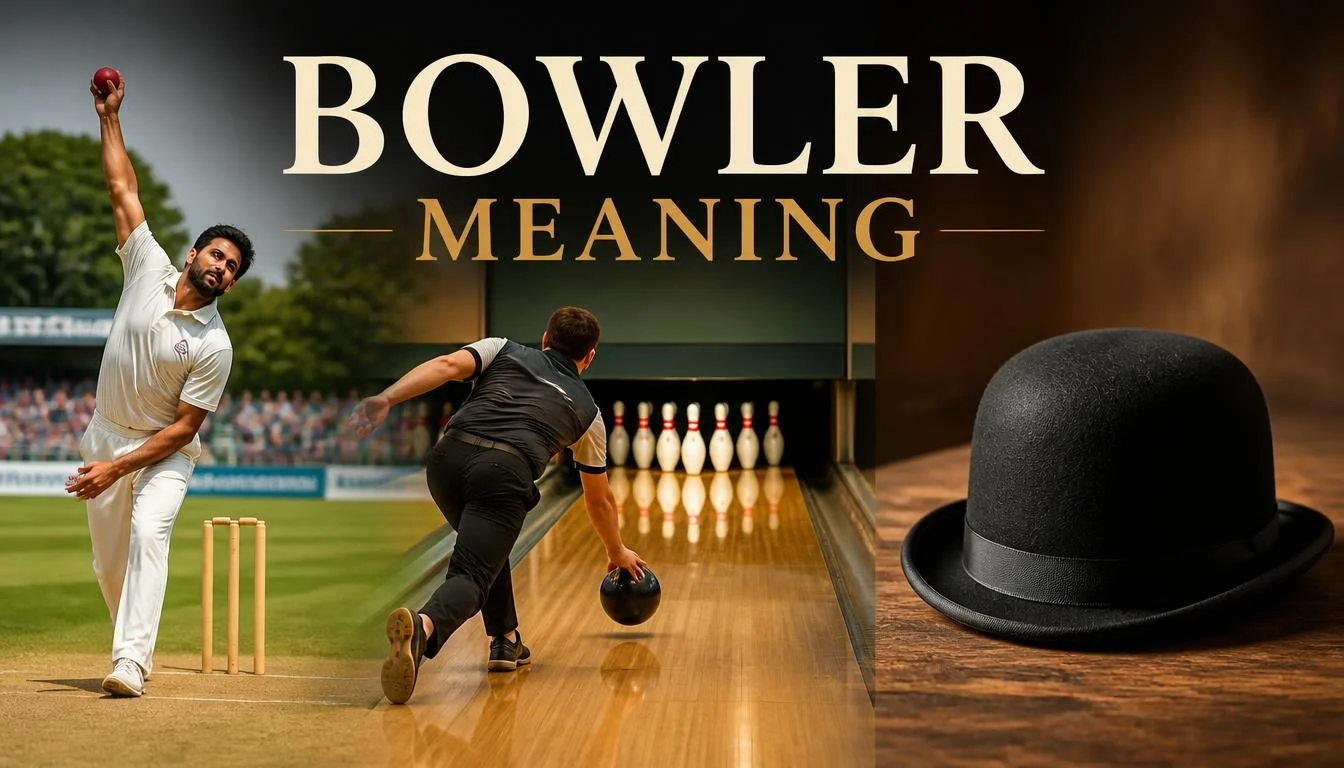
The word bowler has different meanings depending on the context. Most commonly, it describes someone who plays bowling or delivers a ball in cricket. It can also refer to a person who wears or makes a particular type of hat.
Understanding the bowler meaning helps you recognize how this word is used in sports and everyday conversations. Whether you’re reading about cricket, discussing a bowling game, or learning new English vocabulary, knowing its meaning makes communication easier.
What Does Bowler Mean?
A bowler is a noun that describes someone who bowls or performs a bowling action. Its exact definition depends on the activity being discussed.
The word comes from bowl combined with the suffix -er. The suffix identifies a person who performs an action. For example, a person who teaches is a teacher, and someone who runs is a runner.
Similarly, someone who bowls is called a bowler.
In sports, the word usually describes a player who delivers or rolls a ball as part of a game. Cricket provides one of its most familiar uses, where a bowler delivers the ball toward the batter standing at the opposite wicket.
In ten-pin bowling, the term describes a player who rolls a heavy ball toward ten standing pins. The objective is to knock down as many pins as possible.
The word also has a separate clothing-related meaning. A bowler hat is a stiff, rounded hat traditionally made from felt.
Pronunciation and Word Forms
The pronunciation changes slightly between British and American English.
| Word detail | Explanation |
|---|---|
| Word | Bowler |
| Part of speech | Noun |
| British pronunciation | /ˈbəʊlə(r)/ |
| American pronunciation | /ˈboʊlər/ |
| Number of syllables | Two |
| Plural form | Bowlers |
| Root word | Bowl |
| Common related words | Bowling, bowled, bowler hat |
The stress falls on the first syllable: BOWL-er.
For example, you might hear a cricket commentator say, “The bowler is ready for the next delivery.”
Different Types of Bowlers
The term describes different players depending on the sport. Cricket also has several bowling styles, each involving different techniques and strategies.
Here is a comparison of the most common categories.
| Type | Meaning | Main purpose |
|---|---|---|
| Fast bowler | Delivers the cricket ball at high speed | Challenge the batter with pace |
| Swing bowler | Makes the ball move through the air | Confuse the batter’s timing |
| Spin bowler | Uses rotation to change the ball’s movement after pitching | Make the ball difficult to hit |
| Seam bowler | Uses the ball’s seam to influence its movement | Create unpredictable bounce or movement |
| Ten-pin bowler | Rolls a ball toward ten pins | Knock down as many pins as possible |
| Lawn bowler | Rolls a weighted bowl toward a smaller target | Finish closer to the target than opponents |
These categories show why context matters. Someone discussing a fast bowler is probably talking about cricket, while someone discussing a ten-pin bowler is referring to a different sport.
Bowler in Cricket: Meaning and Responsibilities
Cricket is one of the sports most closely associated with this word. A bowler is a member of the fielding team who delivers the ball toward the batter at the opposite end of the pitch.
The main objective is to dismiss the batter, restrict the number of runs scored, or create pressure that forces a mistake.
A cricket bowler does much more than simply throw a ball. Every delivery involves decisions about speed, direction, length, and movement. Experienced players also study the batter’s weaknesses before choosing their next delivery.
What Does a Cricket Bowler Do?
A cricket bowler has several responsibilities during a match:
- Deliver the ball: Send the ball toward the batter using a legal bowling action.
- Take wickets: Try to dismiss opposing batters by hitting the stumps, forcing catches, or creating other dismissal opportunities.
- Control runs: Make it difficult for batters to score freely.
- Follow a strategy: Change speed, direction, and delivery style to challenge different batters.
- Work with fielders: Coordinate with teammates to create opportunities for dismissals.
A bowler also needs physical fitness, concentration, and good decision-making skills. Fast bowlers often rely on strength and speed, while spin bowlers depend heavily on control, accuracy, and changes in rotation.
Famous Cricket Bowlers
Several international players have become famous for their bowling abilities.
Examples of well-known cricket bowlers:
- James Anderson: Known for his fast-medium bowling and ability to produce swing.
- Jasprit Bumrah: Recognized for his unusual bowling action, pace, and accurate deliveries.
- Shane Warne: Remembered for his exceptional leg-spin bowling.
- Muttiah Muralitharan: Famous for his off-spin bowling and remarkable international career.
- Glenn McGrath: Known for accuracy, consistency, and disciplined fast-medium bowling.
These players demonstrate that successful bowling does not depend on one particular technique. Different approaches can be effective against different opponents.
How Does a Bowling Over Work?
In cricket, an over is a set of six valid deliveries bowled by one player from one end of the pitch.
After an over finishes, another bowler delivers from the opposite end. The fielding team continues this process according to the match format and playing rules.
The International Cricket Council (ICC) establishes the international playing conditions that govern these procedures. An important detail is that a wide or no-ball does not count as one of the six valid deliveries in an over.
For example, if a bowler delivers five valid balls and then bowls a no-ball, another valid delivery is needed before the over is complete. This distinction helps explain why cricket scorecards sometimes show more deliveries than the expected six.
Bowler in Ten-Pin Bowling
The word has another common meaning in recreational and competitive bowling.
A ten-pin bowler is someone who rolls a heavy bowling ball down a specially prepared lane toward ten pins arranged in a triangular formation.
Unlike cricket, this activity does not involve throwing a ball toward another player. Instead, the bowler aims to knock down the pins at the end of the lane.
What Does a Ten-Pin Bowler Do?
A player performs several actions during a bowling game:
- Choose a ball: Select a ball with a suitable weight and finger-hole fit.
- Approach the lane: Walk toward the foul line using a controlled approach.
- Release the ball: Roll it smoothly toward the pins.
- Aim for the pocket: Target the area between the head pin and an adjacent pin to improve strike opportunities.
- Adjust technique: Change the angle, speed, or rotation depending on previous results.
A good player needs coordination, balance, timing, and accuracy.
Important Bowling Terms
Some expressions commonly appear when discussing ten-pin bowlers.
| Term | Meaning |
|---|---|
| Strike | Knocking down all ten pins with the first ball of a frame |
| Spare | Knocking down all remaining pins with the second ball |
| Gutter ball | A ball that enters the side channel without hitting the pins |
| Frame | One of the ten scoring sections in a standard game |
| Lane | The long, polished surface where the ball rolls |
| The ideal target area between the head pin and an adjacent pin |
For instance, a player who scores several strikes in a row is demonstrating excellent accuracy and consistency.
The History and Meaning of the Bowler Hat
Not every use of the word refers to a sports player.
A bowler also refers to a distinctive type of traditional hat. It has a hard, rounded crown and a relatively narrow brim that curves upward around the edges.
In American English, people commonly call this style a derby hat.
Where Did the Bowler Hat Come From?
The hat has an interesting nineteenth-century history.
According to historical accounts preserved by Future Museum, the design was developed in 1849 for Edward Coke, a member of the Leicester family. He wanted protective headwear for gamekeepers working around low-hanging branches at Holkham Hall in Norfolk, England.
The London hatmaking business Lock & Co. developed the design, while Thomas and William Bowler produced the prototype. The rounded, reinforced construction offered a more practical alternative to taller hats that could be knocked off or damaged.
The hat eventually became known by the Bowler family’s surname. It also became associated with British businessmen, bankers, and other formally dressed professionals.
The design later gained popularity in the United States, where it became known as the derby. Future Museum+2
What Makes a Bowler Hat Different?
A traditional bowler hat has several recognizable features:
- Rounded crown: Its top forms a smooth, dome-like shape.
- Hard construction: The traditional felt material is stiffened to maintain its structure.
- Curved brim: The brim usually curves upward around the sides.
- Compact design: It has a lower crown than a traditional top hat.
- Formal appearance: It is often associated with traditional British clothing.
Although the style is less common in everyday business clothing today, it remains recognizable in historical photographs, films, costumes, and fashion collections.
The hat is also a useful example of how one English word can develop a separate meaning through history and cultural use.
Bowler vs. Batter vs. Bowling Player
These words are related to ball sports, but they describe different roles. Understanding the differences helps prevent confusion, particularly when reading cricket commentary.
| Word | Definition | Sport or context |
|---|---|---|
| Bowler | Player who delivers the ball | Cricket |
| Batter | Player who attempts to hit the ball and score runs | Cricket |
| Wicketkeeper | Player positioned behind the batter to collect the ball | Cricket |
| Fielder | Player who stops or catches the ball | Cricket |
| Bowling player | Person who rolls a ball toward pins | Ten-pin bowling |
| Bowler hat | Traditional rounded felt hat | Fashion |
The main difference between a bowler and a batter is their responsibility during a cricket match.
A bowler tries to dismiss the batter or limit scoring opportunities. A batter attempts to score runs while protecting their wicket.
A wicketkeeper has a separate job. This player stands behind the stumps and receives deliveries that pass the batter.
In ten-pin bowling, however, the word describes the person playing the game rather than a specific position within a cricket team.
Real-Life Examples and Sentences
The easiest way to understand a word is to see how people use it in different situations.
Here are examples showing its different meanings.
Bowler in Cricket Sentences
- The bowler delivered a fast ball toward the batter.
- Our team’s best bowler took three wickets during the match.
- The captain asked the bowler to change his strategy.
- The young bowler impressed everyone with his accuracy.
- A skilled spin bowler can make the ball turn unexpectedly.
Bowler in Bowling Sentences
- My brother is an excellent ten-pin bowler.
- The bowler knocked down all ten pins.
- She became a professional bowler after years of practice.
- Every bowler needs good balance and coordination.
- The experienced bowler achieved another strike.
Everyday Conversation Examples
You might also encounter the word in ordinary conversations.
Example 1
Person A: Who is bowling for our team today?
Person B: Daniel is our main bowler.
Example 2
Person A: Do you enjoy playing ten-pin bowling?
Person B: Yes! I’m becoming a much better bowler.
Example 3
Person A: What kind of hat is he wearing?
Person B: It looks like a traditional bowler hat.
These conversations demonstrate why surrounding words are important. They help you understand which definition someone intends.
How to Use Bowler Correctly
Using the word correctly is relatively simple once you understand its different meanings.
Here are some practical language tips.
Use It as a Noun
The word normally functions as a noun because it identifies a person or an object.
Correct examples:
- He is a talented bowler.
- The bowler is preparing for his next delivery.
- She purchased a traditional bowler hat.
Pay Attention to the Context
Look at the surrounding words before deciding what the speaker means.
For example:
- Fast bowler usually indicates cricket.
- Ten-pin bowler refers to a bowling player.
- Black bowler hat refers to traditional headwear.
Understand Its Related Words
Learning related vocabulary can help you recognize the word more easily.
| Related word | Meaning |
|---|---|
| Bowl | To roll or deliver a ball in a game |
| Bowled | Past tense of bowl |
| Bowling | The activity or action of bowling |
| Bowler | A person who bowls |
| Bowler hat | A traditional rounded felt hat |
| Bowling alley | A place where people play ten-pin bowling |
One useful grammar point is that bowled can describe a completed action.
For example: “The player bowled six valid deliveries.”
Meanwhile, bowling can describe an ongoing activity.
For example: “The team is bowling against a strong opponent.”
FAQs
Is a bowler a cricket player?
Yes. In cricket, a bowler is a member of the fielding team who delivers the ball toward the batter. Their job is to take wickets and restrict the opposition’s scoring.
What is a female bowler called?
A female player is also called a bowler. English does not require a separate word for women who participate in cricket or ten-pin bowling.
What is the opposite of a bowler in cricket?
The batter is the main opposing role. The bowler delivers the ball, while the batter attempts to score runs by hitting it.
Is a bowler hat the same as a derby hat?
Yes. They are two names for essentially the same traditional hat. Bowler hat is particularly common in British English, while derby hat is commonly used in American English.
Can someone be a bowler in more than one sport?
Yes. Someone can participate in cricket, ten-pin bowling, and other bowling-related sports. The word describes their role in each activity.
Is bowler a noun or a verb?
Bowler is a noun. It identifies a person who bowls or a particular style of hat. The verb is bowl, while bowling is its -ing form.
Conclusion
The word bowler has several meanings, but its most common uses relate to cricket, ten-pin bowling, and traditional British headwear. In sports, it describes someone who delivers or rolls a ball, while in fashion, it identifies a distinctive rounded felt hat. Paying attention to context makes each meaning easy to recognize. Learning these differences also helps you understand everyday conversations, sports commentary, and English vocabulary more confidently.