Quick Answer
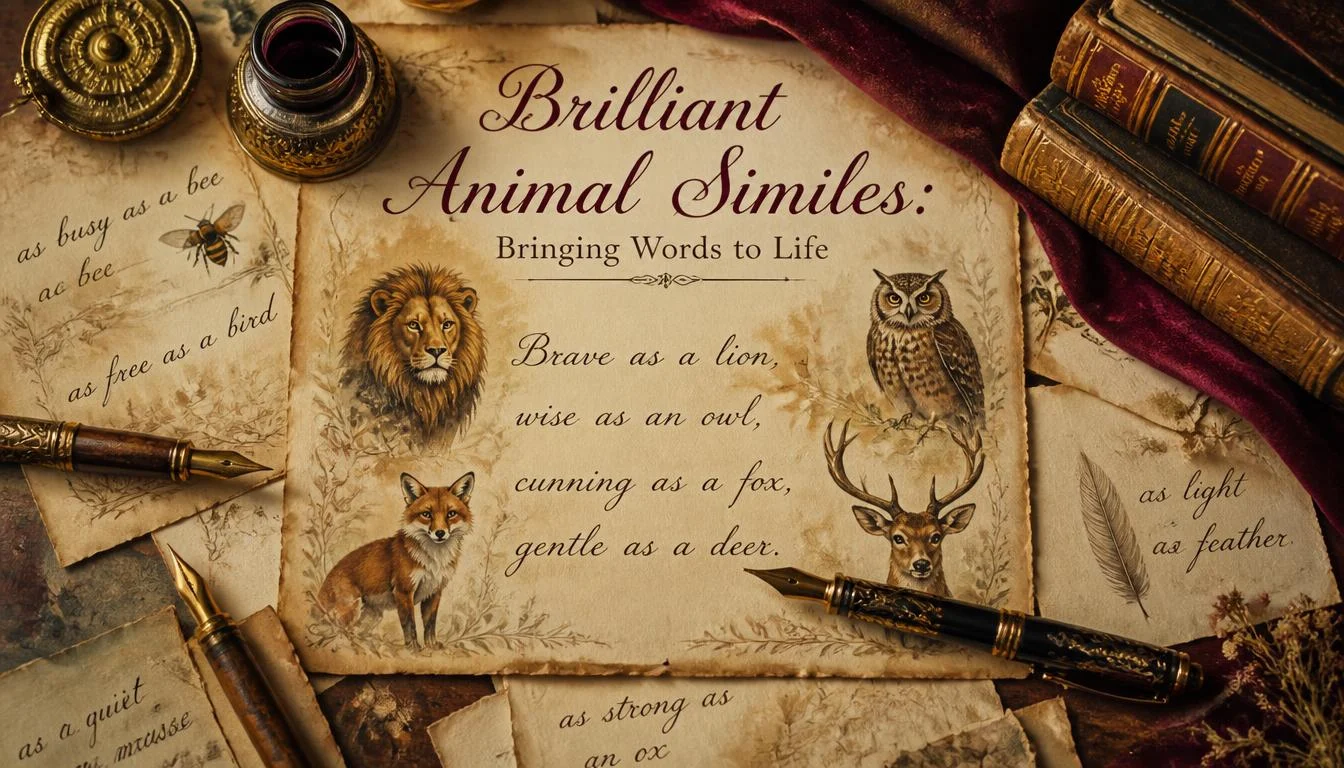
Brilliant animal similes are creative comparisons that use animals to describe people, emotions, and actions. Examples include as brave as a lion, as busy as a bee, and as wise as an owl.
Brilliant animal similes make writing more vivid, engaging, and expressive by comparing people, things, or actions to animals. These creative expressions help readers visualize ideas and understand different qualities through familiar animal characteristics.
Whether you’re writing a story, poem, or school assignment, brilliant animal similes can add color and personality to your words. From the strength of a lion to the speed of a cheetah, these comparisons make your descriptions more memorable and meaningful.
Brilliant Animal Similes for Every Writing Moment
1. Proud as a peacock
Meaning: Someone displaying obvious, often flamboyant pride in their appearance or accomplishments.
Why It Works: The image is immediate that magnificent fan of feathers demanding attention. It captures both the beauty and the slight ridiculousness of excessive pride.
Alternative Expression: Vain as a peacock strutting through a garden.
Examples in Writing:
- Formal: “He entered the gala proud as a peacock, his tailored suit drawing every eye in the room.”
- Casual: “Look at him, proud as a peacock after finally beating me at chess.”
- Creative: “She wore her promotion proud as a peacock, feathers of confidence unfurling with every handshake.”
When to Use It: This works beautifully in character descriptions, especially when you want to hint at vanity without outright criticism. It carries a gentle judgment that readers understand intuitively.
2. Quiet as a mouse
Meaning: Extremely silent, often suggesting timidity or deliberate stealth.
Why It Works: Mice move in that nervous, barely-there way that suggests both fear and delicacy. The simile captures vulnerability and discretion simultaneously.
Alternative Expression: Silent as a mouse tiptoeing past a sleeping cat.
Examples in Writing:
- Formal: “She moved through the hospital corridors quiet as a mouse, unwilling to disturb the fragile peace of recovery.”
- Casual: “He was quiet as a mouse when he came home at 3 AM, hoping I wouldn’t notice.”
- Creative: “Grief made her quiet as a mouse, her footsteps barely registering on floors that once echoed with her laughter.”
When to Use It: Perfect for conveying someone who’s either naturally reserved or deliberately making themselves small. It works in both tense scenes and tender ones.
3. Sly as a fox
Meaning: Cunning, clever, and willing to use deception to get what they want.
Why It Works: Foxes have earned their reputation through centuries of folklore. The simile immediately suggests intelligence that operates in shadows.
Alternative Expression: Cunning as a fox who knows exactly where the hens are kept.
Examples in Writing:
- Formal: “The negotiator was sly as a fox, reading every hesitation and using it to his advantage.”
- Casual: “She’s sly as a fox I didn’t realize she’d been planning this surprise for months.”
- Creative: “His smile was sly as a fox’s, promising secrets he’d only reveal when it suited him.”
When to Use It: Ideal for characters who operate through wit rather than force. Use it when you want readers to respect someone’s intelligence while staying slightly wary of them.
4. Stubborn as a mule
Meaning: Refusing to change course despite all evidence, persuasion, or logic.
Why It Works: Anyone who’s seen a mule plant its feet and refuse to move understands this comparison instantly. It’s frustration made visible.
Alternative Expression: Obstinate as a mule digging in its heels before a storm.
Examples in Writing:
- Formal: “The committee remained stubborn as a mule, rejecting every proposal that challenged their established procedures.”
- Casual: “You’re stubborn as a mule just admit you were wrong about the directions.”
- Creative: “He was stubborn as a mule, and that stubbornness had built empires and destroyed marriages in equal measure.”
When to Use It: This simile carries both admiration and exasperation. It depends entirely on context whether you’re celebrating someone’s determination or lamenting their inflexibility.
5. Graceful as a swan
Meaning: Moving with elegant, effortless beauty that seems almost supernatural.
Why It Works: Swans glide across water with a serenity that hides the furious paddling beneath. The simile captures visible elegance without denying hidden effort.
Alternative Expression: Elegant as a swan cutting through still water.
Examples in Writing:
- Formal: “The ballerina was graceful as a swan, each movement flowing into the next without visible transition.”
- Casual: “She walked into the party graceful as a swan, making everyone else feel like they’d been standing wrong their whole lives.”
- Creative: “Her grief was graceful as a swan beautiful on the surface, working furiously beneath to keep from drowning.”
When to Use It: Great for physical descriptions, but its real power emerges when you use it ironically or contrast it with internal struggle.
6. Busy as a bee
Meaning: Constantly active, productive, and focused on tasks.
Why It Works: The image of bees moving purposefully through their day resonates with anyone who’s ever felt overwhelmed by responsibility.
Alternative Expression: Industrious as a bee in a summer garden.
Examples in Writing:
- Formal: “The research team was busy as bees, each member contributing to the collective effort without pause.”
- Casual: “I’ve been busy as a bee all week I haven’t even checked my messages.”
- Creative: “She was busy as a bee, but unlike the bee, her hive was built of unpaid bills and forgotten dreams.”
When to Use It: This works in both professional writing and personal essays. It’s a gentle way to acknowledge someone’s hard work without making them seem frantic.
7. Fierce as a lioness
Meaning: Protective, powerful, and willing to fight for what matters.
Why It Works: The lioness specifically not the lion carries maternal ferocity. It’s about defense rather than conquest.
Alternative Expression: Ferocious as a lioness protecting her cubs.
Examples in Writing:
- Formal: “The attorney was fierce as a lioness, defending her client with a passion that silenced the courtroom.”
- Casual: “Don’t mess with her kids she’s fierce as a lioness when anyone threatens them.”
- Creative: “Her love was fierce as a lioness’s, tender in moments of peace and terrifying in moments of threat.”
When to Use It: Reserve this for moments when you need to convey protective strength. It works particularly well for mothers, mentors, and anyone defending the vulnerable.
8. Timid as a deer
Meaning: Easily startled, cautious, and quick to retreat from perceived danger.
Why It Works: Deer exist in a state of constant alertness. The comparison captures both physical grace and nervous vigilance.
Alternative Expression: Skittish as a deer sensing hunters in the woods.
Examples in Writing:
- Formal: “The new student was timid as a deer, flinching at raised voices and avoiding eye contact.”
- Casual: “He’s timid as a deer around new people give him time to warm up.”
- Creative: “She approached trust timid as a deer, ready to bolt at the first sign of danger.”
When to Use It: This conveys vulnerability without weakness. It invites reader empathy rather than judgment.
9. Wise as an owl
Meaning: Possessing deep knowledge and sound judgment earned through experience.
Why It Works: Owls have symbolized wisdom across cultures for millennia. The simile carries that accumulated meaning effortlessly.
Alternative Expression: Sage as an owl who’s seen a thousand nights.
Examples in Writing:
- Formal: “The professor was wise as an owl, offering insights that seemed obvious only after she spoke them.”
- Casual: “My grandmother’s wise as an owl she always knows what to say when I’m struggling.”
- Creative: “He was wise as an owl, but his wisdom sat heavy on him, a weight he’d never asked to carry.”
When to Use It: Works for mentors and guides, but be careful it can tip into cliché if you don’t pair it with specific, earned details.
10. Sneaky as a cat
Meaning: Moving with silent purpose, often to achieve something unnoticed.
Why It Works: Cats have perfected the art of appearing innocent while actively pursuing mischief. The simile captures that duality.
Alternative Expression: Stealthy as a cat stalking through tall grass.
Examples in Writing:
- Formal: “The detective was sneaky as a cat, gathering information without anyone noticing they’d been questioned.”
- Casual: “The kids were sneaky as cats, somehow aware of every Christmas present before we wrapped them.”
- Creative: “Her lies were sneaky as cats, appearing suddenly and disappearing before you could catch them.”
When to Use It: Perfect for playful mischief and serious deception alike. Context determines whether your sneaky character is charming or dangerous.
11. Free as a bird
Meaning: Unrestrained, unburdened, and unaccountable to anyone.
Why It Works: Birds move in three dimensions while we’re stuck on the ground. The comparison captures a freedom that feels almost impossible.
Alternative Expression: Unbound as a bird riding thermal currents.
Examples in Writing:
- Formal: “After retirement, she was free as a bird, traveling wherever the wind suggested.”
- Casual: “No kids, no mortgage I’m free as a bird this weekend.”
- Creative: “His laughter was free as a bird’s flight, unburdened by the weight of all he’d survived.”
When to Use It: Works beautifully for liberation narratives. Its emotional impact deepens when contrasted with prior captivity or constraint.
12. Cautious as a cat near water
Meaning: Approaching something with extreme hesitation and wariness.
Why It Works: This specific, almost comical image makes the hesitation feel both understandable and slightly absurd.
Alternative Expression: Reluctant as a cat approaching a bathtub.
Examples in Writing:
- Formal: “The investors were cautious as cats near water, circling the proposal without committing.”
- Casual: “He’s cautious as a cat near water about relationships it’s going to take time.”
- Creative: “She approached happiness cautious as a cat near water, testing the surface before trusting it.”
When to Use It: The specificity here is what makes it memorable. Use it when you want readers to smile while recognizing genuine caution.
13. Loyal as a dog
Meaning: Unwavering in devotion and faithful despite circumstances.
Why It Works: The comparison requires no explanation. Dogs have earned this association through thousands of years of partnership.
Alternative Expression: Devoted as a dog waiting by the door.
Examples in Writing:
- Formal: “His assistant was loyal as a dog, remaining through every scandal and setback without complaint.”
- Casual: “She’s loyal as a dog don’t give her a reason to doubt you.”
- Creative: “His loyalty was loyal as a dog’s, beautiful and slightly tragic in its refusal to recognize betrayal.”
When to Use It: This can be heartfelt or tragic, depending on context. Be aware it can imply blind loyalty when used without care.
14. Angry as a hornet
Meaning: Visibly, dangerously furious.
Why It Works: Hornets attack with seeming vindictiveness, pursuing threats with relentless focus. The image is visceral and immediate.
Alternative Expression: Furious as a hornet whose nest has been disturbed.
Examples in Writing:
- Formal: “The union representative was angry as a hornet, promising retaliation for the unexpected layoffs.”
- Casual: “She was angry as a hornet when she found out they’d cancelled her flight.”
- Creative: “His anger was angry as a hornet’s all sting, no warning.”
When to Use It: For moments when anger is active and dangerous. It suits conflict scenes better than quiet resentment.
15. Gentle as a lamb
Meaning: Soft, harmless, and incapable of cruelty.
Why It Works: The image evokes innocence and warmth. It’s the opposite of predatory aggression.
Alternative Expression: Tender as a lamb nuzzling its mother.
Examples in Writing:
- Formal: “Despite his imposing appearance, the coach was gentle as a lamb with young players.”
- Casual: “He’s gentle as a lamb with his grandkids you wouldn’t believe it.”
- Creative: “Her heart was gentle as a lamb, easily bruised and endlessly forgiving.”
When to Use It: Beautiful for tender moments. Its impact deepens when contrasted with past harshness or future challenges.
16. Restless as a caged tiger
Meaning: Frustrated by confinement, pacing with bottled energy and ambition.
Why It Works: The image combines power with powerlessness. It’s about potential that can’t find release.
Alternative Expression: Frustrated as a tiger in a zoo enclosure.
Examples in Writing:
- Formal: “The young executive was restless as a caged tiger, ready for challenges his position didn’t yet permit.”
- Casual: “I’m restless as a caged tiger I need a vacation or a new project.”
- Creative: “His ambition was restless as a caged tiger, circling the bars of his circumstances.”
When to Use It: Excellent for ambitious characters and situations of unfulfilled potential.
17. Playful as a kitten
Meaning: Lighthearted, energetic, and ready for fun.
Why It Works: The image is pure joy tiny paws batting at everything, endless curiosity, complete abandon.
Alternative Expression: Frisky as a kitten chasing sunbeams.
Examples in Writing:
- Formal: “The new puppy was playful as a kitten, turning the dignified household upside down.”
- Casual: “She’s playful as a kitten today good luck getting any work done.”
- Creative: “Their love was playful as a kitten’s antics, all pounces and purrs and gentle claws.”
When to Use It: Perfect for light moments, but also effective when used ironically or to contrast with pain.
18. Thick-skinned as a rhino
Meaning: Resilient, difficult to offend, and unaffected by criticism.
Why It Works: Rhinos have armor plating for skin. The simile captures both physical toughness and emotional imperviousness.
Alternative Expression: Tough as a rhino’s hide.
Examples in Writing:
- Formal: “The journalist was thick-skinned as a rhino, continuing her investigation despite relentless criticism.”
- Casual: “He’s thick-skinned as a rhino you can’t insult him no matter how hard you try.”
- Creative: “Her defenses were thick-skinned as a rhino’s, protecting a softness no one was allowed to see.”
When to Use It: Works for characters who’ve developed resilience, but can also hint at hidden fragility beneath the armor.
19. Swift as a cheetah
Meaning: Extremely fast, decisive, and efficient.
Why It Works: Cheetahs are the fastest land animals. The simile leaves no room for ambiguity about speed.
Alternative Expression: Quick as a cheetah on the hunt.
Examples in Writing:
- Formal: “The response team was swift as a cheetah, arriving at the scene within minutes.”
- Casual: “She’s swift as a cheetah when there’s a sale you can’t keep up.”
- Creative: “His career was swift as a cheetah’s sprint, breathtakingly fast and alarmingly short.”
When to Use It: For action scenes, sports writing, or metaphorical descriptions of rapid change.
20. Watchful as a hawk
Meaning: Intently observant, missing nothing, waiting for the right moment.
Why It Works: Hawks circle above, seeing everything before striking. The simile combines patience with lethal attention.
Alternative Expression: Alert as a hawk scanning the field below.
Examples in Writing:
- Formal: “The reviewer was watchful as a hawk, catching errors no one else noticed.”
- Casual: “She’s watchful as a hawk when the kids play near the street.”
- Creative: “His attention was watchful as a hawk’s, patient and predatory in equal measure.”
When to Use It: Great for surveillance, vigilance, and characters who notice what others miss.
21. Social as a prairie dog
Meaning: Deeply community-oriented, thriving through interaction and cooperation.
Why It Works: Prairie dogs live in complex societies with communication networks. The image suggests warmth and connection.
Alternative Expression: Communal as a prairie dog town.
Examples in Writing:
- Formal: “The professor was social as a prairie dog, building networks of scholars across institutions.”
- Casual: “She’s social as a prairie dog knows everyone in the neighborhood.”
- Creative: “Their friendship was social as prairie dogs, built on constant chatter and mutual defense.”
When to Use It: For extroverted characters and descriptions of community.
22. Solitary as a snow leopard
Meaning: Preferring isolation, comfortable alone, rarely seen by others.
Why It Works: Snow leopards are rarely spotted, even by researchers who spend years tracking them. The image captures elegant solitude.
Alternative Expression: Private as a snow leopard in mountain mist.
Examples in Writing:
- Formal: “The novelist was solitary as a snow leopard, appearing only for book launches before retreating into obscurity.”
- Casual: “He’s solitary as a snow leopard weeks go by without a text.”
- Creative: “Her grief was solitary as a snow leopard’s, untouched and untouchable.”
When to Use It: Beautiful for introverted characters and moments of chosen isolation.
23. Matriarchal as an elephant
Meaning: Leading through inherited wisdom, commanding respect through experience.
Why It Works: Elephant herds follow the oldest females, who remember paths and dangers others have forgotten.
Alternative Expression: Authoritative as an elephant guiding her herd.
Examples in Writing:
- Formal: “The CEO was matriarchal as an elephant, leading with a memory of every mistake and success the company had weathered.”
- Casual: “Grandma’s matriarchal as an elephant everyone listens when she speaks.”
- Creative: “Her power was matriarchal as an elephant’s, ancient and patient and impossible to ignore.”
When to Use It: For leaders whose authority comes from experience rather than title.
24. Stingy as a squirrel with its cache
Meaning: Protective of resources, hoarding, unwilling to share.
Why It Works: Squirrels defend their buried nuts obsessively. The image suggests anxiety-driven scarcity thinking.
Alternative Expression: Possessive as a squirrel guarding its winter stores.
Examples in Writing:
- Formal: “The department was stingy as a squirrel with its budget, scrutinizing every expense.”
- Casual: “He’s stingy as a squirrel with his fries won’t share a single one.”
- Creative: “Her secrets were stingy as a squirrel’s, buried in places even she couldn’t always find.”
When to Use It: For characters who’ve learned to protect what they have, whether through trauma or personality.
25. Clumsy as a newborn giraffe
Meaning: Awkward, unsteady, learning to navigate unfamiliar circumstances.
Why It Works: Baby giraffes literally tumble into the world. The image combines vulnerability with determination.
Alternative Expression: Ungainly as a giraffe finding its legs.
Examples in Writing:
- Formal: “The intern was clumsy as a newborn giraffe, eager but uncertain of every step.”
- Casual: “I was clumsy as a newborn giraffe in that yoga class complete disaster.”
- Creative: “He entered fatherhood clumsy as a newborn giraffe, all long limbs and good intentions.”
When to Use It: Perfect for beginnings and learning curves. It carries affection rather than criticism.
Practical Writing Guidance
How to Use Similes Naturally
The best similes feel inevitable like they couldn’t have been anything else. When you’re writing, ask yourself: does this comparison illuminate something new, or does it just decorate?
Place similes where you need emphasis. A single well-chosen comparison at the end of a paragraph can do more work than three scattered throughout. Trust your reader to hold the image.
Avoid overloading a sentence with multiple similes. One strong image creates a moment; three competing images create confusion.
Common Mistakes When Writing Similes
Mixing incompatible images: “She was fierce as a lion and delicate as a flower” creates whiplash, not complexity.
Using clichés without awareness: “Smart as a whip” has been used so often it’s lost its edge. Either find a fresh alternative or use the cliché deliberately, with irony.
Comparing too specifically: “Her eyes were like blue Mazda hatchbacks” makes readers think about cars, not eyes. Specificity should serve clarity, not distract from it.
Explaining the comparison: Trust the image. If you write “He moved like a panther,” you don’t need to add ” graceful and predatory.” The panther already did that work.
Similes vs. Metaphors
Similes say “like” or “as.” Metaphors say “is.”
- Simile: “She was quiet as a mouse.”
- Metaphor: “She was a mouse, scurrying through the world unnoticed.”
Metaphors feel more assertive, more absolute. Similes feel more observational, more willing to acknowledge they’re making a comparison rather than a declaration.
Both have their place. Similes work well for:
- Introducing unfamiliar concepts through familiar images
- Softening bold statements
- Adding texture without claiming permanence
Tips for More Expressive Writing
Read your similes aloud. If they stumble in your mouth, they’ll stumble in your reader’s mind.
Consider the emotional temperature. A simile can shift the mood of an entire paragraph. Choose images that match or deliberately contrast with your tone.
Ground abstractions in physical experience. Instead of “she was anxious,” try “she was nervous as a cat in a room full of rocking chairs.” The physical image makes the abstract feeling tangible.
Build your mental zoo. The more you observe animals in nature, in documentaries, in daily life the more accurate your comparisons become.
Creating Original Similes
Start with the quality you want to capture. Then ask: what animal embodies this trait in a way that feels fresh?
“Lonely” is abstract. “Lonely as a wolf whose pack has gone” is specific and haunting.
“Confused” is vague. “Confused as a penguin in the desert” is specific and slightly absurd perfect for a light tone.
Your comparisons don’t need to be obvious. “Patient as a crocodile waiting at the watering hole” works because crocodiles are genuinely patient, but the image carries an edge that “patient as a saint” lacks.
FAQs
What makes a simile “brilliant” rather than just okay?
Brilliance comes from accuracy and surprise. The comparison should feel both true and unexpected something readers recognize instantly but hadn’t thought to articulate.
Can I use animal similes in formal writing?
Absolutely, when they’re precise. Academic and professional writing benefit from vivid comparisons that clarify complex ideas. Just avoid overly casual or clichéd choices.
How many similes are too many?
If readers are noticing the similes more than the story, you’ve probably used too many. One vivid comparison per paragraph is often more effective than three.
Should I worry about using “overused” animals like lions or eagles?
It depends on execution. A fresh take on a familiar animal can work beautifully. The problem isn’t the animal it’s the predictable phrasing.
How do I know if my simile works?
Read it to someone else and watch their face. If they nod or smile, it works. If they look confused or skip past it, you need to revise.
Conclusion
Brilliant animal similes give your writing a pulse. They turn descriptions into experiences and characters into creatures your readers feel they’ve known. The twenty-five comparisons here are starting points, not final destinations let them inspire your own observations, your own fresh connections between the human and the wild.